Expanding Medicaid increased credit-card borrowing by improving access to credit. The credit-supply channel generated 30 percent of the policy’s net welfare gains, from Gideon Bornstein and @sashaindarte https://t.co/ElmHDd0tpn
@Benchimolium@a_bergeaud My guess is that it’s because a lot of the talks are still work in progress. So keeping the videos up only temporarily makes presenters more comfortable.
Finding NBER Summer Institute talks on YouTube is surprisingly frustrating.
I asked Claude to build a searchable webpage that finds any talk by paper, author, or session, and jumps straight to where it starts in the video.
Link in the first reply.
Debt can push viable firms out of the market. Quantifying the welfare losses from excess exits finds that the marginal propensity to exit with debt disciplines financial frictions, from Gideon Bornstein and @lcastillomart https://t.co/QPy2LOKham
Welcome to One Extra Year — a new project on pregnancy, motherhood, and how academia evaluates women’s CVs.
Each week, a female economist will share her story. We begin with our very own @Federomei1 . Read, reflect, and join the conversation.
@AEACSWEP
https://t.co/jDvAL29Vez
אני חושש שיש חוסר הבנה עמוק לגבי המצב בעזה בימים האחרונים. הוא שונה מהותית מכל מה שהיה עד כה במלחמה. היו כאן מגיבים, חלקם תמימים, חלקם פשוט נאצים, שאמרו שהם כבר שמעו אזהרות כאלה מתחילת המלחמה ואין שום סיבה להאמין להן.
אז לא. המצב הוא שונה קיצונית מכל מה שהיה עד עכשיו.>
Forthcoming in the JEL: "How Do Central Banks Control Inflation? A Guide for the Perplexed" by Laura Castillo-Martinez and Ricardo Reis. https://t.co/yoAOXAvbZa
While we’re waiting for Musk to overthrow the present regime, would you like to learn about some recent advances in markups and misallocation, and what it implies for some recent papers? The link is below:
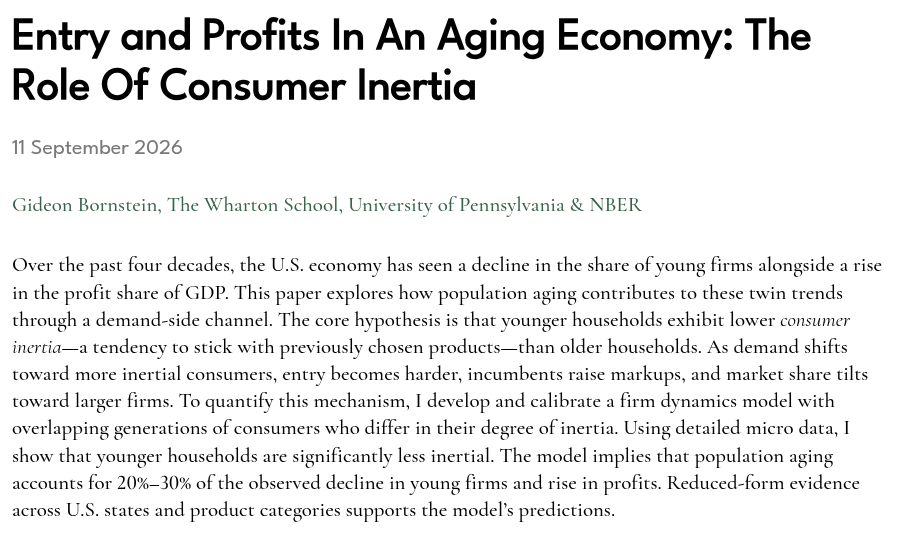
Great paper by @Ale_M_Peter and @GidiBo conditionally accepted at American Economic Review. I agree with the paper of the year (though, admittedly I’m biased 🙃)
There is a close to ubiquitous finding in WB firm-level diagnostics of declining entry of new firms & increased incumbency of older firms. And associated recommendations on the regulatory side. As this paper lays out for case of US, demand effects from demography also matter.
Population aging affects firm entry and profits via demand: older households' higher consumer inertia acts as a barrier to entry and lets incumbents raise markups, from Gideon Bornstein https://t.co/GKw4begEUK