Economist, Research Department, Bank of Israel. Co-organizer @VIMacro_org. AE @ IREF & IF. Previously @Harvard @ESSEC @SorbonneParis1. All views are my own.
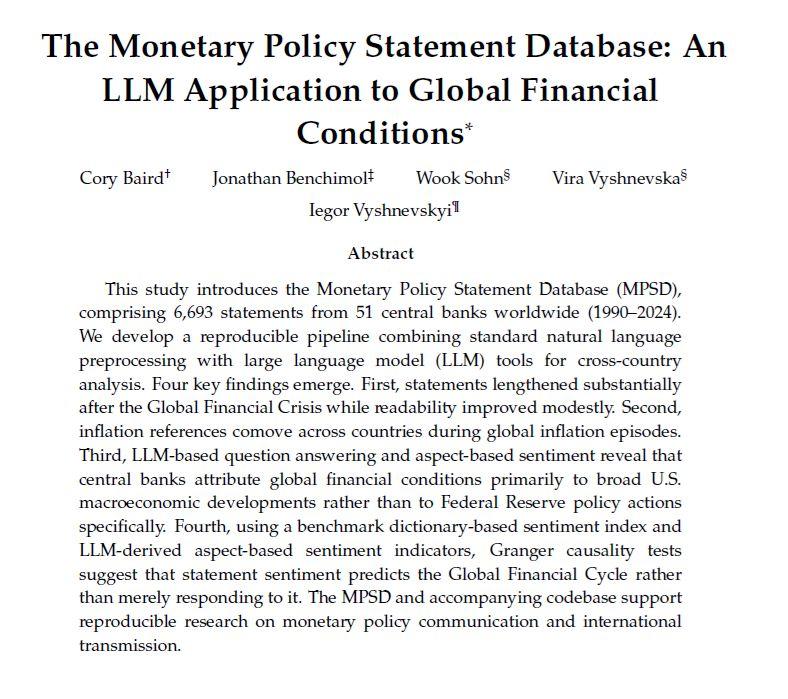
📣 What if central bank statements do not just describe global financial conditions — but help shape them?
I am pleased to share our paper, “The Monetary Policy Statement Database: An LLM Application to Global Financial Conditions” now published in @bis_org IFC Bulletin
🧵 1/7
Today I am posting Lecture 2 of my course on Geoeconomics at Oxford. It covers the history of the field and its open areas of research:
https://t.co/FPX74i0iEb
Since I am fond of the history of thought, I spent perhaps too many slides on it. But I have been reading about geoeconomics and grand strategy since high school. My love affair with the field began when I read Paul Kennedy’s The Rise and Fall of the Great Powers: Economic Change and Military Conflict from 1500 to 2000 in my junior year, and later, a book by two Spanish admirals that summarized the ideas of Alfred Mahan and Halford Mackinder. So I felt I could indulge myself.
I also treat the German-language tradition in detail, since it is less familiar to English-speaking readers. Carl Schmitt, for instance, has gained prominence lately, whatever one thinks of him.
One thing the slides leave out: in class, I spent a good deal of time outlining ideas for new papers. This is a growing field, and young researchers have ample scope to make substantial contributions. But those ideas, really suggestions, are harder to put on slides.
I just finished teaching the first lecture of the course “Geoeconomics Uncovered: Theory Meets Evidence” at Oxford, so I decided to post the slide deck:
https://t.co/8lcVCInfi4
This was a 90-minute, big-picture lecture: what is geoeconomics, why does it matter, and what can economists do in this field?
It draws on several plenary talks I have given over the past year, so you may have seen some of these slides before. But I have many new followers, and some are clearer than before.
During the rest of the week, I will post more of these slide decks. The next one will be on the history of the field.
PS: Oxford is such a lovely place. Unfortunately, a country that gave us Newton, Darwin, and Turing cannot keep escalators running at Heathrow.
Excited to FINALLY release toughest+most rewarding paper I've worked on...
….we attack a 150 year old Walras question that's gone unanswered, not for lack of trying (Hicks, Samuelson, Arrow; our chances?😱)...
Q: Is the market equilibrium stable or unstable?¯\_(ツ)_/¯
🧵
I am not kidding when I say this might be the most important paper in theoretical economics this century. I have been waiting a long time to see it shared and I’m very excited the authors have now released it. Definitely take your time and read it!
Authors can't be trusted to run their own robustness checks.
In 17 AER papers, only 12/211 robustness checks "fail" with p > 0.05 (white).
In robustness checks chosen by 3rd parties, almost *half* of them fail (blue).
1/
More generally, as beautifully shown by @mileskimball the sensitivity of this second derivative (or the size of the third derivative!) capture the strength of prudence. Much like the sensitivity of the first derivative captures risk aversion.
14/n
🚨 Public Good Alert 🚨
Two years of development. Zero funding. 𝟲,𝟲𝟵𝟯 𝗼𝗳𝗳𝗶𝗰𝗶𝗮𝗹 𝘀𝘁𝗮𝘁𝗲𝗺𝗲𝗻𝘁𝘀 𝗳𝗿𝗼𝗺 𝟱𝟭 𝗰𝗲𝗻𝘁𝗿𝗮𝗹 𝗯𝗮𝗻𝗸𝘀. #TextData
Today, we are opening the doors to it all for free 🚀
Visit our website: https://t.co/ToBke8Dxww
🧵1/12 #NLP
What are the implications of bounded rationality for monetary policy, when economies are hit by supply shocks?
Does myopia help central banks in the long run?
In a short note with @BoncianiDario, @Masek_F and Paolo Nanni, we provide an answer. 🧵#econtwitter
1/8
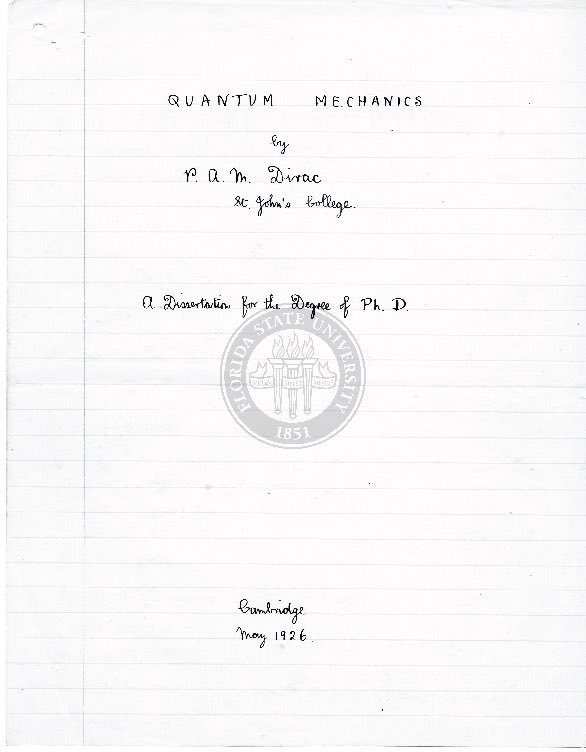
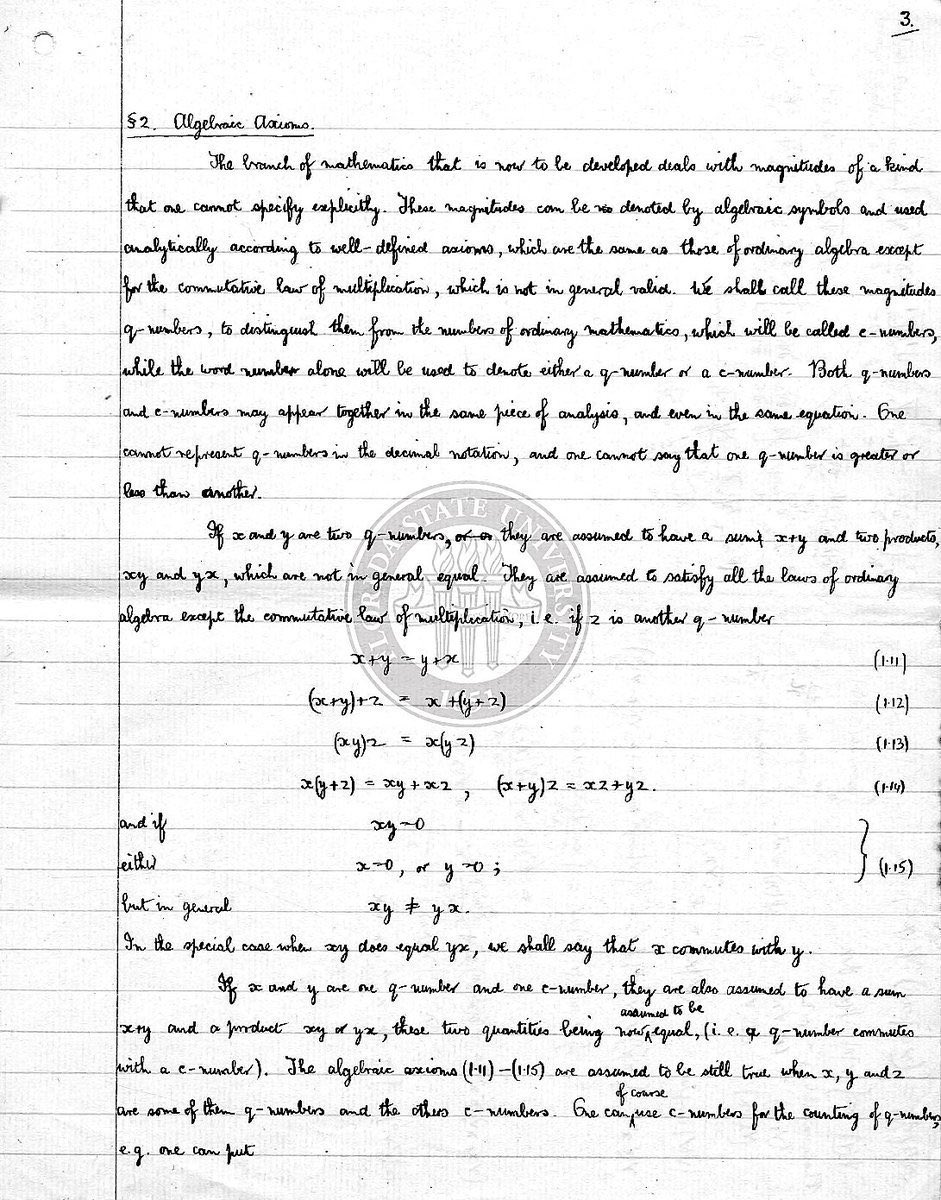
Imagine writing a PhD thesis so foundational that the title is literally just the name of the entire field of study.
Paul Dirac, 1926: "Quantum Mechanics."
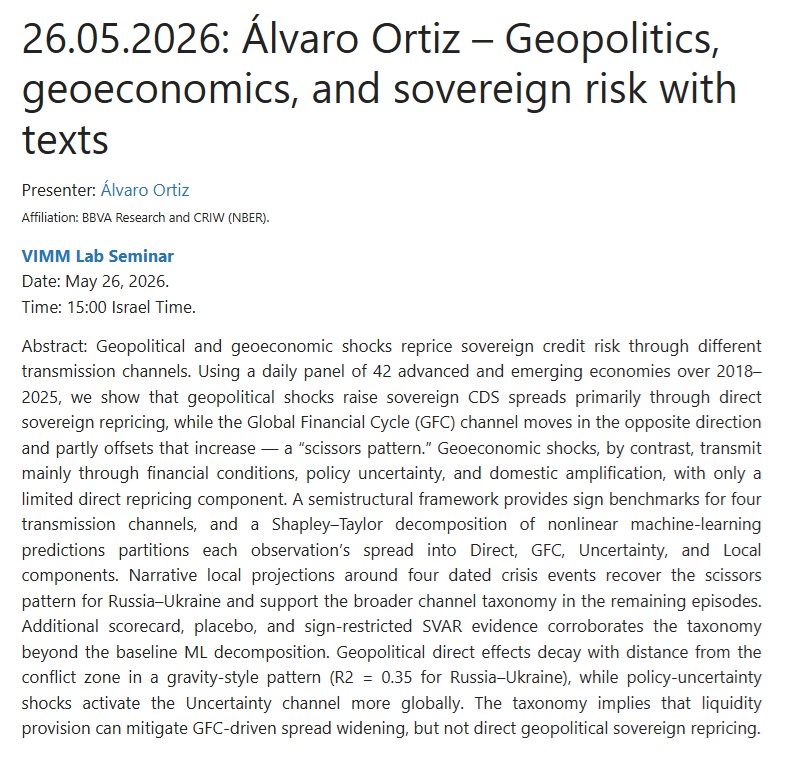
Can ML predict how a conflict zone impacts sovereign CDS spreads?
Yes, and distance matters more than you think 🗺️
We’re breaking down the frontier of Geopolitics x Finance in our next VIMM Lab Seminar.
If you want to understand the modern global financial cycle, be there 👇🏽
Another Israeli AI company goes global 🇮🇱
American software giant Coupa is acquiring Israeli startup Tonkean in a deal reportedly worth hundreds of millions of dollars.
Tonkean helps companies use AI to handle everyday operations more efficiently - from internal approvals to workplace processes.
https://t.co/mOpZYoVRAh
Super interesting!
"A Demand Theory of the Price Level" by Marcus Hagedorn (The paper was submitted to the International Economic Review posthumously. Sadly, Marcus Hagedorn passed away too soon.).
"Heterogeneous agent incomplete markets models offer a new perspective on price and inflation determination. In contrast to complete markets, the price level is determined from the asset-market clearing condition. Fiscal and monetary policy then jointly and uniquely determine the finite steady-state price level and the inflation rate, including in a steady state in which the nominal interest rate is constant. Fiscal policy can determine the long-run inflation rate for a fiscal rule which sets the growth rate of nominal government debt, whereas both fiscal and monetary policy determine the long-run inflation rate under different tax rules."
https://t.co/xQyfA1rJEa