🧵 New @ecb Research Bulletin by A. Bick, A. Dias da Silva & M. Weissler “On-the-job search in Europe and the United States” https://t.co/YbIlGD7D56 1/5
Fear of job loss drives search more than pay dissatisfaction in Europe, the reverse holds in the US (see Chart). Longer European unemployment spells raise the cost of job loss; higher US wage inequality leaves more room for wage gains. 4/5
New @ecb Working Paper by M. Behn, M. Forletta & A. Reghezza “The impact of macroprudential policy fragmentation on corporate lending – evidence from a novel indicator” https://t.co/CGHS8Y8Ppz
New @ecb Working Paper by M. Ampudia, T. Beck & A. Popov “Out with the new, in with the old? Supranational bank supervision and the composition of firm investment” https://t.co/jpTXhP33NI
New @ecb Working Paper by C. Kok, J. Arranz Barquero, C. Hellum Bertelsen “Bank competition and credit risk: the conditioning role of capital” https://t.co/BBzJpxWC12
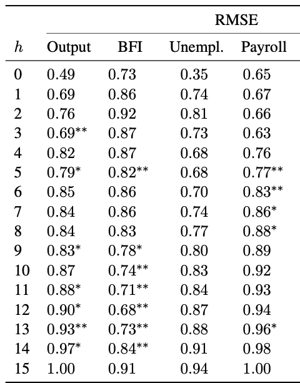
How large? Since 2007, tilting cuts payroll employment RMSE by about a third at horizons of one to three quarters, and business fixed investment RMSE by 25-30% at horizons of two to three years (significant at 5%). Neither is an SPF tilting target. 5/5
🧵New @ecb Working Paper by @elmarmertens & T. E. Clark “Entropic tilting of forecasts to SPF histograms: analytics & applications” https://t.co/x1Hctki9RP 1/5
The SPF publishes no histograms for payroll employment, business fixed investment, or the 5-year Treasury yield. Tilting improves forecasts of all three anyway. The tilt reweights complete scenarios, so survey information travels through the model. 4/5
New @ecb Working Paper by S. Borgioli, G. M. Gallo, C. Ongari, M. S. Mavillonio & C. Giannetti “Measuring sentiment news with transformer-based language models” https://t.co/c7uCMezNsm
New @ecb Working Paper by G. Perinelli, A. Grassi & N. Kerwien “When firms do not take the money and run: evidence from corporate loan moratoria” https://t.co/rvGsiliBC9
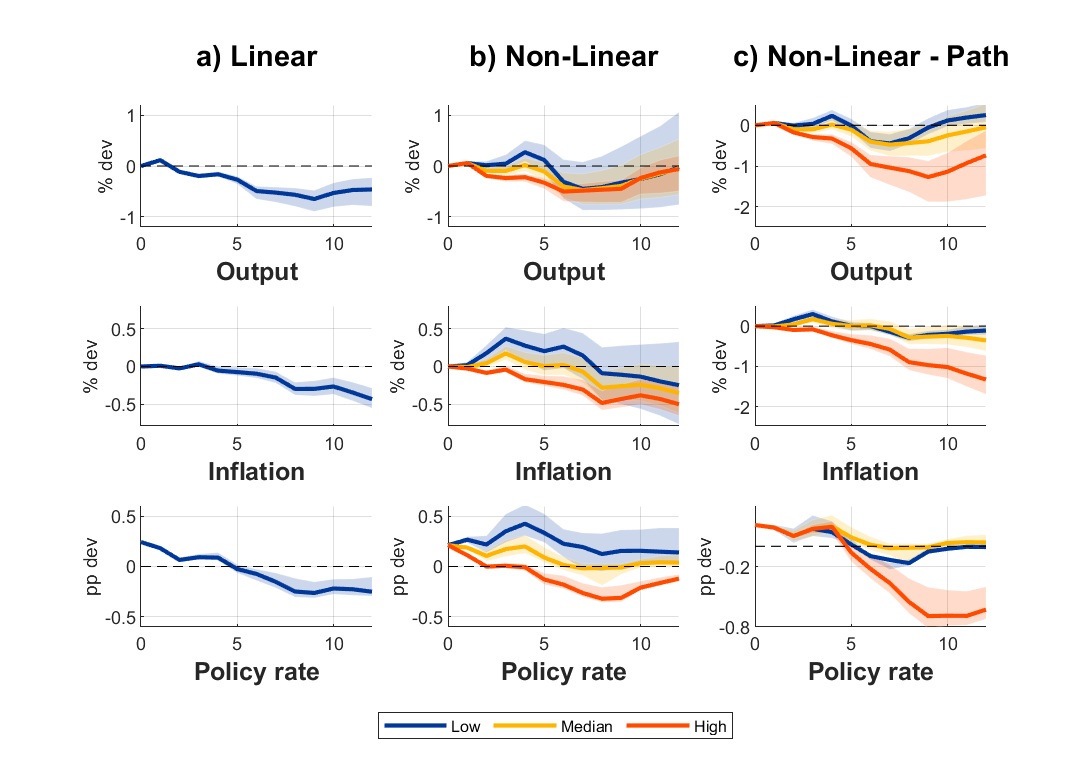
2⃣more findings: tightening leaves the economy more exposed to other shocks (housing, demand) & the effectiveness increases even more if tightening coincides with a downturn. If the tightening occurs during expansions, monetary policy effectiveness is not materially affected 3/3
Monetary policy tightening cycles get more powerful the longer they run, while loosening cycles get progressively weaker. Rate hikes raise private-sector debt-service burdens in the short run, amplifying the next hikes effect 2/3
Apply now to join our 𝗙𝗶𝗻𝗮𝗻𝗰𝗶𝗮𝗹 𝗿𝗲𝘀𝗲𝗮𝗿𝗰𝗵 𝗱𝗶𝘃𝗶𝘀𝗶𝗼𝗻 or the 𝘀𝗲𝗻𝗶𝗼𝗿 𝗺𝗮𝗻𝗮𝗴𝗲𝗺𝗲𝗻𝘁 𝗥𝗲𝘀𝗲𝗮𝗿𝗰𝗵 𝘁𝗲𝗮𝗺 as Student research assistant.
📅D𝗲𝗮𝗱𝗹𝗶𝗻𝗲: 𝟮𝟬 𝗡𝗼𝘃𝗲𝗺𝗯𝗲𝗿 𝟮𝟬𝟮𝟲
More info 👇https://t.co/7kCjDEyHkK