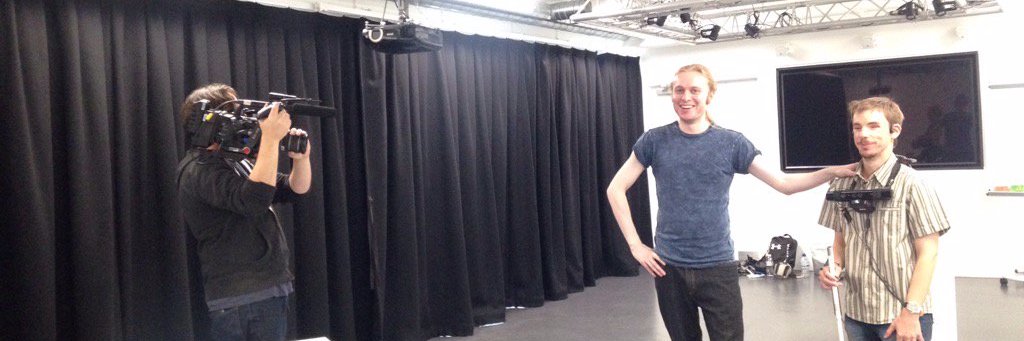
iOS Sensory substitution Apps - The SoundSight ( experimenter and pre-release versions), and the Colour Explorer are now open-source and available on Github at https://t.co/JZs1OC9SB8 and https://t.co/YiFaTeg6re courtesy of James Alvarez, @JamieWardSussex, and myself.
Exciting news! Our latest paper has been published in Imaging Neuroscience - "NORDIC improves tSNR in rodent and Human fMRI".
Thanks Kevin, Giles, Muneeb, Thajunnisa, Steen & Brad. @kevinchancw@Gilouxy@EdelmanBradley@faiq_muneeb
https://t.co/ohlQYeXd8K
Ladies and gentlemen, start your engines ... teams from @PwC_UK taking part in feasibility study during #PwCOFOD exploring how Soundscape using 3D audio assistive technology open sourced by @Microsoft could be taken forward, developed to support the visually-impaired community.
Soundscape for Everyone is coming soon! Felt appropriate to share this on GAAD (Global Accessibility Awareness Day!) Over the past few months, I have been working with a small group of partners and individuals, who have been generously donating their time and expertise,
People are sleeping on the convergence of AI + AR.
GPT-4 image input is on its way, and Apple’s AR/VR headset is on its way.
- navigation overlays
- translation overlays
- immersive education
- personal HUDs
The fusion of these 2 technologies will transform everything.
Cybathlon vision assistance challenge highlight. A smartphone App developed by Kristof Karacs called EyeRider is used by pilot Peter Sulyok during the successful navigation of an obstacle course and tabletop challenge at 5.53.00 https://t.co/KAdy8gePiS
We're very excited to hear Dr. Ella Striem-Amit @StriemAmit discuss #neuroplasticity and vision restoration from #blindness at SKERI on Monday afternoon, March 27 at 4pm! To join via Zoom (or if you're nearby, e.g. for #CNS2023), let us know here:
https://t.co/z5rwIB9ECr
#GPT-4’s new capabilities power a ‘virtual volunteer’ for the visually impaired https://t.co/FNMXPaVQcM "Users can send images via the app to an #AI-powered Virtual Volunteer"; #blind#a11y#BeMyEyes#GPT4
Please RT: My lab is recruiting a postdoc to work on individual differences of plasticity in blindness: how brain #plasticity manifests in different #blind individuals, and how that may account for their compensatory skills and use of assistive devices.
https://t.co/LEC4S2xw3M
The Topo-Speech sensory substitution system as a method of conveying spatial information to the blind and vision impaired https://t.co/giI882spNn by Amir Amedi et al. @NeuroImageLab
Sharing my first first-author paper, published in @FrontPsychol. If you are interested in sensory substitution, auditory localization, cross-modal correspondence or assistive technology for the blind, check it out https://t.co/Zu5BupEaIq (1/4)
@n7zzt@seeingwithsound Another point on the BrainPort, I swear users are best with it when they only use the tip of their tongue to scan the image on the tongue display. At that point, its basically a parallel to finger exploring an embossed image.