Your brand spent 30 years building #loyalty. An #AI shopping agent will re-decide in 30ms.
What survives when your customer is an #algorithm?
We’re editing a @BizHorizons special issue to find out. Submissions close Sept 1.
https://t.co/MyRhp9spQJ
Our second @HarvardBiz article just dropped — "Beware the Agentic Convergence Trap." with @MRPVANESCH and Stewart Black.
Competing AIs trained on the same data reach the same #strategies. No coordination needed. Is your #AI your advantage — or everyone's?
https://t.co/QvOW21XYt1
What if AI doesn't replace salesperson creativity — it just reshapes it?
Our new paper says the real question isn't whether to adopt AI, but how you design the system around it.
#GenerativeAI#B2BSales#AIinSales#FutureOfWork
https://t.co/g8x1fE9WWH
OpenAI slipped shopping into 800 million ChatGPT users’ chats − here’s why that matters.
Check out our latest article, co-authored with @MRPVANESCH).
https://t.co/IpSZFTMzi6 via @ConversationUS@ericsmalley
Many fields—including psychology, sociology, communications, political science, and computer science— use computational methods to analyze text data.
We find that the all versions of #GPT are capable of accurately detecting various psychological constructs in text across 12 languages,
Using simple prompts and no additional training data. GPT thus overcomes the limitations present in existing text analysis methods.
For instance, GPT (r = 0.59 to 0.77) performed much better than dictionaries (r = 0.20 to 0.30) at detecting psychological constructs.
GPT is also effective in several lesser-spoken languages.
https://t.co/ANrBkbI94I
Led by @steverathje2 & @DanMirea4 along with @sucholutsky@RajaMarjieh @CRobertson500
Interesting new working paper by Benjamin Enke, discussing the recent and ongoing "cognitive turn" in behavioral economics.
The proposal of five unifying categories of cognitive simplification strategies has broad relevance, also for psychology.
https://t.co/WZz46TDujR
Although much of human morality evolved in an environment of small group living, almost 6 billion people use the internet in the modern era.
We argue that the technological transformation has created an entirely new ecosystem that is often mismatched with our evolved adaptations for social living.
We discuss how evolved responses to moral transgressions, such as compassion for victims of transgressions and punishment of transgressors, are disrupted by two main features of the online context.
1) the scale of the internet exposes us to an unnaturally large quantity of extreme moral content, causing compassion fatigue and increasing public shaming.
2) the physical and psychological distance between moral actors online can lead to ineffective collective action and virtue signaling.
led by @CRobertson500 @azimshariff
https://t.co/Uh6EB1eGPY
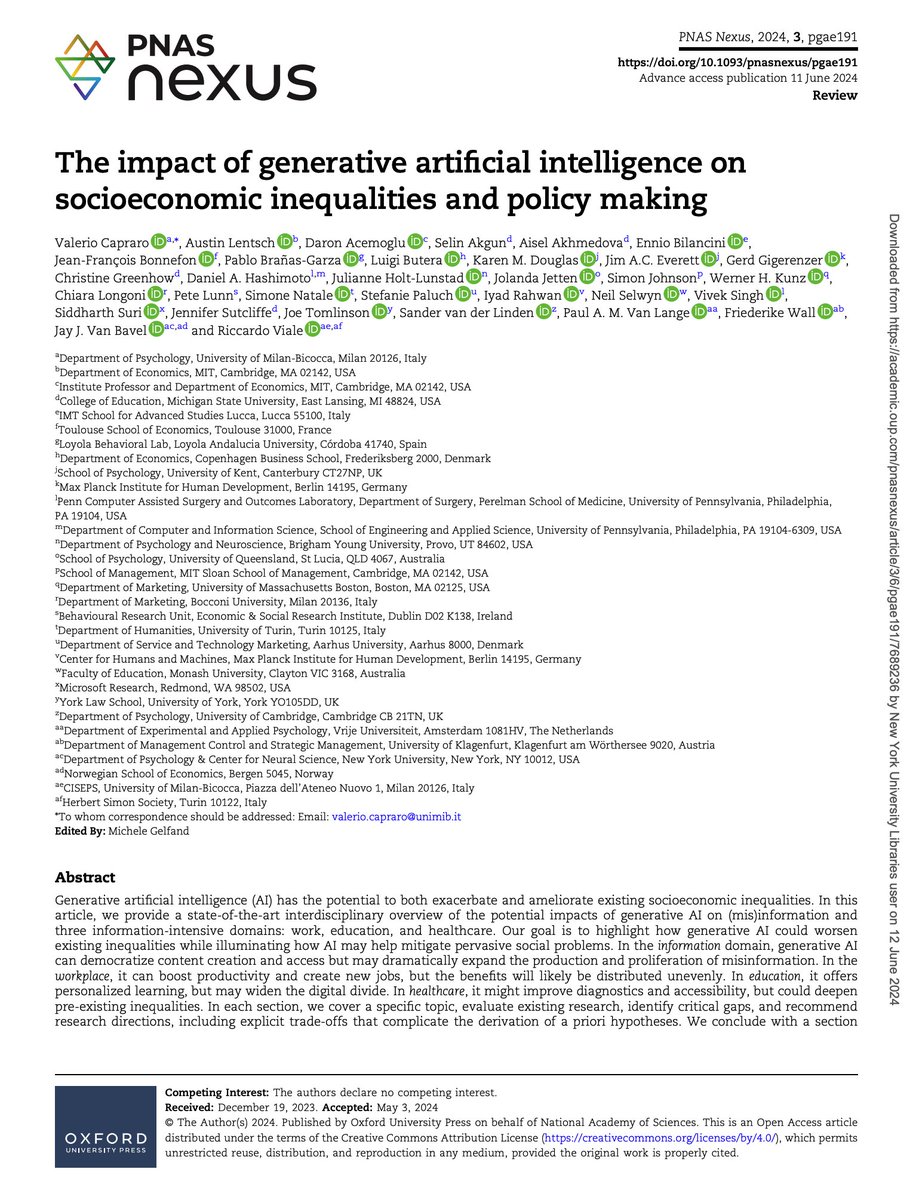
Our new paper @PNASNexus provides a state-of-the-art interdisciplinary overview of the potential impacts of generative AI on (mis)information and three domains: work, education, and healthcare: https://t.co/EnJeqA6AWT
Our goal is to highlight how generative AI could worsen existing inequalities while illuminating how AI may help mitigate pervasive social problems
I was so lucky to be able to have Danny Kahneman as a best friend and collaborator for decades. He usually ended our conversations with "to be continued..." but I now have to simulate his part which is impossible. My favorite image of us "working".