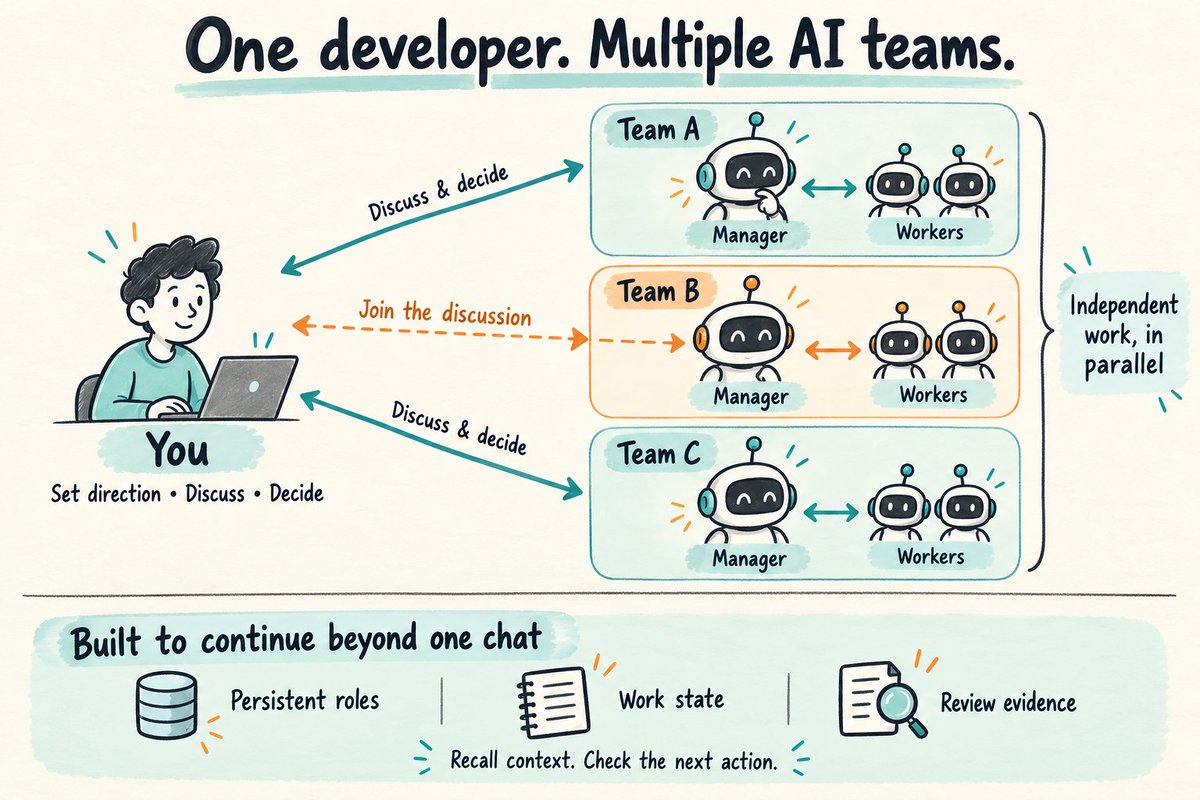
AI already writes code fast. What falls apart is coordination.
The API just changed, the frontend is waiting on a field decision, and the build is failing. You keep piling requirements, error logs and "did you verify that?" into one chat. By the time you ask "where are we actually stuck?", you have to scroll back through everything yourself.
So I split a single Codex chat into an AI dev team with real roles:
· Manager: clarifies scope, splits tasks, coordinates dependencies, sends work back, accepts results
· Workers: each one a separate Codex task that builds and tests within an agreed scope, then hands back changes plus evidence
· Liaison: answers "where are we?" so I don't interrupt the Manager
The part I care about most: every Worker is a real task I can open. If it picks an approach I didn't expect, I ask why on the spot. If it misreads a field, I correct it right there. I get involved during execution, not just at the end.
One lesson learned the hard way: writing "you are the Manager" in a prompt isn't enough. After long chats and context compaction, agents forget who they are. A Worker would finish the code, say "done" in its own window, and never hand it to the Manager.
So team identity ("who am I, which team, who do I report to") is now persisted and can be looked up again. Task state is tracked separately: executing, submitted, reviewing, rework, approved.
And one rule that feels very much like a real team: a Worker whose submission hasn't been accepted doesn't get new work just because its window looks idle. An idle window is not finished work.
So far I've run 3 teams and a dozen-plus agents for over two weeks without noticing any team memory loss. That's an observation from real use, not a benchmark, and the project is still in development.
What's the messiest part of coding with AI for you?
Gemini used to be my most-used AI. Then GPT-5.4 and Opus 4.6 came out, and I quietly stopped paying for Google One.
Now Gemini 4 Argon shows up on the Artificial Analysis index at 53, tied for 3rd, but it's not even publicly available yet.
Ship it, Google. You might win me back. 👀
One developer. Multiple AI teams. Here’s how I work with them.
I’ve been using Codex Team Runtime for over a month, working with three teams and more than a dozen agents.
Each team has a Manager coordinating the work and Workers executing in separate conversations. Independent tasks can move forward in parallel.
I can discuss an implementation with one Worker, check another team’s progress, and bring changes in direction back to the Manager. I’m part of the work—not just waiting for a final result.
The useful shift is from one long chat holding everything to several teams with continuing responsibilities.
Keeping that useful over weeks takes more than launching agents. When conversations pause or get compacted, the team needs to recover who owns the work, what remains unfinished, and what needs review.
That’s the connection to my broader research into agent runtimes.
I wrote up the workflow, real screenshots, trade-offs, and what still needs work: