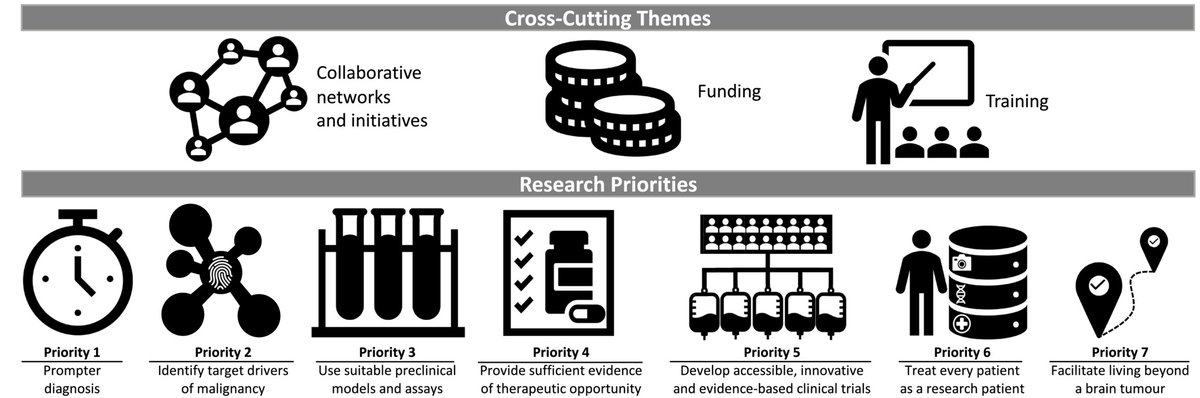
This position paper highlights the need for better experimental models, but also *better access* to a *range* of different models, for brain tumour research. The most complex organ in the human body needs a multifaceted experimental approach to understand the diseases within it!
Pledges to increase brain tumour research funding in the UK have not improved outcomes, as was hoped. Our position paper opines why "Adult brain tumour research in 2024: Status, challenges and recommendations" https://t.co/7OPNfSHRjk @KarinPurshouse@allyrooney@jenkinsonmd
Just published 🥳A @UniOfHull & @GliomaGenomics collaborative study using a 'GlioModel' (brain tumour biopsies kept viable on chip)🧠👀👉https://t.co/58zTskoxrF funded by @YorkshireBTC. Patient-derived models included thanks to @LeedsNeuroRTB. Huge congrats @AntoniaBarry18 👏
We love models, but we also love finding out about all the hugely advanced technology we can apply to learn as much as possible from them! Investigation of GBM cell plasticity NEEDS single-cell multi-omics!
If you're interested in Spatially Resolved, Single-Cell Transcriptomics & Proteomics, join us @ 2pm, Worsley 9.60 or alternatively via TEAMs for the seminar
“Nanostring: Multi-Omic, Spatial Profiling at Single-Cell Resolution to Unravel Complex Biology”
Speaker: Dr.Bryan Serrels
We are excited to announce Leeds Centre for Disease Models Annual Meeting on the 8th of March@Nexus to @UniversityLeeds community. 🗣️📯🥳
Please register here: 🧑💻https://t.co/HfVQHYxvnx (tickets are limited)
Microrobots in the brain Vasculature!
We use microrobots and control them wirelessly in the brain vessels (even against the flow).
We are just at the beginning of this exciting field.
What kind of application do you imagine?
https://t.co/61Y7AumrXJ #innovation#medtech
Exciting news alert 🗣️📯: we are delighted to let you know that our 2023 disease models 🧫👁️🧠🫀🫁conference will be taking place on Wednesday the 8th of March at NEXUS. Please save the date and more details to follow soon ✍🏼
State-of-the-art experimental models need state-of-the-art analysis techniques. Out today in JBM: 'SpheroidAnalyseR—an online platform for analyzing data from 3D spheroids or organoids grown in 96-well plates' @GliomaGenomics@Rhiannon_Barrow@LucyFStead https://t.co/QwxJRs3t6v
We are looking for an enthusiastic PGR to join the Leeds Centre for Disease Models Executive Committee. If you are actively involved in cellular disease models and would like to help shape this research area and community at the University of Leeds, please get in touch!
Really great to catch up with colleagues today in @GlioModel on zoom. Superb collective who are aiming to establish validated glioblastoma models to aid in all glioblastoma research. So excited for what is ahead! Thanks to @LucyFStead for organising
LOOK 👀 a special research topic in @FrontCellDevBio on GLIOMA: From Genetic to Cellular Heterogeneity 🧠🧬There's so much exciting research in this area right now. Submit your abstract by 24th Sept✏️ & manuscript by 23rd Nov🖊️More info here 👉
https://t.co/TKrrVXwPum Pls RT
Hugely informative and entertaining talk on organoid development and assays by latest GlioModel member @jamesapoulter who was also one of the organisers for this @DIMOLeeds Organoid workshop 👌👍👏
@Rhiannon_Barrow from @GliomaGenomics presenting on SpheroidAnalyseR, an automated programme for measuring growth of preclinical 3D models, at @DIMOLeeds Organoid Workshop
@Rhiannon_Barrow presenting work that used 3D GBM spheroid models to gain real clinical insight. To facilitate this she developed https://t.co/HYg6zprnqA for automated analysis of spheroid imaging data #BNOS22@BNOSofficial@DIMOLeeds
We used the opportunity, whilst in Liverpool at #BNOS22, to visit GlioModel member Prof Harish Poptani's amazing imaging setup for preclical glioma models. We see so much opportunity for sharing of these kinds of resources in our consortium to expedite target validation in GBM!