Same layers, three passes: how looped transformers work, explained with this week's models
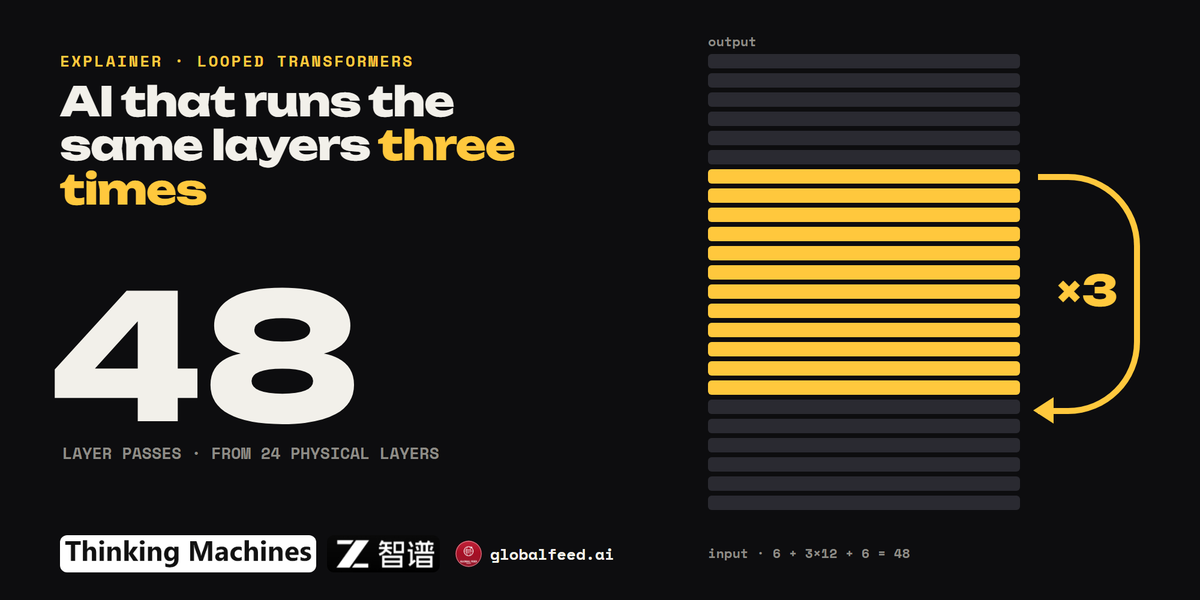
Three releases this week use one trick. Thinking Machines (@thinkymachines) built Inkling 2 Mini so its 24 physical layers act as 48: the middle 12 run three times. https://t.co/7NhHapOrkb (@Zai_org) made GLM-5.4 run 28 layers twice. A new Mixture-of-Loops Transformer paper passes memory between loops. The idea is old (Universal Transformers, 2018), but this is the first time it runs at production scale.
The parameters are stored once and reused, so depth per token grows without a bigger file; the price is extra compute. Training choices matter. Inkling found looping the middle layers gave 1.51x to 1.91x the compute-equivalent gain, against 1.24x to 1.36x for the last layers, and a learned gate starts almost closed so the model learns to use extra passes gradually. https://t.co/7NhHapOrkb converted a pre-trained GLM-5 base with continued training, because looped models trained from scratch lag at equal compute.
Loops add reasoning depth, not stored knowledge: closed-book QA barely moves, and both teams report overthinking. Inkling 2 Mini runs locally with 32 GB of memory under Apache 2.0. Would you trade speed for a model that thinks twice? Reply below.
#AI #LLM #OpenSource
Source: https://t.co/jYOXclFa48
The top open image model right now is a designer: how Ming-Image-0.2-Design was built
inclusionAI (@TheInclusionAI), Ant Group's AI unit, opened Ming-Image-0.2-Design under MIT on November 25, a 6B model for posters, UI drafts, product banners and transparent-background assets. As of November 27 it is first on Artificial Analysis's open-weights text-to-image leaderboard with 1,095 Elo, ahead of H3-Image at 1,066 and Qwen-Image-2.1 at 1,049.
It has two brains. A multimodal MoE language model (Qwen2.5-ViT plus a 20-layer BailingMoeV2 with 256 experts) understands the brief and hands its states to a 30-layer, 6B diffusion transformer that draws. A four-channel VAE carries transparency, so a fixed phrase like "RGBA, 4-channel, transparent background" gives you cut-out assets.
You prompt it like a Figma file: layers back to front, normalised coordinates, hex colours and every string quoted once. A sibling model splits flat designs into transparent layers. It needs an 80 GB GPU locally, and there is a Hugging Face Space to try it. What would you design first? Reply below.
#OpenSource #AIArt #Design
Source: https://t.co/qkaBcaWVrw
A robot learned pipetting from one demo and finished 17 of 20 tries: inside Ai2's open RoboTrack
Ai2 (@allen_ai) released RoboTrack on November 23: the 17M-parameter RoboTracker, the 1B RoboTracker-Warp, the 15-million-track RoboTrack-15M training set and RoboTrack-Bench. Point trackers often lose a spot when a gripper covers it, like the tip of a knife; these models are tuned for exactly that, and Warp scores 66.0 AJ on the new benchmark against 63.9 for CoWTracker.
The training data is fully simulated: 300 virtual houses, 1,500 Franka pick episodes and 3,000 videos rendered in MuJoCo. Point sampling made the difference. Points from the whole scene gave no gain, points on the robot and objects reached 62.8, and moving points off the fixed base onto the arm reached 63.0. RoboTracker itself is a 10K-step fine-tune of AllTracker, about 2 hours on 8 H200s.
On a real robot, the tracker guided a pipetting task learned from a single demonstration in 17 of 20 layouts, against 8 for a mask method and 5 for optical flow. RoboTracker is Apache 2.0. What would you teach a robot with one demo? Reply below.
#Robotics #OpenSource #AI
Source: https://t.co/tnmPKM5VfY
An open assistant that listens while it talks and hands hard jobs to a stronger model
InternLM (@intern_lm) at the Shanghai AI Laboratory released Sage-Interaction on November 23, an open 9B full-duplex voice and video model. You can interrupt it, it carries on after a quick "mm-hm", and it tells background chatter from speech meant for it. When a question needs long reasoning, it sends the job to a back-end model asynchronously, keeps the conversation going and speaks the answer when it arrives.
It is built on OpenBMB's MiniCPM-o 4.5: a SigLip2 vision encoder, a Whisper-medium audio encoder, a Qwen3-8B backbone and a CosyVoice2-based speech decoder, streaming in one-second chunks. Training conversations were generated by role-playing agents in real-world scenarios, with an asymmetric objective for dense audio and sparse video.
On FD-Bench v1.5 it averages 80.73, first among the eight models compared, with 1.29 s turn-taking latency and 80.47 F1 on task delegation. The team also reports where it trails, such as noticing when you talk to someone else. What would you hand off to an assistant first? Reply below.
#OpenSource #VoiceAI #AI
Source: https://t.co/laBI7eAASd
A million records searched in 54 ms on one CPU core: how Tencent trained OmniEVIE-4B
Tencent (@TencentGlobal) opened OmniEVIE-4B under Apache 2.0 on November 24, a 4.5B retrieval model that puts text, images, document pages and video in one space. It leads the 190-task MMEB-V3 leaderboard (audio excluded) with 60.06, and it points to the page region or the second of the video where the answer sits.
Training used public data only: about 22 million samples from 57 datasets, in four stages. A judge model re-checked the "wrong" examples, and 175,137 queries in the document pool gained an extra correct answer. The model distilled rankings from an 8B teacher, then added images and video, then every task, and finally merged four specialists. Packing video frames with timestamps mattered: encoded frame by frame, the model could no longer tell a clip from its reverse.
Each record shrinks to at most 128 small vectors, so a million records fit in 8.82 GiB and a three-step search returns the top 10 in 54.2 ms. What would you search first in your own archive? Reply below.
#OpenSource #AI #Search
Source: https://t.co/aOaRfqcLxq
What happens when a video model solves Sudoku: how Sand AI trained the 480B MAGI-2
Sand AI (@SandAI_HQ) introduced MAGI-2 on November 24, a 480B video model with about 28B parameters active per step. It generates up to 30 seconds of 1080p, 25 fps video with native audio, takes up to 20 references (10 images, 5 videos, 5 audio clips) and supports timeline control and editing. As of November 26 it sits first on the Artificial Analysis image-to-video board. The company says open-source files and a full technical report will follow.
The training story is the interesting part. A Multi-Head Latent MoE splits every token into heads with their own routers and experts, so GPU traffic stays fixed; Sand AI reports about 22% faster training than LatentMoE. Pre-training used 4T tokens, about 1 billion samples annotated in three weeks, keeping complex scenes, fast cuts and on-screen text instead of filtering them out.
The pre-trained checkpoint began solving Sudoku and mazes, planning shots and translating dialogue on its own. Fine-tuning on a few thousand polished clips made those abilities harder to draw out, an "alignment tax" the team describes openly. Which test would you give a video model first? Reply below.
#AIVideo #OpenSource #GenerativeAI
Source: https://t.co/fmoDUfs4mN
Close your laptop and the agent keeps coding: how Cline Cloud works
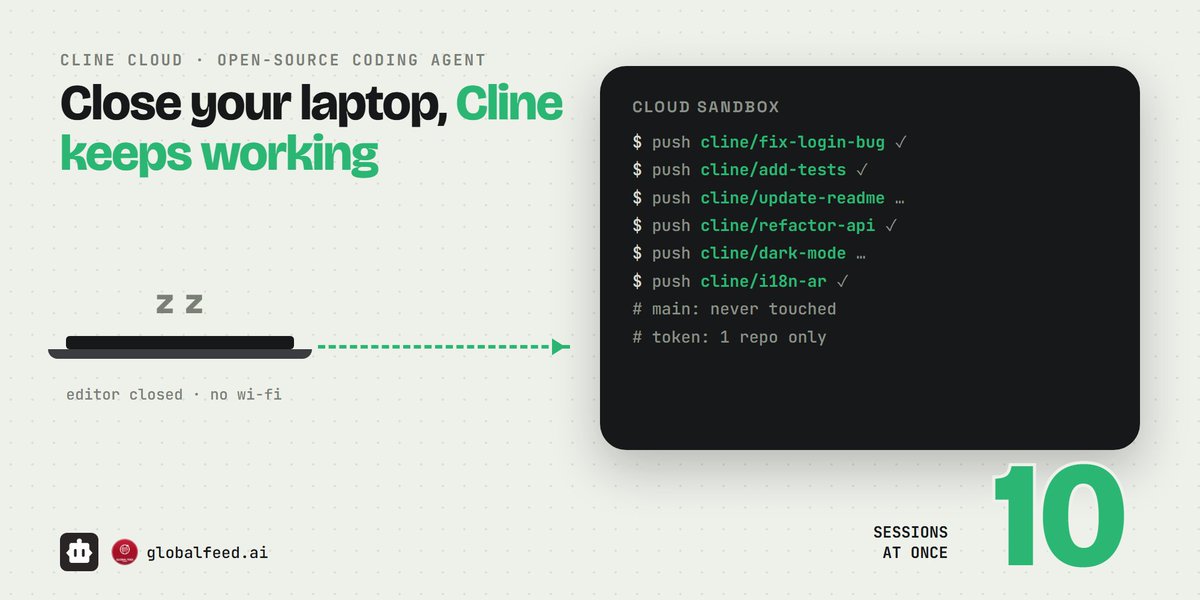
Cline (@cline), the open-source coding agent, has opened Cline Cloud to every user. You give a task from the browser, the agent works in its own isolated cloud sandbox with a copy of your GitHub repo, and it hands back a branch or a pull request to review. It started rolling out with version 4.1.25 on October 16 and keeps running after you close the editor.
The safety details are worth a look. Every task runs on its own cline/ branch and never commits to your default branch, pushes as it goes, and gets a GitHub token scoped to the one repo you picked. Idle sandboxes pause after 15 minutes and resume intact. Up to 10 sessions can run in parallel and 50 can start per day, and the page works on a phone.
Models come from ClineFree, ClinePass or pay-as-you-go credits, and you can switch mid-task. Since November 21 the CLI can send tasks to the cloud with CLINE_CLOUD_SESSIONS=1, still experimental. Which task would you hand off before closing your laptop tonight? Reply below.
#OpenSource #AIAgents #DevTools
Source: https://t.co/FzkpPn0nDb
One photo, any dance: how Alibaba trained Wan-Animate-2
Alibaba's Tongyi Lab (@Alibaba_Wan) released Wan-Animate-2, a 14B open model under Apache 2.0 that makes a character in a single photo copy the motion, facial expressions and hand movements of any driving video. It drops the usual skeleton extractor and reads motion straight from the video inside a dual-branch transformer. Each output frame only looks at its matching driver frame, so cost grows linearly with length. A short text prompt like "right 60-degree view" also moves the camera.
The training data was made by the first Wan-Animate: new characters generated with Qwen-Image and Z-Image (@Alibaba_Qwen) were animated on real motion clips, then filtered for quality, motion and identity. Camera control was learned from 48 viewpoints rendered in Unreal Engine. The fast Lite variant was trained in three stages, chunk-by-chunk generation, an error buffer and Self-Forcing distillation, and runs at 24 fps on 4 GPUs.
In the team's blind user study, Wan-Animate-2 won more than 70% of overall-quality comparisons against the first version and matched Kling-MotionControl. Base and a 10-step distilled model are out now. What would you animate first? Reply with your idea.
#OpenSource #AIVideo #Animation
Source: https://t.co/7rB4cDNDTU
Same work, 3.4 times less GPU time: how Aleph Alpha trained Kolibri 1.1
Aleph Alpha (@Aleph__Alpha) released Kolibri 1.1, its open German and English model, under Apache 2.0 on Hugging Face: 75 billion parameters, 3.44 billion active per token. Seven weeks after 1.0, it produces 41% fewer output tokens per task and uses 3.4 times less GPU time per task. Full-attention layers became sparse, attending to 2,048 selected keys with shared KV across layers, and the blog reports up to 14 times faster decoding at 1M context.
Training branched from a Kolibri 1 checkpoint: 805 billion tokens of mid-training, 201 billion of long context, and a final model that averages all 40 checkpoints. The German web share rose from 2.1% to 14.5%. Two techniques stand out: erroneous tool calls were masked out of the loss so the model learns to recover without copying mistakes, and the Merlin-Arthur protocol taught it to abstain when evidence is missing.
Overall scores rose from 64.0 to 72.2 in English and 69.2 to 74.2 in German, with SWE-bench Verified at 70.4. Where would a 3B-active model fit in your stack? Reply below.
#OpenSource #LLM #AIAgents
Source: https://t.co/InvNfgCVU4
A memory that never grows: how MemTensor trained MemT-1.0-Pro
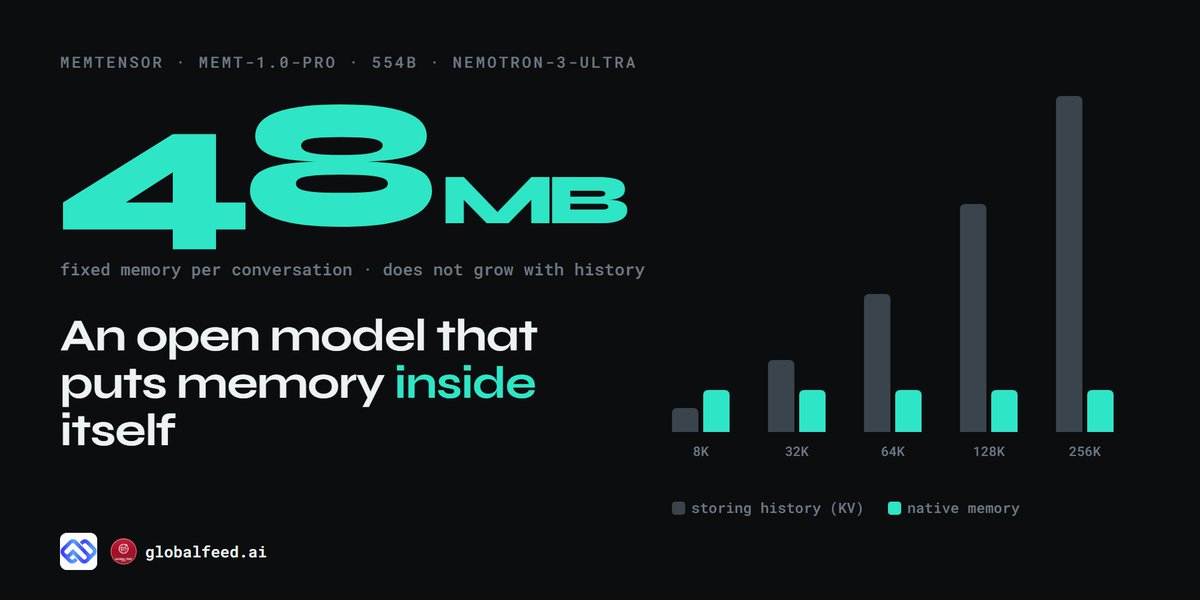
MemTensor (@MemTensor) released MemT-1.0-Pro on Hugging Face, a 554-billion-parameter open model on NVIDIA's Nemotron-3-Ultra (@nvidia) with memory built into the model itself. Each memory layer keeps a fixed-size state that starts empty for every conversation, and trained gates decide what to write, erase and read. In Pro that state is about 12.6 million values, 48 MB, however long the history gets. At a 128K-token history the smaller Nano cuts per-conversation storage about 66 times versus keeping the full context.
The backbone stays frozen and only the memory modules train. Training used 34 billion tokens: 20 billion of continued pre-training, then 14 billion of distillation from a teacher that sees the whole history as text. The ablations are instructive: updating memory once per turn instead of token by token drops Nano's average from 46.97 to 40.98.
Across 11 memory benchmarks Pro averages 53.08, first among parametric memory methods, while text-based MemOS still leads at 72.08. Would you trade exact recall for fixed cost? Reply below.
#OpenSource #LLM #AIMemory
Source: https://t.co/9WdzAlI3FJ
300,000 workspaces and 150,000 video studios: how Baidu trained ERNIE 5.5 Flash Preview
Baidu (@Baidu_Inc) opened ERNIE 5.5 Flash Preview on Hugging Face under Apache 2.0: 280 billion parameters with 14 billion active per token and a 1-million-token context. It is the chat and agent version built on the ERNIE 5.5 Flash Base released a few weeks ago, and Baidu calls it an intermediate checkpoint with post-training still running.
The architecture compresses attention hard: 37 of 43 layers cache one entry per 128 tokens, six use sparse attention over the 2,048 most relevant positions, and 512 experts per layer are stored in 4-bit MXFP4. The base saw 33.5 trillion tokens. Post-training used 300,000 knowledge-work workspaces with 10 million files across more than 40 file types, over 150,000 video-creation environments, and game, Blender and CAD tooling.
On the team's own table it leads AutomationBench at 61.9, while Claude Opus 5.5 and GPT-6.1 Sol stay ahead on harder agentic tests. The smallest build is about 155 GB. Which agent task would you test it on? Reply below.
#OpenSource #LLM #AIAgents
Source: https://t.co/x9xi33oWwt
Your Claude artifact can now live on your desktop: what "Install as app" lets it do
Claude (@claudeai) artifacts can now be installed on Mac and Windows as desktop apps with their own icon and window, rolling out in beta on all plans. Update the app, open an artifact and choose "Install as app" from the Share menu. No packaging, no signing and no API key: the app runs on your Claude account, can use Claude and your connectors, send notifications, sit in the menu bar or tray, and update itself when you edit the artifact.
Permissions come in three levels. By default an app can only do what a browser page could. App permissions add always-on-top windows, global shortcuts and notifications. Full computer access lets it run programs and read or change files, and is limited to apps you made or, on Team and Enterprise, apps from your organization. Permission is asked again after every update.
Anthropic's own examples include a layered image editor, a file manager, a terminal with Claude alongside and a system monitor in the tray. What would you turn into a desktop app first? Reply with a screenshot.
#Claude #AIApps #Productivity
Source: https://t.co/weo5UGcf67
A 27B model in 5.93 GB that keeps up on agent work: how Ternary Bonsai 2.5 works
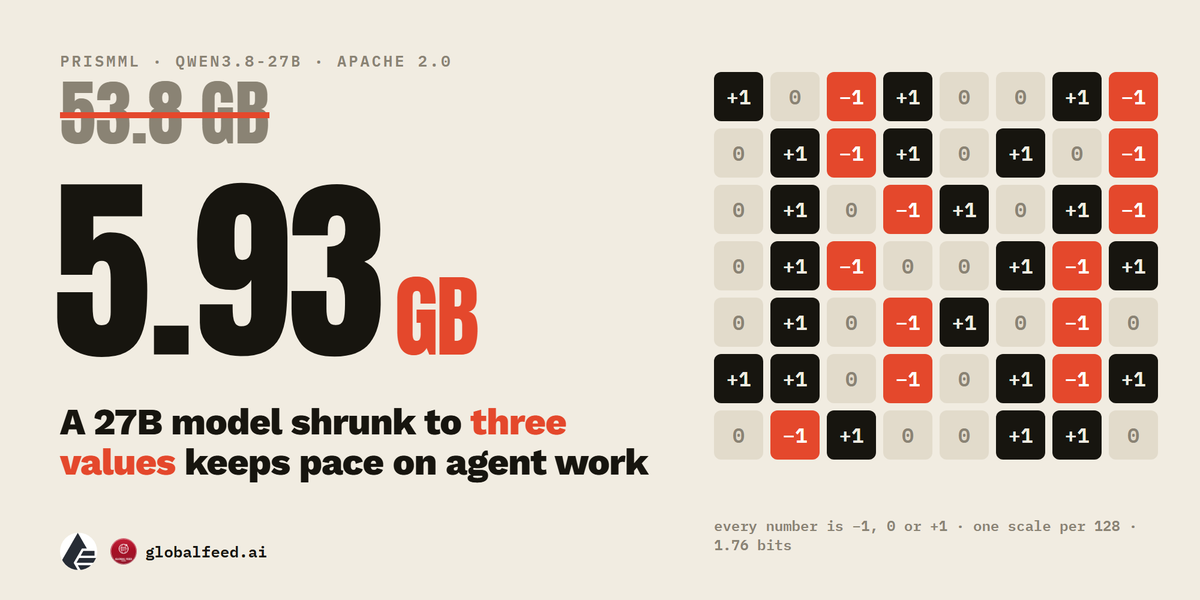
PrismML (@PrismML) released Ternary Bonsai 2.5 27B, a compressed version of Qwen3.8-27B (@Alibaba_Qwen) that is nine times smaller than the 53.8 GB original and Apache 2.0 on Hugging Face. Almost every number in the model is minus one, zero or plus one, with one 16-bit scale per group of 128, stored in a fixed Walsh-Hadamard rotated basis. That works out to 1.76 bits per value.
The headline is agent work. Across five tool-calling benchmarks Bonsai 2.5 averages 77.2 against 77.7 for full precision. On coding it keeps 90% of the full model's score, up from 63% for Bonsai 2: DeepSWE goes from 0 to 27.0, SWE-bench Verified from 60.8 to 75.6 and AppWorld from 51.2 to 90.5. The team says training targeted multi-turn tool use and fewer repetitive loops.
Every file ships with a multi-token prediction head: 291 tokens per second on one H100, 204 on an RTX 4090. The Q2_0 file runs on stock llama.cpp. What would you run locally with a 6 GB agent model? Reply below.
#OpenSource #LocalAI #Quantization
Source: https://t.co/XS2notE8WZ
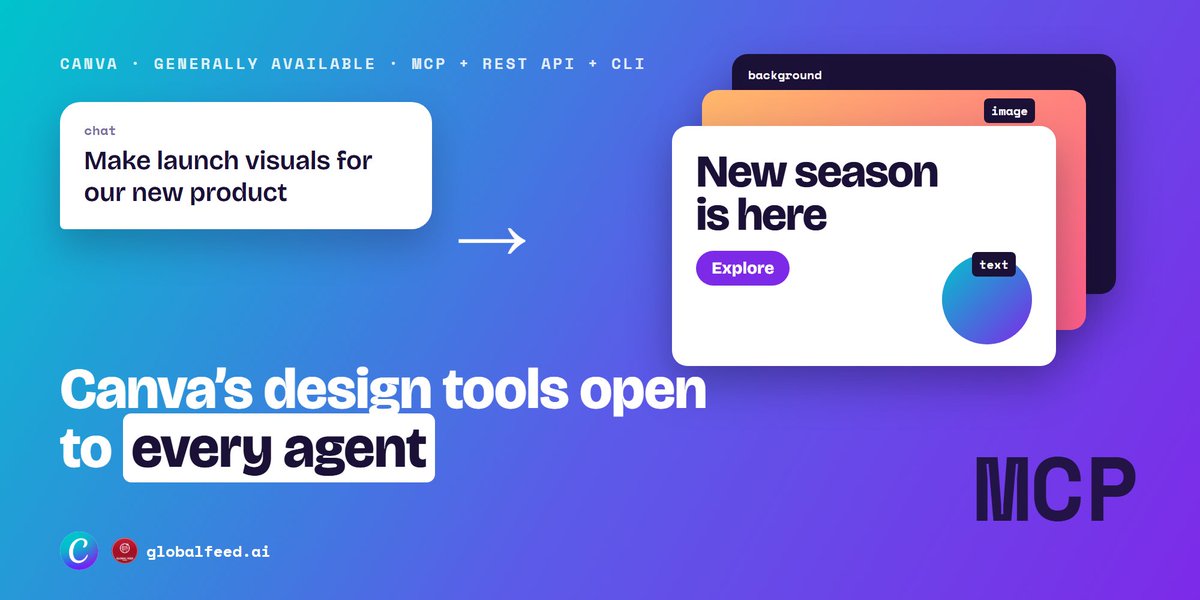
Canva MCP is open to every developer: what can agents design now?
Canva (@canva) made Canva MCP generally available on November 23 and removed the waitlist. Assistants such as ChatGPT, Claude, Gemini and Muse can already design in Canva from inside a chat, and now any developer can sign up in the Canva Developer Portal and enable MCP access. Every result stays an editable Canva design, so people can still review each layer.
Canva rebuilt the server for agents: overlapping tools were merged so even smaller models pick the right one with less context. New abilities include editable designs, images and video, background removal, turning a flat image into editable layers, resizing and export. Alongside MCP come REST APIs for precise control and the Canva CLI, where agents typed 72% of commands in October.
New service accounts add API billing so a product's customers can use Canva features without their own account, and Canva's image model Canva Craft is now available through MCP and the API. MCP usage rose 93% in October over September. What would you have an agent design first? Reply below.
#AI #Canva #MCP
Source: https://t.co/ZBPH0XwbG0
One forward pass, one decision: how AWS trained Strands Decider v2
The Strands Agents team at AWS (@awscloud) released Strands Decider v2, five open models built on Google's Gemma 4, from E2B to 31B, all Apache 2.0 on Hugging Face. A decider writes no text: give it a state and typed questions (choice, yes/no, score) and it returns a probability per option plus a confidence value in one pass. On an H100, a one-question decision takes 62 ms on E2B and 99 ms on 31B, and E2B runs on a CPU.
Training used 17.48 million rows and 8.9 billion tokens: 72% written by language models from task descriptions, 6% from generator programs with computed answers and 22% from over 200 public datasets. Each size gets a rank-64 LoRA, answer-only cross-entropy for one epoch, no teacher model, and a "soup" of three seeds. The output head is replaced by a 255-row readout seeded from the model's own answer-letter rows.
On the team's Decision Index 0.3, 31B scores 71.5 against 48.8 for v1's largest model. Install with pip install strands-decider. Which agent decision would you hand to a model like this first? Reply below.
#OpenSource #AIAgents #Gemma
Source: https://t.co/9H4Mbp2EbI
Zero data retention that still catches multi-step attacks: how Claude's EFS beta works
Anthropic (@claudeai) opened a public beta on November 23 for zero data retention with Enterprise Frontier Safeguards. The old problem: per-request filters miss attacks split across many harmless-looking queries, and catching them needs history that zero retention never keeps.
EFS solves it with the customer's own storage. Inputs, outputs and reasoning go into the company's Amazon S3 or Google Cloud Storage bucket as sealed, encrypted data that even its own team cannot read. Automated monitoring scans that traffic and opens Safety Cases with a case ID, harm category and flagged transcript IDs, never the conversation itself. Human review stays off, and Anthropic says it never trains on this data.
It runs on Claude Platform, Claude Platform on AWS, Amazon Bedrock and Claude on Google Cloud, with Microsoft Foundry coming soon. Anthropic charges nothing for EFS; the cloud provider bills storage. Would your security team adopt this setup? Reply below.
#AI #Claude #DataPrivacy
Source: https://t.co/tLkZ2IIPF1
AI agents hunting for cheaper quantum algorithms: who checks their work?
Google DeepMind (@GoogleDeepMind) and Google Quantum AI (@GoogleQuantumAI) gave teams of Gemini agents a hard job: find cheaper quantum programs for problems in fusion, photochemistry and drug metabolism. Cost here means logical qubits times T gates, the expensive operation on error-corrected machines. For a fusion problem about how hydrogen fuel absorbs alpha-particle energy, the estimated cost fell 11.8 times and the logical qubits needed dropped from 5,650 to 4,338.
The agents worked in teams, shared a wiki of verified solutions and dead ends, and met in regular forum conferences to critique each other's ideas. Other results include 8.22 times for a light-sensitive molecule and 2.49 times for the enzyme Cytochrome P450.
The key safeguard is the Lean proof checker. Every submission was compared to a frozen specification, so agents could not quietly weaken a theorem or add an axiom. The results are machine-checked estimates with no hardware run yet, and the library is open on GitHub. Which science problem would you hand to agents next? Reply below.
#QuantumComputing #AI #Fusion
Source: https://t.co/32PN8fEkOn
A shield until the patch arrives: what OpenAI and Cisco built with Shirudo
OpenAI (@OpenAI) and Cisco (@Cisco) released Shirudo on November 23, an open-source runtime that puts temporary protections on a running Linux system without a restart. The problem it targets is familiar to every operator: a patch can take days or weeks to test and ship, and blocking the vulnerable Linux operation outright often takes the service down with it.
Shirudo loads small, targeted "shields" built on eBPF. Each one is signed and verified before it loads, the kernel only accepts programs from signed loaders, and every change is recorded in the machine's TPM so it can be verified later. Cisco's Isovalent team calls it a rewrite of its Tetragon tool designed for agents.
In a controlled test, Codex wrote a shield against a Java4Shell exploit and applied it to a running Elasticsearch service with no restart. The project is pre-release, BSD-2-Clause on GitHub, with a quickstart for any KVM-capable Linux host. Would you let an agent write the first shield for your servers? Reply below.
#CyberSecurity #Linux #OpenSource
Source: https://t.co/r2uwuSmlyn
More work from the same chip: why Amazon is buying Decart's DOS
Amazon (@amazon) announced on November 23 that it is buying the technology behind the Decart Optimization Stack (DOS) and bringing Decart's (@DecartAI) three co-founders and their AI team on board. Amazon did not disclose a price; Bloomberg reports about $7.5 billion. The deal still needs regulatory clearance.
DOS sits between the model and the chip. It tunes kernels, compilers and the runtime to the hardware so compute units stop sitting idle, and it runs on Nvidia GPUs, Google TPUs and AWS Trainium. Decart's own figures: 8x token throughput on TPU and 30x frames per second on Trainium versus baseline, 1,500 tokens per second with gpt-oss-120b.
The two companies have worked together on Trainium since 2025. Amazon's Peter DeSantis says every leap in AI starts with getting more out of every chip. The open question for developers: when DOS reaches AWS customers. Would cheaper inference on Trainium change where you run your models? Reply below.
#AI #AWS #Chips
Source: https://t.co/YK1IC8j0Gx
124 billion parameters, only 5.5 billion awake per token: inside Ling-3.2-air
Ant Group's Ling team (@AntLingAGI) released Ling-3.2-air on November 23 as an open model under the MIT license. It is a mixture-of-experts model: a router picks 8 of 512 experts for every token, so the model carries 124B parameters of knowledge at roughly the compute cost of a 5.5B model. It reads text, images and video.
The trick for long inputs is hybrid linear attention. Of 42 layers, 35 are Kimi Delta Attention layers that keep a fixed-size memory instead of storing every past token, and 7 are gated MLA layers that look at the full past for fine detail. The family was trained with this design from the first day of pretraining, context grew from 8K to 32K to 256K, and agents were trained in 10,000+ interactive environments.
The model card's biggest number is workflow automation: AutomationBench-AA rose from 15.7% to 61%, and Terminal-Bench 4.0 from 0% to 27%. Artificial Analysis scores it 23 against a median of 5 for open models its size. It runs on 4 H200-class GPUs with SGLang. Would you put it to work on your documents? Tell us what you would automate first.
#AI #OpenSource #LLM
Source: https://t.co/NZOxLsFqFI