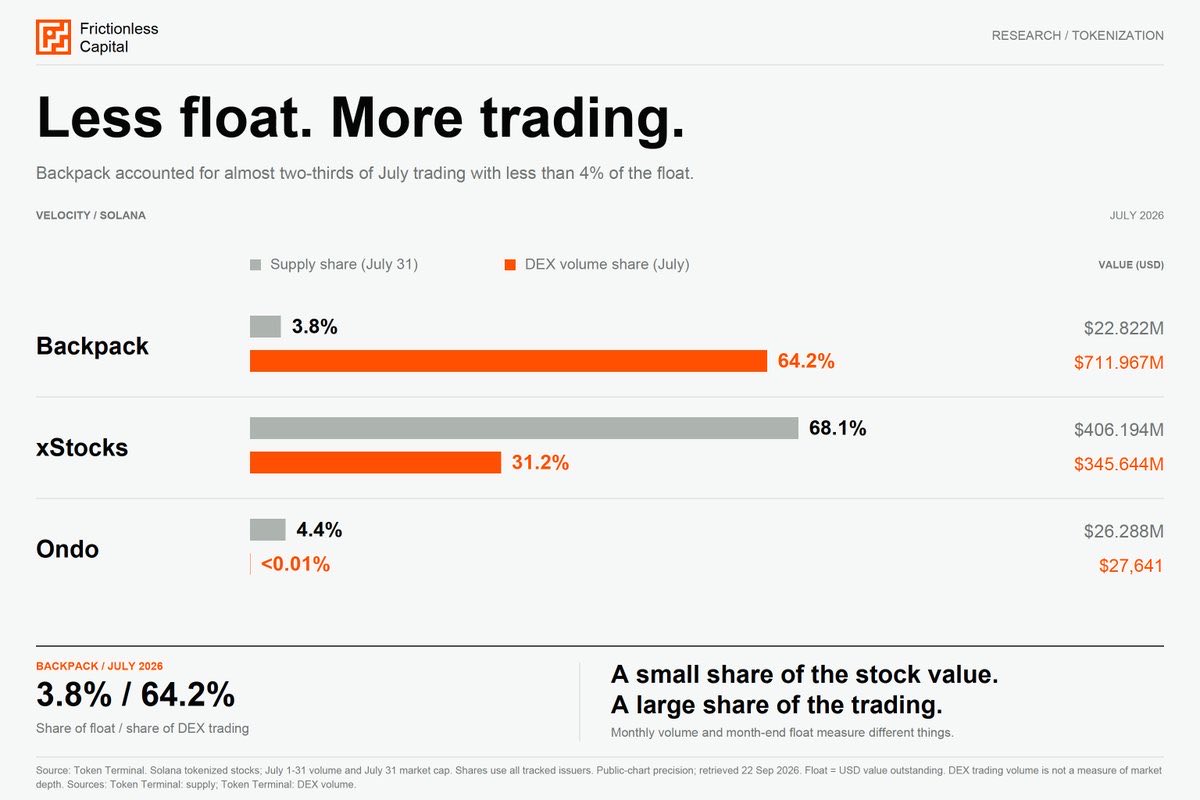
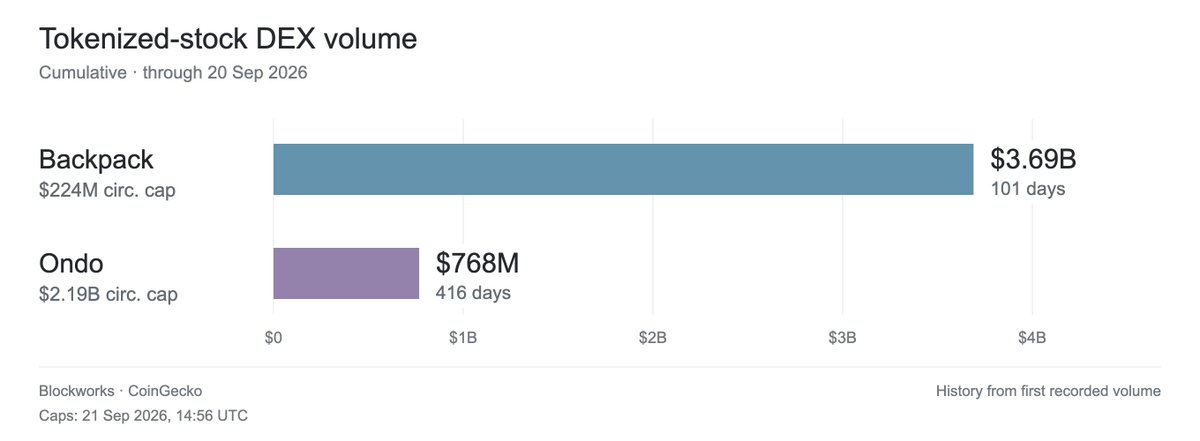
Backpack just took the lead in tokenized equity spot DEX volume across ALL chains.
27% of our tracked volume on Oct 25, ahead of Coinbase’s 25%.
Issuance models (@Backpack x @sunrise) and the underlying tech (@solana) still matter, and that is the fwd looking lens needed to see who wins this sector in the long run.
Mark Wetjen, president of @Backpack US, on the growing demand for tokenized securities: “There’s clearly appetite for trading these assets around the clock.”
Much of the trading in Backpack’s tokenized securities on @Solana is happening after U.S. markets close.
Our tokenomics is clear - no investor, shareholder, founder, employee, or team member has any token allocations. If you've actually spent 2 mins looking into into our tokenomics, you'd have realized that dumping on retail is impossible: https://t.co/rzPnzSLyj5
You're also confusing a buyback policy contingent on governance with a legally enforceable shareholder right. ~100% of fees going towards buybacks is great and we have a lot of respect for those models. On the other hand, if the underlying business starts getting licenses, patents or other value/assets, would you rather have 20% or 0% of the underlying business? These are fundamentally different products and business models.
You might like our model. You might not. We think it's genuinely novel--and certainly one of the most extreme tokenomics ever imposed onto a team. Users get tokens just by using the product. If you don't want to use the product and you don't like the token, don't buy it.
In the Backpack tokenomics, we have one guiding principle.
- Insiders "dumping on retail" should be impossible: no founder, executive, employee, or venture investor should receive wealth from the token until the product hits escape velocity.
Of course it begs the question, what does it mean to "hit escape velocity". Every project is different, and it's impossible to generalize. For Backpack, the answer is clear: we want to IPO in the USA. Going public might happen quickly, it might happen not so quickly, and in fact, it might not happen at all. In any case, we're going for it.
But before going public, we have to grow--a lot. The odd thing about Backpack's growth over the past year--and in fact one of the things that makes Backpack so different from basically every token project in crypto--is that, today, Backpack Exchange only serves about 48% of the world. We've been very slow, very intentional about opening up our product to the world, ensuring that we have every "i" dotted and ever "t" crossed as a regulated financial institution. Growth that sometimes feels like running with a parachute, but we are happy to take the long path, because it's precisely that parachute that will allow us to fly.
For those that don't know us, the reason for this is simple. Backpack is trying to not only build great crypto products, but we're also trying to build great TradFi products. We're trying to not only give our users access to every crypto asset, every blockchain, and every decentralized application, but we're also getting banking rails around the world, USD client money accounts in the USA, EUR in the EU, JPY in Japan--every currency on every major payment network you can imagine. We're trying to build a great securities product, whether that's getting access to your favorite stocks in a traditional brokerage or bidding on primary shares of a company about to go public on NASDAQ. We want to serve not only retail users worldwide, but we want to serve regulated products for regulated counterparties and regulated institutions around the world. All of this takes an enormous amount of time, effort, blood, sweat, and tears. We've been working on this for over three years at this point, laying an international foundation for the company and for the product slowly but surely, brick by brick. If we're lucky, we'll spend a lifetime.
What this all means is that, in the most literal sense--and I know this sounds silly--we're just getting started. We still have half the world to open up into. We still have some of our most exciting products to launch. And this leads to our next guiding principle in our tokenomics.
- Liquid tokens should exclusively go to users, fueling growth triggered by key product milestones.
Every time we open up a new region, every time we launch a new product, that's an opportunity to grow. Open up EU => grow. Open up Japan => grow. Open up the USA => grow. Open up predictions => grow. Open up stocks => grow. Open up card => grow. Like gasoline onto a fire, the token serves to continuously kickstart new markets in the same way points kickstarted Seasons 1-4.
With every growth lever we pull, tokens unlock in a predictable way to users, bringing in a new wave of token holders, growing the community, and allowing the product to soar to new heights. The objective constraint for this to work is precise: the value of added growth created by new token unlocks must always be greater than the dilution of those unlocks. As long as that condition holds, we can continue to unlock tokens direct to our most active users, growing along the way.
Last but not least is the question:
Ok so if all the liquid tokens are going to users, then what about the team? How exactly do you remain incentive aligned while ensuring the team cannot unlock, dump on retail, and become enormously wealthy without building something great?
And the answer is simple: not a single founder, executive, team member, or venture investor has been given a direct token allocation.
The entire "team allocation" sits in a "corporate treasury", i.e. on the balance sheet of the Backpack company--locked until at least one year post IPO. The team owns equity in the company, and the company owns a large percent of the token supply. It's not until the company goes public (or has some other type of equity exit event), that the team can earn any wealth from the project. It's not until the company has access to the largest, most liquid capital markets in the world by going public--and it's not until the company has done all the hard work to earn access to those markets--that the team can reap the rewards of the value created by the Backpack community from now until then.
We either go big, or we go home.
Friday stats on $PUSA are mind blowing:
- TradFi volume was ~$8m.
- Of that TradFi volume, 37.5% of it happened through @Backpack's brokerage.
- On @solana, volume eclipsed TradFi, totalling ~$12m through Backpack Securities assets.
The future of finance is here.
Backpack’s stock tokens may give holders a stronger claim to the shares behind them.
Holding a stock token does not always give investors the same rights as holding the stock through a broker. Many other stock tokens pay cash when holders redeem.
Backpack lets eligible holders redeem their tokens for a stock position in a Backpack brokerage account with the option to transfer those shares to another brokerage through ACATS and DTCC rails.
That position is a security entitlement, the same legal interest investors hold when they buy stock through a traditional broker.
Backpack’s token is a claim on an entity holding the shares, so the two carry different rights.
Redemption changes what the investor owns while preserving exposure to the stock.
Not sure if you've yet seen my interview with @armaniferrante but it's super interesting on the tokenizing of everything . Really enjoyed this
https://t.co/MtYbgmMB1S
Backpack, the Engine for Internet Capital Markets and Tokenization.
https://t.co/NYR8fytWVz
A thesis piece on how the United States is in the process of exporting its capital markets in the same way the dollar was tokenized with stablecoins and distributed over the Internet.