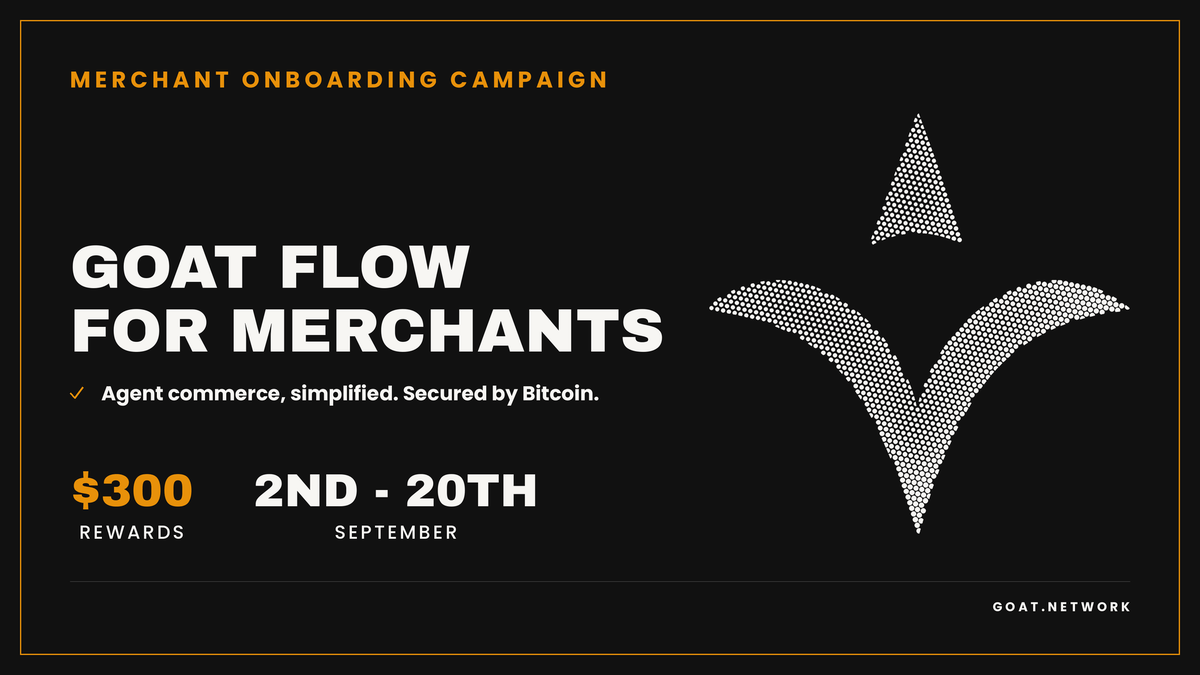
GOAT Flow is live. Now it's time to bring businesses in.
From the 2nd to the 20th of September, find a business that should be selling to agents and put GOAT Flow in front of them.
Pick a real business: a merchant, startup, creator, store, platform, or API provider. Post original content on X introducing them to GOAT Flow. Explain what it enables and how it fits their business, highlight the features that matter for them (Checkout, QuickPay, API Payments, card and crypto payments, x402), tag the business and @GOATNetwork, and include a link to https://t.co/yK6Im2fILj.
Up to 3 entries per person, each targeting a different business in a different content style, with only that one business tagged. The 5 best entries win $20 each, judged on quality, originality, relevance, and how well GOAT Flow is presented.
If a business you introduced goes on to integrate GOAT Flow, a $200 bounty is yours once the GOAT team confirms the integration. To qualify, the business must be a real, active operation with a genuine use case and a working integration. The GOAT team makes the final call.
Find a business. Introduce GOAT Flow. Bring them into the agent economy.
In addition to McKinsey's $5 trillion retail projection for 2030, @Gartner_inc forecasts $15 trillion in agent-intermediated B2B purchasing by 2028.
And every one of those transactions needs a merchant agents can find and pay.
Start selling to agents → https://t.co/hELMP8kNJ7
If your business isn't findable by agents, you're missing out on a projected $5 trillion category.
That's the top of @McKinsey's range for agentic commerce by 2030. Agents are already out shopping. They research, compare and pay on their owners' behalf, and they can only buy from merchants they can find.
GOAT Flow makes your business agent ready. No code and no agent expertise needed. Set up your checkout, drop it into the pages you already run, and agents can discover you and pay you, with every payment secured by Bitcoin.
Find more details here:
https://t.co/nJ5vbKZW7H
GOAT Research has published a full explainer of SHRINCS, the draft signature scheme proposed for Bitcoin's post-quantum migration.
SHRINCS was published as a BIP in August. It is built from hash-based cryptography older than Bitcoin, runs entirely on SHA-256, and asks the network to trust nothing it does not already trust. The open question is its statefulness: a SHRINCS key signs through a compact path that must track how many signatures it has produced, because reusing a slot makes forgeries possible, and when state is lost a stateless path takes over at a larger signature size. Compact signatures in exchange for new wallet complexity is the trade the proposal makes, and it is the substance of the discussion around it.
The explainer covers the mechanisms behind that trade: the two signing paths, the state rules, the signature budget, and how the August draft differs from the April specification.
https://t.co/EjYoCSEwM4
The first batch of BitVM3 Bug Bounty submissions is in. The response from the security community has been strong, with over 100 submissions so far.
The GOAT engineering team is in the final stages of reviewing every report from this batch. Exact numbers, the findings breakdown and award details for this first round will be published soon.
The bounty is still open. If you work in protocol security, smart contracts, cryptography or distributed systems, there is still time to challenge the system and be rewarded from the $5,000 pool.
Full details below.
https://t.co/MMrHRUYGut
Ziren is the proof system under the GOAT BitVM3 bridge, so this ties directly to our post-quantum map.
The memory check is Ziren's one remaining discrete-log dependency, and closing it gates our move off verifying a pairing on Bitcoin.
The post-quantum migration continues.
We are not only enabling businesses to use Bitcoin as a settlement layer, but also to connect to agent commerce without the usual difficulties that come with such an integration.
If you sell anything online, agents are about to become major customers. This is how you get ready.