Happy to share our latest work on Ziren @ProjectZKM@GOATNetwork. Feedback welcome!
A summary:
1. A new proof system based on Jaggled reduction and WHIR(including recursion proof over binary field and Blake3). Acknowledgements to SP1 team and Plonky3 contributors.
2. 4x proving efficiency, 10x emulation efficiency improvement over previous v1.2. Speedup is happening every day with AI assistant.
3. >100-bit proven security
4. A fully Lean 4 assisted constraint determinism proof, covering 104 chips.
5. A complete end-to-end zkVM design reference.
BitVM Node v0.4.0 is out.
• Handles Kickoff and Watchtower challenges, and settles confirmed disproofs on GOAT
• Proofs move to Ziren 2.0, with versioned program IDs
• Bug bounty fixes included
• 11 TLA+ models run in CI
→ https://t.co/dZ3Ehsse8R
🧵⬇
"We are changing the digital locks before the burglar shows up at the door." - @natalia_ameline
We asked four of the people behind the @MetisL2 Hybrid Rollup what it is, what it means for Metis, and what the hardest problem was to solve.
Now live on devnet.
Excited to share our latest work for Bitcoin PQ Bridge protocol.
The idea is very straightforward, in a classical BitVM protocol, we garble the STARK verifier into a Boolean circuit. The challenging is also very obvious, how to reduce the input labels' commitment on Bitcoin? it is over a thousand times BitVM3's Assert of about 2.4 kvB.
In our work, for an Ethereum block proved (actually for any programs) through four recursion levels, the final recursive WHIR-proof verifier has 175.4M non-free gates and 520,832 input bits, corresponding to 2.81 GB of garbled tables, and publishing that input with translated Winternitz keys takes 3.93 million virtual bytes (MvB), in 41 standard transactions.
This is the SOTA afaik.
Welcome to discussion:
> Discussion: https://t.co/FWSqWjSm57
> Code: https://t.co/oMcbu6PlUZ
The GOAT BitVM3 bridge is what will let activity on GOAT Network settle on Bitcoin, so it has to stay secure for as long as Bitcoin does.
In bridge designs today, a disputed withdrawal is settled by a proof that is first compressed with elliptic curves, and that step is the one a quantum computer would break.
This paper removes the step: the full hash-based proof from Ziren, the prover behind the bridge, is checked instead. A withdrawal nobody disputes publishes none of the extra data. A disputed one would put about four Bitcoin blocks of it onchain.
A bridge is only post-quantum once the signatures that authorize its Bitcoin transactions are replaced too, and that work sits outside this paper.
→ https://t.co/5Ab1z1i7h1
@wyatt_benno This is actually hard to be operational, no matter zkVM or TEE, it needs 3rd parties to audit the weights, neutrals, and optimizers , but model providers may need enough incentive or forces to do this. Would love to know your though about this
The Metis Hybrid Rollup is live on Devnet. ZK validity proofs verify execution on-chain, aiming to cut withdrawal delays.
Faster settlement is only part of it. The work also builds a post-quantum path for scaling Ethereum. https://t.co/oTBu1CGs1f
first i need to say the operator (who withdraw) can run the Ziren proof by itself.
you mention the challenge path, so it means there is a verifier to challenge the operator's withdrawal.
so when the proof fails to generate, probably the reasons are from the invalid L2 state transitions, or fork attack, then the operator can not respond the challenges, and will not withdraw successfully.
if its just delayed, its easy, they can use a shared proven state, and continue prove over that to the latest blocks (or at least include its withdrawal txn), it would be fast.
Our team has taken the hard path on every decision for many years.
Build a zkVM from scratch on MIPS. A working decentralized sequencer set. A truly trust-minimized Bitcoin bridge. Post-quantum security in progress across the stack. And now real-time proving on Ethereum.
Ziren is already the heart of GOAT Network, and work is now underway to bring it to Metis.
Excited to release Ziren v2.0!
Main updates:
1. Proof system upgraded to WHIR, > 100-bit proven security, compressed proof < 300KiB, and >4x speedup over Ziren v1.x
2. Chip constraint determinism formally verified by Lean 4
3. On @eth_proofs, RTP on Reth is launched, Geth keeper proving is ready to go
4. More use cases delivered internally!
FlashProve proves inference for a 400B model on a single H100, reaching up to 110 tokens/s.
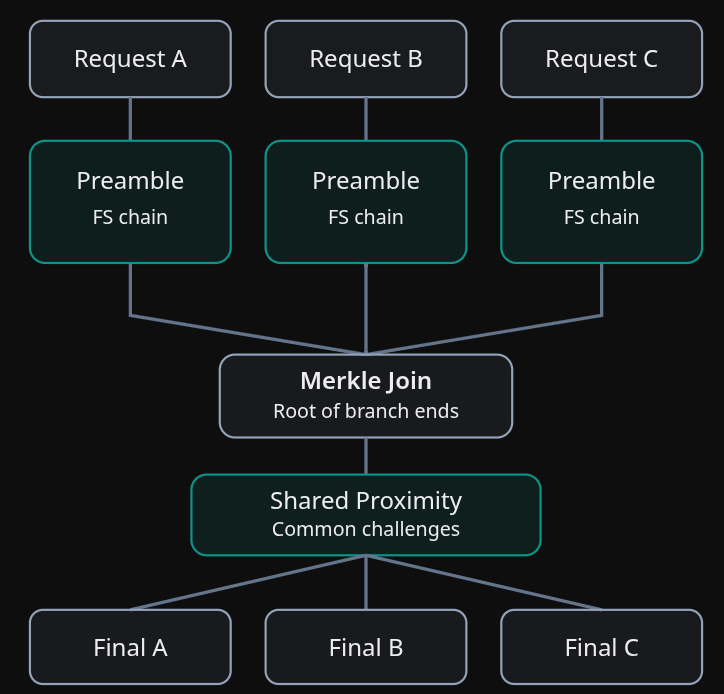
But the MOST interesting part to me is its DAG Fiat–Shamir construction.
It uses round-by-round soundness and a ROM security reduction to handle adaptive branch scheduling and shared challenges, with formal verification in Lean.
The real innovation may be in the soundness composition, not just the proving performance.
anthropic’s flashprove uses zkSNARKs, the proofs that scale Starknet, to prove a 400B-parameter model wrote a response without revealing its weights
~110 tokens/sec on one H100, 19 MB proofs that check in seconds on a cpu
verifiable AI is closer than we think.
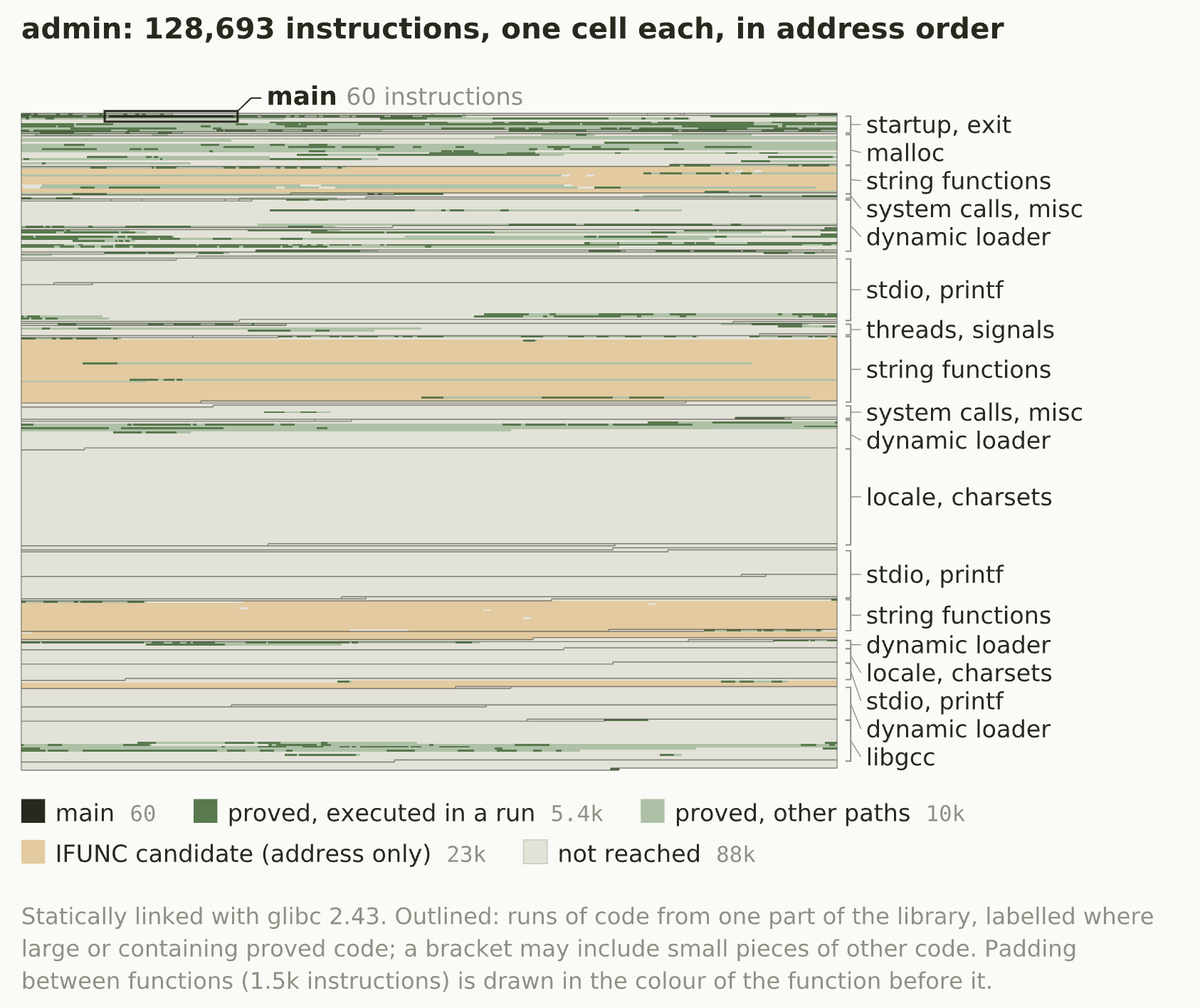
x86 formal verification is coming!
The (first?) published machine-checked proof of a security property for the end-to-end execution of a Linux process running an x86 binary statically linked against glibc.
And we believe it scales!
A joint research project with @zellic_io 🧵👇