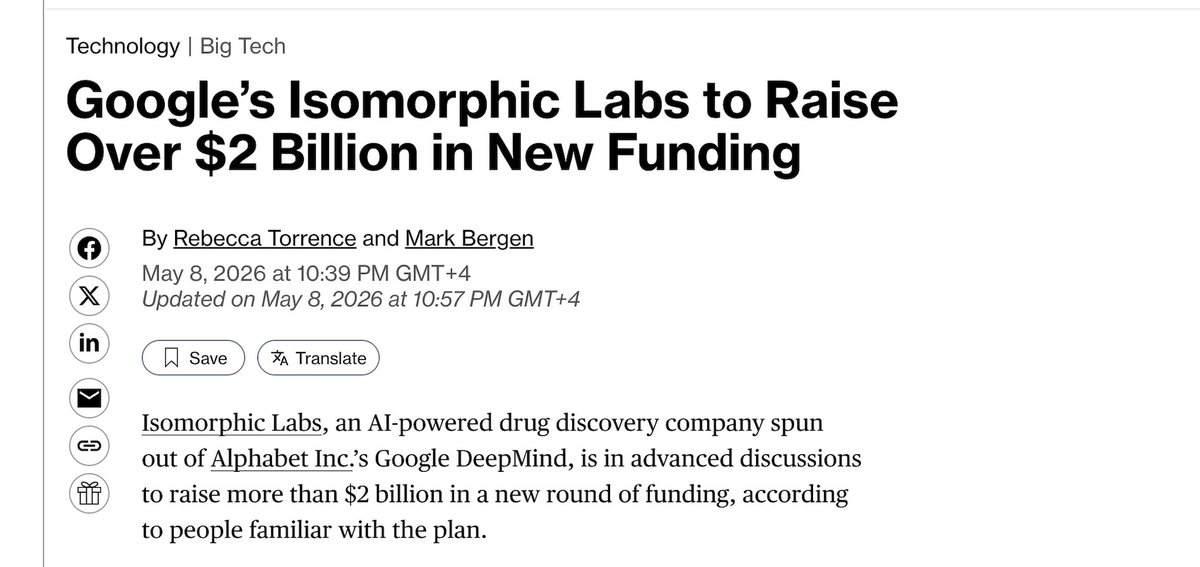
demis from deepmind → isomorphic, $2.7B
brian from coinbase → newlimit, $435M today.
the best builders go where the hard problems are and right now that’s biology.
Aging is arguably the root cause of most major diseases (loss of function in our cells). Four years ago, we made a bet that aging was treatable, and NewLimit was born.
NewLimit now has a prototype drug that reverses the age of some human cells (restores function they had when they were younger), and a clinical trial scheduled for next year (with more drug candidates in the pipeline).
Grateful to Founders Fund, Thrive, Greenoaks, and the rest of the investors for this latest round. @jacobkimmel and the team are just getting started.
great piece on biotech financial engineering.
we've gotten so good at financializing drug development that you can now bet on drugs that already work, drugs that might, and drugs that definitely won't.
every outcome is tradable. worth sitting with what that means.
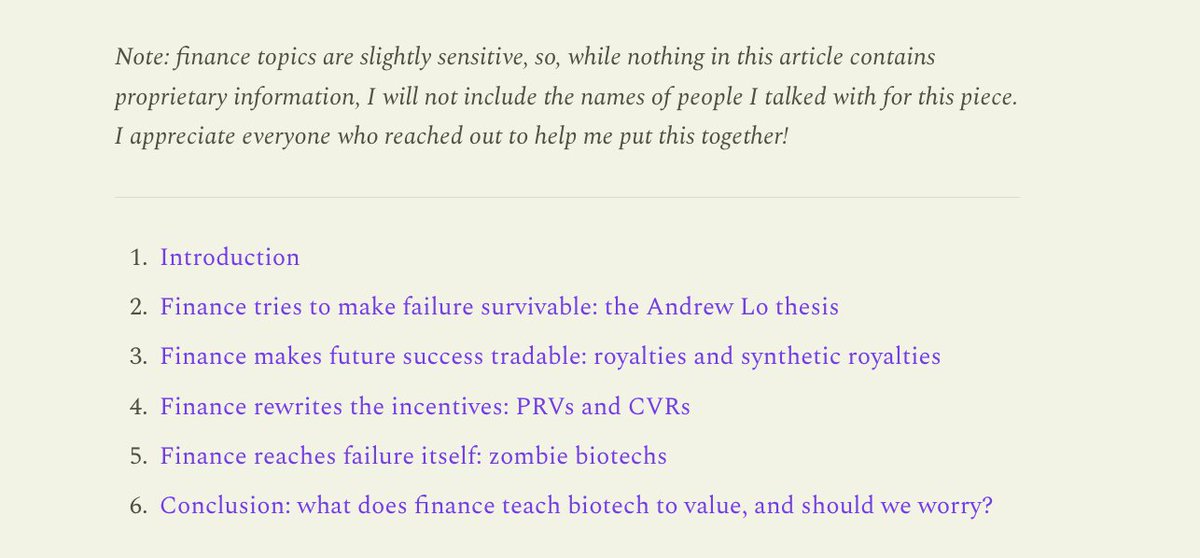
Curious cases of financial engineering in biotech
7k words, 32 minutes reading time
link: https://t.co/gmPe7Dn5H3
the inflation-adjusted cost of developing a new drug roughly doubles every nine years. this is obviously horrible, but at least its had one interesting consequence: financiers, faced with an industry this structurally broken, have had room to exercise a kind of radical creativity
the essay is about that creativity, which i'll loosely call 'financial engineering'. i walk through five examples, a case study for each, and why they're worth thinking about. at the end, i ask what the aggregate effect of all this creativity is, and whether it's worrying for what biotech decides to value in the upcoming years
for any undergrad, the highest-EV move of the next decade is picking a study path in one of these fields
fusion, biotech, neuro, robotics, space, BCI
high demand. low in supply.
i've never worked in a wet lab and i'm making bets on bio × ai. the ppl who've spent 20 years pipetting don't trust the models. we barely speak the same language. and somehow this handshake b/w two worlds that don't fully understand each other is where the next trillion dollar industry gets built. probably fine.
AI labs have largely solved comp sci and math reasoning bec it's easy to verify and operates v mechanically.
biology is different.
it's hard to generate a hypothesis AND hard to verify one.
so the next real frontier for AI is figuring out how to crack a domain where both the asking and the answering is hard.
@mtslive
Isomorphic Labs, which spun out of Google DeepMind in 2021 has raised $2.1B in in their second external funding round led by Thrive Capital.
@krinza: " In the next three years we might see all these big AI labs spinning their own bio arm."
"We are going from exploring, like okay, we know what protein looks like, this was the problem statement which AlphaFold worked on, to now thinking about that okay, now we can design molecule to manipulate those proteins that we know."
"Right now it's just compressing the drug discovery. In the next wave it might just compress the clinical trial design or synthetic biology."
in the next 3 years, every major AI lab will spin up its own bio arm and in-house wet labs.
biology is the next big bet in AI after code
pay attention.
I’ve always believed the No.1 application of AI should be to improve human health.
That work started with AlphaFold, and now at @IsomorphicLabs with the mission to reimagine drug discovery and one day solve all disease!
We are turbocharging that goal with $2.1B in new funding.
"do it" might be the most consequential two words in modern science. a century of biology, compressed into a month bec someone in the room had the conviction to just say go.
Mind-blowing moment from the DeepMind doc: Demis Hassabis gets told AlphaFold can predict all 1-2 billion known proteins in just a month.
He instantly says: “Do it.”
This is how history gets made