How do we scale biotech while safeguarding against biological risk?
We asked American Wetware CEO @p_maverick_b:
"As we get better at engineering biology, we should also get better at biosecurity."
"Better AI models like AlphaFold mean it's more predictive, 'I am pretty sure this protein binds the receptor I'm trying to drug.' That's a big step forward."
"As the models get better at reasoning and learning the why of what they're trying to do, that improved reasoning also helps biosecurity."
"A very smart AGI version of Claude that has a constitution where it's decided not to develop bioweapons should be able to be more active in screening people who are trying to do bad things."
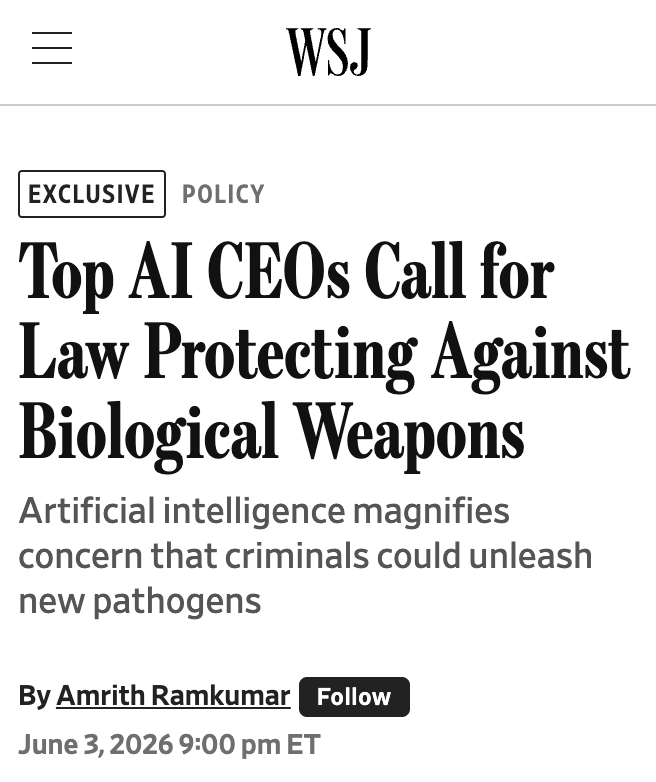
Sam Altman, Dario Amodei, Demis Hassabis and many others have signed a letter urging Congress to increase security on orders of synthetic nucleic acids - and the equipment needed to make them - as models continue to become increasingly bio-capable.
What's the right way to handle AI biosecurity?
We asked @MattBurtell of @A1Policy:
"The letter focuses on screening being the safeguard for the companies that synthesize DNA themselves, that just makes way more sense."
"We will just have advanced AI models in a couple of years where you can run it on your computer and it could coach you how to make dangerous things, this is a sort of inevitability."
"Frontier models already have that latent capability with safeguards on top, but the real solution isn't telling labs to behave."
"It's gonna be somewhere further down the stack, and that's exactly what the screening approach targets."
Sam Altman, Dario Amodei, Demis Hassabis and many others have signed a letter urging Congress to increase security on orders of synthetic nucleic acids - and the equipment needed to make them - as models continue to become increasingly bio-capable.
Why are Claude's models named Haiku, Sonnet, and Opus?
• Postscript was a café in Jackson Square, near Anthropic's original office
• Their coffee blends were named Haiku, Sonnet, Opus, and Requiem
• A requiem is a traditional Catholic mass for the dead
• The shop has since closed but you can still get the coffee online
@theojaffee: "Anthropic is, of course, kind of a millenarian organization but you don't wanna be so on the nose about it. So rather than Requiem, they decided to make their new model Mythos."
SITUATION BREWING: Airbnb CEO Brian Chesky is starting a new AI lab focused on user interaction and design, per Bloomberg. Chesky will remain CEO of Airbnb.
Is AI actually creating more jobs?
@MattBurtell of @A1Policy:
"AI revenues for OpenAI and Anthropic are just skyrocketing, and yet there's been a negligible impact on the labor market today. That's like a puzzle."
"Two or three years ago people would say if you had an AI that could do 90-100% of software engineering, this will have serious impacts on the software engineering labor market. That has just not so far come to pass."
"Jevons paradox is just super real, increased efficiency creates more demand, not less work."
"The labor market is a super dynamic system, your prediction about it, no matter what it is, is gonna be wrong."
We asked @OliviaHelenS from @IFP and Josh Wentzel from @JoinFAI about the future of biodefense.
"I think the future of biodefense is bright. Is it super catastrophic and imminent? I don't think so."
"Leading American companies are calling for, let's just raise the floor to what we're already doing and make it a standard."
"Small biotechs entering this space for the first time are having to figure it out on their own. 'We had to come up with our own bespoke training program because we care about national security, but it'd really be helpful if there was a federal basic guideline as a starting point.'"
SITUATION BREWING: Airbnb CEO Brian Chesky is starting a new AI lab focused on user interaction and design, per Bloomberg. Chesky will remain CEO of Airbnb.
We asked @OliviaHelenS from @IFP and Josh Wentzel from @JoinFAI how they got Sam, Dario, and Demis to sign the same open letter on DNA synthesis screening.
"I talked to a lot of folks on the Hill about screening orders of synthetic DNA, I always get this question: 'What does the industry think? What do the AI labs think?'"
"Everyone kind of agreed, so it seemed like a really good opportunity. 'I know all you guys agree, but you don't know each other agree with each other.' Now we can just point to this thing and say, 'Hey, you guys, I know you're on the same page.'"
"One of the things I hear when I bring up synthesis screening is, 'Oh, well, don't we already do that?' People are really shocked that this is not already a law, seems like pretty common sense national security legislation. It's super bipartisan."
No one should be able to order a bioweapon through the mail.
@IFP & @JoinFAI are proud to co-lead an open letter calling for mandatory DNA synthesis screening & recordkeeping.
Signatories include:
- Sam Altman, CEO & Co-Founder, OpenAI
- Dario Amodei, CEO & Co-Founder, Anthropic
- David Baker, Director, Institute for Protein Design; 2024 Nobel Prize in Chemistry recipient
- Patrick Collison, CEO & Co-Founder, Stripe
- Paul Graham, Founder, Y Combinator
- Demis Hassabis, CEO, Google DeepMind; 2024 Nobel Prize in Chemistry recipient
- Emily Leproust, CEO & Co-Founder, Twist Bioscience
- Lawrence Lessig, Roy L. Furman Professor of Law and Leadership, Harvard Law School
- Gerald W. Parker, former Special Assistant to the President for Biosecurity and Pandemic Response
- Mustafa Suleyman, CEO, Microsoft AI
- Alex Tabarrok, Professor of Economics, George Mason University
- Alexandr Wang, Chief AI Officer, Meta; Founder, Scale AI
- Christine E. Wormuth, President & CEO, Nuclear Threat Initiative; 25th Secretary of the Army
Read the letter and see the full list of signatories: https://t.co/BwZiJXw3JT
Many DNA synthesis companies voluntarily screen orders to mitigate biosecurity risks, but no law requires them to do so.
Leaders in AI, biotech, life sciences, national security, and the nucleic acid synthesis industry agree that Congress should act to strengthen safeguards against biological threats.
@deanwball put it well in the WSJ:
“If you’re synthesizing the stuff that yields biological life and viruses, we’re asking you to screen to see whether it is dangerous in some way. That seems like a reasonable thing for society to insist upon.”
SITUATION BREWING: Jane Street is exploring plans to build and finance its own data center, targeting 100 to 200 megawatts of additional capacity as part of a broader goal to increase compute by 10x, per Bloomberg.
Image generation is becoming serious enterprise infrastructure.
We asked @mo_norouzi, CEO of @Ideogram_ai, about the inflection point:
"Until last year it was all about beauty, entertainment, maybe a small business uses it for a landing page. But it's not possible to do on-brand imagery at the quality the best brands want."
"Now the quality is at the level that enterprise is super excited to use this."
"It's not about what's the best generic model, it's about what is the best model we can build for you, for your enterprise, for your use case."
"We're gonna have a lot of branded models. Creatives will build their own models, design becomes even more important than ever. Customization is the new frontier."
Introducing Ideogram 4.0: the best open image model in the world.
Think it. Make it. Own it.
Download the weights, fine-tune on your own data, and run it on your hardware. Live on every Ideogram plan and the API today.
What if we stopped calling them data centers?
@SamoBurja: "Consider why do we talk about data centers, not supercomputers?"
"A data center in my hometown that sounds like someone's gonna steal my data. I don't feel like I have any opportunities."
"A supercomputing center in my hometown? Suddenly I might have opportunities. I might have a job. Galaxy-brain stuff is happening there."
"These are not data centers anymore, these are actually distributed supercomputers."
"If the median use case is not the laptop on my desk or the phone in my hand, the chips can be pretty big. You might actually see the macro chip. I think people are underrating that future and not really expecting it."
SITUATION EXPLAINED: Anthropic just published data on how fast AI itself is accelerating AI development.
Here are the numbers:
• Claude's success rate on open-ended coding problems: 76%
• On a standard AI training speedup task: Opus 4 got 3X in May 2024. Mythos Preview got 52X this April
• More than 80% of code merged into Anthropic's codebase is now authored by Claude
@theojaffee: "They trust their own models probably more so than any other company."
"They write all of their own code with their models. Claude Code is vibe coded by Claude Code."
Our internal data shows Claude is accelerating AI development—a possible path to recursive self-improvement, or AI autonomously building a more capable successor.
It’s happening faster than we thought, and the implications deserve greater attention. https://t.co/OVVPJO7VQx
SITUATION DETECTED: OpenAI has launched a new memory system for ChatGPT called Dreaming, which automatically synthesizes and updates user context in the background across conversations without requiring explicit save requests.
Rolling out to Plus and Pro users in the US today.
SITUATION DETECTED: Anthropic has published new data on its progress toward recursive self-improvement.
Claude now authors more than 80% of Anthropic's production code and Claude Mythos Preview achieved a 52x speedup on an internal coding benchmark.