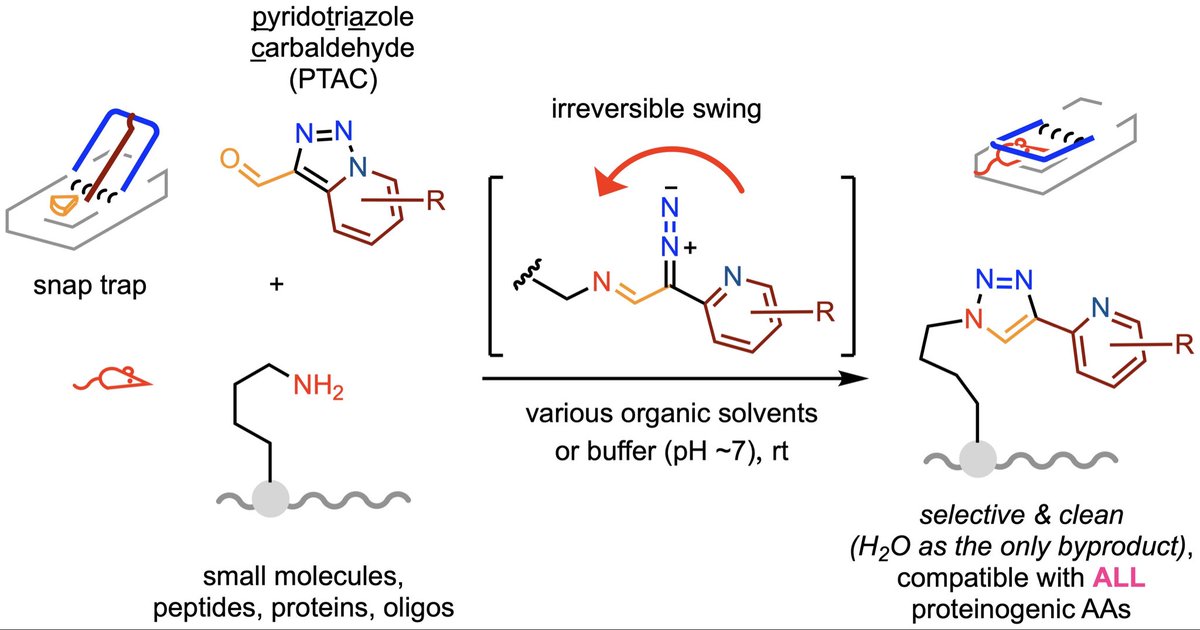
We turned a triazole ring into a molecular mousetrap—snapping up amino groups for bioconjugation! 🧠💥
Super reactive, highly selective, and thiol-tolerant.
Great teamwork with Huadong Xu (Changzhou University)!
Snap-Trapping Strategy for Amine-Specific Bioconjugation with Pyridotriazole Carbaldehydes | Journal of the American Chemical Society https://t.co/ZA9sYhmLv8
We’ve been dreaming of this type of conjugation chemistry for years—and finally, a simple fix to a stubborn problem, all thanks to just a tiny drop of CS₂. Minimalist chemistry is the new gold. ✨
@gongchenlab have been hunting for ways to crosslink two different amines for conjugation: turns out that just a drop of CS₂ in air delivers great results! Read on in their Research Article: • https://t.co/u8OqVKjDCC
A huge thank you to our amazing guest editors, Masayuki Inoue, Lara Malins @Malins_lab, and Hans Renata @hanzyduzit, for organizing this OL special issue on radical-mediated reactions! Special thanks to Steve Ritter and Matt Saucier for your invaluable support.
Special Issue alert! 🚨 This one is truly •radical•
https://t.co/1brknWrgqF
This VSI highlights the state of the art in radical reaction development and the strategic incorporation of radical reactions in the construction and modification of important molecules.
Interested in sulfonium ylide chemistry? Don’t miss Biao Xiong's latest Organic Letters paper @JOC_OL on a sleek Cu-catalyzed [3+2] route to 5-CF3-pyrroles, starting from CF3-imidoyl sulfonium ylides and terminal alkynes.
Peptide Stapling by Crosslinking Two Amines with alpha-Ketoaldehydes through Diverse Modified Glyoxal-Lysine Dimer Linkers (Gong Chen and co-workers) @NKU1919 https://t.co/rTEzAWEw9F
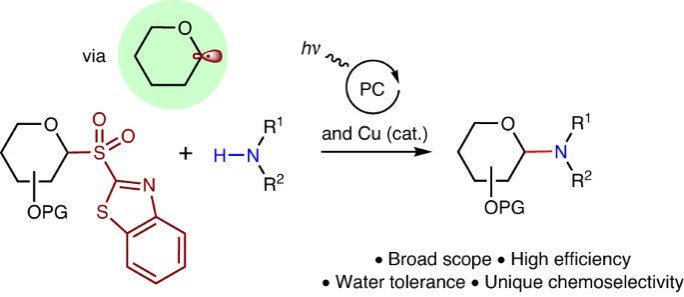
N-glycoside synthesis, a tough nut to crack, is now approachable with our new light/Cu catalysis method, allowing N-glycosidic bond formation under mild conditions with exceptional water tolerance and unique chemoselectivity. Another fruitful collaboration with MJ Koh @MJKoh87.
N-glycoside synthesis, a tough nut to crack, is now approachable with our new light/Cu catalysis method, allowing N-glycosidic bond formation under mild conditions with exceptional water tolerance and unique chemoselectivity. Another fruitful collaboration with MJ Koh @MJKoh87.
Now online:
Article by @MJKoh87@GongChenLab and co-workers @NKU1919@ChemNUS
N-glycoside synthesis through combined copper- and photoredox-catalysed N-glycosylation of N-nucleophiles
https://t.co/93Xl4Pwm1P ($)
Two simple reagents, HCHO and hexafluoroisopropanol (HFIP), unleash new chemical magic! HCHO effectively “sucks” the alpha C-H bond from common alkyl amines in HFIP solvent, enabling hydride liberation without metals or light. It works for complex systems, too.
Formaldehyde-Mediated Hydride Liberation of Alkylamines for Intermolecular Reactions in Hexafluoroisopropanol
@J_A_C_S#Chemistry#Chemed#Science
https://t.co/EIjQf9WmvF
I am deeply humbled and honored to be part of the editor team of Organic Letters. I very much look forward to serving the journal and our organic community☺️
We are thrilled to announce that Prof. Gong Chen of Nankai University will be joining #OrgLett as an Associate Editor on December 1. Known for his work on metal-catalyzed C-H functionalization and on peptides and oligosaccharides, Gong may soon be handling your manuscript!
Our lucky streak continued! Formaldehyde can glue amine and guanidine together like a charm :) Thank Xiaosong Xue at Nankai and SIOC for the computational collaboration! https://t.co/T7mGFvZMFN