Hepach & Daniel synthesize recent research on the development of altruism in children: it rests on intrinsic, extrinsic, and strategic motivations for (costly) prosocial behaviour building on one another through externalisation and recalibration:
https://t.co/sycGu4oDf1
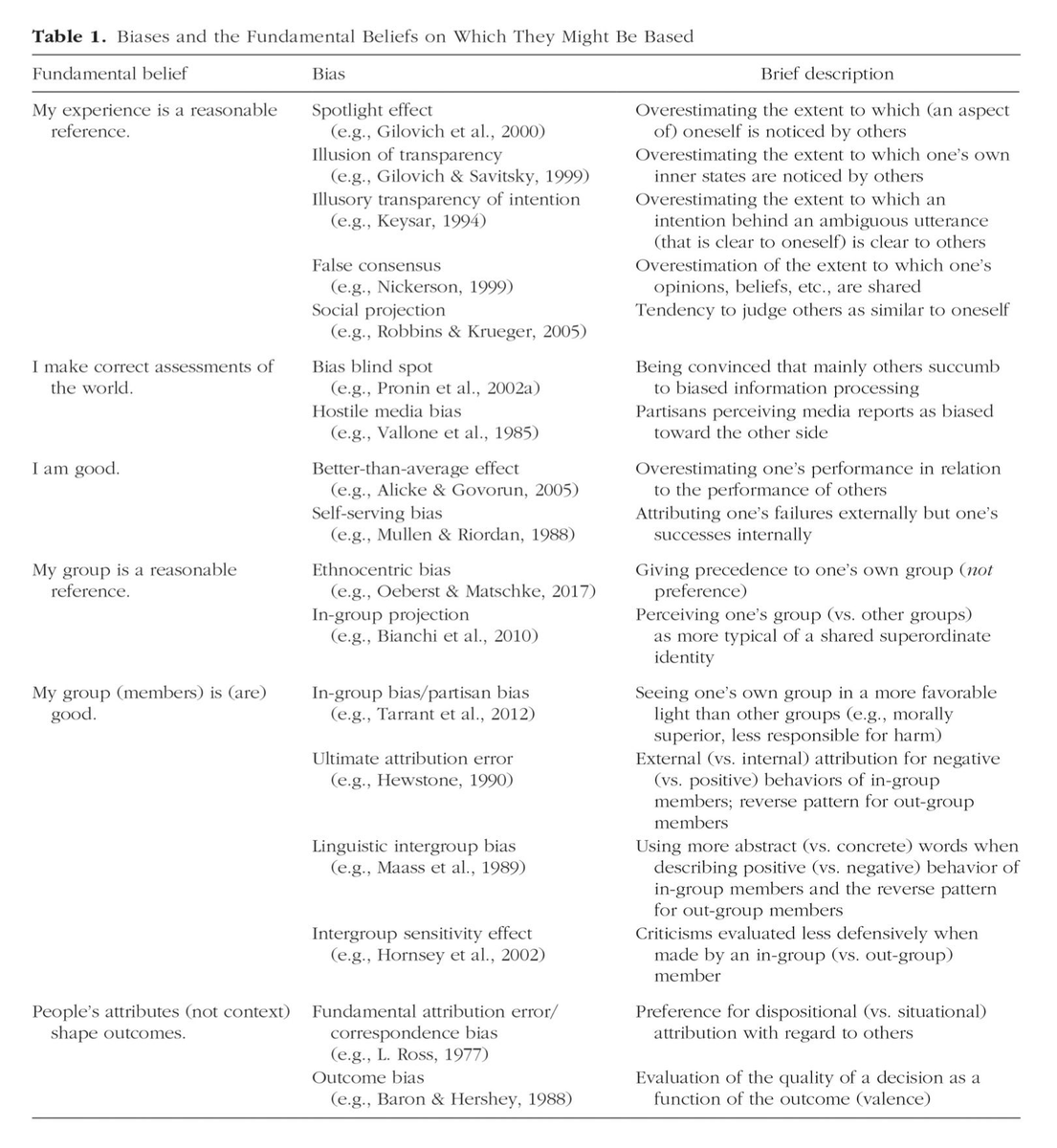
Psychologists have posited hundreds of cognitive biases over the years. A fascinating new paper argues that they all boil down to one of a handful of fundamental beliefs coupled with confirmation bias.
https://t.co/uZTVbGnH3d
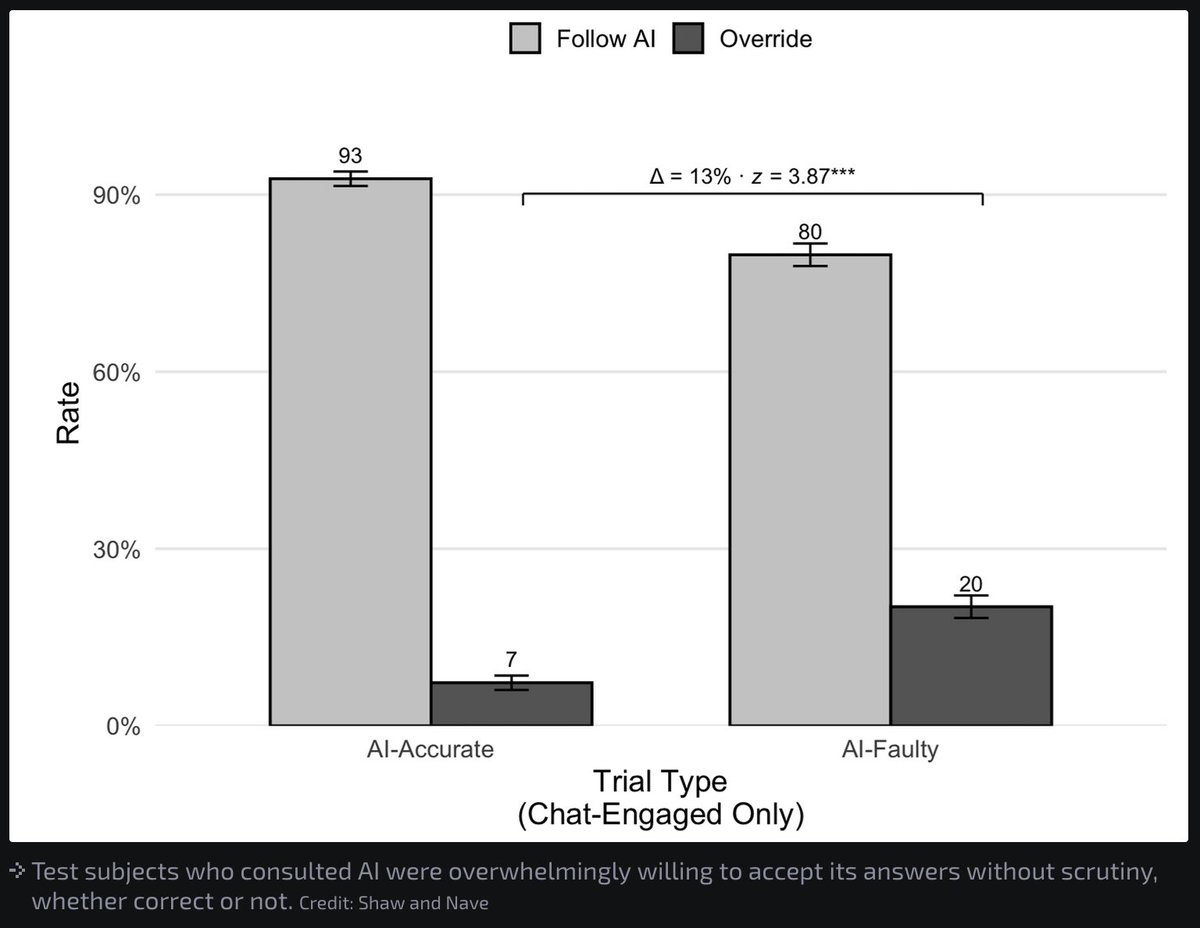
🦔Researchers at the University of Pennsylvania studied what they call cognitive surrender, the tendency to accept AI outputs without critical evaluation. Across 1,372 participants and over 9,500 trials, subjects accepted faulty AI reasoning 73.2% of the time and only overruled it 19.7% of the time. When the AI was wrong, users still accepted its answer 80% of the time. Subjects who used AI scored 11.7% higher on confidence in their answers despite the AI being wrong half the time. Adding time pressure made people 12 percentage points less likely to catch AI errors. Adding financial incentives and immediate feedback made them 19 points more likely to catch them.
My Take
The time pressure finding matters enormously for how AI is actually being deployed in workplaces. Companies are using AI to justify faster turnaround times, which means employees are using it under exactly the conditions that make them least likely to catch mistakes. When you're rushed, your internal monitor for detecting errors essentially stops firing, so you get AI output, no time to review it, high confidence it's correct, and a meaningful chance it's wrong.
People using a system that was wrong half the time still felt more confident in their answers than people who weren't using AI at all. That is a system actively making people worse at knowing what they don't know, which is one of the most dangerous things you can do to human judgment at scale. The companies pushing AI hardest into employee workflows should be reading this research carefully.
Hedgie🤗
Link to research for those interested: https://t.co/0iZz42132M
“Correlation does *not* imply causation” is not the last word—it’s only the beginning.
@cesarchavezp29 tracks how modern economics has been approaching causality (and the causality fallacy… and its reverse):
https://t.co/D1vfzK8YzT
@SpencrGreenberg When you watch a magician, you enter a tacit agreement to be amused by being deceived. Therefore, even though the magician lies about it being psychological, any form of magic is a lie. Not unethical, as you agree to it.
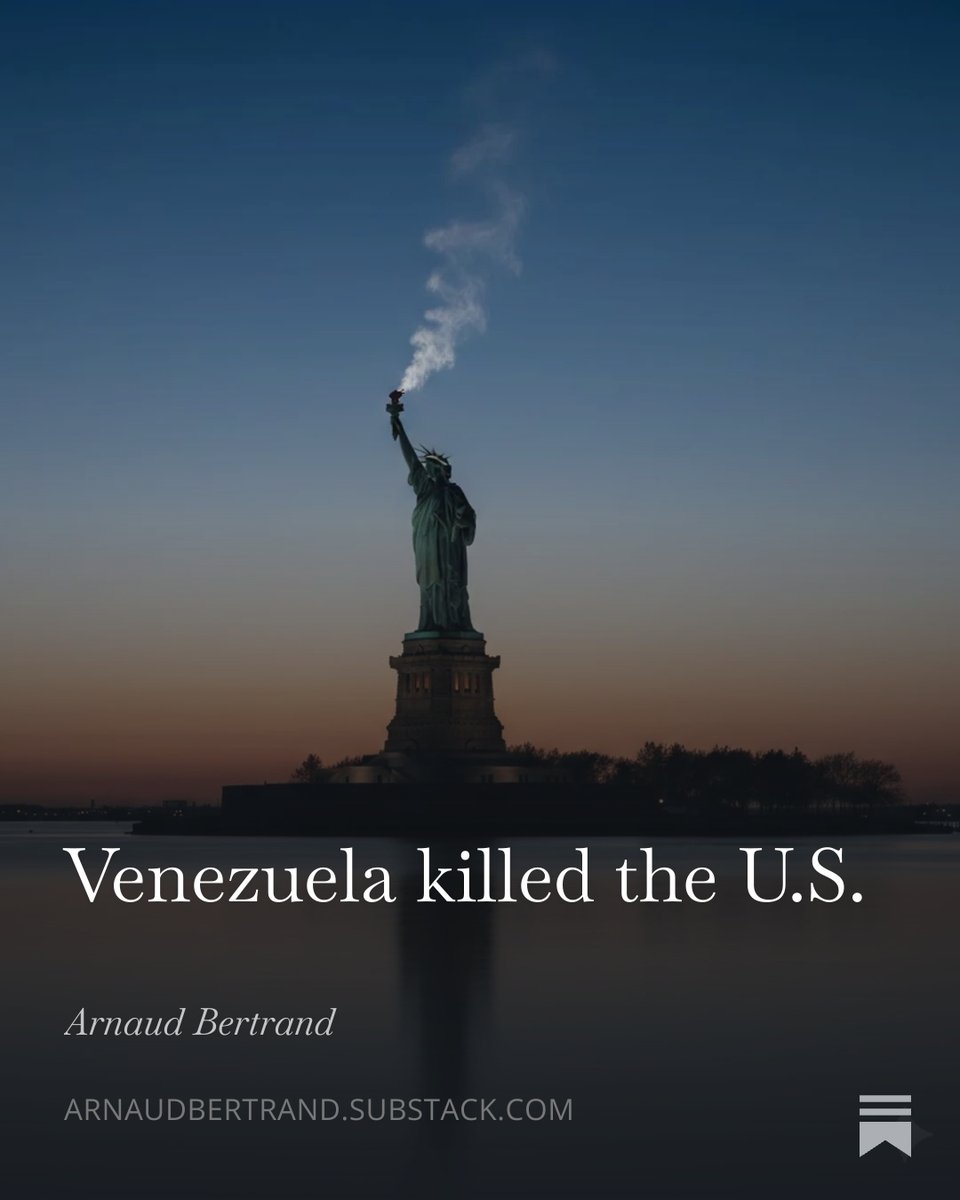
Venezuela killed the US. Or rather, it revealed it was already dead.
In the history of the US’s relation with Latin America, what just happened in Venezuela is hardly unique: the U.S. government has intervened to change governments in Latin America a total of 41 times (https://t.co/3CDBc7fbez).
What is unprecedented however is the brazenness, the unabashedly predatory nature of the intervention.
Trump is not pretending this is about anything else than resource extraction. He explicitly stated "we're going to be taking out a tremendous amount of wealth out of the ground" and that this wealth would “go to the United States of America in the form of reimbursement for the damages caused us by that country." (https://t.co/5ZVibGjEBd).
Stunningly, the US isn’t even insisting on regime change. They’re quite happy for the Chavista government to stay in place under acting president Delcy Rodríguez as long as she “does what we want,” (said Trump: https://t.co/Mm8rSftT1f), vowing to bomb the country again if she didn’t.
In other words, there is absolutely zero pretense there: submission to the U.S.’s will is the only variable that matters.
Never before in its entire history has the U.S. been so nakedly… bad.
This might sound almost trivial. “So what if they admit they’re bad, at least they’re not hypocritical about it anymore,” you might tell yourself. Some might even find that refreshing in its honesty.
Quite the contrary. The story a nation tells itself is not trivial - it is everything.
We, human beings, for better or worse, are structured by mythology and self-deception.
Think about yourself, what drives your own behavior? You have, doubtlessly, ideals you want to live up to. If you have kids you have ideals of what a good parent ought to be. If you have a spouse you have ideals of what fidelity and partnership mean. If you have a job you have some conception of integrity.
You probably fall short - we all do - but the ideals still structure your behavior. They give you something to reach for, they provide the terms in which you can be criticized - including by your own internal dialogue. They make it possible for you to do better tomorrow.
The hypocrisy - the gap between ideal and reality - is not the problem. It's the proof that the ideal still has a hold on you, that you can still be called back to it. As the saying goes, hypocrisy is the tribute vice pays to virtue.
Now imagine you renounce all this. Imagine you stop being a hypocrite in the sense that you abandon your ideals entirely, that you start owning up to your worst self and become comfortable with your vices. You cheat on your spouse and stop pretending it bothers you. You neglect your children and make peace with it.
Have you thus become “refreshingly honest”? Maybe. But you’ve also died inside. You’ve become something deeply broken - beyond shame, beyond appeal. You’ve lost the internal architecture that makes moral life possible. The little light that said “this is not who I want to be” is extinguished.
That is what the United States just did.
The consequences of this are, frankly, terrifying. What happens when a nation stops telling itself it should be good? This is precisely what I try to answer in my latest article: https://t.co/KNoPdy028H
Can we predict the past? 🔮
New open-access paper in American Historical Review proposes 'Retrodiction'—using gaps in the archival record to test historical theories.
Interdisciplinary collab feat. David Gill, Marc Trachtenberg, @PTetlock@cendripetalfrce, and more 🧵👇
No matter who you are, you probably don't know enough about group dynamics! Watch this superb conversation with @ColinMFisher to learn the basics. Author Talks: Getting group dynamics right https://t.co/wQEXxLMXZv via @McKinsey#groups#teams
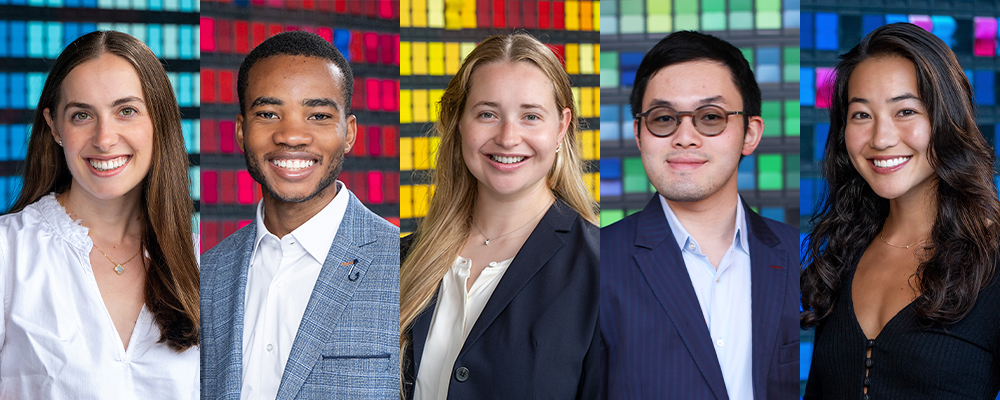
The Siebel Scholars program honors top students from leading graduate schools in business, computer science, bioengineering, and energy science. Meet five second-year Stanford MBAs recognized for their achievements and commitment to shaping the future. https://t.co/VUKSS8RwDI