I’m joining @monogram_ai as Head of Content and Comms to bring the best personal AI app to the world.
There are some obvious problems with AI right now: Most tools cater to power users, churn out walls of text, are only accessible through a chat, lack clear rules around privacy and data use, and require extensive setup for customization.
Monogram is AI for the rest of us.
It’s for the busy people just trying to spend more time with family and friends.
It’s for everyone juggling work and life, who just want AI to work for them.
For the past 5 years, I’ve been reporting on emerging tech. Now, I want to help build it.
Check out Monogram free on iOS and let me know what you think!
We’re bringing more financial opportunities to businesses traditionally underserved by treasury providers.
Very excited to be partnering with @ground_onchain, @tempo, @hastrafi, and @figure to get this new tokenized private credit vault on for our Reah customers.
Every time someone requests a wet signature in crypto, I think, “What are we even doing here?” It seems like someone is taunting me, saying that my last 10 years of work were for nothing.
We're bringing tokenized private credit to Reah Treasury with PRIME by @HastraFi.
Built with @ground_onchain on @tempo, the vault gives eligible Reah customers exposure to US real estate-backed lending via the Prime marketplace from @Figure.
Learn more: https://t.co/PT49rntke3
Adding a tokenized product usually means a fund relationship, onboarding, vault setup, and new operations.
For @ReahPlatform, adding PRIME from @HastraFi took one simple integration: the Ground API.
We run the vault on @tempo, and adding the next source that Reah's users want is even easier than the first.
We're bringing tokenized private credit to Reah Treasury with PRIME by @HastraFi.
Built with @ground_onchain on @tempo, the vault gives eligible Reah customers exposure to US real estate-backed lending via the Prime marketplace from @Figure.
Learn more: https://t.co/PT49rntke3
Ground designs on the assumption that an attacker is already inside, then works out what that access still can't touch.
Our security team has spent the past several months on that same question with Ground, and their open-source mapping tool is worth running on your own stack.
.@ground_onchain has built a cash management platform for stablecoins on zero trust architecture.
Turnkey’s policy engine defines what Ground can execute for clients, enforced outside its own server, keeping funds safe even if its server is compromised.
Secured by Turnkey.
When it comes to infiltration, the North Koreans are persistent geniuses.
Our industry puts enormous effort into preventing breaches, but we should be equally demanding about what a successful breach permits. Here's how we approach that at Ground. https://t.co/Bzkyd6j6QC
It’s been non-stop in the 72 hours since Election Day, and the work continues at @BlockchainAssn.
We now have dozens of members stepping up in our Vaults Workstream to tackle how agencies should regulate this next wave.
More to come as we head toward the #BAPolicySummit. DM @SophiaCookDC@lindsayfraser0 or @JackSolowey for details.
@milesjennings Thank you for this. I don’t think they are as much at odds as they are advertised to be. In a lot of ways, the latest letter would work better for Morpho’s model than others.
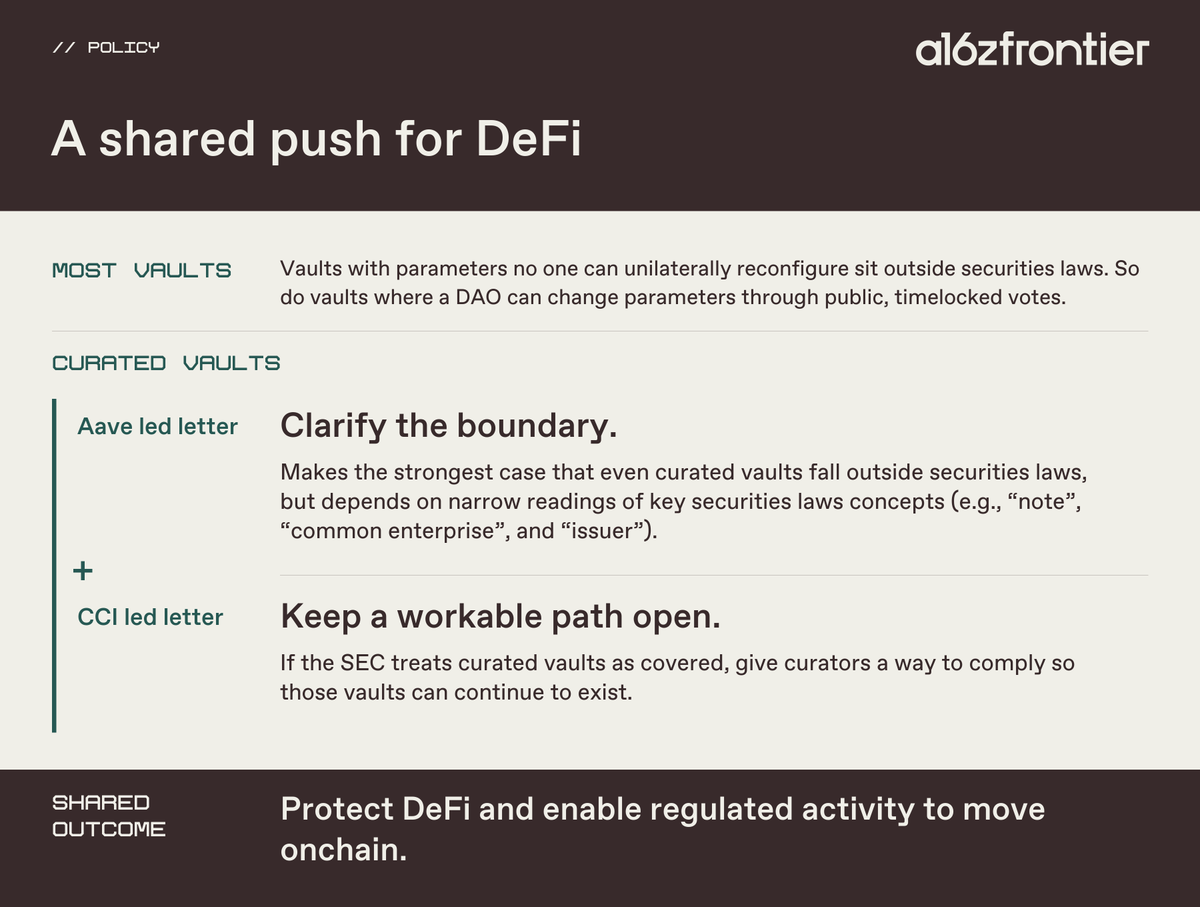
Everyone agrees about the vaults that hold most of DeFi’s capital.
If a user supplies assets to a lending protocol with parameters that no one can unilaterally reconfigure, the securities laws aren’t triggered—the user didn’t buy a security, the protocol isn’t an investment company, no one is an adviser, no one is a custodian.
Control is what matters.
The same applies to vaults where a DAO can change parameters through public, timelocked votes. DAO governance that sets rates and collateral parameters is market administration, not managing anyone’s money.
In July, then-Commissioner Peirce asked the people “setting interest rates, deciding which assets to accommodate, setting loan-to-value limits, and establishing liquidation thresholds” to think about whether the securities laws are implicated.
A group led by CCI and a group led by Aave recently submitted compelling answers to that call—securities laws do not reach the vaults that hold most of DeFi’s capital, and the SEC should confirm that this activity sits outside their scope.
But vaults come in many forms, and when you add complexity, the legal arguments get more complex.
Where a vault has a single curator with unbounded discretion over how the vault’s assets are deployed, the argument that it falls outside the securities laws is much more tenuous, because one cannot credibly argue that such a vault is truly autonomous.
Aave’s letter makes the strongest form of the argument that even curated vaults fall outside. But that argument depends on the SEC reading “note” to require a person who promises repayment, “common enterprise” to require a venture that investors finance rather than assets they co-own, and “issuer” to require an entity that owns the vault’s assets. Those are good arguments, but they're not conclusive. The letter also concedes that curators may be subject to the Investment Advisers Act, but does not say how they would comply.
CCI’s letter addresses what happens if the SEC does interpret securities laws to apply to some subset of curated vaults. In that world, curated vaults should still exist! The passages being quoted as “concessions” are CCI stating the adverse facts before the SEC does, which is how the baseline argument keeps its credibility, and it is what lets CCI then argue for a way for curators to comply under authority the SEC already has to tailor compliance.
Ultimately, the two letters work well together.
Both safeguard a broad vision of DeFi, both open the door for regulated financial activity—like investment fund management—to move onchain, and both provide the SEC with a lot to consider, based on how different types of vaults actually work.
*Disclosure: a16z is a member of CCI and commented on drafts of its paper.
Ground now supports Tempo in its Portfolio Wallets, so apps on Tempo can give their users access to Ground's yield catalogue via one API.
Businesses can also access a @ground_onchain product via Tempo Earn using their stablecoin balances on Tempo. Learn more: