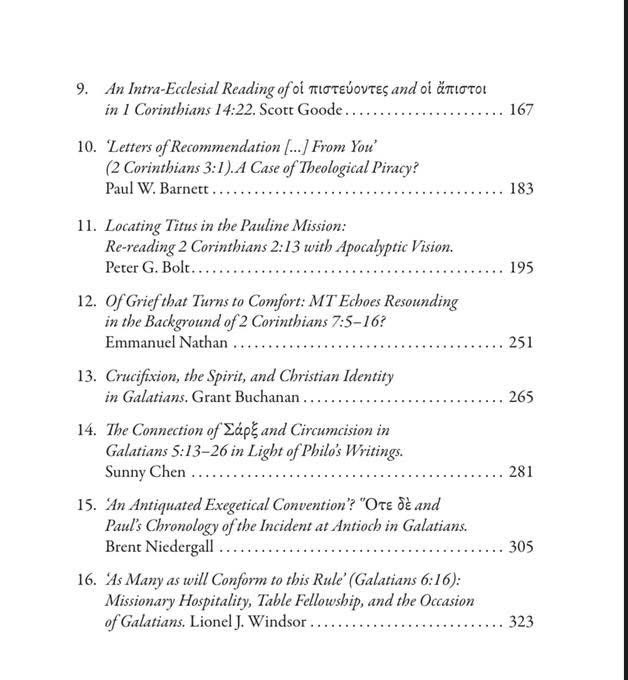
The @wipfandstock team have provided a fantastic cover and I couldn't be happier with the endorsements from some of my favourite New Testament scholars. Next stop is the printing press.
@MurrayJCampbell Although biblical scholars, quite apart from the gender debate, hold views along a spectrum on this. So, some who may identify as complementarian, argue that it's likely she read and explained Paul's words to those gathered. So, Burk's either/or and hoax rhetoric is overstated.
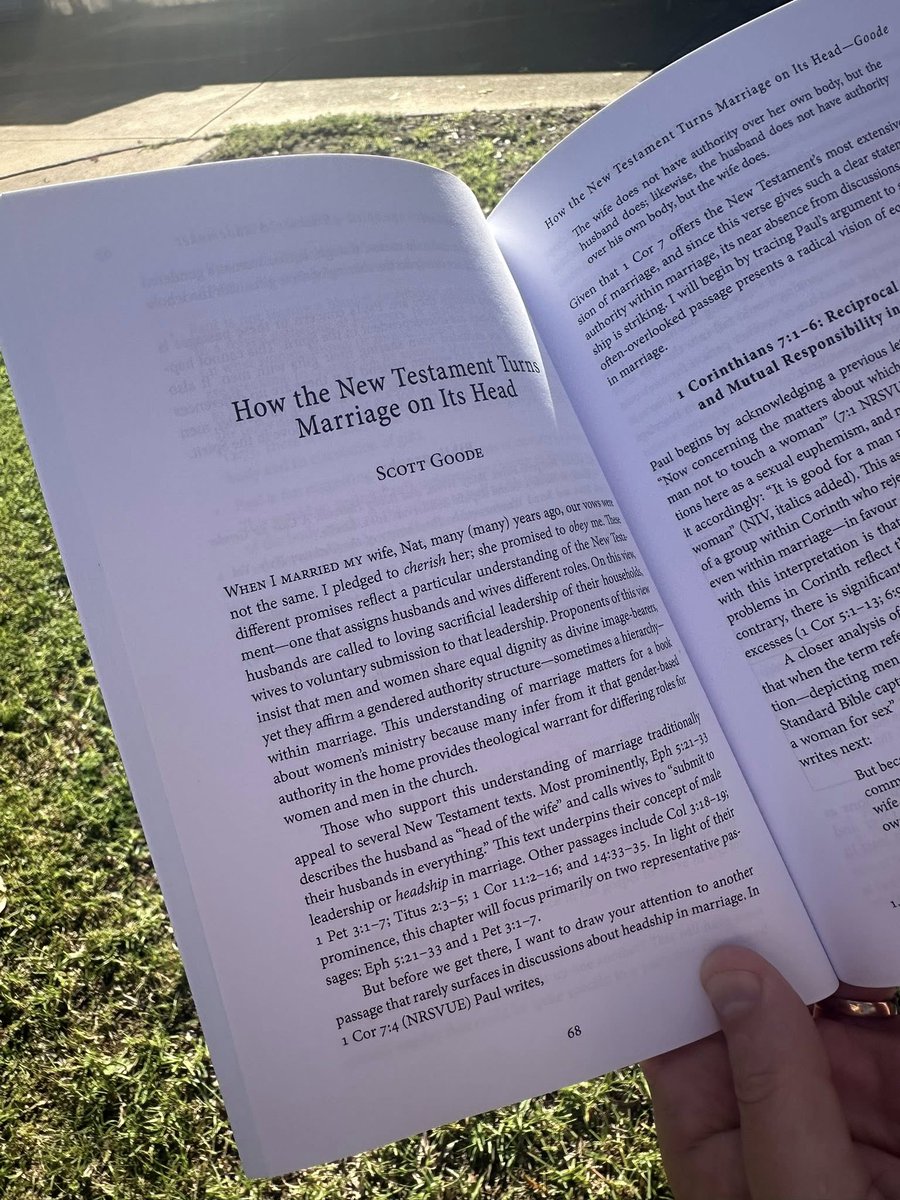
New edited volume now available to which I contributed a chapter: How the New Testament Turns Marriage on Its Head. I start with 1 Cor 7:1–5, where Paul asserts the symmetrical and shared authority that spouses have over one another. https://t.co/PITyrv88PH
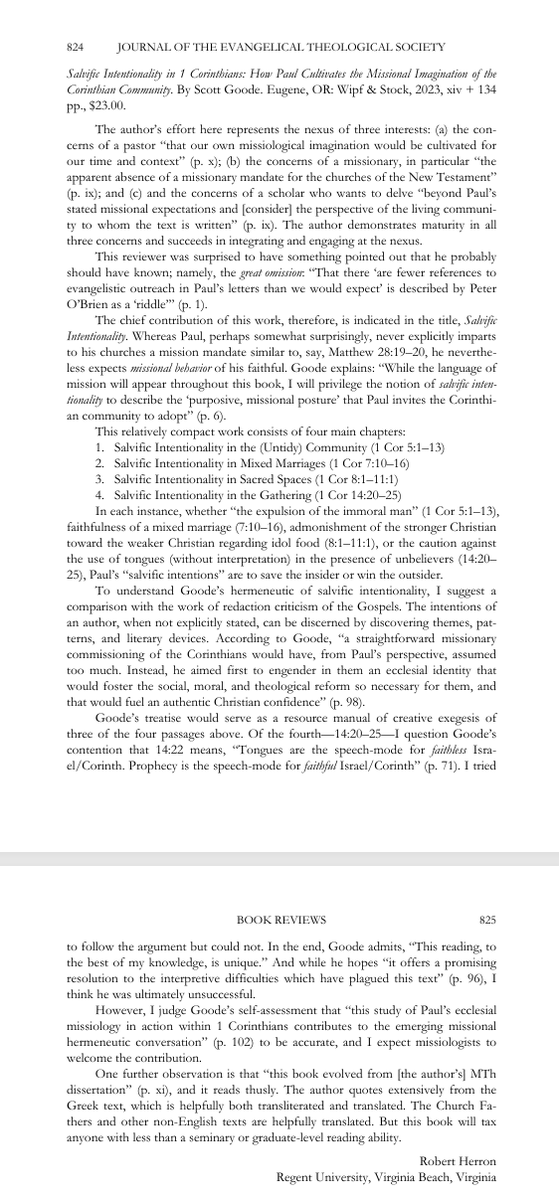
Having quite accidently come across this review of "Salvific Intentionality in 1 Corinthians" in JETS (68.4, 2025), I thoroughly appreciated the reviewer's thoughtful engagement with the book. I may, however, need to keep working on my explanation of 1 Cor 14:22. 😉
@danitreweek I think the third (latest) edition of “Discovering Biblical Equality” is supposed to present the best and up to date from various methodologies.
I just picked up Gregg Allison’s “complementarity” which is fairly descriptive of the debate.
Terran Williams might be worth a look.
This was one of the best discussions I have come across in its generosity, clarity, and nuance in discussing Egalitarian and Complementarian approaches to particular ministry roles.
A sneak peek into my doctoral research on Paul's marriage theology: why exploring the New Testament marriage texts could offer fresh insights into the evangelical gender debate.
https://t.co/GROzCDSFS6
@kamalweerakoon@TGC Yes, I was recently at Laodicea where quite a sizeable church complete with a baptistry has been unearthed and dated to the early fourth century. That indicates real momentum prior to Constantine.
"The first phase was that as a historian I realised no society had been successfully organised on the basis of atheism. All attempts to do that have been catastrophic. That was an insight that came from studying 18th, 19th and 20th-century history." 5/17
Pauline marital theology is under-represented in the literature re the “order” of gendered relations. Super pleased to be starting as a PhD candidate with this proposed title:
One Flesh: A Literary and Socio-Rhetorical Study of the Pauline (and Deutero-Pauline) Marriage Texts.
“Evangelism is only possible when the community that evangelises—the church—is a radiant manifestation of the Christian faith and exhibits an attractive lifestyle.” — David Bosch
From my perspective, both Eastern Orthodox and Roman Catholic theologies tend to collapse ontological and ethical categories—the East in a preference for good creation overwhelming sin, while the West tilted toward confusing sin with creation.
It seems to me that the Pauline line of thought in particular presses us to distinguish ontological and ethical categories without either setting them in opposition or allowing one side to swallow the other whole.
To be sure, God made the world and pronounced it good. Nothing evil can be attributed to nature as nature. And yet, Western theology is correct to recognize that sin has become an inherited part of human existence.
By clearly distinguishing the ontological goodness of nature from the ethical depravity that makes the attainment of salvation impossible even for the most morally committed, one is able to uphold the integrity of creation and its consummation on one hand while doing justice to the imputation of guilt that leads to death on the other. In this way, both a subtle form of Manichaeism on one hand and a subtle form of Semi-Pelagianism on the other can be avoided.
@PrestonSprinkle This argument is not usually a feature one but rather a supporting one. But have you read Dorothy Lee, The Ministry of Women in NT (Baker, 2021)? The Counterpoint Two view would have something too.