Biosecurity is one of the most urgent challenges for the AI era. Bringing SynthID to biology so AI-generated proteins can be watermarked is a critical step - and we’re open sourcing SynthID Bio tools so the research community can build on this work. Published in @Nature today, congrats to the team! https://t.co/Y4sv8bnGQY
The global biosecurity landscape is rapidly evolving. On July 16, Google DeepMind & Isomorphic Labs shared how they are approaching bioresilience, including work to prevent misuse, detect new outbreaks and accelerate the design of countermeasures.
➡️ https://t.co/WeHIEA4m7S
Getting access to quality healthcare often depends on where you live and whether a specialist is available nearby. In busy city hospitals and remote village clinics around the world, healthcare workers face challenges in treating a high volume of patients with limited specialized help. To help address these challenges, we developed MedGemma, a collection of open-weight AI models designed to understand medical text and images. Built on our Gemma models, MedGemma provides developers, researchers, and public health organizations with an adaptable foundation to build specialized tools to support triage, diagnostic screenings, and more. Since its release, MedGemma has been downloaded more than 10 million times worldwide.
Published in Nature Medicine: @Google researchers and collaborators share lessons from prospective studies of AMIE, highlighting why real-world clinical evidence is critical to evaluating conversational AI in health.
Read more: https://t.co/vAKMGHioXM
Today, we're introducing AlphaGenome Atlas, a database that predicts the effects of every possible single nucleotide variant in the human genome.
Learn more ⬇️ https://t.co/tmL9aROWHa
Intended as starting points for developers to evaluate and adapt to their medical use cases, our open MedGemma models support potential applications spanning medical imaging, document understanding and text. Learn more: https://t.co/t6IzsxIs3E
Introducing the planetary prediction engine (PPE), an experimental research capability within Google Earth AI.
From tracking real-time public health disease outbreaks to forecasting regional food security, PPE matched or improved performance across geospatial prediction tasks.
Gemma, @Google’s family of open models, has surpassed 1 billion downloads. In health, developers & researchers are using Gemma to build solutions for managing health data and pioneer breakthroughs in medical research.
See the impact in health & beyond ➡️ https://t.co/ZRTHjQzWEF
Backed by rigorous clinical research, Health Guardian features track subtle physiological shifts and help you catch changes in your health and wellness that need attention. See how Health Guardian features on Google #PixelWatch 5 helps you stay informed. ⬇️
Health Guardian features are our suite of proactive health technologies on Google #PixelWatch 5. Designed to quietly track Blood Pressure trends, Insulin Resistance trends, and more over time ⛑️ Read about it at https://t.co/EF9HMufLL9 #MadeByGoogle
NEW: @Zocdoc is coming to @GeminiApp, bringing a first-of-a-kind agentic experience for booking healthcare appointments. The integration will make it easier to find providers, book appointments and connect to care.
Learn more: https://t.co/g5riTmCwg9
New from @GoogleResearch and @GoogleDeepMind: AMIE can now conduct real-time video consultations. In a randomized study using simulated consultations, it met clinical performance benchmarks, showing AI’s potential to expand telehealth access.
Learn more: https://t.co/fwQD8bxwLB
Google researchers joined the @AuntMinnie podcast to discuss a new study in JAMA Network that demonstrates how AI and blind sweep ultrasound has the potential to expand access to gestational age assessment and improve global maternal health.
Listen here: https://t.co/yU0txa0Fhn
Access to prenatal ultrasound remains limited in many settings. A new JAMA Network Open study found an AI system interpreting blind sweep ultrasound by novice operators achieved accuracy comparable to clinical standards, showing potential to expand access: https://t.co/u4bbnMr7HN
Dr. Michael Howell, @Google's Chief Health Officer, joins the latest episode of “A New Era of American Innovation” from @WSJ to discuss how collaborative AI research, including Project AMIE, can help connect medical research with clinical care. Watch: https://t.co/X0oLUfxWaQ
Taiwan’s National Health Insurance Administration, in partnership with Google, is transforming public health by integrating their predictive AI risk model into a universal clinician system and utilizing a Gemini assistant in a population-scale health app: https://t.co/lIWKxhXt89
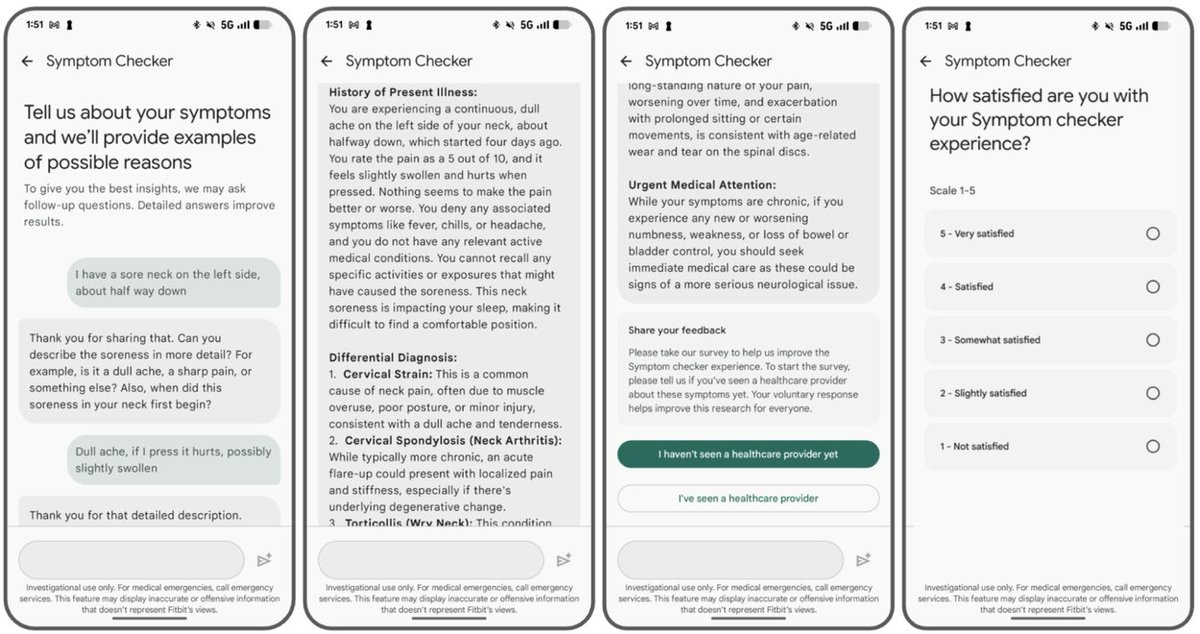
New from @GoogleResearch: A study exploring how conversational AI might conduct end-to-end symptom interviews and differential diagnostic assessment for research benchmarking purposes.
Learn more about this first-of-its-kind, national-scale study: https://t.co/BUaUN0LtNK
In Nature Medicine, a new perspective from researchers at @Stanford, @Google, and leading experts across major AI labs and academic institutions, explores the need for a rigorous, task-based framework to define and measure medical AI: https://t.co/Hbsy8G846k
See how Seattle Children’s is using an AI Pathway Assistant built with @GoogleCloud's Gemini Enterprise to access trusted guidance in real time—helping support more consistent care across teams.
Learn more: https://t.co/LVkSawZRRB