Duckworth can’t & won’t call Trump’s war what it is: illegal, the supreme war crime of aggression (as per Nuremberg Trials). This here is just militarist demagoguery, music to the DNC’s ears.
It’s really fascinating that so many hardcore Zionists just suddenly switched to ‘Zionist occupied government’ nationalism, it’s almost like there isn’t much difference between being one version of a dumb asshole vs another. The transition is seamless
There is so much US government-aligned editorial propaganda in this header, from calling the widely loathed Saudi proxies who govern a tiny portion of Yemen “the Yemeni government”, to reducing Ansarallah, which governs over 80% of the population, “the Iran-backed Houthi militia”
One of the many examples of Saudi genocidal intent against Yemeni people:on May 8 2015,Saudi-led coalition declared the entire city of Saada home to 50,000 civilians a "military zone"What followed was a campaign of massacres and the destruction of a 1,200 year old historical site
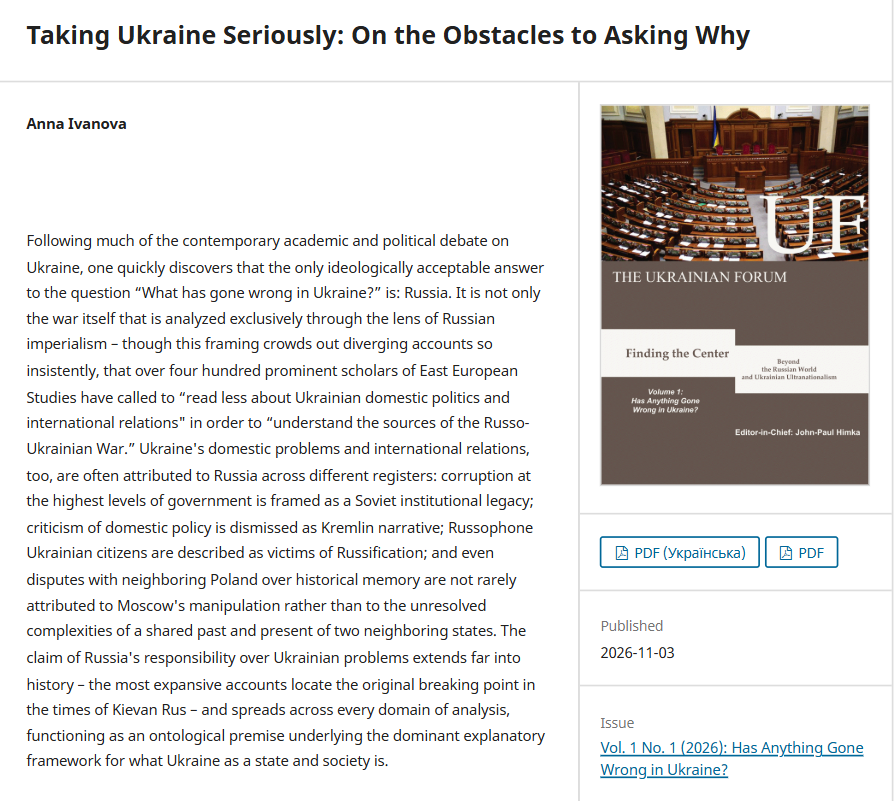
One article from the first issue of The Ukrainian Forum that I would like everyone to read is by Anna Ivanova. It is a brilliant, wide-ranging essay on the ever more evident bankruptcy of the knowledge production on Ukraine, which renders invisible, and cannot analyze or even recognize, the primary roots of the most urgent problems. Anna is certainly among the brightest Ukrainian social scientists of the youngest cohort, maybe even the brightest. Because when most social science studies on Ukraine have gone into the reproduction of nationalism, one must be anti-nationalist to do any critical social science at all. Some fragments are below, but there is so much more in the full text.
https://t.co/N2MQB4MWJr
"Following much of the contemporary academic and political debate on Ukraine, one quickly discovers that the only ideologically acceptable answer to the question “What has gone wrong in Ukraine?” is: Russia. It is not only the war itself that is analyzed exclusively through the lens of Russian imperialism – though this framing crowds out diverging accounts so insistently, that over four hundred prominent scholars of East European Studies have called to “read less about Ukrainian domestic politics and international relations" in order to “understand the sources of the Russo-Ukrainian War.”1 Ukraine's domestic problems and international relations, too, are often attributed to Russia across different regis-ters: corruption at the highest levels of government is framed as a Soviet institutional legacy; criticism of domestic policy is dismissed as Kremlin narrative; Russophone Ukrainian citizens are described as victims of Russification; and even disputes with neighboring Poland over historical memory are not rarely attributed to Moscow's manipulation rather than to the unresolved complexities of a shared past and present of two neighboring states. The claim of Russia's responsibility over Ukrainian problems extends far into history – the most expansive accounts locate the original breaking point in the times of Kyivan Rus – and spreads across every domain of analysis, functioning as an ontological premise underlying the dominant explanatory framework for what Ukraine as a state and society is.
<...>
After the outbreak of the 2022 Russian invasion, legal restrictions in language use were accom-panied by open stigmatization of Russian-speaking Ukrainians in public discourse. Depending on the context, these people appeared as victims of Russification who needed cultural rehabilitation, as carriers of foreign influence, as potential collaborators, as remnants of the Soviet past, or as a group that did not exist.70.The minister of education has pointed at a “correlation” between missile strikes on Ukraine and the Russian language.71 A columnist in the country's largest online outlet argued that "there are no Russian-speaking Ukrainians, only Russified ones," simultaneously placing on them "a share of responsibility for this war.”72 The mayor of Ivano-Frankivsk has supported the launch of lan-guage patrols to monitor Russian use in public spaces.73 A well-known actor proposed beating children for speaking Russian; a writer called for publicly reprimanding parents of "Russified" children.74 The current Commissioner for the Protection of the State Language went so far as to question whether people who had not switched to Ukrainian could be considered homo sapiens at all.75 What is striking about these representations is that they assign Russian-speaking Ukrainians virtually every possible status except that of ordinary citizens capable of defining their subjectivities themselves. They may be victims, security risks, colonial subjects, or historical anomalies – what they increasingly cease to be is a segment of population whose existence can be taken for granted.
Every time I hear that Russian-speaking Ukrainians are a “political construct,”76 I find myself won-dering who exactly the people around whom I spent my entire life were. Were my parents, whose bedtime fairy tales gave me a sense of security, and my grandparents, whose accounts of their own lives gave me a sense of continuity, simply victims who had failed to realize their true identity? The teachers in my kindergarten and school or the professors at my university, who taught me to doubt, to ask questions, to be curious, to analyze and to understand, were they at least “homo sapiens”? Were my neighbors at the apartment block, who solidarily supported one another when times were hard, and my great-grandparents in the village, who lived through every upheaval of the twentieth century, nothing more than remnants of Russification? Were my friends, with whom I shared childhood secrets, first loves, and discoveries of various kinds – in Russian, always – colonized subjects unable to eman-cipate? Did all these people exist at all? Do I exist?
The question is not rhetorical. From a sociological perspective, what is unfolding can be understood as a movement from ontological exclusion toward erasure.77 Exclusion presupposes the existence of a group that within a given picture of the world is denied rights, resources, or recognition. Erasure refuses to accept the very existence of the group itself. If Russophone Ukrainians do not exist, then there can be no legitimate representation of their interests, no claims-making on their behalf, and no collective grievances requiring political attention. The disappearance of the category removes the pos-sibility of political contestation altogether: one cannot organize, or demand recognition, as a member of a group that official discourse insists is not there. This foreclosure has a determinate social address. Attachment to Russian has not disappeared since February 2022, but it has become concentrated: it persists most strongly among the working class, for whom questions of language and symbols remain "far from pressing problems."78 What presents itself as cultural policy operates as a "social struggle on the basis of language"79 – that is, a form of class struggle, an instrument through which a ruling class consolidates its symbolic and institutional authority, and whose costs fall on those least equipped to contest them.
<...>
The consequences of this affective climate are recognized in the field of knowledge production. Fear increasingly structures academic life in Ukrainian studies at every level. The choice of research topic, the formulation of research questions, the language in which findings are presented – all are shaped by the anticipation of consequences. Entire domains of social life that generate significant tension – violent mobilization, draft evasion, illegal border crossing, political imprisonment, language conflicts – remain effectively underresearched because engaging with them carries political risk. Re-spondents hesitate to express views that diverge from socially approved narratives or refuse to answer altogether – the rate of non-response to sensitive questions in surveys and interviews has reached lev-els that themselves constitute a finding about the state of public affairs.92 Academic disagreements are transformed into campaigns of denunciation, public shaming, and demands for ideological conform-ity, expressed by the collective letter against “inconvenient” researchers, the blacklisting of academ-ic publications, campaigns against lectures deemed politically inconvenient. One begins to wonder whether a colleague has come to a conference to engage in debate or to report ideological deviations. One hesitates before submitting a manuscript, uncertain whether a particular formulation violates an existing law or will provoke accusations of disloyalty. Peer-review process is evolving into a means of conveying threats. Even well-established scholars privately admit to self-censoring out of fear of marginalization or misinterpretation. The implicit assumption behind every research is that the only legitimate scholarly commitment during wartime is to serve the interests of the nation. Knowledge production is subject to police-style surveillance, the borders of which are defined by political loyalty.
A public sphere governed by fear cannot reliably generate knowledge about itself, nor can schol-arship produce reliable knowledge about the society it studies. A scholarship in which fear forecloses departure from the dominant approach cannot avoid stagnation, as it loses the capacity to innovate. Younger researchers will reproduce the same mode of thinking rather than propose new approaches to the problems that matter. More broadly, the more dangerous certain questions become, the less capable a society is of understanding its own condition, and the less capable it becomes of imagining alterna-tives to that condition, or even improvements upon it. I include my own position in this description not as a dramatic gesture. In writing this text I do not know how to establish whether I have violated a law and have already become a criminal, or whether I will still be permitted to remain a sociologist who asks questions about Ukrainian society and looks for answers to them. The fact that I cannot de-termine this is not a private difficulty but an illustration of the state of the legal system that the Venice Commission identified as “vague” when it issued its conclusions on the “decommunization” laws.
<...>
The war unleashed by Russia is, obviously, an enormous threat that is destroying Ukrainian soci-ety and the Ukrainian state, and only its immediate end can significantly improve Ukraine's position. But is there anything within the sphere of responsibility of Ukrainian actors that might have been organized differently? This essay has been an attempt to identify some of those areas. Yet what it describes only points to what has gone wrong. It maps the symptoms of a structural crisis; the next step would be to examine their causes in depth. A proper diagnosis would require locating the source of the crisis and formulating the means of addressing it. That demands answering not only what went wrong but why: why these choices were made, who benefited from them and who lost, what alterna-tives were foreclosed and by whom, and what social forces might yet produce different outcomes. It would, moreover, be insufficient and ultimately unfair to direct this question exclusively at Ukraine. As Ishchenko argues in this issue, Ukraine is not an anomaly but a norm, or even "the vanguard of the world in crisis":96 a country moving at the forefront of dynamics visible, perhaps, in less acute form, across much of the globe, and showing the most extreme futures that may await other societies if the trajectory remains unchanged. The hollowing out of democratic deliberation, the replacement of the politics of redistribution by the politics of recognition,97 the securitization of dissent, the concentration of wealth amid the erosion of public institutions – none of these is uniquely Ukrainian. In this sense, the question "what has gone wrong in Ukraine?" is a version of a larger question about what is going wrong in the world of “democratic capitalism” after "the end of history" – and the urgency of asking it is not diminished by the difficulty of doing so.
<...>
I am finishing this text in Kharkiv, as the fifth year of the war draws to a close. I write these final lines on the day two Russian FPV drones fly into my neighbors' cars and kill them on the only road into our district – the road where I know every tree at the verge and every crack in the surface, the road that felt like the most mundane part of my existence and therefore, by definition, the one that could hide no danger. These days I am afraid to drive home. Looking for a safer detour, of which there is none, I think: yes, something in Ukraine has indeed gone wrong, if the safest place I have ever known feels unsafe. Are the obvious crimes committed by Russia a sufficient reason to stop speaking about Ukraine altogether or to postpone the study of Ukrainian society until the violence ends? Does this fear cancel out all the others I have described in this essay? If anything, it sharpens them. Fear of what comes from outside – bombs, missiles, drones, occupation – is compounded by fear of what may come from within: prison terms for likes, violent conscription in the streets, expulsion from the ranks of "homo sapiens" on grounds of language. Both narrow what people in Ukraine are able to do with their lives. Precisely for this reason we must retain every opportunity to study what is happening in our society, to discuss it, and to formulate alternatives. We cannot af-ford to "read less" about Ukraine. We must attend to it constantly, in every dimension, while doing everything possible to end the war immediately."
SBU General Duka, accused of belonging to a criminal organization allegedly involved in protecting drug trafficking operations, scam call centers, kidnappings, torture and murders in Ukraine and Europe, walks out of pre-trial detention to a standing ovation from masked men in uniform.
And who exactly are these enthusiastic supporters with their faces conveniently hidden?
Everyone who had a cut of the profits?🤔
What a beautiful little mafia state under Zelensky.
Criticize corruption? Enjoy a decade of sanctions and perhaps a prison cell.
Get accused of serious organized crime? Enjoy a standing ovation.
Traveling to the first Buddhist temple in China, perched atop a great peak, surrounded by monasteries that offer travelers respite and also by XingXing-like monkeys
NEW Every year, the archaeology sector in China selects 10 archaeological sites as its ‘Top 10 Archaeological Discoveries in China'. Our new Guest Editorial explores this year's selection and their importance to international #archaeology
🆓 https://t.co/qQ2M3G1WAG