New GovAI post: I argue Frontier AI companies should publish their third-party evaluation contracts. This would show the conditions evaluators work under, make results easier to interpret and compare, and create incentives to improve evaluation arrangements.
More in thread ����
We're looking for a Head of Hiring to join GovAI!
You'll lead a growing team, shape our recruitment strategy, and strengthen how we identify and assess exceptional talent as GovAI scales.
Help us build the next generation of AI governance talent. Apply by 22 November:
https://t.co/dt3ozKvhHl
Apply for GovAI's 2027 DC Summer Fellowship!
📍 Location: Washington, DC
📅 Deadline: Sunday, November 22nd, 2026 at 11:59 pm ET
The DC Summer Fellowship is a three-month bipartisan opportunity designed to accelerate or launch impactful careers in American AI governance and policy. Participants deepen their understanding of the field, connect with a network of experts, and build their skills and professional profile, all while conducting a research project of their choice under expert guidance.
🔗 Learn more: https://t.co/HVhrNHMTk0
Apply for GovAI's 2027 Summer Fellowship, Research and Applied tracks!
📍 Location: London, UK
📅 Deadline: 23:59 GMT Sunday, 22 November 2026
Fellows will join us in London to conduct a project on a topic of their choice, participate in an expert Q&A and seminar series aimed at developing a broad understanding of the field, and spend time forging connections with researchers and practitioners. Learn more below.
🔗 Learn more about the Research Track: https://t.co/ByViwtygR6
🔗 Learn more about the Applied Track: https://t.co/2KBsNDngi0
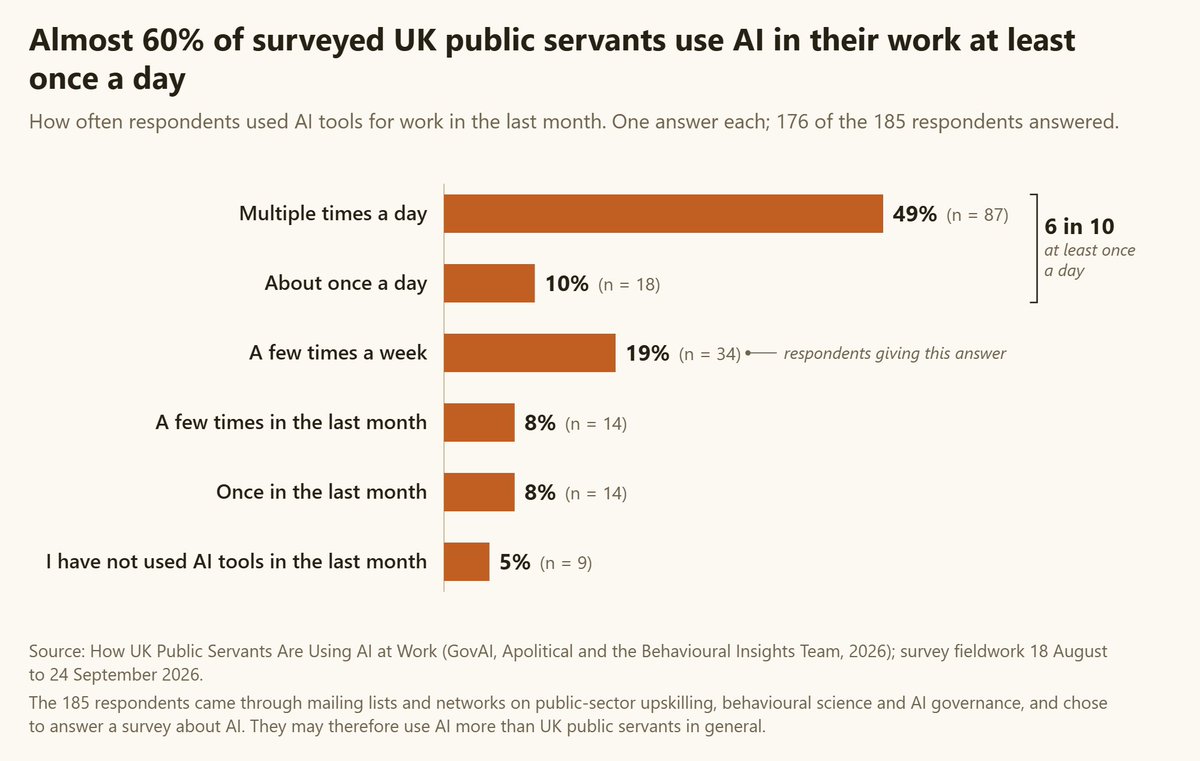
Understanding how governments use AI is important, so how are UK public servants using AI at work today?
To start getting a sense of this, we polled ~200 UK public servants from our network - in collaboration between @GovAIOrg, @B_I_Team, and @apoliticalco.
Results suggest many public servants today use AI daily for routine tasks, and that broader adoption might be held back by lack of trust in accuracy and security.
🧵below on key charts. A blog summary of our results can be found on the GovAI website: https://t.co/zsH58eaqXU
1) The vast majority (95%) of our respondents report using AI tools for work in the last month, and 6 out of 10 use it at least once per day.
Happy to share I am now Research Director for AI Economics and Policy at @DigEconLab. As part of new role I will be leading the AI Economic Indicators.
I am also now a Research Fellow at @GovAIOrg. I'm excited to work with them on most important questions in econ of AI.
Interested to learn how Chinese companies talk about recursive self-improvement (RSI) and what that means?
Check out the new article by GovAI researchers Cheryl Wu and Zilan Qian.
→ https://t.co/WcTHBeA0WC
[1/7] China’s AI labs are also talking about “recursive self-improvement” (RSI). A big question here is: Is Beijing coordinating a race to achieve RSI?
@ZilanQian and I looked at Chinese AI companies, investors, and policy docs.
We found a more bottom-up, commercial story.
At GovAI, we have a growing team and focus on AI in China — so stay tuned for updates from us in this space!
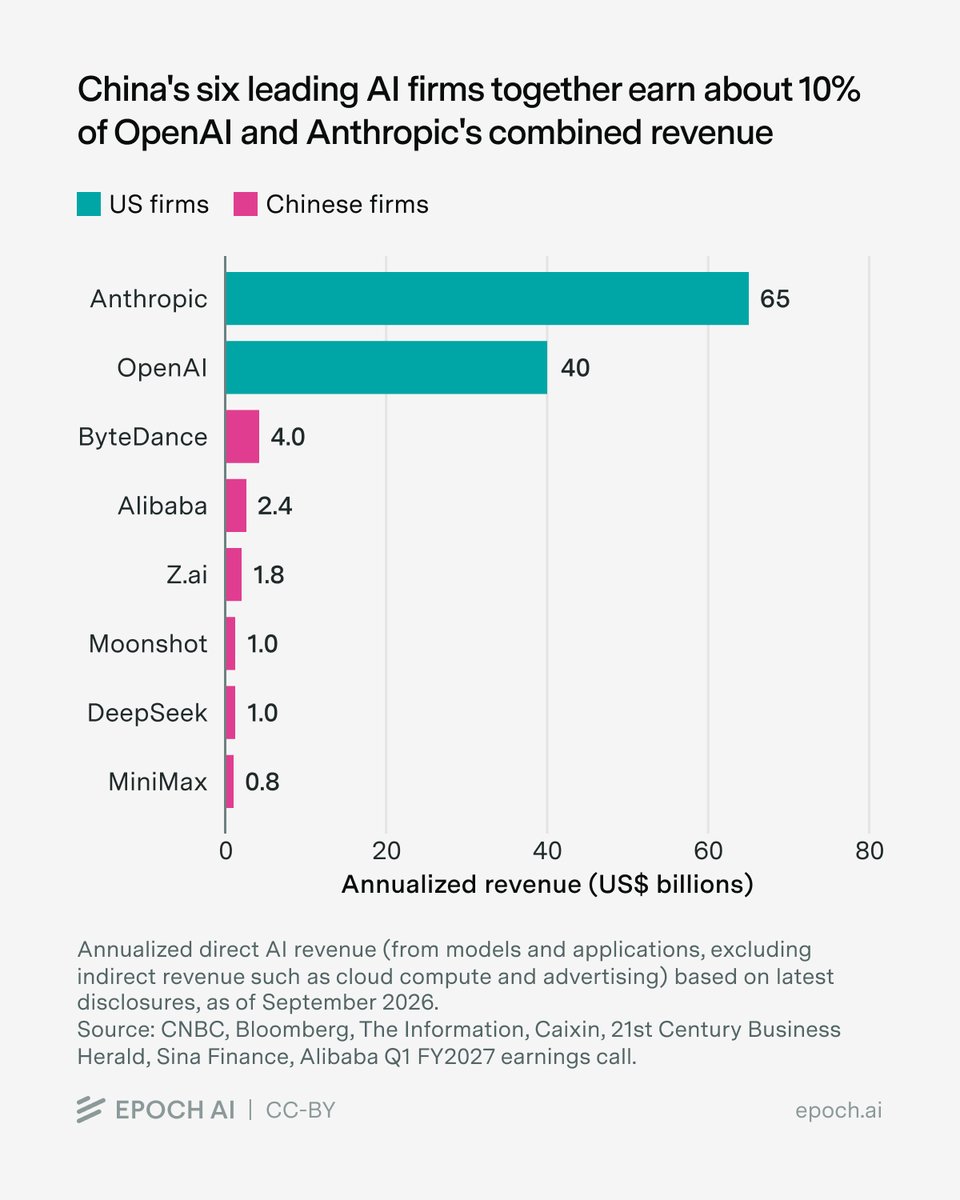
For instance, how do Chinese AI firms make money?
GovAI researcher Cheryl Wu takes a look at this question in recent work collaborating with @EpochAIResearch.
How do Chinese AI firms make money? In a new report, @cherylwoooo and @ansonwhho identify five revenue sources and analyze how much each contributes. 🧵
Does China think it's in an “AI race” with the US?
How worried is Beijing about AI-driven job loss?
Find out answers to these questions and many more in this explainer co-authored by GovAI researcher Zilan Qian.
And wondering whether China thinks it is in an “AI Race” With the United States, whether Beijing is worried about AI-Driven job loss, or China's public opinion about AI? We also got answers here!
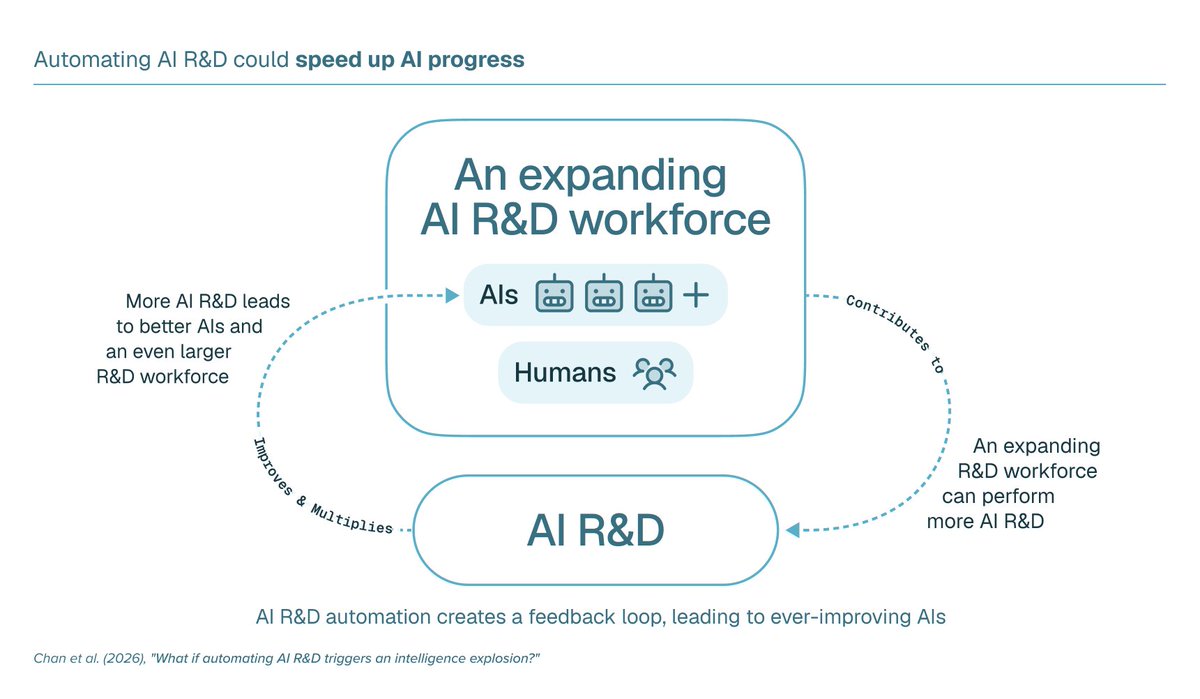
How could using AI to automate the AI research and development process itself lead to a potentially rapid speed-up in capabilities? What's the current evidence for how much this is happening already?
On current trends, it’s possible that AI research & development (R&D) will be fully automated within the next few years. We should take this seriously.
Although the existing evidence is preliminary and sometimes mixed, it suggests that this positive feedback loop could lead to an “intelligence explosion” that compresses years of AI progress into months or less.
You might have heard recently about third-party evaluation for frontier AI and the idea of "embedded assessments" — learn more about what this is, why it matters, and how it could work in practice in the recent paper from our team.
Third-party evaluators mostly test frontier AI models through an API. That misses the risks that come from how companies build and use AI internally.
Our new paper makes the case for embedded assessments. It was led by Jacob Charnock. The other co-authors are Sophie Williams, @zaheedkara, @Manderljung, Alejandro Tlaie Boria, @StephenLCasper, @AnkaReuel, and me.
🔗 Read the paper: https://t.co/Ul5ayxyGwH
How do Chinese AI firms make money? In a new report, @cherylwoooo and @ansonwhho identify five revenue sources and analyze how much each contributes. 🧵
[1/5] The 8 most valuable data points labs should share to help measure RSI:
First, RSI would likely accelerate growth in AI capabilities.
Thus, companies should report performance on diverse benchmarks for the latest internally deployed models.
Read more in the new Substack publication from GovAI’s Threat Modeling Team, called “Credible Threats.” The team studies and writes about the pathways by which AI might lead to harm, such as via cyber attacks.
→ https://t.co/0iKiDzYrQK
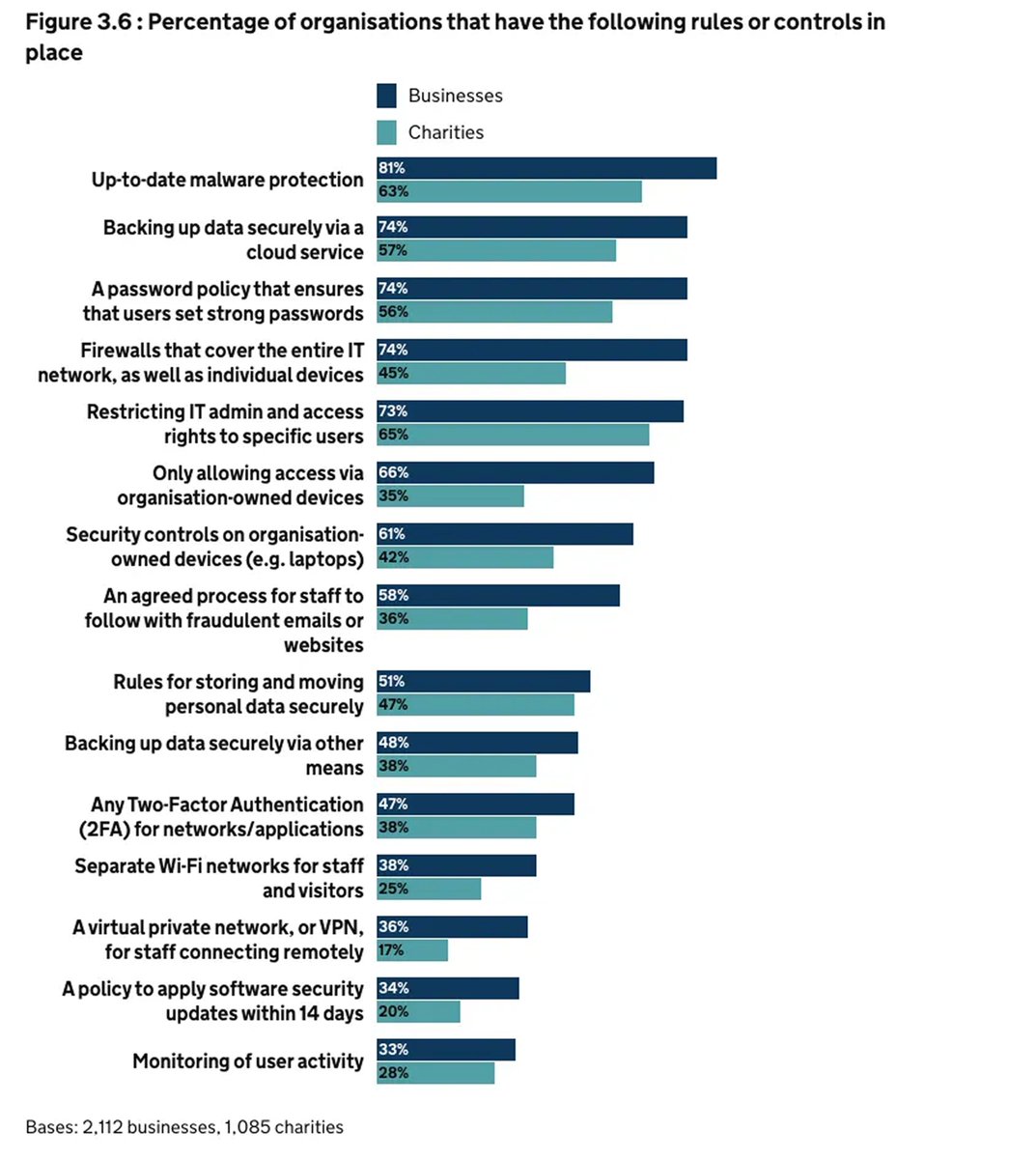
Many organizations sit below the “cyber poverty line”: they skip basics like two-factor authentication and timely patching, making it easier for attackers to breach them through phishing, stolen credentials, and by exploiting known vulnerabilities.
For instance, the chart here shows the security practices of businesses and charities in the UK, from a nationally representative 2025/26 survey by the UK Department for Science, Innovation and Technology.
Fewer than half of UK businesses and charities use any two-factor authentication, or have a policy to apply security updates within two weeks. A quarter of UK businesses do not have a firewall covering their whole network.
The neglect of cybersecurity has partly been a rational response to the fact that, so far, the risk of cyberattacks for most organizations has been fairly low.
But AI may soon change that.
For most organizations, AI’s biggest near-term effect will not be to discover powerful “zero-day” exploits, but to make known attack methods — such as phishing and stolen credentials — cheaper to execute at scale. This would end the era in which skipping the basics was a safe bet.
To manage the AI-cyber transition, we need to improve basic cyber hygiene as well as fixing novel vulnerabilities.