Researching trustworthy AI advice for navigating the societal impacts of advanced AI. Research Fellow @MATSprogram. Formerly @WorldBankGroup, @GovAIOrg.
Calling all the unusual suspects: transformative #AI is not only, or even mainly, about labor market impact in low- and middle-income countries, yet this comprises the bulk of the analysis to date. Effects also go beyond the AI for Good use cases that are so prevalent... Won't TAI-enabled cybercrimes start in the countries where cybersecurity is weakest, for ex? What kinds of safeguards against TAI-enabled systemic risks does every country in the world need to implement? If realizing #AI benefits requires greater connectivity and digitalization, how can we speed up these investments? If #AI-enabled science cures cancer, how does it help if your country only treats a quarter of cancer cases to begin with? And what do you tell policymakers in countries at different levels of national income? Send your thoughts to @indevmag@asteriskmgzn
New GovAI post: I argue Frontier AI companies should publish their third-party evaluation contracts. This would show the conditions evaluators work under, make results easier to interpret and compare, and create incentives to improve evaluation arrangements.
More in thread 🧵
There’s a lot of writing on what AI means for rich-country economies and far less on what it means for Nairobi, Lagos or Lima.
@asteriskmgzn and @indevmag want to fix that. Essay contest: $10k first prize, deadline Dec 31.
https://t.co/5YCG2mxDQM
Apply for GovAI's 2027 Summer Fellowship, Research and Applied tracks!
📍 Location: London, UK
📅 Deadline: 23:59 GMT Sunday, 22 November 2026
Fellows will join us in London to conduct a project on a topic of their choice, participate in an expert Q&A and seminar series aimed at developing a broad understanding of the field, and spend time forging connections with researchers and practitioners. Learn more below.
🔗 Learn more about the Research Track: https://t.co/ByViwtygR6
🔗 Learn more about the Applied Track: https://t.co/2KBsNDngi0
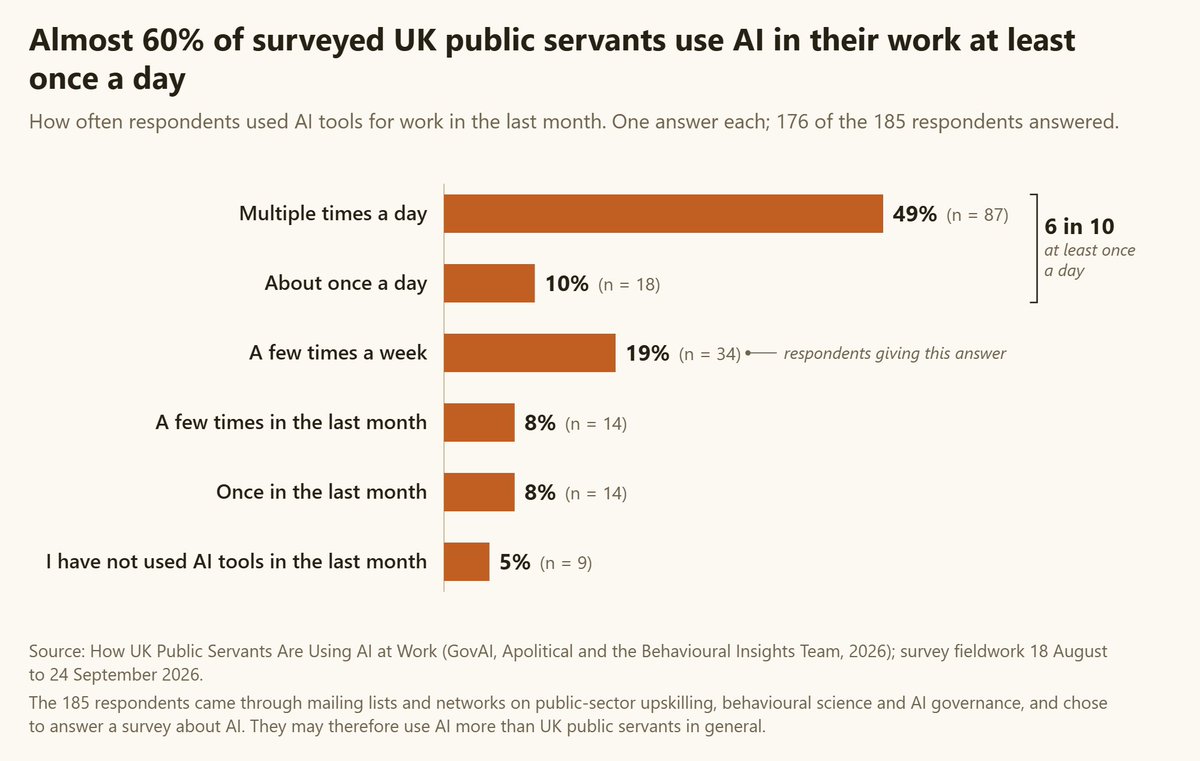
7) What does this all mean for AI in policymaking? Our results suggest that enterprise solutions are enabling AI tools to become an important part of UK public servants’ work. The vast majority of our respondents report using AI tools, and 6 out of 10 use it at least once per day.
These findings suggest that improving the accuracy of AI outputs, and users’ perceptions of its reliability, would provide the biggest boost to adoption, though significant minorities of respondents also say they would use AI more if they had stronger security guarantees or more training. Respondents expect usage to continue to rise, and that usage will increase as AI systems become more capable and accurate.
Governments are already facing pressing questions about how to support efficient, secure, and transparent use of AI in government. This survey is a first attempt to put concrete data on how public servants use AI in their daily work behind those questions.
Understanding how AI is used in policymaking and public services will take sustained, comparable measurement, and repeated surveys and experiments to establish what safe and effective adoption looks like in practice.
If any of this sounds interesting, please do get in touch! This research agenda is gathering momentum as we work to understand and experiment with more trusted methods for integrating AI in decision-making - both in governments and elsewhere in societally consequential roles.
Understanding how governments use AI is important, so how are UK public servants using AI at work today?
To start getting a sense of this, we polled ~200 UK public servants from our network - in collaboration between @GovAIOrg, @B_I_Team, and @apoliticalco.
Results suggest many public servants today use AI daily for routine tasks, and that broader adoption might be held back by lack of trust in accuracy and security.
🧵below on key charts. A blog summary of our results can be found on the GovAI website: https://t.co/zsH58eaqXU
1) The vast majority (95%) of our respondents report using AI tools for work in the last month, and 6 out of 10 use it at least once per day.
6) But is AI use leading to AI influence? We spent a lot of time on these questions to define it as ‘significant influence on the substance of the work’: the content, conclusions, or recommendations would have been different if no AI tool was used - this wasn’t about formatting.
The answer seems to be that AI is already having an influence for many UK public servants, with 28% saying that at least a third of their work today is significantly influenced in its substance. They estimated that this is a steep rise from last year (when half hadn’t even started using AI for work) and nearly everyone expected AI’s influence to rise further next year.
We also asked respondents to estimate how often AI significantly influences their colleagues’ work. The results were broadly similar: 34% of respondents estimated peers’ work to be significantly influenced by AI at least one-third of the time.
Nearly half of respondents (45%) could recall a specific instance in the last month when AI significantly influenced an output and offered further details of that case. In one instance, a respondent said that AI was used to think of different options and to challenge existing opinions regarding advice that was to be delivered to a minister or senior official. The final output was strengthened by using AI in this way, the respondent reported.
The tradeoffs between sovereign AI and capable AI
Today on VoxDev, @SharifKazemi and Joseph Levine explore the costs of sovereignty over AI, how those costs might change, and when they are worth paying: https://t.co/IQq53xIaHA
New from Guidelight: our Alignment Standard is out today!
It lays out the minimum any frontier AI developer should be doing to keep its models from becoming egregiously misaligned.
1/ AI could make poor countries richer, but still leave them further behind.
In a piece for @ReadTransformer, I asked economists, forecasters and policymakers whether an AI-driven Great Divergence is likely and what policymakers can do about it. 🧵
New post! Alignment doesn't just relate to a model's properties, but also the systems and institutions under which it operates. As we enter an increasingly multi-agent world, better harnesses, protocols, and mechanism design will be critical for safety. 🐜 https://t.co/DbG0yUyYQ0
@sebkrier Cheers @sebkrier! If we care about equitable global diffusion, we have to take seriously both capability trajectories *and* deployment bottlenecks. Hence our call to build the adaptation layer that bridges them. With @oliverhanney@ShahrukhWani@hanshengchia and Sid Ravinutala.