New @windfalltrust AI Economics Brief on AI R&D and automation is out! Here a quick summary followed by the link:
A new growth model by @TomDavidsonX , @BasilHalperin, @akorinek, and @tomwhoulden predicts that AI R&D automation could accelerate AI’s economic impact, driven by economic and technological feedback loops. They model an AI research sector that spans software and hardware and calibrate it using estimates of AI software and hardware progress, such as Moore’s Law.
But current measures of AI R&D automation are limited, and existing benchmarks saturate quickly. The think tank @GovAIOrg@_achan96_@ranayssance, Joe Kwon, Hilary Greaves + @Manderljung proposes a framework that combines experiments, surveys, operational tracking, and organisational metrics to address this gap.
AI automation might also accelerate as task chains are automated contiguously according to a model from @Peyman_Shahidi@demirermert@johnjhorton@immorlica, and Brendan Lucier. This might overturn comparative advantage in some cases, as firms prefer to automate a task when AI is sufficiently good at it to save labor costs, while end-stage verification costs remain fixed.
Plus: Anthropic's "observed exposure" metric, @ajeya_cotra on AI R&D timelines, and @davideoks on ATMs vs. iPhones.
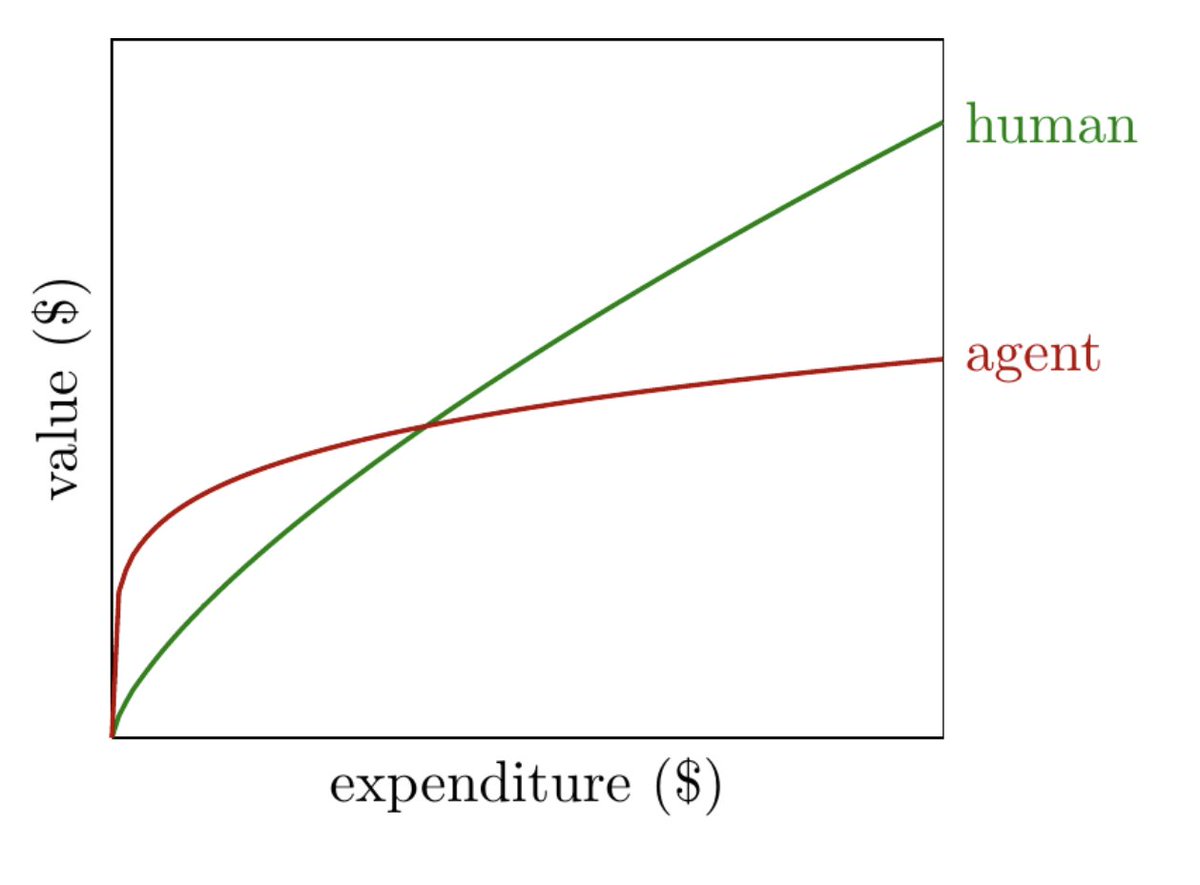
I think most domains look like this at the moment: the returns to expenditure on agents diminish much more quickly than the returns to expenditure on human labor: (1/n)
@windfalltrust's AI Economics Brief #11 is out!
AI’s uplift is overestimated in most cases, according to @METR_Evals@testingham@whitfill_parker, since the productivity gains are concentrated in new tasks, such as coding personal apps, which were previously not valuable enough. Meanwhile, the uplift in previous tasks and in value is lower, similar to inflation being lower when looking at the new consumption bundle, since workers substitute toward more attractive tasks or goods.
AI agents can't yet price their own work according to @AndreyFradkin and @krishnanrohit. For AI agents to compete for tasks in a market, they need to assess their own likelihood of success and costs, but six frontier LLMs get both wrong. In simulated auctions, this means tasks go to overconfident agents rather than the most capable, degrading the market from an efficient allocator to something closer to a lottery.
Plus @ahall_research on why the real AI backlash hasn't started.
@Simon__Grimm Oh I meant more that the general political consensus, especially in the US, is favouring protectionism and the political elites don't regard economists highly any more/ don't listen to them
@mattyglesias Depends on how much the tax base erodes with AI, but probably if there is a productivity boom, the tax intake increases mechanically while the expenditure does not that much so it should make us less worried in the short term
Interesting piece on the political economy of AGI! If the predictions on AI's economic impact are true, the political implications will be massive. While it might be tough to agree on a social contract before, the disempowerment of workers might reduce the bargaining power at the same moment when it's the most necessary! Interesting times ahead!
My new research piece: what the politics of jobless prosperity might look like in an AGI world, why the real political backlash to AI hasn’t started yet, and how the labs should prepare.
1. The backlash to AI isn’t here yet. There is anxiety among American voters, but there is no populist backlash yet, because the job losses haven’t started yet—and we don’t even know if they ever will. AI is not in the top 20 issues Americans say they care most about, and the AI policy issue with the most energy right now, data center opposition, reflects not just AI but also NIMBYism, as @mattyglesias has pointed out.
2. Real backlash will happen if and when unemployment climbs by two percentage points, because that’s where data shows we tend to see meaningful electoral effects of unemployment. At that point, if we do not have a good inventory of smart policy ideas ready, we could be overwhelmed with bad ones.
3. The labs should focus more on measurement, and less on dreaming up New Deals. There is tremendous uncertainty about what kind of job displacement there’s going to be. Instead of attempting to write a new social contract from the top down before Americans are even asking for one, the labs should be helping us all get more intel on whether, when, and how job displacement is occurring—building from the helpful data sharing they’ve already started piloting. This will put society in a better position to design policies that make sense for everyone.
In doing the research for this piece, I came to two broader realizations.
First, there is way more uncertainty than I appreciated about how the economics of AGI might play out, and there is stronger evidence than I appreciated that job losses from AI have not meaningfully started yet.
And second, if AGI plays out the way the labs are predicting, the politics will be very hard to forecast, because it will be the politics of “jobless prosperity,” with jobs falling while the economy grows. We have very little experience with this happening at this kind of scale, and it will break our typical models of politics.
For both of these reasons, we should all be really humble in making pronouncements about the politics of AGI. I hope my piece will be read in this light, as an attempt to reason about something that is super important but also super hard to forecast accurately.
You can check out a lot more in the piece here:
https://t.co/JlwaF1fF8V
@ahall_research This might give us a hint: https://t.co/LthQHUT1Kd Looks like AI's effect will be much more concentrated in reduced junior hiring than layoffs for some time
Surveys of young graduates indicate that full-time employment fell from 70% to 55% over the last 3 years, consistent with a range of recent studies
https://t.co/mMKAJyDqBT