Tina Smith (D-MN) exited her full position in $MRSH — Marsh & McLennan — on January 27, 2026. Sale range: $50,001–$100,000.
That number matters less than the pattern behind it. Across 42 total trades, Smith carries a 100% win rate and +123.1% average excess return vs. the market. Her best single trade: +161%. That's not luck — that's a ledger.
The profile here is mostly liquidation. Long-held positions, minimal new entries. This looks like another exit off the shelf — not a fresh conviction bet. But Marsh sits in a sector facing real regulatory heat: insurance brokerage fee scrutiny from state departments, the SEC, and DOJ. Regulatory density score: 75/100.
She sits on the Banking and Finance Committees. Marsh is a financial services firm navigating exactly the kind of oversight those committees touch.
Now we watch the disclosure clock.
Dan Crenshaw (R-TX) bought $PLTR — down 20% in the last 30 days.
A former Navy SEAL who sits on the House Permanent Select Intelligence Committee, buying into a company that earns 72% of its revenue from U.S. defense and intelligence contracts. The overlap is hard to miss.
His track record on trades like this: 33 total disclosed trades, +33.2% avg excess return vs. the market, with a best single trade of +547%. The conviction score here lands at 60/100 — A tier.
Roughly 40% of his disclosed trades fall inside sectors his own committees regulate. And 24% of his filings come in late.
None of this was hidden — we just organized what was already public.
Five Congress members converged on $AAPL in 14 days — Fields, Cisneros, Case, McGuire, Capito. Herd score 28/100. Rare signal: only ~31 convergence events tracked across 189K filings since 2012.
37.7% win rate in finance sector trades. That's the number behind this one.
Markwayne Mullin (R-OK) bought $100K–$250K of $AMZN on December 29 — his 84th finance-sector buy across 368 total trades and $39.46M in career volume.
The herd was already moving. 31 members of Congress net bought Amazon-adjacent names: 168 buys vs 115 sells. HR.2853, the Combating Organized Retail Crime Act, just cleared a House floor vote — a crackdown on stolen-goods resale that directly benefits the marketplace Amazon runs at scale.
His finance-sector average is -1.4% excess return. The stock is down 12% over the last 30 days. He bought anyway, into the cluster.
None of this was hidden — we just organized what was already public.
47 prior finance-sector buys. 64.3% win rate in the sector. +7.5% average excess return.
David McCormick (R-PA) bought $GS on June 2nd — up to $250K in Goldman Sachs, one of the most regulation-sensitive names on the board.
McCormick sits on the Banking Committee. Goldman carries a 92/100 regulatory density score. That's not a coincidence — that's a pattern. 87.3% of his trades match his committee sectors across 54 total trades and $44M in 5-year volume.
The timing matters. Goldman's entire business model bends around whatever Washington decides about capital rules and market structure. The senator who helps write those rules just loaded the stock.
See who else is quietly loading the same name — on GovGreed.
In the first half of 2026, Congress spent months debating whether to ban its own stock trading. In those same months, 94 of its members disclosed 3,406 trades.
The ban had everything going for it. More than 80% of voters, Republican and Democrat, support one. In January, a House committee advanced a version of it. Leadership promised a floor vote by the end of March.
It never came. A separate effort to force the vote stalled at 82 of the 218 signatures it needed. By spring, with the midterms closing in, the coalition quietly fell apart. The most popular reform in Congress could not get to the floor.
Here is what did not stall. The trading.
While the ban sat unvoted, members disclosed more than $200 million in transactions in the first half of 2026 in their STOCK Act filings, measured by the midpoints of the ranges they report. It was not one party.
Nancy Pelosi (@SpeakerPelosi), Democrat: 21 disclosures, an estimated $80 million.
Jefferson Shreve (@repshreve), Republican: about $35 million across two trades.
Chip Roy (@RepChipRoy), Republican, who runs as a fiscal hawk: roughly $18 million across three.
Ro Khanna (@RepRoKhanna), Democrat: 811 trades.
A Republican senator, David McCormick, and two House members from opposite parties, Michael McCaul (@RepMcCaul) and Josh Gottheimer (@RepJoshG), kept trading straight through the debate.
None of it broke a rule. That is the point. There is no rule. The penalty for trading on what you learn in office stays at nothing, because the law that would change it cannot get a vote, because the people who would have to pass it are the people it would bind.
They debated the ban in public and kept trading in public. GovGreed just stacked the two timelines on top of each other.
Not financial advice. All data from public federal disclosures.
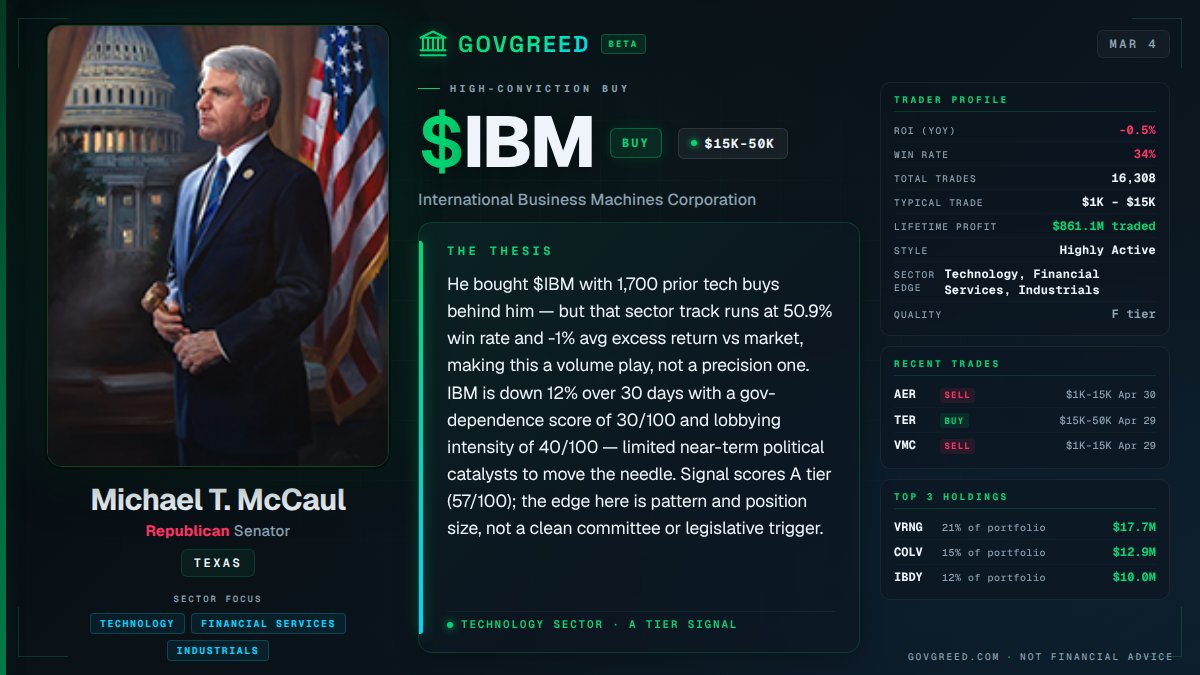
Michael McCaul (R-TX) bought $15K–$50K of $IBM on March 4th — while the stock was down 12% in the prior 30 days.
McCaul runs one of the largest portfolios in Congress: 184 tickers, $2.5B in disclosed volume, 16,308 total trades. In tech specifically, he's made 1,700 buys with a 50.9% win rate. Not exceptional — but this isn't a random name dipping a toe in.
The timing matters. A herd cluster is active on IBM right now — meaning other members are quietly loading the same name in the same window. That kind of convergence is a pattern worth watching, especially from a former Homeland Security Committee Chair whose jurisdiction touched technology and cybersecurity directly.
IBM has real federal contracting exposure. Hybrid cloud, AI infrastructure, government IT. The committee overlap isn't theoretical.
They write the laws, trade the companies those laws move, and disclose it months later. We just keep the receipts.
Taylor, Moore & Peters converged on $T (44/100) — 3 buys in 11 days. Telecom sector markup cycle; all three sit on Commerce or Armed Services committees where spectrum + infrastructure policy moves. Rare herd (top 0.02% of 189K filings).
The companies the U.S. government pays the most are the same companies Congress trades the most. Nobody is hiding it. It had just never been counted.
GovGreed lined up the federal contract record — roughly $1.5 trillion in awards across more than 400 publicly traded companies — against the disclosed stock trades of Congress. The overlap at the top is almost total.
Lockheed Martin, the largest defense contractor in the country, is traded by 44 different members of Congress. Boeing: 52. General Dynamics: 33. RTX: 31. Northrop Grumman: 25. These are the firms that live on federal money — and dozens of the people who appropriate that money hold their stock.
It isn't only defense.
Pfizer, a major federal vaccine and drug supplier, is traded by 69 members. Microsoft, with billions in government cloud and software contracts, is traded by 131 — the single most widely held name in Congress. IBM: 53. Honeywell: 52. Eli Lilly: 50. Oracle: 42.
Think about what that means. The same body that writes the checks — that decides which contractor gets the submarine program, the cloud contract, the vaccine order — is, member by member, an owner of the companies cashing them.
None of this is illegal, and none of it is secret. The contracts are public on the federal spending record. The trades are public in STOCK Act filings. The two ledgers simply lived in different places, and almost nobody put them side by side.
GovGreed did. The checkbook of the government and the brokerage statements of Congress turn out to have a lot of the same names on them.
Not financial advice. All data from public federal disclosures.
You don't have to guess who benefits from a trillion-dollar spending bill. The 2026 Appropriations Act wrote it down — program by program.
On February 3, the Consolidated Appropriations Act of 2026 became law. Buried in it are specific dollar figures for specific weapons programs, and each program has an obvious public-company beneficiary.
Submarines — billions for the Columbia and Virginia classes — go to General Dynamics and Huntington Ingalls. Black Hawk helicopters go to Lockheed Martin. Destroyers go to General Dynamics. Missiles and aircraft systems go to RTX. The bill names the programs. The contractors are all publicly traded.
And in the months around the bill, members of Congress traded those exact names. Both parties.
Markwayne Mullin, Republican, and Roger Williams, Republican, bought RTX. Maria Salazar (@RepMariaSalazar), Julia Letlow (@RepJuliaLetlow), and David Rouzer — all Republicans — traded Boeing. On the other side, Gilbert Cisneros, Democrat of California, cycled through Lockheed, General Dynamics, RTX, and Palantir in the same stretch. Jonathan Jackson and Thomas Suozzi (@reptomsuozzi), both Democrats, traded Palantir. Steve Cohen, Democrat, sold Northrop Grumman.
None of it broke a rule. Appropriations bills are public the day they pass. Every one of these trades was disclosed. That's the point, not the exception.
The budget said, in writing, which companies the money would flow to. And the people who write the budget were holding the stock.
GovGreed didn't dig up a secret. It read the spending bill and the brokerage filings side by side.
Not financial advice. All data from public federal disclosures.
We ranked all 538 members of Congress by how aggressively they trade. The top of the list is bipartisan, and the numbers are hard to picture.
The ranking is a score GovGreed calls greediness: how often you trade, how much volume you move, and how recently. Zero to a hundred. Read it carefully — it measures activity, not profit, and activity is not a crime. It's a measure of how hard a member works the market while holding office.
At the top, the parties trade places.
Michael McCaul (@RepMcCaul), Republican of Texas, has disclosed about $869 million in trading volume. For scale, a rank-and-file member of Congress is paid $174,000 a year. McCaul's disclosed volume is roughly five thousand times one year's salary.
Ro Khanna (@RepRoKhanna), Democrat of California, has filed more than 14,000 separate purchases — about $580 million in volume. The most active trader in Congress by sheer count.
Then Nancy Pelosi (@SpeakerPelosi), Democrat of California, near $230 million. Josh Gottheimer (@RepJoshG), Democrat of New Jersey, $224 million. Suzan DelBene, Democrat of Washington, $170 million.
The honest caveat: volume is not winnings. A member who buys and sells the same position ten times stacks up volume without making a dime. This isn't a list of who profited. It's a list of who treats a Senate or House seat like a trading desk.
And that's the point. The people writing the rules for the market are among the most active participants in it — in both parties, at a scale most Americans will never see in a lifetime.
None of it is hidden. Every dollar of it sits in public STOCK Act filings. GovGreed just added them up and put them in order.
Not financial advice. All data from public federal disclosures.
Cisneros, Salazar, McGuire, Fetterman, Gottheimer converged on $MSFT in 14d window (herd score 58/100). 6-politician cluster ranks top 2% of all tracked convergences since 2012.
In 2025, Congress voted to kill the one new rule that would have made crypto easier for the IRS to track. Members of both parties were buying crypto stocks while they did it.
The rule was an IRS reporting requirement. It would have forced crypto and DeFi platforms to report their users' transactions, the way your brokerage reports yours. In early 2025, Congress used the Congressional Review Act to erase it. The resolution, H.J.Res 25, was referred to the House Ways and Means Committee in January, passed the House with bipartisan support, and was signed into law. The rule was gone.
Killing it was good news for the companies that live on crypto trading volume. GovGreed's model flags the winners: Coinbase, and MicroStrategy, the largest corporate holder of Bitcoin.
Here's the part that's hard to look away from. As the repeal moved, members were buying those exact names.
Jefferson Shreve (@repshreve), Republican of Indiana, bought MicroStrategy on February 24, 2025 — two days before the House committee advanced the repeal.
Shri Thanedar (@RepShriThanedar), Democrat of Michigan, had bought MicroStrategy the summer before.
And the through-line runs straight into a sitting senator. Dave McCormick, Republican of Pennsylvania, sits on the Senate Banking Committee — and on its subcommittee on Digital Assets. On CNBC he made the case that America has to lead on crypto and needs "a legislative fix that the president can sign." The same year he was arguing that on camera, he bought the Bitwise Bitcoin ETF 22 separate times.
None of it was illegal. The vote was public. The trades were disclosed. That is the point, not the exception: members were trading the sector they were deregulating, in the open, on the record.
The penalty for filing one of these trades late is $200. The number of members prosecuted under the STOCK Act since it passed in 2012 is zero.
GovGreed didn't uncover a secret. It lined up one deregulation vote with the disclosures filed around it.
Not financial advice. All data from public federal disclosures.
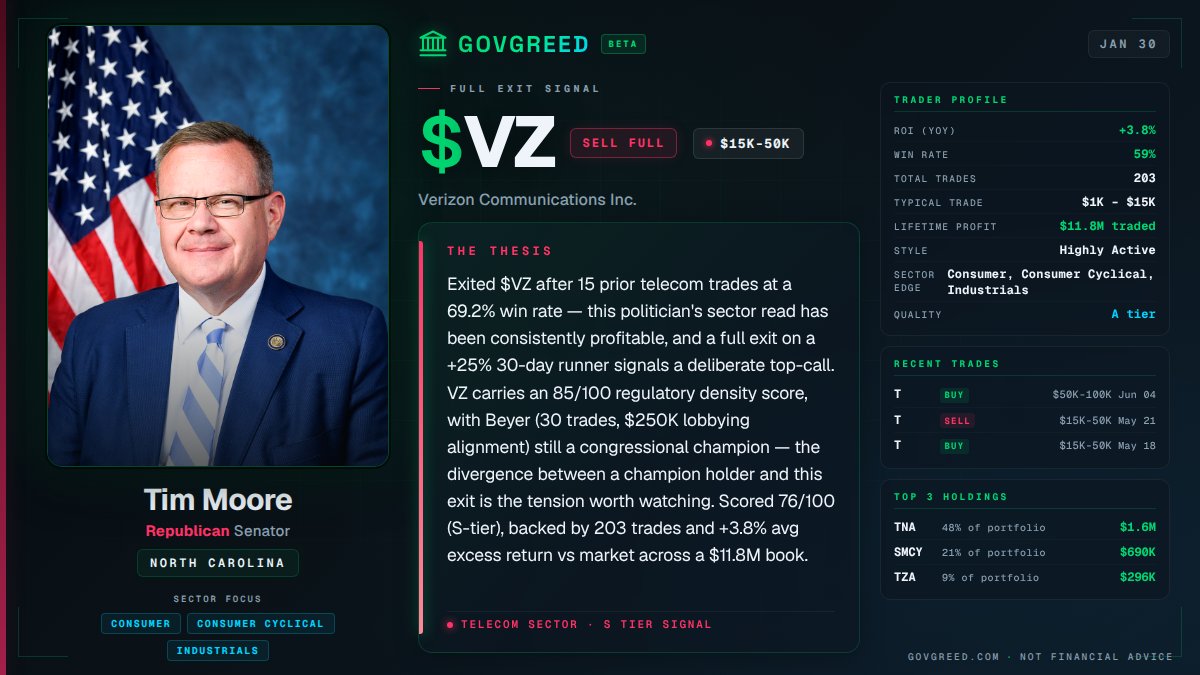
$VZ is up 25% in the last 30 days. Tim Moore (R-NC) just exited.
Moore runs a 203-trade portfolio with a 59% win rate and +3.8% avg excess return vs the market. In telecom specifically, he's 15 trades deep with a 69.2% win rate. He knows this sector.
The full exit landed January 30 — $15K–$50K out the door — right as Verizon was posting its strongest 30-day run in recent memory. Selling into strength, not panic.
Verizon carries an 85/100 regulatory density score. It's not a quiet company. It lobbies hard, and members like Moore — sitting on Financial Services — sit directly in its orbit.
343 total trades. $29.6M in volume. 44 late filings. This isn't a passive investor.
The receipts were always public. We just connected them.
$MSFT down 15% in 30 days — and Josh Gottheimer (D-NJ) just bought $500K–$1M worth.
Gottheimer has 911 prior technology buys on record. His win rate in the sector sits at 57.8%, against a career average of 39% across all trades. Tech is where he's sharpest.
Microsoft isn't a random pick here. The company carries $3.84B in federal contracts and a regulatory density score of 70/100 — exactly the kind of name that moves on policy, and Gottheimer sits on both the Financial Services and Intelligence Committees.
He's not alone in this trade. A herd cluster is quietly loading the same name right now — multiple members moving in the same direction, same window.
The receipts were always public. We just connected them.
Markwayne Mullin (R-OK) bought $50K–$100K of $JPM on December 29th — the last trading week of the year.
In finance, his sector win rate sits at 37.7% with an average excess return of -1.4%. This isn't his strongest hunting ground.
What's interesting is the timing. A herd cluster is active on JPMorgan right now — multiple members moving the same name in the same window. Mullin has 368 total trades logged and a 73-day average disclosure gap with 44 late filings. When he shows up in a crowded trade, it's worth noting.
JPM carries an 85/100 regulatory density score — heavily exposed to the Fed, OCC, CFPB, and SEC. Finance regulation doesn't move quietly.
Now we watch the disclosure clock.
$MSFT down 15% in 30 days. Gilbert Cisneros (D-CA) bought $50K–$100K anyway.
Cisneros has 3,948 disclosed trades totaling $75.8M in volume. In tech specifically, he's entered 448 times — 44.1% win rate, averaging -1.7% excess return vs. the market. Not his strongest sector.
His edge lives elsewhere: defense, financials, energy — where his Armed Services Committee jurisdiction overlaps with $4.5M in lobbying spend targeting his committees and an 81.3% win rate on those trades.
So why Microsoft, and why now? A herd cluster is active. Multiple members are quietly loading the same name into the same dip.
Microsoft carries $3.84B in federal contracts and a gov-dependence score of 65/100. When the dip is this clean and the cluster this tight, someone usually knows something the chart doesn't yet.
They write the laws, trade the companies those laws move, and disclose it months later. We just keep the receipts.
The U.S. government has started buying stock in the companies it funds. Not regulating them. Owning them. And around the announcements, members of Congress in both parties were trading the same names.
Two examples on the public record. In July 2025, the Department of Defense bought $400 million of preferred stock in MP Materials, a rare-earth miner. It was the first time the federal government became a major shareholder of a critical-minerals company. In January 2026, the Commerce Department took an 8-to-16% equity stake in USA Rare Earth, on top of a $1.3 billion loan.
This isn't one administration. The pattern started earlier and bigger. Under the CHIPS Act, Commerce put $8.5 billion into Intel, $6.6 billion into TSMC, and $6.1 billion into Micron. Tens of billions of federal dollars into a handful of named public companies, across two presidents and both parties.
When the government decides to fund a specific public company, that decision moves the stock. Which makes it something a member of Congress can trade. Legally, and on the record.
And they did.
Tommy Tuberville (@SenTuberville), Republican, traded Intel heavily around its $8.5 billion award: roughly $940,000 in disclosed sales and another $425,000 in purchases, including three buys in three days that May.
Ro Khanna (@RepRoKhanna), Democrat, sold Intel the day the grant was announced.
Michael McCaul (@RepMcCaul), Republican, sold about $175,000 of TSMC two weeks before its $6.6 billion grant.
Josh Gottheimer (@RepJoshG), Lisa McClain (@RepLisaMcClain) and Jonathan Jackson (D) traded the same chipmakers in the same window.
There's a twist. The government is not a good stock picker. Its $8.5 billion pick, Intel, fell 29% in the month after the announcement. Its $6.1 billion pick, Micron, rose 17%. Even the government is guessing.
None of this is hidden and none of it is illegal. The grants were public. The trades were disclosed. They were just never laid side by side. When the government picks a company to bankroll, that is now a trade, and the people who write the budget are the people holding the stock. Two parties built the same machine.
GovGreed didn't find a secret. It laid the government's checkbook next to Congress's brokerage statements.
Not financial advice. All data from public federal disclosures.
Elizabeth Warren (D-MA) bought $RTX — the senator with zero lifetime personal stock trades on record just appeared in a defense disclosure.
RTX Corporation sits at 95/100 government dependence. $68.6B in federal contracts. Up 5% in the last 30 days. This isn't a random tech bet.
The backdrop: SJRES.32, a joint resolution on congressional disapproval of a proposed foreign military sale, moving through Senate Foreign Relations. A blocked Israel arms deal doesn't hurt RTX — it redirects demand. Alternative pipelines, preserved global pricing power.
Warren sits on Armed Services. She sees the flow before the flow is public.
The signal scores a 51/100 conviction — a B tier. Not a screaming buy signal. But for a member whose trading history reads as completely blank, any trade is a data point.
See who else is quietly loading the same name — on GovGreed.
Eli Lilly is down 5% in the last 30 days. Someone still bought.
Josh Hawley (R-MO) sits on the Senate HELP Committee — the same committee with jurisdiction over S.1157, the Women and Lung Cancer Research and Preventive Services Act of 2025. $LLY is the largest household-name pharma with a major oncology portfolio. Expanded lung cancer R&D and screening mandates flow downstream to therapeutics. Hawley's own trading history shows minimal activity, making this purchase stand out against his usual pattern.
Lilly's regulatory density score is 95/100. Its government dependence score is 85/100. Congress is the top threat — and the top opportunity.
They write the laws, trade the companies those laws move, and disclose it months later. We just keep the receipts.