Despite the efficacy of GLP-1s in treating obesity, the high cost of these drugs pose significant challenges for public health systems worldwide.
In @TheLancet, Johan Dellgren, @GovindPersad, and I look at the limitations and the promises of GLP-1s. https://t.co/WyUjWyLhOT
There are many more results in the paper, so check it out!
https://t.co/VXlUXIb9Ib
(Feel free to email/DM me if you can't access it.)
And a huge shout out to the whole VIBES team: @sophiehgibert, Leila Orszag, @_Haley_Sullivan, Rachel Fei, @GovindPersad, and @emily_a_largent.
Our article, Bioethicists Today: Results of the Views in Bioethics Survey (VIBeS), is now out in AJOB!
We surveyed 824 US bioethicists on:
(1) Major issues in bioethics, like medical aid in dying, paying organ donors, abortion, and many others
(2) Their backgrounds
🧵
Using GLP-1 scarcity as a working example. Prof Ezekiel Emmanuel says allocation has been done in many countries without any thought to ethics. But if you’re 20 + have a BMI of >45 you may lose up-to 13 years of your life: if you are 70 + have a BMI >45 it is only 3. So what is fair? @BCEPShealth
'Fair Allocation of GLP-1 and Dual GLP-1–GIP Receptor Agonists' is out in @NEJM (ungated)
https://t.co/04kMmEIB1O
We propose a framework to guide goverments, professional societies, & docs in allocation choices about drugs like semaglutide (#Ozempic/#Wegovy) when demand > supply
"Coverage for weight-loss drugs could reduce obesity immediately while less consumption of harmful foods could help prevent it. Fewer people would need expensive treatments like Wegovy in the longer term."
@GovindPersad & @ZekeEmanuel via @WSJopinion
https://t.co/T38umnaAO4
In my latest for @WSJ, @GovindPersad & I argue that North Carolina’s decision to deny coverage for GLP-1 drugs like #ozempic for individuals with obesity is both unethical and short-sighted. Read below ⬇️ 1/4
https://t.co/nTJWnBE1ns
North Carolina & other health systems are being unethical when they categorically refuse to cover GLP-1 receptor agonists (e.g. Ozempic, Mounjaro) for obesity. So I & @ZekeEmanuel argue in our @WSJ op-ed.
https://t.co/o3hAVkJGZR
Thread highlighting a few points 1/5
#bioethics
Last, while trade-offs in drug spending are inevitable, creative use of Pigouvian taxes could lessen their sharpness
Taxing soda & other obesogenic foods could raise revenues for covering GLP-1 receptor agonists, while mitigating the need for them.
https://t.co/i0CDKT246L
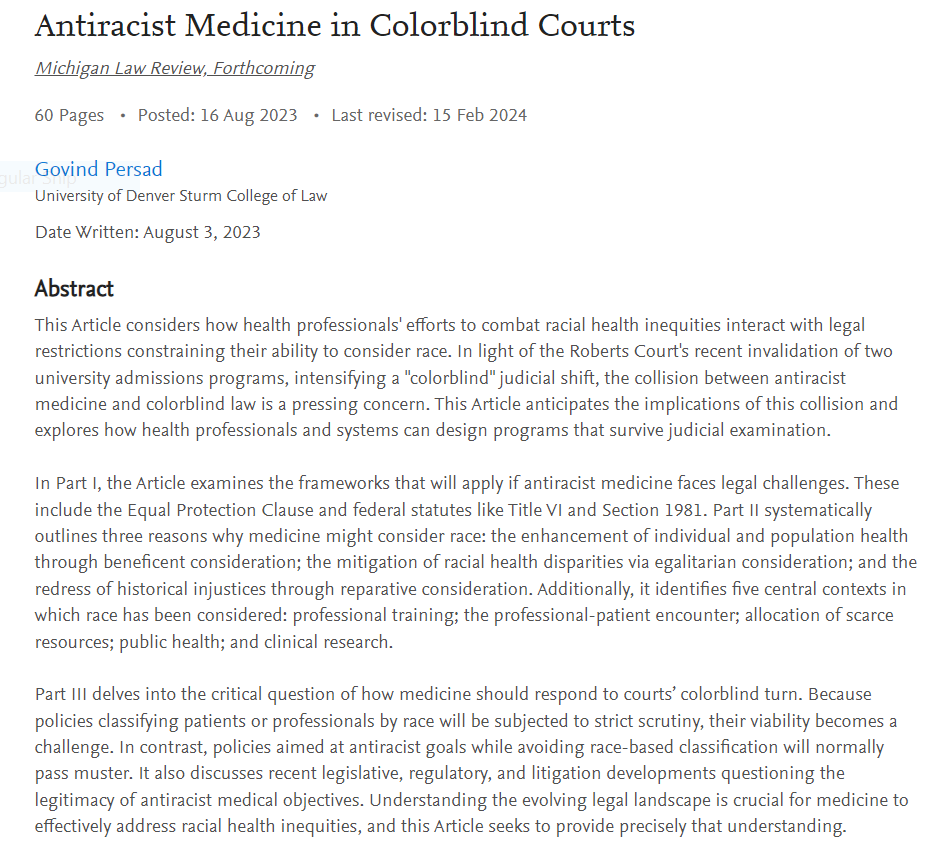
Revised draft of “Antiracist Medicine in Colorblind Courts,” forthcoming @michlawreview: https://t.co/ZarzsqZNyF
Added material on new §1981, §1557, and Equal Protection litigation against health & other programs that consider individuals’ race.
New TX & UT laws also discussed
Some of the grant cases are patterned on litigation against non-health grantmakers (e.g. Atlanta's Fearless Fund) being brought by the same organization and attorneys that litigated the Harvard/UNC affirmative action cases:
https://t.co/s4DmCfkowi