India does not need more hospitals.
It needs fewer heart attacks, fewer strokes, and fewer repeat events.
Treatment saves lives.
Prevention changes outcomes. 🧵
By the end of life, your IQ correlates with your parents at 80 percent. Everything else, school, nutrition, coaching, late nights, reading, accounts for the remaining 20 percent.
That single number reframes how much credit we give to effort and environment. Twin studies that keep genetics identical while changing the upbringing keep returning the same pattern across dozens of traits.
In the clip Chris Williamson lists the heritability estimates from Robert Plomin’s book Blueprint: psychological traits overall around 50 percent, eye color 95 percent, height 80 percent, weight 70 percent, breast cancer 10 percent, stomach ulcers 70 percent, schizophrenia 50 percent, autism 70 percent, school achievement 60 percent, verbal ability 60 percent, remembering faces 60 percent, spatial ability 70 percent, and general intelligence starting at 50 percent before rising to 80 percent later in life.
These figures matter because they are population-level statistics drawn from decades of twin and adoption research, not individual destinies. Environment still influences outcomes, especially in extreme conditions, yet the consistent genetic contribution is far larger than most public discussion allows. Treating nearly every difference as primarily environmental has led to repeated over-investment in late interventions that the data suggest have limited independent power.
I stopped assuming most trait gaps were mainly the result of trying harder or better upbringing years ago. The numbers keep pointing in a different direction.
EU relaxes rules for gene-edited crops
The new laws break away from 20-year-old restrictive GMO directives to give an official nod to plants made with new genomic techniques https://t.co/dy3JPxs03z
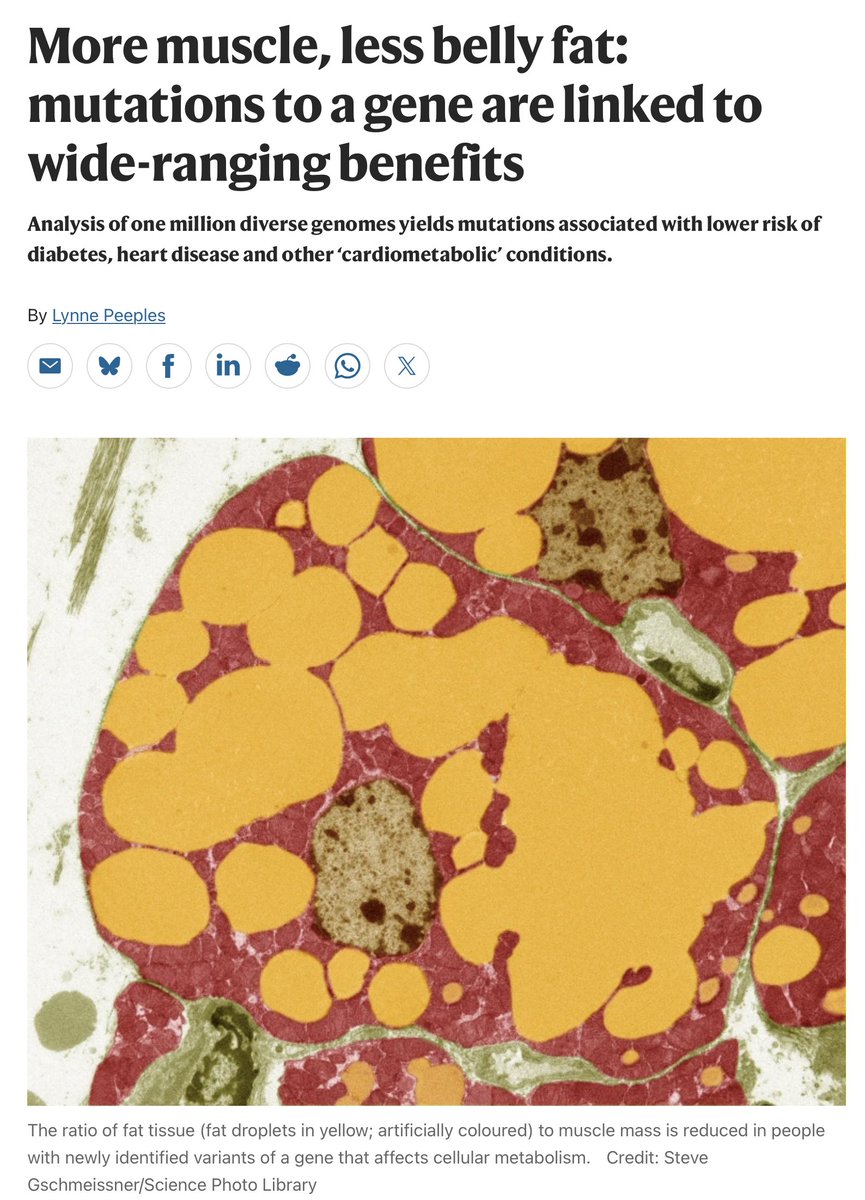
New finding @Nature from >1 million diverse individuals:
These are rare FNIP gene variants that are very good to have
Less belly fat, more muscle, 60% lower chance of cardio
metabolic disease, protection vs obesity
https://t.co/pbwBzt2w5o
https://t.co/f6lCPg5tI0
At the cellular level, your body has about forty different ages (according to one of the largest aging studied ever run and published this week)
A new study in Nature Medicine took blood from 60,542 people, measured over 7,000 proteins, and traced them back to the specific cell types that made them: brain cells, muscle cells, lung, gut, bone marrow. Then they built a separate "aging clock" for each one.
The finding: your cell types don't age in sync. Your muscle can be a decade older than your liver. Your brain's support cells can be racing ahead while your immune cells stay young. One to three percent of people have ten or more cell types aging fast all at once.
Fast-aging brain support cells (astrocytes) flagged future Alzheimer's about as strongly as the highest-risk Alzheimer's gene. Fast-aging muscle cells flagged ALS more than three years before diagnosis. Aging airway cells stacked on top of smoking to push lung cancer risk higher still.
But the one to sit with is muscle. Across all forty-plus cell types, accelerated muscle aging was the single strongest predictor of dying from any cause. Not brain, not heart. Muscle.
muscle is the most modifiable tissue you have. This study can't prove training rewinds the clock, but everything we already know points the same way. Muscle loss tracks death in every population it's been measured in, and the protein signatures behind this clock are the same ones tied to how your muscle is built and how well it makes energy. The strongest death-predictor in the body is also the one you have the most power over.
Normal cellular aging: 9 in 10 alive at fifteen years. More than twenty cell types aging fast: about 1 in 3.
this isn't a test you can buy. It's a research finding from banked blood, in a group skewing older and mostly white. Younger, more diverse validation comes next.
We're offering grants of up to $50,000 in Claude usage credits to researchers accelerating cures for rare diseases.
This is our first focused call within AI for Science, our program supporting scientists using Claude to speed up discovery. https://t.co/rZEmwh07cd
🚨 Carlo Ancelotti on why he did not celebrate wildly after Gabriel Martinelli’s late winner for Brazil against Japan:
🗣️ “People asked me why I didn’t celebrate, but football is also about respect. Yes, we were happy to win, but I looked across and saw a Japanese team that had given absolutely everything. They fought with incredible courage, and I know exactly how painful a defeat like that can be.”
“Of course I celebrated inside because my responsibility is to Brazil and qualifying was our objective. But I’ve been in football for many years, and I’ve experienced both victory and heartbreak. Sometimes the best way to respect your opponent is to remain humble in your biggest moments.”
“Japan made us suffer for ninety-five minutes. They deserved our respect, not exaggerated celebrations. Brazil are through, but we know we must improve. Tonight we celebrate the qualification, but tomorrow we go back to work because the World Cup only gets more difficult from here.”
Carlo Ancelotti is a legend
{@FoxNews }
In India for a few dollars a day people are being paid to use claws devices and head cameras to capture mundane tasked for world model and Robotic training.
This is genuinely one of the most powerful Claude stories I have come across.
A 62 year old man in India had severe migraines for 25 years. Only when lying down. Neurologists. Nephrologists. Brain MRIs. Blood thinners.
Nobody could explain it.
His nephew brought everything to Claude.
Claude noticed the one thing 25 years of specialists missed.
The headaches were positional. It connected dots across nephrology, neurology, and pulmonology simultaneously. Something no single doctor was positioned to do.
Then it asked one question nobody had thought to ask in 25 years.
Does he snore?
Loud snoring for 25 years. Every doctor dismissed it as dialysis fatigue.
Sleep study done. Breathing stopped 119 times per night. Oxygen dropped to 78%.
CPAP machine. Headaches gone.
Claude did not replace his doctors. It just looked at everything at once.
That was enough.
One Claude conversation cracked it.
Renowned geneticist, Dr. Kumarasamy Thangaraj honoured with Padma Shri, globally recognised for his outstanding contribution in the field of population and medical genetics, advanced Indian population science through studies of genetic origins, migration patterns, and an alternative hypothesis on ancient Indian population history.
#peoplespadma2026 #padmaawards2026 #padmashri #scienceandengineering
Today, @lifebiosciences confirmed the first patient has been dosed with an epigenetic restoration drug candidate. An exciting milestone 🚀
Life Biosciences is the OG cellular rejuvenation using epigenetic restoration to reverse diseases of aging. It was cofounded by @davidasinclair, who serves as Chairman
The company’s proprietary Epigenetic Restoration platform utilizes three transcription factors, OCT4, SOX2, and KLF4 (OSK), to restore older and damaged cells to a younger and healthier state. This innovative approach targets a root cause of aging at the epigenetic level, and has the potential to address a wide range of serious age-related diseases
The Phase 1 trial will evaluate the safety and tolerability of ER-100, with additional endpoints assessing visual function. ER‑100 is the first clinical candidate from Life Bio’s Epigenetic Restoration platform, which uses controlled expression of three transcription factors, OCT4, SOX2 and KLF4 (OSK) to restore cellular function by resetting the epigenetic code to more youthful patterns of gene expression
“This is an important moment for Life Bio and for the field of aging biology,” said David Sinclair, Ph.D., Co‑founder of Life Biosciences and Professor of Genetics at Harvard Medical School. “Our research has suggested that aging is driven in large part by the loss of epigenetic information, not irreversible damage. This clinical study represents the first opportunity to test whether restoring that information can ameliorate human disease.”
Beyond ER-100, the company is strategically broadening its therapeutic pipeline to address additional age-related diseases, underscoring the platform’s versatility and transformative potential.
“This milestone reflects years of rigorous scientific development and translational research,” said Sharon Rosenzweig‑Lipson, Ph.D., Chief Scientific Officer of Life Biosciences. “Our preclinical studies have demonstrated that controlled OSK expression can reset epigenetic patterns associated with healthy cellular function, improve tissue performance, and restore visual function in animal models. Advancing ER‑100 into the clinic is an important step toward translating epigenetic restoration into a new class of medicines for age-related diseases.”
Optic neuropathies represent a large unmet medical need. Current treatments primarily address risk factors, such as intraocular pressure in glaucoma, but do not directly target the damage to retinal ganglion cells. As a consequence, the disease often leads to irreversible vision loss despite treatment
Vision loss not only directly impacts patients’ lives, but also increases the risk of loss of independence, damaging falls, and depression and dementia due to social isolation, underscoring the need for disease-modifying therapies.
Beyond ER‑100, Life Bio is developing applications of its proprietary Epigenetic Restoration platform for multiple indications in a variety of organs, reflecting the broad therapeutic potential of this platform.
About Optic Neuropathies Optic neuropathies are a group of disorders characterized by damage to retinal ganglion cells (RGCs), the primary neurons connecting the eye to the brain. Because RGCs do not naturally regenerate, damage results in permanent vision impairment. One such optic neuropathy, open-angle glaucoma (OAG) is a chronic neurodegenerative disease and a leading cause of blindness in older adults
While often associated with elevated intraocular pressure, disease progression frequently continues despite treatment, and some patients suffer from OAG despite normal intraocular pressure. Non-arteritic anterior ischemic optic neuropathy (NAION) is the most common acute optic neuropathy in adults over fifty. It involves sudden, painless vision loss due to insufficient blood flow, for which there are currently no approved treatments
About ER-100 ER‑100 is an investigational therapy in clinical development for the treatment of optic neuropathies including OAG and NAION. ER‑100 is designed to restore function in retinal ganglion cells using Life Biosciences’ Epigenetic Restoration platform, which utilizes controlled expression of three transcription factors, OCT4, SOX2 and KLF4 (OSK), to reset cellular gene expression patterns and restore cells to a more youthful and functional state. ER‑100 is currently being evaluated in a Phase 1 clinical trial. More information can be found at https://t.co/GDRzIctoot (NCT07290244): https://t.co/Jj9cnu2M6w
For more information, visit https://t.co/msih0JTYfF or follow on social media
https://t.co/pEGPJjFjnQ
🚨 What if heart disease is not a modern lifestyle disease at all?
Mummies from Egypt, Peru, and the American Southwest all show calcified arteries.
These people never touched a drive-through, a cigarette, or a bag of processed chips.
But the data says this problem runs far deeper than your diet.
And no, they are not just outliers.
I am a board-certified cardiologist.
I have spent my career treating patients who do everything right and still develop atherosclerosis.
This research stopped me cold.
Here is what the science actually says.
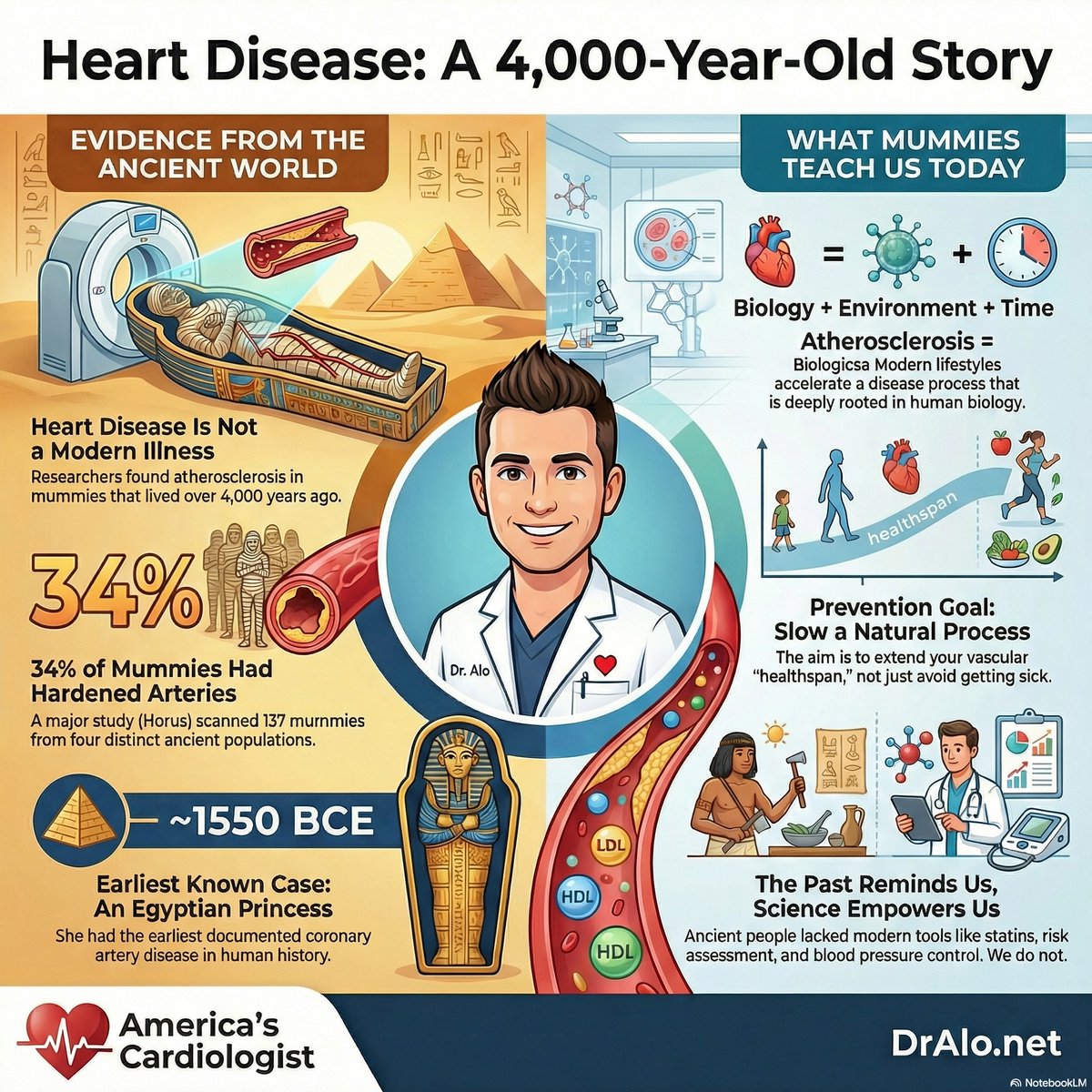
🔬 The Horus Study scanned 137 mummies across four ancient populations:
Egyptian mummies dated 3800 BCE to 364 CE
Peruvian mummies dated 200 to 1500 CE
Ancestral Puebloans from the American Southwest
Hunter-gatherer populations from the Aleutian Islands
✅ HORUS STUDY: Probable or definite atherosclerosis found in 47 of 137 mummies. That is 34%.
✅ HORUS STUDY: Atherosclerosis identified in all four populations regardless of diet, geography, or lifestyle.
✅ HORUS STUDY: The oldest confirmed case of atherosclerosis dated to a woman who died approximately 3500 years ago.
💓 These populations had zero industrial food.
No seed oils.
No refined sugar at industrial scale.
No sedentary desk jobs.
Many were hunter-gatherers walking 10 to 20 miles daily.
And their arteries still hardened.
That matters because it obliterates the idea that diet alone caused the cardiovascular epidemic we face today.
🔬 What drove ancient atherosclerosis:
Chronic infection and systemic inflammation from untreated wounds and parasites
Smoke inhalation from open fires used for cooking and heating
Genetic predisposition to elevated LDL and ApoB particles
Lipoprotein(a) elevation requiring no modern diet to manifest
Chronic stress from predation, famine, and warfare
⚠️ This is not permission to eat whatever you want.
Modern diet and lifestyle accelerate a process that already existed in human biology.
We took a slow-burning fire and poured fuel on it.
🩺 The distinction that matters clinically:
Ancient populations showed atherosclerosis concentrated in major arteries, primarily the aorta and coronary arteries, at rates around 34%.
Modern Western populations show atherosclerosis in the same vessels at rates exceeding 70% by age 65 in autopsy studies.
We did not invent the disease.
We perfected it.
🔸 What the ancient data cannot excuse:
Smoking doubles plaque progression rate
Insulin resistance accelerates vascular inflammation by 3 to 5 times baseline
Untreated hypertension adds mechanical stress that ruptures existing plaque
Elevated ApoB in a modern high-calorie environment is catastrophically more dangerous than in a calorie-scarce ancient one
❌ Blaming only processed food will not save you.
❌ Blaming only sedentary living will not save you.
❌ Blaming only stress will not save you.
The tools with the strongest data are unsexy, free, and require your participation.
A patient who measures their ApoB, checks their Lipoprotein(a) once, controls blood pressure, and treats inflammation early can halt plaque progression in 12 to 24 months.
That is the difference between a stable artery and a ruptured plaque at age 52.
❤️ Bottom line:
Heart disease is not a modern invention. It is an ancient human vulnerability we have made catastrophically worse.
The Horus Study scanned 137 mummies across four civilizations separated by thousands of years and found the same arterial disease in all of them.
Know your ApoB. Know your Lipoprotein(a). Treat inflammation. Control blood pressure. Do not wait for symptoms.
You can identify and interrupt this process years before it kills you.
The question is no longer whether your lifestyle caused this entirely. The question is whether you are accelerating a process already written into human biology.
Are you paying attention to the numbers that actually predict your risk?
#Cardiology #HeartDisease #HeartHealth #CardiovascularHealth #Atherosclerosis #ApoB #Lpa #AncientMedicine #PreventiveCardiology #MetabolicHealth