Since it's fashionable at the moment, maybe I should launch my own party and run for chancellor. I'll bring back nuclear power and outlaw fax machines!
ePA? Nein, danke!
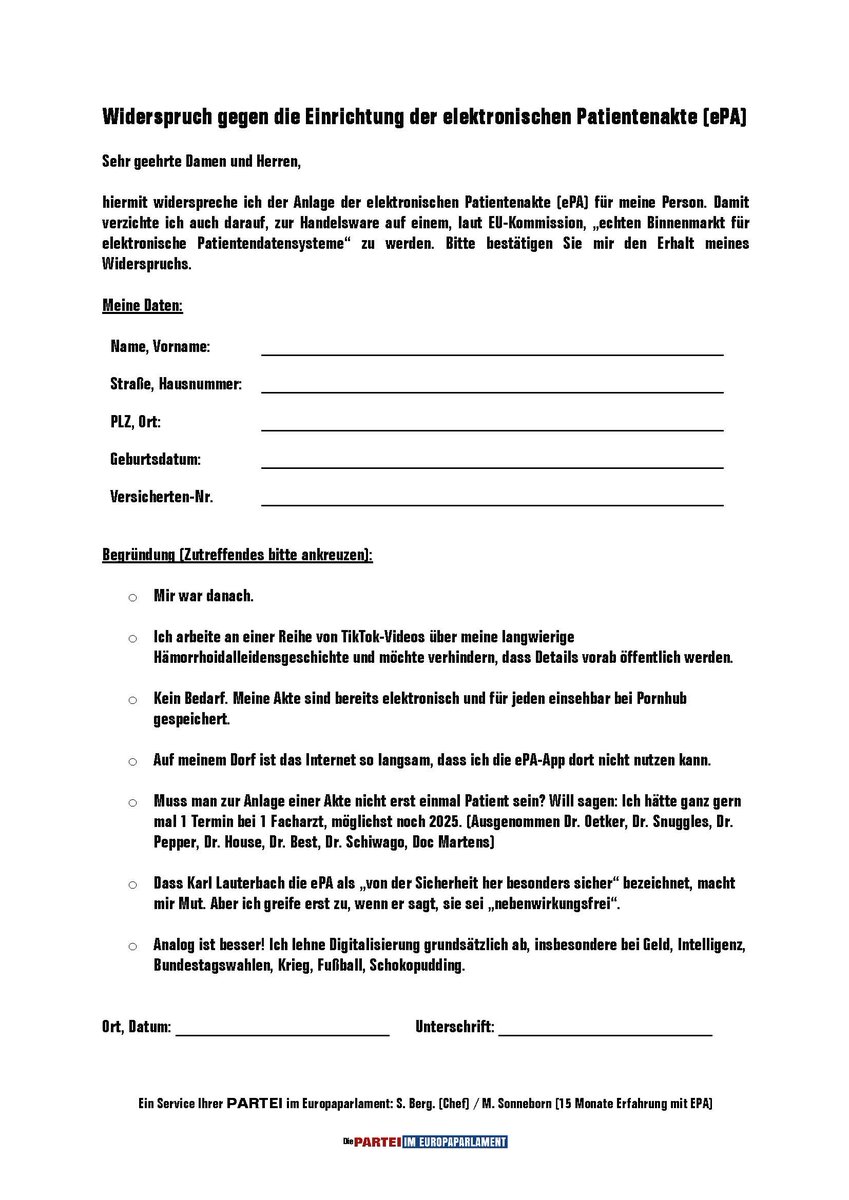
Hurra, die elektronische Patientenakte ist da! Ab dem 15.1.2025 wandern die Gesundheitsdaten von 70 Millionen Bürgern ins Netz - wenn Sie nicht widersprechen: Leberwerte, Adipositas, Schuhgröße, Wochenbettdepression etc.
Leider haben die Lümmel vom Chaos Computer Club gerade gezeigt, wie fix sie dort wieder abgerufen werden können. Von praktisch jedem.
Wenn Sie also der Einrichtung einer ePA widersprechen möchten, haben wir hier das passende Formular für Sie. Einfach auf meiner Homepage herunterladen, ausfüllen, an Ihre Krankenkasse schicken. (Profi-Tipp: „Porto zahlt Empfänger!“) Nichts zu danken, küss’ die Hand, Ihre PARTEI im EU-Parlament...
@TravisMWhitaker@bayesalgo It saves you time/effort as the interviewer, but you won’t get a good signal and it’s not a fun process for the interviewee. Unless you’re interviewing for low-level internships, don’t do this if you *actually* want to find the best fit for the role
Good news everyone! The C++ committee just adjourned and decided that the syntax for reflection would be a double caret:
^^
Also known as operator unibrow 🤨
You heard it here first, operator unibrow is (likely) coming to C++26
Now, all the programming fonts need a new ligature…
@TravisMWhitaker@bayesalgo Sure but how does a code screen with leetcode questions help you there? Asking questions / walking through their open source code could have given them such a strong signal in comparison
I’m watching Category Theory lectures and I became convinced that the following is myth:
“You need to learn Category Theory to understand Haskell”
The following, however, is absolute facts:
“You need to learn Haskell to understand Category Theory”
According to multiple new surveys, many people – including scientists – censor personal views. Most worryingly, scientists admit to self-censorship even in academic publications.
https://t.co/0h64X9kzQz
"Arbeitgeberanteile" sind die größte PsyOp der Geschichte der Bundesrepublik Deutschland.
Für einen Nettolohn von 2300 € muss ein Arbeitgeber satte 4350 € in die Hand nehmen. Das "Arbeitnehmerbrutto", hier 3500 €, ist eine reine Phantasiezahl, die nur eurer Ablenkung dient.
@seanbax Why prescribe panic on out of bounds for builtin types etc, instead of making it an implementation-defined choice of exception or panic? For testing & debugging I’d probably want to have exceptions thrown. Or maybe my safety requirements preclude me from abrupt termination
Here’s your periodic reminder that
`usr` in /usr/bin stands for “universal system resources” not “user”, and
`/dev` in `/dev/vdisk0` stands for “device” not “development”
🙌
All my experience tells me that the main cause of unmaintainable code is that each piece of code is not kept independent. I don't care about OOP, the language you use, where the heck you put your brackets, whatever. Just keeps your pieces of code isolated.
And name things well
If you can't name it, you probably don't know what it is.
If you don't know what it is, you don't know what it _isn't_.
If you don't know what it isn't, you don't know what code shouldn't be in it.
So much code shouldn't be in it.
Actually I was reading the book "A Poison Like No Other: How Microplastics Corrupted Our Planet and Our Bodies" just last week.
I didn't realize the extent to which plastics have come to permeate and mess with our entire environment. It's not just about the polymer granules of the plastic, which is problematic by itself when during their breakdown they get small enough to make their way everywhere, including inside our organs, brains, etc.
It's about the ~thousands of exotic chemicals that get mixed into the plastics to tune them: plasticizers (to make them more flexible/durable), stabilizers (to help them resist heat, light), flame retardants, colorants, fillers, antioxidants, UV stabilizers, antistatic agents, lubricants, biocides, etc etc. These chemicals leach from the plastics over time (by default, but especially when you e.g. when you microwave your food). The vast majority of these chemicals have never been evaluated for safety.
There's many other fun facts in the book. We already knew "recycling" of plastic is basically fiction. It also turns out that e.g. when you see "biodegradable" on your plastic, that doesn't mean in normal natural conditions - they only degrade via specific processing plants that are equipped to degrade them.
Toxic, indestructible, synthetic molecules are mixing through the organic environments and the food chain and quite likely poisoning the environment and us.
It definitely feels like we've allowed the convenience of plastics to get way ahead of our understanding of their global effects and that there are some major unpriced externalities in the industry.