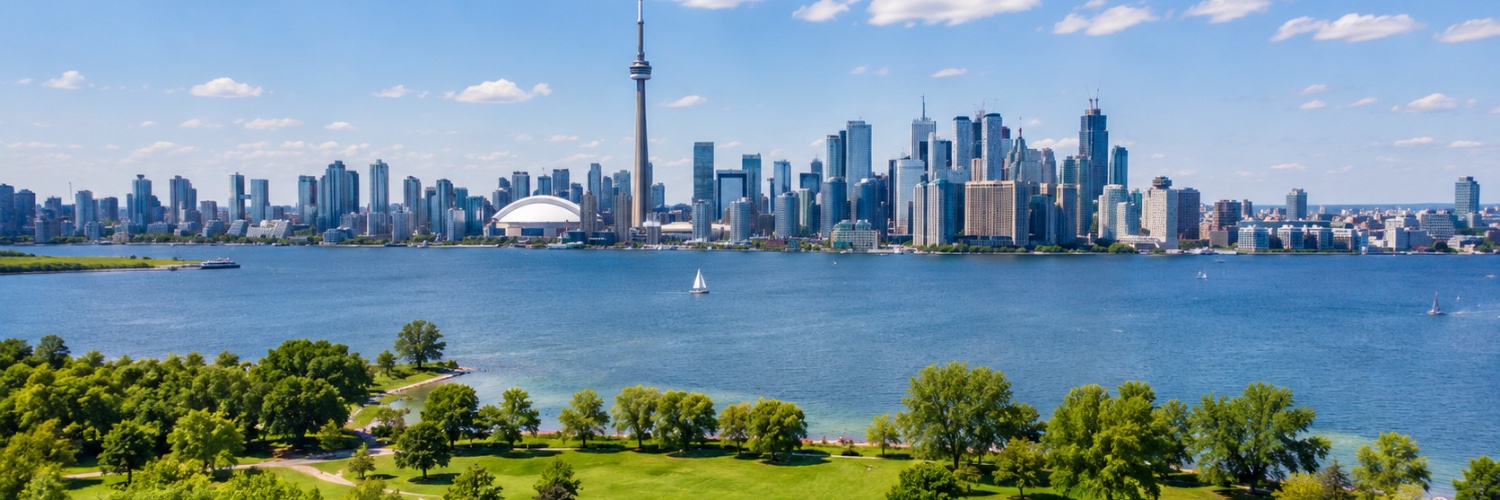
Canada Needs a New Model for Building Cities
Prime Minister Mark Carney's Canada Investment Summit has brought some of the world's largest pools of capital to Toronto with an ambitious objective: to catalyze $1 trillion of investment in Canada over the next five years.
That's exactly the kind of ambition Canada needs.
But it also raises a bigger question:
Are we being ambitious enough about what we ask investors to invest in?
Much of the discussion around investment understandably focuses on energy, critical minerals, AI, manufacturing and major national infrastructure.
But Canada has another enormous investment challenge sitting in plain sight:
our cities.
Canadian municipalities are struggling to build the transit, housing infrastructure, water systems, public spaces and other assets needed to support population growth.
The usual explanation is that cities don't have enough money.
That's true — but I think it misses the larger problem.
Canada doesn't simply have an urban infrastructure funding problem. We have an urban infrastructure business-model problem.
Our current system is remarkably fragmented.
A city plans a transit line.
Another government funds part of it.
Developers build housing around it.
Landowners benefit from rising property values.
Governments collect additional income, sales and corporate taxes, from the economic activity it creates.
Pension funds and other institutional investors invest their capital elsewhere.
Everyone participates in the economic value created by the infrastructure — but we rarely design the project from the beginning so that some of that value helps pay for the infrastructure itself.
Instead, municipalities rely heavily on property taxes, development charges, debt and periodic funding agreements with provincial and federal governments.
Then we wonder why it is so difficult to build.
There is another way.
Suppose we stopped thinking about a new subway line as simply a transportation expenditure.
Think of it instead as the backbone of a 30-year urban investment strategy.
The public sector could assemble land around stations, establish the planning framework, build the infrastructure and retain ownership of strategically important public land.
Private developers could compete for development rights.
Instead of selling valuable public land outright, governments could use long-term ground leases.
Some of the increase in land value created by the transit investment could be captured and reinvested.
Commercial development, housing, district energy, station retail and other revenue-producing assets could create investable cash flows.
The Canada Infrastructure Bank could provide patient capital or help reduce particular project risks.
Canadian pension funds, sovereign wealth funds and global institutional investors could invest in assets capable of generating long-term returns.
Government would still fund the portions that are genuinely public goods.
But the entire project would be designed as an integrated economic platform, not a collection of disconnected expenditures.
This requires more than new financing instruments.
It requires a different institutional model.
Our largest cities need dedicated Urban Investment Corporations that can combine public land, infrastructure, planning, development rights, and private capital into projects spanning several decades.
City councils would still determine the public objectives.
But professional investment and development organizations would turn those objectives into executable projects.
There is an important principle here:
Public infrastructure creates enormous economic value. The question is whether we deliberately capture some of that value for the public, or simply allow it to accrue elsewhere.
Canada already has many of the ingredients.
We have enormous pension funds.
We have sophisticated infrastructure investors.
We have the Canada Infrastructure Bank.
We have valuable public land.
We have rapidly growing cities.
And now, through the Canada Investment Summit and a reinvigorated Invest in Canada, we are actively looking for opportunities to put large amounts of long-term capital to work.
The opportunity is to connect those pieces.
Instead of asking only:
"Where will governments find the money to build our cities?"
perhaps we should also ask:
"How do we redesign our cities' growth so that it becomes investable?"
Seriously? I couldn't believe this was real, but sure enough, I looked it up. It's an actual Rogers TV program airing in Saskatoon.
https://t.co/39TDIp1Sev
Oh boy. Environmental Defence’s checklist gets the economics totally wrong. It treats as-of-right upzoning as a way to “lower land costs” when in fact, it does the opposite.
Land is a perpetual call option; expanding what can be built on a lot raises residual land value. It gets capitalized immediately as a windfall to existing landowners.
Ontario’s housing shortage is driven by immigration-led demand growth. Unlocking more sites without capturing the uplift or addressing demand just transfers property rights to the rich and concentrates location premiums.
@treebeing@Graff2023@pothen@envirodefence Yes. I agree. Pothan’s arguments make no sense. He thinks adding more people to an area will reduce car trips. He makes no sense.
Toronto (and Vancouver) are suffering from the Eminem Effect — it’s what happens when a volcano meets a tornado and we are tied to the bed with the house on fire.
The volcano is that we have nowhere else for the lava (population) to go. We grew for decades through cheap, easy, outward sprawl. Today we can only layer on what we have.
The problem is that layering is slow and really expensive. Infill cannot absorb population nearly as fast.
The tornado is immigration. Not only can we not absorb at the rate we once did, we’ve increased the population growth rate.
What this does is it bids up the price of land and housing. A recent Fraser Institute analysis found new single-detached homes in Vancouver sold for roughly 4.7 times their construction costs and in Toronto for about twice those costs.
Add to it that we have had to increase development charges because we have had to add so much new infrastructure to support the volume of new residents. These charges get piled onto the cost of new housing.
Make no mistake—this is a disaster. We are tied to the bed with the house on fire. But until we recognize the dynamics of why it has happened and make appropriate changes, it will just get worse.
While we should welcome this effort, I doubt it will produce results. It’s focused on the wrong problem. It’s concerned mostly with taxes, fees, regulations, modern methods, and capital attraction. Those are important, but they aren’t the reason for the affordability crisis.
Here’s why:
The largest cost in Toronto, Vancouver, and similar metros is land, not construction. A recent Fraser Institute analysis found new single-detached homes in Vancouver sold for roughly 4.7 times their construction costs and in Toronto for about twice those costs. Those gaps reflect land values, zoning constraints, and charges—not the price of lumber, labour, or elevators.
In geographically constrained cities with greenbelts and little remaining easy greenfield, additional demand capitalizes almost entirely into residual land values. Cutting development charges or speeding permits may improve feasibility on the margin, but it won’t expand the underlying supply of developable land. In a rationed market the gains are largely captured by landowners.
Development charges themselves are high because the volume of new residents has required large new infrastructure. Ontario municipalities have treated “growth pays for growth” as an operating principle for two decades. Charges on single-detached homes in parts of the GTA have risen several-fold since 2011. That is not an accident of regulatory excess; it is the direct fiscal consequence of rapid population growth that outran existing capacity in water, wastewater, roads, and transit. A plan that does not address high immigration and asks only how to make building cheaper will not produce results.
Canada’s recent experience with high immigration illustrates the problem. From 2022 to 2024 housing starts remained near 1970s levels while population growth ran three to five times faster. In peak years the country added roughly five new residents for every home completed.
Non-permanent residents drove the bulk of that surge. Even the Bank of Canada has acknowledged immigration-driven demand as a contributor to the housing shortage. Recent reductions in temporary resident inflows have already eased rental pressure in several markets; that is evidence that we should be focusing on keeping our immigration numbers low.
The coalition’s priority list—attracting private capital for a multi-trillion-dollar build-out, simplifying taxes and fees, harmonizing codes, and enabling modern construction—may make sense for its members (developers, materials suppliers, rental providers). It won’t address the two main problems:
(1) limited remaining land in the highest-demand cities and (2) population growth that continues to exceed demonstrated absorption capacity in housing and infrastructure.
Attracting more capital to build on scarce land for a still-elevated inflow of residents will not lower residual land values; in fact, it will most likely bid them higher.
A better approach would be to treat housing, infrastructure, jobs, and population growth as one system. That would change the focus to calibrating permanent and temporary immigration targets to actual housing completions and infrastructure capacity rather than the reverse. It would confront land scarcity directly—through growth-boundary policy, genuine densification trade-offs, and realistic assessment of remaining greenfield—rather than assuming construction-cost cuts will dissolve it.
We need infrastructure funding reform so that rapid growth is not financed primarily by loading ever-higher charges onto new homes. We need to measure success by whether middle-class households can actually form and buy or rent suitable housing in the cities where jobs exist.
Until we make those elements central, this coalition’s report will just double down on solutions that have already been tried and failed. It will not fix the residual land price problem created by constrained land and that demand has outrun our absorption rate.
Unlike Canada, Japan and South Korea invest heavily in domestic human capital and use tightly controlled, selective temporary inflows rather than high-volume permanent immigration or open-ended TFW programs.
Both countries have education systems focused on strong outcomes and clearer vocational and apprenticeship-style pathways. They also have lots of company-based training, productivity focus, and automation.
I think one of the biggest problems is the power and protectionism of the provinces. Education, trades training, and certification are all provincial responsibilities in Canada. We have poor performance on producing the skills that are in demand across the country.
Germany’s higher density doesn’t mean places like Toronto can “just build like Europe.” There are lots of reasons why Germany is the way it is which go back centuries. Canada’s growth, by contrast, occurred mostly in the car era.
And don’t be fooled. Germany currently has a huge housing shortage. Its completions are running 185k units a year against an estimated need of near 320k. They have a shortfall of roughly 1.5 million homes concentrated in the big cities. Rents have also risen sharply too.
Density doesn’t remove high land/construction costs, planning friction, or high demand in desirable locations. And theoretical room on a map is not the same as available, assembleable land in the places people want to live.
Past Canadian population growth occurred when cheap greenfield land around cities was still available. Today’s growth is mostly infill on already-owned, occupied parcels. Assembling those parcels is slow and expensive. This pushes up land values and steers development toward tall, costly high-rises rather than the missing-middle forms that sound good in theory. We simply cannot absorb population at the rate we used to.
Missing-middle zoning changes help over the long term, but only at the margin. They don’t erase the assembly delays, infrastructure constraints, or the fact that new arrivals need somewhere to go in the meantime.
Canada needs a new growth plan—one that spreads population around the country more widely. If we continue with the model of trying to stuff everyone into Toronto and Vancouver, it will break. Pointing at Europe and saying “look at them” won’t solve the problem.
You misinterpret "there is plenty of room" with "land that is available." Yes, theoretically, plenty of room, but it's currently owned and occupied.
The difference between where Canada is today and where it was in past periods of high population growth is that land around our major cities was available for little money.
We are no longer in that world. All we have is infill, and infill is much harder (and slower) to build on. First, it is occupied and owned in many small plots. To build on it, you have to persuade people to sell and then assemble the land parcels. That can take decades, and it drives up land prices.
Infill drives massive high-rises rather than smaller, more human-scale urban designs. These tall buildings are expensive to build and take a long time.
In the meantime, new populations have to go somewhere. But where?
Canada needs a coherent growth plan that spreads the population out more uniformly across the country. The Liberals have not put one forward.