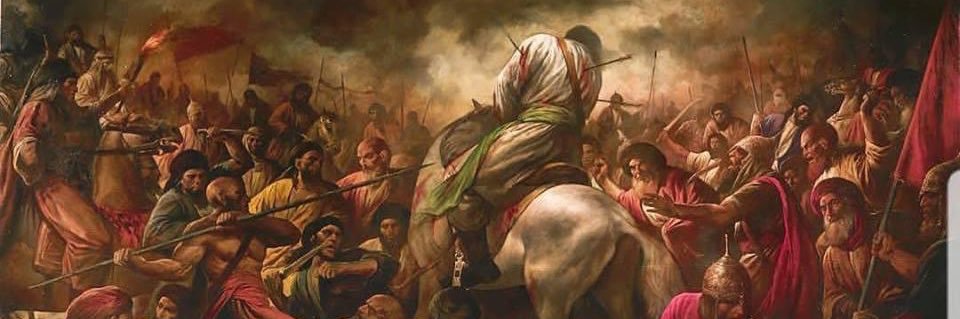
11th Muharram. 61 AH.
The day after.
Umar ibn Sa'd remained at Karbala until noon. He gathered his own dead, the men who had fallen attacking a camp of seventy and buried every one of them with full prayers and full honor.
He left Imam Hussain AS where he had fallen. He left every single one of his companions where they had fallen.
Unwashed.
Unshrouded.
Unburied.
The grandson of the Prophet ﷺ, lying in the sand of the same earth Jibra'eel had once shown his grandfather in a vision, denied the one thing every human being, friend or enemy, has always been granted since the beginning of Islam.
Only one body was treated differently. Hurr ibn Yazid's own tribe came forward and refused to let his head be severed or his body trampled with the rest. They carried him seven kilometers away and buried him in their own village, the only act of basic human decency permitted that day, granted to the one man among the attackers who had crossed over to die beside the Imam instead.
In the afternoon, Umar ibn Sa'd ordered the camp broken and the surviving family prepared for the march to Kufa.
His men brought camels with no saddles, deliberately, to make the journey as difficult and as degrading as possible for the women of the Prophet's ﷺ own household.
When his soldiers stepped forward to help the women mount, Sayyida Zainab SA stopped them outright. She said: "May Allah darken your face in this world and the next. You ask to help us mount when we are the trusts of Muhammad ﷺ himself. Step back. We will help each other."
They stepped back.
She moved between the women and children herself, helping each one onto the bare backs of the camels, until only Imam Zayn al-Abideen AS remained, too weak with fever to stand unaided. He told her he would manage with the help of the soldiers, then asked her gently how she intended to mount her own camel, since there was no one left to help her.
Before they were taken, the women begged to be allowed to see the bodies one final time. Permission was given.
What they found broke them where they stood. They fell upon the bodies, kissing them, weeping over wounds that could not be counted.
Sayyida Zainab SA, standing over what remained of her brother, cried out the words that have been carried in this family's memory since that hour: "O Muhammad! Here is Hussain, in the desert, covered in blood, his limbs cut from his body! Here are your daughters taken captive, and your descendants slaughtered!"
Then they were made to leave him there, in the sand, and the caravan turned toward Kufa.
I want to tell you honestly what is known and unknown about what happened next to the Imam's own body. The earliest historians, the ones whose pens we have leaned on throughout this entire series, fall silent here, because they had already moved with the captives toward Kufa and were not present for what followed at Karbala itself.
What Shia tradition holds, recorded by Shaykh Abbas Qummi and later affirmed in a narration attributed to Imam al-Rida AS, is this: Imam Zayn al-Abideen AS, despite lying chained and fevered in the captive caravan, was granted by Allah the same power later attributed to Imam al-Rida AS himself when he travelled to bury his own father, to return that very night to Karbala, bury his father's body and the bodies of his family with his own hands, and return to the caravan before anyone noticed his absence.
When a doubting follower once questioned how a sick, chained captive could have done this, Imam al-Rida AS answered him directly: "the same power that let me travel from Madina to Baghdad to bury my own father is the power that let Zayn al-Abideen do the same for his."
What the tradition agrees on regardless of this account is that the people of Banu Asad, the tribe whose land the Imam had purchased weeks before any of this began, eventually came forward and buried what was left at Karbala, the bodies sorted and placed in the ground that has remained, since that day, the most visited Shrine on earth.
The sun had set. The first night of captivity had begun. The road to Kufa, and from there to Damascus, lay ahead of a family that had just buried no one, and yet would not stop carrying everyone they had lost for the rest of their lives.
1400 years later, their story is far from over.
#YaHussain
#YaZainab
Sham e Ghariban.
The Evening of the Strangers.
اَلسَّلامُ عَلَی الْحُسَیْنِ وَ عَلی عَلِیِّ بْنِ الْحُسَیْنِ وَ عَلی اَوْلادِ الْحُسَیْنِ وَ عَلی اَصْحابِ الْحُسَیْنِ علیہ السلام
"Peace be upon Hussain, and upon Ali ibn al-Hussain, and upon the children of Hussain, and upon the companions of Hussain, peace be upon him."
اللّٰهُمَّ الْعَنْ قَتَلَةَ الْحُسَيْنِ وَقَتَلَةَ أَوْلَادِ الْحُسَيْنِ وَقَتَلَةَ أَصْحَابِ الْحُسَيْنِ
"O Allah, curse the killers of Hussain, and the killers of the children of Hussain, and the killers of the companions of Hussain."
I want to be honest with you about what follows. Some of it is recorded in the earliest histories. Some of it comes from the devotional tradition that grew in the centuries after, carried by mothers and grandmothers, generation after generation, because it captured something true even where it cannot be traced.
By sunset, every man who could have stood between the women and children and the world had fallen. Imam Hussain AS himself lay on the sand of Karbala. Seventy-two men. Heads severed. No ghusl. No kafan. No burial.
The army did not stop. They set the tents on fire, one after another, moving down the camp
In the chaos, the children scattered, fleeing the flames and the trampling horses in the dark. Sakina could not be found for a time. Umm Kulthum stood guard over the others while Sayyida Zainab SA went out searching, calling her name into the smoke and the noise.
Imam Zayn al-Abideen AS, the only adult man of the family left alive, lay through all of this unconscious with fever, too weak even to stand.
It is recorded, in the account preserved through the line of his own family's history, that when he learned what had happened, he asked his aunt to lift the edge of the tent so he could look out toward the field, and upon seeing it, said: "My aunt, my father has been killed, and with him the spring of generosity and honor has come to an end." His illness that night, severe enough to keep him from the battlefield, is held by the tradition to have been a mercy in disguise, sparing the line of Imamate so that someone would remain to carry this story forward.
There was no one left to guard the camp except a woman who had just watched every man she loved be carried home in pieces.
Sayyida Zainab SA did not weep, not where the children could see her break. She gathered them. She comforted the orphans. She is remembered, in the words passed down through generations of this story, as having picked up a broken spear to stand between the remaining tents and the soldiers still moving through the camp, the daughter of Ali AS, alone, armed with nothing but a length of broken wood and the fact that she would not move.
It is told, in the devotional tradition carried through this story for fourteen centuries that later that night, in the darkness, Zainab SA saw a rider approaching on horseback. Frightened, exhausted, certain there was nothing left to take from them, she called out for him to stop, that the children had only just settled, that they had nothing left to give. The rider did not stop. She raised the broken spear and warned him again, that she was the daughter of Ali AS and he should come no closer. Only when he was near enough to see clearly did she recognize her own father. He had not come to take anything. He had come to tell her: rest tonight, my brave daughter. I will guard your tents. There is a long road ahead of you yet, to Kufa, to Damascus. You are the guardian of this Imamate now.
We share this with you exactly as it has been carried, generation after generation, by people who needed somewhere to place an unbearable night, because even where history's earliest pen is silent, the truth of what Zainab SA carried that night, alone, wounded, surrounded, responsible for every surviving soul in that camp, needs no further proof.
By morning, the dead still lay where they had fallen. The living were already being readied for the march to Kufa.
This was the first night of a grief that has not ended in fourteen hundred years.
Ya Hussain. Ya Zainab.
Imam Hussain ibn Ali AS.
By the early afternoon of Ashura, the Imam stood in a field that had taken everyone from him. Since dawn he had carried, with his own hands, the bodies of men he had grown up loving and children he had raised as his own. Habib. Muslim ibn Awsajah. Zuhair. Hurr. Ali al-Akbar. Aun and Muhammad. Qasim. Abbas. And, in the final hour, his own infant son, whose blood he had caught in his palm before burying him in the sand.
There was no one left to carry now. He stood alone, in white clothes marked everywhere with the blood of everyone he had loved.
He went back to the tents one final time.
He went first to the tent of his son, Ali ibn al-Husayn, Zayn al-Abideen, who lay there unconscious with fever, too weak to stand, let alone fight. The Imam woke him gently. His son opened his eyes and saw his father standing over him, dressed in white stained everywhere with blood. He asked about Ali Akbar. The Imam told him: "My son, do not ask me about anyone else. Everyone is gone, except for you and me." His son tried to rise, asking for a sword so he could go and help. The Imam would not allow it. He told him there was a different jihad still ahead of him, one that required patience rather than a blade, one that would ask him to lead a broken family through what was still coming. He gave him his final instructions. Stay patient. Tell the people the truth of what happened here. Remember me whenever you drink water.
Then he turned to find his sister.
What passed between Imam Hussain AS and Sayyida Zainab SA in those final minutes belongs to her more than to anyone else, and we will tell her story in full when we reach it. What the sources agree on is this: he asked her to be patient, to try not to let her grief be seen, and he placed into her hands, without needing to say it outright, the leadership of everyone who would survive him.
He gathered the children. He held his young daughter close. He moved among the women of his household one final time, looking at each of them, the sources say, with eyes that could not stop themselves from filling with tears even as he tried to remain composed for their sake.
Then he walked to his horse, Zuljanah, the same horse the Prophet ﷺ himself had once gifted him as a child, an animal so bonded to him over the course of his life that the sources describe it lowering itself to the ground the very first time the young Hussain AS wished to climb onto its back.
The horse had carried him back and forth across that field since dawn, carrying the weight of everybody he had brought home. It is said that when he tried to mount it this final time, it would not move, as though it understood, in whatever way an animal understands, that this ride had no return built into it.
His daughter clung to its legs and would not let go.
He gently freed himself from her, and rode out, alone, toward an army that had already taken everyone he loved.
What followed is recorded plainly in the earliest chronicles. Imam Hussain AS, completely alone, fought with a courage that stunned the men sent to kill him. Even hardened soldiers, men who had killed without hesitation all day, found themselves unwilling to be the one who closed in on him directly. He held off the army that surrounded him for a length of time no single, exhausted, grieving man should have been able to manage.
When the time for prayer arrived, even in the middle of this, he stopped to pray. Some of the enemy mocked the very idea that his prayer would be accepted. He prayed anyway, the special prayer of one in fear and danger, because some things do not stop simply because death is close.
He was wounded again and again. Stones. Arrows. Spears. The sources record more than sixty wounds across his body by the time it was over. At one point he made his way toward the Euphrates one last time, not for himself, but still thinking, even then, of the thirst of the children behind him. An arrow struck him in the mouth. He pulled it out himself and continued fighting.
Eventually, weakened beyond what anybody could sustain, he fell from his horse.
The army closed in around him on the ground. Even then, some hesitated, unwilling to be the one remembered for what came next. It was Sinan ibn Anas, by the account preserved through Hamid ibn Muslim, who struck him at the time of Asr. Other accounts name Shimr ibn dhi al-Jawshan as the one who finished it, severing his head while the Imam was prostrate, his forehead already on the ground in worship.
Shimr was no reluctant or conflicted man that day. He had spent the entire siege as one of its most eager and merciless agents, the same man who had pressed Umar ibn Sa'd to attack when others hesitated, who had tried to set fire to the very tent sheltering the women and children, and who would go on to be remembered as one of the most cursed names in history. Whatever passed through his mind in that final moment, it was not mercy, and it was not reluctance born of conscience. It was a man finishing, without hesitation, what he had spent days working to bring about.
It was Friday, the tenth of Muharram, 61 AH.
The earliest sources record what is said to have happened in the heavens and the earth in that instant. Darkness. A trembling of the ground. A red rain. A voice, heard by some, saying that an Imam, son of an Imam, had been unjustly killed, the one who had cared for the poor, the sick, the widowed, and the orphaned, butchered without cause.
His body was stripped. His shoes, his sword, even the tattered shirt he had worn so the looters would have less to take, all of it taken. He was trampled, as Ibn Ziyad had specifically ordered, by the horses of the same men who had just killed him.
Zuljanah did not flee from any of it. The devotional tradition tells us the horse circled its fallen master, drawing arrows meant for the Imam's body onto its own, before finally turning and running back alone toward the tents, blood soaked, saddle empty and twisted to one side. When Sayyida Zainab SA and the women saw it approaching with no rider, they understood before a single word was spoken. They ran out toward the field, uncovered and wailing, needing no messenger to tell them what an empty saddle already had.
He was sixty years old, by most accounts. He had spent every one of those years, by the testimony of everyone who knew him, exactly the way he spent his last morning. Praying when it would have been easier not to. Giving water to enemies who came to him thirsty. Refusing to let injustice pass simply because resisting it would cost him everything.
It did cost him everything.
We have told you, across two months and dozens of names, what that cost actually was. Every companion. Every nephew. Every son. His own infant child. And finally, himself, alone, on a field he had purchased with his own money so that what happened on it would always belong to him and never to the empire that surrounded him.
A grandson of the Prophet ﷺ, the child once carried in his arms at Mubahila, the heir to the Wilayat declared at Ghadir, walked out alone into a field of thousands, having buried his own son with his own hands an hour before, and did not turn back.
إِنَّا لِلّهِ وَإِنَّـا إِلَيْهِ رَاجِعونَ
"Indeed, we belong to Allah, and to Him we shall return."
#YaHussain
#Karbala
Ali al-Asghar
The youngest of them all: Abdullah, known across the Muslim world as Ali Ashgar AS
He was the son of Imam Hussain AS and Rubab bint Imru al-Qays, an infant, only months old, perhaps newly born when the caravan left Madinah. His own sister, Sakina, loved him so dearly that when the family was preparing to leave, she would not let him go and had to be gently separated from him so the journey could begin.
By the time water was cut off from the camp, this child had gone days without his mother's milk, since thirst and grief had dried it in her. He cried, the way infants cry, from a need no one in that camp had the power to answer.
On the day of Ashura, when his father had nothing left to offer the world but the sight of this suffering, Imam Hussain AS carried him out toward the enemy lines. He held him up before thousands of soldiers and said, in words preserved across the historical tradition:
"If you will show no mercy to me, then have mercy on this child. He has done nothing. Give him water."
An arrow was shot at him by a soldier of the Yazidi army. The shooter was Hurmala ibn Kahil. The arrow which is said to have three heads, pierced into the throat of a nursing infant, in his father's arms, in full view of both camps.
Imam Hussain AS caught the blood in his palm. He raised it toward the sky and said, as recorded across the sources: "O Allah, judge between us and a people who invited us to defend their faith and then turned to kill us."
Imam Hussain then rubbed Ali Asghar's blood on his own face.
He carried his son's body back. He buried him with his own hands in the sand of Karbala.
This child never spoke a word in this world. He carried no sword, made no speech, chose no side in any battle of conscience the way every other martyr in this series did. He simply existed, thirsty, innocent, and present, and that alone was treated as a threat worth silencing.
There is a detail from the aftermath of Ashura, though it happened after his father had already buried him.
When Umar ibn Sa'd's men set fire to the camp and gathered the severed heads of the seventy-two martyrs to send to Ibn Ziyad, they counted them against the bodies on the ground and noticed something was missing. The infant's head was not among them.
Imam Hussain AS had buried his son with his own hands in the sand, away from the trampled battlefield, the only act of mercy he had left to give. The soldiers knew the child was dead. They simply did not have his head to add to the display they were building.
So they searched for the grave.
The sources record that they walked the soft ground near the camp, driving the points of their spears into the earth wherever the soil looked recently disturbed, probing for the place a father had dug with his own hands hours before. When a spear finally struck something, they did not stop to lift the body out with any care. They drove the spear through and lifted the infant's body straight out of the ground on its point.
Then they removed his head and added it to the rest, carried with the other seventy-one on spears, first to Ibn Ziyad in Kufa, then onward thirty-four days later to Yazid in Damascus.
The suffering did not end with his death. Even his small grave, the one act of dignity his father managed to give him in the middle of the worst day of his life, was violated within hours, by men searching the earth with spear points for a body too small to need such force to find.
There is nothing more to say about this that the bare fact does not already say on its own.
There is no lesson to extract from this one.
No choice to admire, no courage to hold up as an example, because an infant makes no choices.
There is only the fact of it, sitting where it has sat for fourteen centuries, refusing to be made smaller or more comfortable by anything we might say about it.
Ali Asghar AS is buried in Karbala, next to his father and his brother Ali Akbar AS.
#YaHussain.
#Karbala
Abu al-Fadl al-Abbas ibn Ali - Qamar Bani Hashim
He was the son of Imam Ali and Fatima bint Hizam, known to history as Umm al-Banin, the Mother of Sons. He was the eldest of four full brothers, all of whom would stand by Hussain at Karbala, all of whom would be martyred on that burning sand, with Abbas destined to be the last of them to fall.
He had inherited his father’s build and his father’s bearing so completely. Historical sources describe him as strikingly handsome, tall enough that his feet nearly touched the ground when riding. They called him Qamar Bani Hashim, the Moon of the Hashemites, a title tradition says his own father, Imam Ali, gave him after witnessing his fierce, veiled brilliance on the battlefield of Siffin while he was still barely a young man.
Yet, what defines Abbas in the memory of every generation since is not his physical stature. It is not even his unmatched swordsmanship.
What defines Abbas is his restraint.
From the earliest days of the siege at Karbala, Abbas asked his brother repeatedly for permission to fight, to break the blockade by force, to unleash the devastating skill everyone around him knew he possessed. But Imam Hussain asked him each time to wait. "We have not come here to wage war," the Imam told him. "We are here to show the world who we are through how we carry ourselves, not through what our swords can do."
And so, Abbas waited.
He waited through the cutting off of the water.
He waited through the agonizing deaths of companions he had grown up beside.
When the time came for his own maternal household to offer their sacrifice, Abbas stood by his blood brothers and sent them into the fray one by one, witnessing their martyrdoms to ensure their sacrifice was absolute:
1. Abdullah ibn Ali: The eldest of his younger brothers, whom Abbas sent first so he could bear witness to his patience and sacrifice in the way of Allah.
2. Jafar ibn Ali: Who stepped onto the sands next, fighting fiercely under his older brother’s gaze until he fell.
3. Uthman ibn Ali: The youngest of the four, was struck down by enemy arrows.
Throughout it all, Abbas carried the standard of the Imam's small army, the Alamdar, the flag-bearer, the visible anchor of hope that every crying child in the camp and every fearful eye on the battlefield turned toward.
The earliest written historical account we possess, preserved in Kitab al-Irshad by Shaykh al-Mufid, records that when the thirst became unbearable in the tents, the Imam himself set out toward the Euphrates, with Abbas riding directly in front of him. Ibn Sa'd's cavalry blocked their path. In the brutal, chaotic struggle that followed, the two brothers were violently separated.
Abbas, cut off from his master, was surrounded by an entire army, and was killed alone. That is the account history’s earliest pen wrote down.
Yet, there is a far more detailed narrative beloved across Muharram gatherings worldwide.
It is said that Abbas AS could not bear Sakina’s empty water-skin and he was only given permission by Imam Hussain to ride to the river and get water. Abbas rode alone to the river, filling the mashq while refusing to drink a single drop himself out of loyalty to his thirsty brother. On the way back he was attacked from all sides, and one by one both his arms were severed while he still gripped the water-skin with his teeth. He was struck on the head and fell on the ground with no hands to support his fall and with an arrow still stuck in his eyes.
I am too weak to narrate, the final, heart-wrenching words exchanged when Hussain came to his broken body.
This fuller telling comes to us through the devotional and Maqtal traditions that grew in the centuries afterward. Centuries of scholars, poets, and mourners have carried this narrative because it speaks an absolute truth about who Abbas was.
It is here, at the banks of that denying river, where the love of generations began adding its own tragic brushstrokes, immortalizing the grief in poetry that still echoes through the ages:
توفان اٹھانا تھا تجھے یا سوکھ جانا تھا تجھے
کچھ تو نے خدمت ہی نہ کی اے وائے نہرِ علقمہ
اک مشق پانی کے لیے عباسؑ کے شانے کٹے
ندی لہو کی بہہ گئی اے وائے نہرِ علقمہ
You should have raised a storm, Or you should have dried up entirely! You rendered no service at all, Alas, O River of Alqama!
For the sake of a single water-skin, The shoulders of Abbas were severed. A river of blood flowed instead,Alas, O River of Alqama!
What both history and devotion agree on completely is this: Abbas never once raised his sword for vengeance.
He carried water, not malice, as his final mission. And when he fell, he fell trying to bring relief to thirsty children, and Sakina AS, the daughter Imam Hussain loved the most.
He is buried exactly where he fell, on the banks of the canal that came to be called Alqama.
He rests separate from the mass grave of the martyrs, his own magnificent shrine standing just a short distance away from his brother’s resting place in Karbala.
And to this day, eternally standing guard.
Qamar Bani Hashim. The moon does not produce its own light; it only reflects the sun it orbits. Abbas spent his entire life standing so close to his brother, reflecting the light of Hussain so perfectly, that the whole world still looks at the night sky of Karbala and calls him by that name.
#YaHussain
#YaAbbas
#Karbala
Qasim ibn al-Hasan.
The son of Imam Hasan AS, the second Imam.
The nephew Imam Hussain AS raised as his own.
Qasim was only about three years old when his father was martyred by poison. He grew up without ever truly knowing him, raised instead in his uncle's household, taught the Quran by the man who would one day have no choice but to watch him die. He learned fencing alongside his cousins, Aun and Muhammad, and Ali al-Akbar, under the instruction of his uncle Abbas ibn Ali AS, a boy being quietly prepared, without anyone telling him so directly, for a day his own father had somehow already known was coming.
Before Imam Hasan AS died, he had given his wife, Umm Farwa, a letter. He told her to keep it, and only give it to their son if the day ever came when he found himself in difficulty, he could not resolve any other way.
On the day of Ashura, when Aun and Muhammad had already ridden out and not returned, Qasim went to his uncle and asked permission to fight. Imam Hussain AS refused him. He told him gently: "Whenever I look at you, I remember my brother. I could not bear to watch you be killed in front of my eyes." Qasim asked a second time. He was refused again.
He went to his mother in tears.
Umm Farwa remembered the letter. She gave it to him.
It read, in the words his father had written years before either of them could have known exactly how they would be needed: "My son Qasim. A day will come when my brother Hussain faces an army of thousands. That will be the day Islam needs to be saved through sacrifice. You must represent me on that day."
Qasim took the letter to his uncle. The Imam read his late brother's handwriting, and wept, understanding only now that Imam Hasan AS had foreseen this exact moment years in advance and had prepared his son for it without either of them knowing when it would come. He said: "O my brother's son. How can I stand in the way of what your father wished for you?"
He tied his brother's own turban onto the boy's head. He tore a piece of his own shirt and told him: let this mark you as an orphan, so that perhaps, seeing it, the enemy might show you some mercy. Then he helped him onto a horse far too large for a boy of thirteen and let him go.
Qasim entered the field. The soldiers facing him are recorded to have mocked his age, before his swordsmanship silenced them. He fought, thirsty and small against grown men, with what the sources describe as the bearing of his grandfather Ali AS visible in every strike.
He was struck from behind. He fell, calling out: "O dear uncle, peace be upon you."
Imam Hussain AS heard him and rode out immediately, Abbas AS beside him. In their approach, the enemy panicked, believing they were under direct attack, and in their disordered retreat, their own horses trampled over the boy already lying wounded on the ground.
When the Imam reached him, there was no body left that could simply be lifted and carried. He took off his own cloak, spread it on the sand, and gathered what remained of his brother's son the way a person gathers flowers from a garden, piece by piece, with his own hands.
He carried the bundle back to the tent where Umm Farwa waited.
She asked him where her son was. The Imam did not answer her in words. He only pointed to what he carried.
She fell to the ground and said: "O Allah, accept this small sacrifice."
A mother's only son. A father's letter, written years before, finally opened at the exact moment it was needed. A boy who had never really known his own father, given, in the end, exactly what his father had asked of him before he was even old enough to understand the words.
He is buried with the other martyrs at the foot of his uncle's grave in Karbala.
#YaHussain
#Karbala
Aun and Muhammad
The sons of Abdullah ibn Jafar
The sons of Sayyida Zainab SA
We have already told the beginning of their story in this series. At Dhat al-Irq, weeks before Karbala, their father placed them in the Imam's hands and in their mother's hands and called them sadqa, an offering, one from each parent. He told the Imam that Aun would represent his maternal grandfather, Ali ibn Abi Talib, and Muhammad would represent his paternal grandfather, Jafar al-Tayyar. Then their father rode back toward Makkah, and they rode forward, and they never saw him again.
They were boys. The sources describe Aun as around thirteen. Muhammad was younger still. They had learned the art of fencing from their uncle, Abbas ibn Ali AS himself a great warrior.
On the day of Ashura, when the companions had fallen one after another and only the family remained, Aun rode onto the field. The sources preserved in Nafasul Mahmum, drawing on al-Tabari and the Manaqib, record what he called out as he fought:
"If you do not know me, I am the son of Jafar, the truthful martyr, who dwells in illuminated Paradise, flying there on green wings. And this alone is honor enough for me on the Day of Judgment."
He was invoking his father's own father, Jafar al-Tayyar, the brother of Imam Ali and cousin of the Prophet ﷺ
He had said Allah has given you wings in Paradise after he had lost both arms at the Battle of Mu'tah. A boy of thirteen, surrounded by grown soldiers, calling out his grandfather's martyrdom as his own claim to courage.
He killed three horsemen and eighteen foot soldiers before Abdullah ibn Qatabah al-Ta'i struck him down.
His brother Muhammad followed him onto the same field and was martyred in the same hour, by the same army, for the same cause.
There is a story told widely in the devotional tradition, that on the night before Ashura, Sayyida Zainab SA came to her sons and told them she could not ask them to fight, since they were still so young, but that if anything happened to their uncle Hussain AS while they still lived, that would be a sorrow she could not carry, and the next day she watched them ride onto that field and did not stop them.
A mother who had said to her husband, weeks earlier, that she could not face her own mother Fatima al-Zahra SA on the Day of Judgment if she did not stand by her brother. Now her own two sons rode out to stand by him in the way that was left to them.
They are both buried in Karbala.
Their father, who had given them away as sadqa before any of this began. He spent the rest of his life saying he wished he had been there himself, but he had been given other responsibilities by Imam Hussain.
#YaHussain.
#Karbala
Ali Akbar AS
The son of the Imam
Picture the moment first. Not the biography. The moment.
It is the morning of Ashura. The camp has not slept. The water has been gone for three days. Imam Hussain AS turns to his son and says: "My son, go and give the adhan. I want to hear the voice of my grandfather." Ali Akbar resembled Prophet Mohammad ﷺ in all aspects. In his looks and his mannerism. He even sounded like his Great Grandfather.
Ali al-Akbar's voice was, by every account that survives, was beautiful beyond what words can carry. He stood and called the believers to prayer, and his father wept while he did it, because everyone standing in that camp understood, without anyone saying it aloud, that this might be the last time they would ever hear that voice.
The women wept inside the tents. No one needed to be told why.
Later that day, when the fighting had already taken everyone else, when the companions were gone and only the family remained, Ali al-Akbar came to his father and asked permission to go to the battlefield.
Imam Hussain AS had made a promise to Allah that he would not stand in his son's way. He told him to go, but first to ask permission of his mother, Umm Layla, and of his aunt, Sayyida Zainab SA. Zainab SA said to him: "My son, I would sacrifice a thousand lives to save Hussain. Go."
He went to the field. The sources record he fought until he had killed two hundred men, the enemy soldiers themselves so struck by his resemblance to the Prophet ﷺ that many refused to engage him directly.
Imam Hussain prayed to Allah that he wants to see his son one more time. Allah listened to his prayer. Ali Akbar came back from the battlefield to his father and asked him, if he saw how the grandson of Imam Ali is fights. The he said, if I can get some water, I will show these tyrants what Bani Hashim’s are like. But there was no water.
شدتِ پیاس سے اکبرؑ نے پلٹ کر دیکھا
ماں نے خیمے کی طنابوں سے لپٹ کر دیکھا
کتنی مجبور تھی وہ ساقیِ کوثر کی بہو
خالی مشکیزہ کئی بار الٹ کر دیکھا
"In the grip of thirst, Akbar turned to look back.
His mother clung to the ropes of the tent and looked on.
How helpless was she, the daughter in law of the Cup Bearer of Kawthar,
Turning the empty water-skin over, again and again, hoping for one more drop."
There was no water left to give him. There had been none for three days. And still he rose to ask his father for permission to give everything else he had left.
Ali Akbar went back to the battle field. Thirsty. Tired. But he was the son of Imam Hussain, and the grandson of the Lion of Allah Imam Ali.
They could not fight him face to face and a man named Murrah ibn Munqidh drove a lance from behind, into Ali al-Akbar's back.
What followed, the army surrounding him, the swords falling from every side, is recorded plainly in Nafasul Mahmum, drawing on Abu al-Faraj al-Isfahani's earliest account. An arrow pierced his throat. Drenched in blood, he called out: "O dear father, peace be upon you. Here is my grandfather the Messenger of Allah ﷺ, calling me to hasten to him."
Then he fell, and did not rise again.
Imam Hussain AS reached him. Sayyid ibn Tawus records that he placed his own cheek against his son's cheek. Hamid ibn Muslim, present that day, later testified that he heard the Imam say with his own ears: "O my dear son. May Allah kill the one who killed you. What measure of audacity have they acquired against Allah, the Beneficent, in violating the sanctity of the Prophet ﷺ?"
A father, kneeling in the dust of a battlefield, his cheek against his dead son's cheek, asking aloud how anyone found the audacity to do this.
It is said written that the Imam found his son's hand pressed against his own chest, refusing to release a spearhead lodged inside it. It is said that Imam Hussain cried the most on the martyrdom of four. Ali Akbar was one of them.
The truth alone is unbearable. A father called his son to give the call to prayer one final time because he wanted, one more time, to hear something of his own grandfather's voice in this world. Then he watched that son ride out to die, because a promise made to Allah could not be broken even for this.
He is buried beside his father in Karbala.
It has been very difficult for me to write these stories without tears running down my cheeks. Those who had prayed the Kalma were killing the family of the man they were following. All for worldly power. All for greed.
The battle of Karbala was at its peak but there were many more left who will embrace martyrdom.
#YaHussain.
#Karbala
Habib ibn Mazahir
We have already told you who he was. The Imam's childhood friend. The man entrusted by Imam Ali AS with a knowledge of calamities given to very few. The man who wept upon receiving Sayyida Zainab SA's personal greeting, saying how fortunate were the companions whom the daughter of Fatima al-Zahra SA had chosen to honor by name.
On the morning of Ashura, the Imam placed him in command of the left flank of his small army.
Before noon, when Muslim ibn Awsajah lay dying, having pointed to the Imam and named protecting him as his only final wish, Habib knelt beside his old friend and said: "Your death is hard for me to bear. But be glad, for you are going to Paradise." Muslim, with what little voice remained to him, answered: "May God give you good news as well." Habib told him: "If I did not know I would be following the same path very soon myself, I would ask you to leave me your final instructions." Muslim had nothing left to give but the same answer twice. Stay with him. Defend him.
When the time for noon prayer arrived, the Imam asked the enemy to pause the fighting so his companions could pray one final time. A man named Hussain ibn Numayr called back across the field that God would not accept their prayers anyway. Habib answered him without hesitation: "You think the prayer of the Prophet's household will not be accepted? It is your prayers that will never be accepted, you drunkard." Then he rode at the man directly and struck his horse across the face, sending him to the ground.
By the time it was his own turn to enter the field, Habib was an old man, somewhere near seventy five years of age, a man who had fought alongside Imam Ali AS himself decades before this day. He rode out anyway, calling his own name and his father's into the dust as his battle cry: "I am Habib, and my father is Mazahir. I am a horseman of the desert and a flaming fire. Your numbers may be greater, but our proof is greater."
He fought, by the accounts that survive, until somewhere near sixty or more of the enemy lay fallen around him. Eventually he was struck from his horse. A man named Budayl ibn Maryam reached him on the ground and beheaded him.
The Imam came to him.
He took his old friend into his arms and wept, and is recorded to have said over his body: "I bear witness that you were a man who completed the entire Quran in a single night." There is no higher praise the Imam gives to anyone else recorded in this entire battle. Not courage. Not loyalty. The fact that this old man, in the quiet hours when no one else was watching, had spent his nights with the whole of the Quran on his tongue.
Habib left behind a young son named Qasim, too small that day to understand what his father had done. The tradition holds that this same boy grew older, and one day, somewhere far from Karbala, found the man who had beheaded his father, and finished what that morning on the battlefield had started.
A childhood friend who became a commander. A commander who became, in his final hour, simply a man who could not let an insult to his Imam's prayer go unanswered, even with his own death already certain. The same boy who once played beside Hussain AS in the streets of Madinah was the last man standing beside him on his left, the last name spoken with that particular tenderness reserved only for those who have been loved since before either of them understood what loyalty would one day cost.
He is buried within the main shrine complex of Imam Hussain, located just left of Mola himself in the same courtyard, beside the man he loved since childhood, and he has remained there, beside him, for fourteen centuries.
#YaHussain
#Karbala
Muslim ibn Awsajah al-Asadi.
He was an elder of the Banu Asad tribe, a companion of the Prophet ﷺ by some accounts, and certainly a long devoted companion of Imam Ali AS. By the time of Karbala he was an old man, his fighting years long behind him by any reasonable expectation. But his service to this cause did not begin at Karbala. When Muslim ibn Aqeel arrived secretly in Kufa to gather support for Imam Hussain AS, it was Muslim ibn Awsajah who was entrusted with one of the uprising's most sensitive responsibilities, collecting funds, purchasing weapons, and formally accepting the pledges of allegiance being made in the Imam's name. He was present at the very root of everything that would later collapse in Kufa.
When that collapse came, he did not scatter. He made his way to Karbala and stood among the Imam's companions.
On the afternoon of Ashura, when Amr ibn al-Hajjaj led the right wing of Umar ibn Sa'd's army in the first major assault against the Imam's small camp, Muslim ibn Awsajah was the first of the Imam's companions to fall.
He fought reciting his own lineage as his battle cry: "If you ask about me, know that I am a lion, from the chiefs and nobles of Banu Asad. Whoever oppresses us has strayed from the right path and from the religion of the Self-Sufficient Lord."
When he went down, wounded beyond recovery, two men reached him before anyone else. Imam Hussain AS himself, and Habib ibn Mazahir, his closest friend, the man we have already told you crossed the desert at night to reach this same camp.
Habib knelt beside him and said: "By God, Muslim, your passing is hard for me to bear. But be glad, for you have attained Paradise."
Muslim answered him, his voice already failing: "May God give you good news as well."
Then Habib told him: "If I did not know I would be following the same path as you very soon myself, I would ask you to leave me your final instructions."
Muslim ibn Awsajah used what little strength remained to point toward Imam Hussain AS, standing over them both, and said the only thing he had left to say: "My last request of you is this man. Stay with him. Defend him. Do not stop, until death takes you too."
Habib gave him his word.
And he kept it. Within hours, Habib ibn Mazahir would be martyred defending the same man, in the same cause, exactly as he had promised a dying friend he would.
There is something in this exchange that belongs alongside every other moment of devotion this series has tried to honor. A dying man, with nothing left to give the world, used his final breath not to ask for anything for himself, not to send word to his family, not to ease his own passing, but to extract one more promise of protection for Hussain AS from the friend kneeling beside him.
Muslim ibn Awsajah is remembered as the first companion to be martyred in the battle itself, on the same day three other men we have told you about, Hurr, Muslim, and soon Habib, would each complete their own part of this same story within the span of a single morning.
He had spent his final years collecting pledges in Kufa that would ultimately be broken by almost everyone who made them. He spent his final breath making sure at least one pledge, his own, would be kept until the very end.
Muslim ibn Awsajah was of the Banu Asad, the very tribe whose land the Imam had purchased weeks earlier, the same tribe that would later come forward, ashamed, to bury the martyrs when no one else would.
To this day, every year on Ashura, the descendants of that tribe run between the shrines of Imama Hussain and Mola Abbas, retracing with their own feet the path their ancestors once walked carrying the bodies of the men they had buried.
Muslim ibn Awsajah was one of their own who fell first, before that walk had even become necessary. His tribe has never stopped making it.
#YaHussain
#Karbala
Hurr ibn Yazid al-Riyahi.
We have mentioned his name many times across this series, since the very first morning the caravan encountered him. He was a commander in Ibn Ziyad's army, sent with a thousand cavalry to intercept the Imam on the road and prevent him from reaching Kufa or returning to Madinah.
It was Hurr who blocked the caravan's path. It was Hurr who redirected them toward the open, waterless plain that would become Karbala. It was Hurr who watered his own thirsty soldiers from the Imam's own supplies, then stood alongside them as the siege slowly closed in.
For days, this was not a comfortable position for him. The sources describe a man visibly torn, respectful toward the Imam in a way his orders did not require, once going out of his way to speak of the Imam's mother, Sayyida Fatima al-Zahra SA, with open reverence.
He warned the Imam more than once, sincerely, that this would end in death, urging him in private to save himself. The Imam answered him only with verses of poetry about a man unafraid to die for what was right.
By the night of the 9th, Hurr's unease had become something he could no longer carry quietly.
On the morning of Ashura, as Umar ibn Sa'd lined up his army for battle, Hurr rode up to him and asked him plainly: are you really going to fight Hussain? Umar ibn Sa'd told him he had no choice, that Ibn Ziyad would accept nothing less. Hurr asked if there was no way to take even one of the Imam's peaceful offers. Umar ibn Sa'd said if the decision were his alone, there would be no harm in it, but it was not his to make.
Umar ibn Sa'd was also following the chain of command, without thinking of the consequences.
Something in Hurr broke open at that answer.
He turned his horse, not toward Umar ibn Sa'd's ranks, but away from them entirely. A companion, Muhajir ibn Aws, asked him in confusion if he intended to attack the Imam's small camp alone.
Hurr told him: "I am going to my Lord. By Allah, I see myself standing between Heaven and Hellfire, and I swear by Allah I would not choose anything over Paradise, even if I were to be cut into pieces and burned."
He rode to the Imam's camp, turned his shield over in a gesture of surrender and respect, and stood before Hussain AS.
He said: "May I be your ransom, O son of the Messenger of Allah. I am the one who stopped you from returning, who forced you to camp in this place. I did not know they would refuse every one of your offers and bring you to this state. I repent before Allah for what I have done. Do you think my repentance will be accepted?"
The Imam answered him without hesitation: "Yes. Your repentance is accepted. You are free, just as your mother named you, free in this world and free in the next."
Hurr asked if it would be better for him to stay mounted and fight a while longer before being struck down, since he expected to fall from his horse eventually regardless. The Imam told him: "Do as you wish."
Before he raised a sword, Hurr rode toward his former comrades one final time and called out to the men he had commanded only an hour earlier:
"O people of Kufa, woe to you. You called him here and then abandoned him to fight alone. You have denied his family water that even your animals are permitted to drink from the Euphrates. How poorly you have honored the family of your Prophet ﷺ. May Allah deny you water on the Day of Judgment, the day you will be thirstier than you have ever been, unless you repent and turn back from this stand of yours today."
They answered him with arrows.
He retreated to stand before the Imam and entered the battle. The sources describe him fighting on foot after his horse was wounded, striking down a number of his former soldiers before he was finally overwhelmed and killed.
Imam Hussain AS sat beside him, wiped the blood from his face with his own hand, and said: "You are truly free, just as your mother named you. Free in this world and free in the Hereafter."
Several companions had already fallen before him that day by most historical accounts, but Shaykh al-Mufid's own early record names no one martyred before Hurr except Muslim ibn Awsajah, and it is on this basis that Shia tradition has long remembered him as the first, or among the very first, to embrace martyrdom on Ashura, a single hour standing between a lifetime of service to tyranny and a death that placed him at the front of the line for Paradise.
He had spent days as the instrument of the Imam's containment. He spent his final hour as one of his defenders. Islamic tradition has never asked anyone to forget the days that came before, only to recognise what a single honest hour of repentance can still accomplish, even after everything.
There is a reason scholars have long called him the symbol of hope for every soul that fears it has gone too far to turn back.
It had not gone too far for Hurr. It is not too far for anyone.
#YaHussain
#Karbala
Zuhair ibn al-Qayn al-Bajali
We have already told you how Zuhair ibn al-Qayn al-Bajali entered this story. At a desert station called Zurud, weeks before Karbala, a man who had spent his whole life opposing the family of Imam Ali AS sat with Imam Hussain AS for a few private minutes and came out changed. He released his wife from their marriage that same day and joined the caravan. We told you then that no one recorded what was said in that tent.
Tonight we finish his story.
Zuhair was no ordinary recruit. He was a senior and deeply respected man of the Bajila tribe, a veteran of many battles, a man whose own father is named in some sources among the companions of the Prophet ﷺ himself. And he had been, by his own admission, an Uthmani his entire life, a man who held Imam Ali AS responsible for the death of the third caliph and had never once considered himself a follower of this household. He even fought against Ali AS in Siffen.
When men from Umar ibn Sa'd's army recognized him on the field and mocked him for it, calling out, "Zuhair, you were never a Shia of this household, you were a supporter of Uthman," he did not deny it. He answered them directly: "Does my standing here not tell you what I am now? I never wrote to Hussain. I never sent him a single message. I never promised him anything. Our paths simply crossed, and when I met him, when I remembered what the Prophet ﷺ once said of him, and understood that he was walking toward men like you, I chose to stand with him and give my life for what is right, the very thing you have abandoned."
A man can spend a lifetime in one camp and still recognize, the moment he is finally given the choice, exactly where he belongs.
The Imam gave him command of the right flank of his army, a position of real trust, on Ashura itself. On the night before, when the Imam released every companion from their pledge and told them to leave if they wished, it was Zuhair who stood and said the words that have echoed since: "By Allah, I wish I could be killed, then brought back to life, then killed again, a thousand times over, if it meant you and your household would be safe."
On the morning of the battle, before a single blow was struck, Zuhair walked out alone in front of the enemy lines and gave them one final chance. He called out to the people of Kufa, men of his own city, men who shared his own tribe and his own faith: "We are of the same religion as you. The grandson of the Prophet ﷺ deserves your loyalty more than anyone else alive. You have seen what this regime has already done to good men, to Hijr ibn Adi, to Hani ibn Urwah. I warn you, do not let yourselves be the ones who kill the best people walking this earth."
Shimr answered him with an arrow and a command to be silent.
Zuhair did not flinch. He said: "I was not speaking to you. You are an animal who does not know a single verse of the Quran. You deserve nothing but humiliation on the Day of Judgment."
When the battle began, Zuhair fought with everything he had. He killed, by the count preserved in Karbala and Ashura, more than one hundred and twenty men. He defended the Imam's own tent when Shimr's men tried to set it ablaze, leading ten companions in a direct charge that drove them back. He stood beside Habib ibn Mazahir until Habib fell, and continued after him.
He was finally struck down from the front and from behind at once, two blows meeting in the same moment, the men who killed him too afraid, even then, to face him alone.
There is a lesson in this we should not rush past. Conviction is not inherited and it is not permanent. It is chosen, and it can be chosen again, completely, in a single afternoon, by anyone willing to actually look at the truth standing in front of them instead of the version of it they were raised to believe.
Zuhair looked. And he never looked away again.
#YaHussain
#Karbala
Jaun ibn Huwai.
He was African. Nubian, from the region of present day Ethiopia. By some accounts he had been a Christian before embracing Islam. He began his life enslaved, the property of Fadl ibn Abbas, before Imam Ali AS purchased him and gave him as a gift to Abu Dharr al-Ghifari RA, the great companion of the Prophet ﷺ known for his fierce honesty and his refusal to bow to wealth or power.
Abu Dharr freed him. But Jaun chose to stay by his side regardless, serving him until Abu Dharr's death in exile at Rabadha.
After that, Jaun did not scatter into the world as a free man seeking his own fortune. He went straight to Imam Ali AS and asked to remain in his service. He stayed with him until his martyrdom. Then he stayed with Imam Hasan AS until his martyrdom. Then he stayed with Imam Hussain AS.
Three Imams. One lifetime. One man who had been freed by every one of them and chose, every single time, to stay anyway.
By the time the caravan reached Karbala, Jaun was an old man. Some accounts say he was ninety years old. His body had given everything it had to give decades ago. No one would have questioned him for remaining in the tents with the women and children on the day of Ashura.
He did not remain in the tents.
When the time came for him to ask the Imam's permission to go to the battlefield, the Imam initially refused him. He told him gently that he had already given enough, that an old man had no obligation here, that he should rest.
Jaun did not accept the refusal.
He said: "I have eaten their food, drunk their water, and loved them. My color may be black but make my face white on the Day of Judgment by allowing me to defend you and be killed in your way. Do not deprive me of the fragrance of your household."
According to the sources preserved in Al-Luhuf and repeated across the maqtal tradition, the Imam wept and gave him permission.
Jaun went to the battlefield. He fought as a free man fights, not as a man repaying a debt but as a man defending his own family. He fell, wounded fatally, and collapsed to the ground.
The Imam went to him.
He did not send someone else. He went himself, knelt beside the body of a man who had served the Ahle Bait, and held his blood covered head in his lap.
The sources say the Imam's grief over Jaun was the same grief he would show only one other time that day. For his own son, Ali Akbar AS.
There was no difference in the Imam's eyes between the blood of his own child and the blood of a freed Nubian slave who had simply refused, for sixty years, to leave the people he loved.
That is who Jaun ibn Huwai was.
His name is barely known. His story is barely told. But on the Day of Judgment, by his own request and the Imam's own promise, he will be amongst the ones who stood with Imam Hussain.
#YaHussain
#Karbala
Over the next twelve hours, I will try to write about as many martyrs of Karbala as my strength allows me to.
There are seventy two names, by the most common count.
Each one has a story that is entirely their own.
I have only managed to research a handful of them, and there is no possible way I can to justice to all of them even in a lifetime. But tonight is the last night.
Tomorrow is Ashura. And it did not feel right to let it pass without trying.
I will write for as long as I am able, and I will continue this series after Ashura as well, for as long as Allah gives me the strength to carry on.
It has been not easy to do so much research for someone like me in such a short period of time, but perhaps one day, maybe I will gather the strength to tell you all why I started this series in the first place.
Please forgive me if I miss some names or some names only get a single line where they deserve a thousand.
Please forgive me if I cannot finish.
Please forgive me if I have made any mistakes.
#YaHussain #Karbala
9th Muharram. 61 AH.
Karbala. The last night.
After Asr prayers, Umar ibn Sa'd called out to his army: "O soldiers of Allah, mount your horses and receive the good tidings of Paradise." His men moved toward the Imam's camp.
The Imam was sitting in front of his tent, his sword across his lap, his head resting on his knees in a brief and exhausted sleep, when his sister Sayyida Zainab SA heard the advancing army and rushed to him. "Brother, do you not hear them drawing near?"
He raised his head and told her he had just seen the Messenger of Allah ﷺ in his sleep, who said to him: "You are coming to us soon."
She cried out. He told her: "Do not let me see you in distress, my sister."
He sent his brother Abbas AS to ask Umar ibn Sa'd for one night's delay, time to pray, to recite the Quran, to prepare. Umar ibn Sa'd agreed.
That single night divided two camps so completely it is difficult to believe they shared the same patch of earth. In Umar ibn Sa'd's camp, men sharpened their swords and readied their arrows for the morning.
In the Imam's camp, voices rose in prayer until, as the sources describe it, the sound of their supplication filled the air like the steady hum of bees.
The companions had already dug a trench behind the tents and filled it with firewood, so that when the moment came, it could be set ablaze and the camp could only be approached from one direction, protecting the women and children from being surrounded.
That evening Burayr ibn Khudayr asked permission to go and speak with Umar ibn Sa'd directly, to appeal to whatever remained of his conscience. He went, sat without greeting him, and left having heard nothing but excuses.
He returned and told the Imam plainly: "O son of the Prophet, Umar ibn Sa'd would rather kill you than give up his claim to the rule of Ray."
After the night prayer, the Imam gathered everyone who remained, his family and his companions together, and spoke to them. He thanked Allah for them. He said he did not know of companions more loyal or a family more devoted than his own.
Then he told them plainly: "I think tomorrow is the day we face this army. I release every one of you from your pledge to me. The darkness of this night is yours to use. Take the hand of one of my family members and disperse into the towns, scatter into the dark, until Allah grants you relief. They want nothing but me. Once they have me, they will pursue no one else."
According to the tradition long carried in retellings of this night, the Imam had the lamps put out as he said this, so that no man would feel the shame of being seen leaving.
Not one person left.
His brothers, his nephews, the sons of Abdullah ibn Jafar, all answered as one voice: "We will never do this, so that we might live after you. May Allah never let that happen."
Abbas AS spoke first, and every other voice followed his.
Then the Imam turned to the sons of Aqeel ibn Abi Talib specifically and told them: "The sacrifice of Muslim is enough for your family. I permit you to leave."
They refused to leave the Imam.
Earlier that same night, Imam went for a walk to the surrounding hills. Nafi ibn Hilal had noticed the Imam leave the camp alone. He followed at a distance. When the Imam noticed him, he asked why he had come. Nafi told him he feared for Imam’s life out there alone. The Imam asked him gently if he wished to vanish into the darkness instead, to save himself while there was still time.
Nafi fell at his feet and said: "I have a sword worth a thousand dirhams and a horse worth a thousand dirhams. I swear by the One who honored me with your company, I will never leave you while this sword can still cut."
The Imam then went to his sister's tent. Nafi waited outside and overheard Sayyida Zainab SA ask her brother: "Have you tested your companions?" The Imam answered her: "I have tested them, by Allah. I have found them to be brave men who look upon death the way a small child looks upon its mother's breast."
That was the night. A trench filled with firewood. A sermon releasing seventy-two men from any obligation to die. Not one of them taking the offer. And a sister who needed to hear, one more time, that the men staying beside her brother understood what tomorrow was.
Tomorrow is Ashura.
Step by step. There are no more nights left.
#YaHussain
#Karbala
#Muharram
#Ashura
8th Muharram. 61 AH. Karbala.
Tonight, a private meeting took place between Imam Hussain and Umar ibn Sa'd.
When darkness fell, Umar ibn Sa'd rode out with twenty of his men. The Imam came with twenty of his own. Both leaders asked their companions to withdraw to a distance, out of earshot, leaving only those closest to them standing nearby. Imam Hussain AS kept only his brother Abbas AS and his son Ali al-Akbar at his side. Umar ibn Sa'd kept only his son and a servant.
Two men, alone in the dark, with the people they trusted most standing just close enough to listen.
The Imam spoke first, and he did not waste the moment on anger.
He asked him directly:
Do you not fear standing before Allah, the One to whom you will return, knowing whose blood you are preparing to spill?
Do you truly intend to fight me, knowing whose son I am?
Then he offered him a way out from every excuse a man in his position might raise.
Afraid your house in Kufa will be seized in punishment? "I will have one built for you."
Afraid your wealth and your land will be taken? "I will compensate you, from my own money, with something better, in the Hijaz."
Afraid for the safety of your family? "I will guarantee it myself."
Umar ibn Sa'd said nothing to any of it.
He stayed quiet for a long moment. And then he said the only thing in that entire exchange that was actually true. He had been promised the governorship of Ray.
There was nothing left to say after that. The Imam had offered him a house, wealth, and the safety of his family, every fear a man could name, answered before it was even fully spoken. The one thing Umar ibn Sa'd could not let go of was a province he had not even been given yet, only promised.
The meeting ended there.
Two days remain.
The grandson of the Prophet, who was also the Imam, his brother, and his son, stood in the dark, having just watched a man choose a governorship over his own soul in front of them.
There was nothing more to negotiate after that. Everyone standing in that circle understood exactly what was coming, and exactly why.
This is what greed does to a man. It does not need to take everything from him at once. It only needs to offer him one thing he wants badly enough, and he will sell the rest himself, his conscience, his afterlife, his own soul, without anyone forcing his hand.
Step by step. The night is running out.
#YaHussain
#Karbala
#Muharram
7th Muharram. 61 AH. Karbala.
Today the order arrived that changed everything. Ibn Ziyad wrote to Umar ibn Sa'd from Kufa, and the instruction was explicit: block the water from Imam Hussain's AS camp.
Let them not taste a single drop.
Five hundred horsemen under the command of Amr ibn al-Hajjaj al-Zubaydi rode to the bank of the Euphrates and took their positions between the river and the camp. The same river that had flowed freely past the tents for five days was now a wall no one could cross.
That night, a small group of the Imam's companions tried to slip down to the water anyway. Amr ibn al-Hajjaj's men saw them and called out, demanding to know who they were. "We are the companions of Hussain," came the answer. Among them was Hilal ibn Nafi al-Bajali, whose cousin happened to be standing guard that very night. His cousin recognized his voice and told him he could come and drink, just him, just this once. Hilal refused. He said: "When the grandson of the Prophet, the children, and the women in his camp are not allowed to drink, it would be shameful for me to drink."
A soldier standing at the riverbank, identified in the sources as Abdullah ibn al-Husayn al-Azdi, looked out at the water and called to the Imam across the open ground: "Don't you see how clear this water is, as pure as the sky itself? By God, you will not taste a drop of it until you die."
The Imam raised his hands toward the sky and asked Allah that the man taste the full severity of thirst before his own death came.
History records what happened to him. He was suddenly overtaken by a burning, unquenchable thirst. He threw himself into the river and began gulping its water, vomiting, and gulping again, unable to stop, until his stomach swelled and he collapsed and died right there in the river he had just mocked the Imam with.
Despite the blockade, Imam Hussain AS sent his brother Abbas AS that day with a small group of horsemen to attempt what seemed impossible. They fought their way to the river's edge against al-Hajjaj's men and managed to fill a number of water skins, carrying them back to the camp under pressure the entire way. It was not enough. The water that reached the children that evening barely touched their thirst. This would be the last time water reached the camp in any real measure.
From this point until the morning of Ashura, the Hjussain and his companions, including the women and children of the house of the Prophet ﷺ would know only one kind of thirst. The thirst that does not end with sleep.
But there is something worth mentioning about Amr ibn al-Hajjaj. He was himself one of those from Kufa who once wrote to Imam Hussain AS, begging him to come and save them from injustice. He had asked for Imam's help. Now he stood at the river with five hundred soldiers, making sure that Imam's children do not get any water.
I want to leave the reader with three possibilities.
1. Was he trying to lure the Imam to Kufa on behalf of the Yazidi forces all along?
2. Was he so consumed by the rewards promised to him that he knowingly stood against the grandson of the Prophet ﷺ?
3. Or was he simply following the same "unity of command" that soldiers are taught even today, where obedience to a commanding officer is placed above the voice of one's own conscience?
I will let you to decide. But regardless of which explanation you choose, the fact remains that Amr is counted among those who stood with the oppressor, not with the likes of Hurr who is counted among the righteous ones, the ones who gave their lives standing with the truth.
Three days remain, and even water had been turned into a weapon.
#YaHussain
#Karbala
#Muharram
6th Muharram. 61 AH.
Karbala.
A letter left the Imam's tent today, carried toward Kufa, addressed to a man he had known since they were very young
Habib ibn Mazahir and Imam Hussain AS were close in age. They had grown up knowing one another, their bond stretching back before either of them carried the weight history would place on their shoulders. When Imam Ali AS moved the seat of the caliphate to Kufa, Habib moved there too, and he stayed close to the family of the Prophet ﷺ through every chapter that followed, fighting beside Imam Ali AS in his battles, earning from him what the sources call ilm al-balaya wal-manaya, a knowledge of calamities and the timing of deaths, a gift Imam Ali AS gave to very few.
This was not a man being recruited. This was a childhood friend being called.
The letter read: "From Hussain son of Ali to the scholar Habib ibn Mazahir. O Habib, you know our kinship to the Messenger of Allah, and you know us better than others, and you are a man of nobility and honour, so do not fall short in supporting us. My grandfather will reward you on the Day of Judgment."
The sources describe what happened when it reached him. Habib was sitting down to a meal with his wife and young son when the messenger arrived, having slipped into Kufa under cover of darkness. Habib opened the letter, kissed it, and began to weep. His wife asked him what it said. He told her: "Who would have thought the people would be so thirsty for the blood of the grandson of the Holy Prophet ﷺ, whose name they utter in every adhan and in every prayer?"
His wife did not hesitate. She told him his childhood friend had called, that his master needed him, and asked what he was waiting for.
Habib arranged for his horse to be taken outside the city under the pretence of grazing. At the time of Asr prayer, when the streets were quiet, he slipped out of Kufa and rode through the night toward Karbala.
When he arrived, the Imam greeted him with visible affection, the way one greets a friend who has just walked back into your life at the exact moment you needed him most.
And when Sayyida Zainab SA heard that Habib had reached the camp, she sent her own personal greeting to him through her attendant. Habib wept when he received it. He said: "How fortunate are the companions of Imam Hussain AS, that the daughter of Fatima al-Zahra SA herself should honour them with her greeting."
A man in his seventies, who had already lost everything once in this exact cause in this exact city, wept not from fear of what was coming, but from the honour of being remembered by name by the daughter of the Prophet's own daughter.
This is who Habib ibn Mazahir was to this family. Not a soldier. Not a recruit. A friend whose loyalty had been tested by decades and had never once wavered, arriving now to stand beside the man he had loved since they were boys together in Madinah.
What happens to him on the day of Ashura, we will tell you when we reach that day. Today, we wanted you to understand who arrived, and why his arrival meant what it meant to the family inside those tents.
Four days remain until Ashura.
Step by step. The ones who already know the cost are the ones still coming.
#YaHussain
#Karbala
#Muharram
Wahb ibn Wahb al-Kalbi.
He was a Christian. So was his mother. So, until a few days before Ashura, was his bride.
His family belonged to the tribe of Kalb, a tribe in which Christianity had remained strong even as Islam spread across Arabia. His father had once been close to Imam Ali AS. The sources record that decades earlier, when Wahb's mother was pregnant and gravely ill, his father went to Imam Ali AS and begged him to pray for her. Imam Ali AS prayed, and she recovered, and Wahb was born because of that prayer.
Wahb grew up Christian. He married a Christian woman. And then, only days before the events of Ashura, his small family found themselves on the road near Kufa.
At the border they were stopped and questioned. They asked why Kufa had been sealed off so tightly. They were told a rebel group had camped at Karbala and the city was being protected from them. Wahb's mother asked who led this rebel group.
They told her. Hussain ibn Ali ibn Abu Talib.
She nearly fainted on hearing the name. This was the son of the very man whose prayer had given her this son. She turned to Wahb and said she had to go and see for herself what was happening. Wahb said he wished to come with her.
They arrived at Karbala on the 7th of Muharram. A Christian mother, her newly married Christian son, and his bride, walking into the middle of the most consequential standoff in Islamic history, not as combatants, not as believers, simply as people who needed to understand what was being said about a name they could not ignore.
What they witnessed in those days changed everything.
They watched the Imam. They watched his companions. They watched the character of a man who had every reason to be consumed by fear and showed none. According to Rawdat al-Wa'izin and Amali of Shaykh al-Saduq, Wahb and his mother accepted Islam at the hands of Imam Hussain AS himself, embracing the faith only days before the battle that would end their lives.
When the fighting began on Ashura, Wahb went to his mother and his wife and told them he intended to fight.
His mother said: "Arise, my son, and defend the grandson of the Messenger of Allah."
He answered her: "I shall not act miserly."
He rode into battle, calling out his lineage, his tribe, his warning to the enemy that this would be no easy fight. The sources record he fought with extraordinary skill, striking down a number of the enemy before his own hands were severed, first one, then the other.
He fell. He was captured where he lay and killed.
His head was cut off and thrown toward the camp, toward his own mother, as an act of mockery.
She picked it up. She kissed it. And then, according to the sources, she threw it back at the men who had thrown it at her, and said: "What we have sacrificed for our Imam and for Islam, we do not take back. I am only sorry that I have but one son to give."
Ten days. That is how long Wahb ibn Wahb al-Kalbi had been Muslim when he was martyred. Ten days between a roadside conversation about a name his mother could not place and his own head thrown back in defiance at the men who killed him.
He did not grow up in this faith. He did not inherit it. He walked toward it with open eyes in the final days of his life, recognised the truth when he saw it standing in front of him, and gave everything he had the moment he understood what it asked of him.
Some people spend a lifetime circling the truth. Wahb found it in an afternoon and never let it go.
#YaHussain
5th Muharram. 61 AH.
Karbala.
The camp has now spent three full days on this ground. The tents purchased with the Imam's own wealth stand near the riverbank. Ibn Sa'd's forces remain positioned between the camp and the Euphrates, the mechanism of the siege already in place, waiting only for the order to close completely.
Today letters were moving back and forth between Karbala and Kufa, each one tightening the space the Imam has left to manoeuvre.
Umar ibn Sa'd continued writing to Obaidullah Ibn Ziyad, still searching for a way to claim his reward without being the one remembered for what would have to happen to get it. Ibn Ziyad's replies grew shorter and less patient with each exchange.
There is a particular kind of dread in days like this one. No blood has been spilled yet. No army has charged. The water still moves past the camp, close enough to draw from, though surrounded on every side. The women and children still have their tents, many unaware of what their fathers already understand.
These quiet days are not empty. They are the slow closing of every door.
Five days remain until Ashura.
Step by step. The siege tightens.
#YaHussain
#Karbala
#Muharram