My Proven B2B Marketing Funnel (4 simple stages):
B2B Founder: "How do I get and retain customers?"
Me: "You need a B2B marketing system. Follow this..."
Stage 1: Awareness
Drive people into your funnel with CONTENT.
- Thought leadership articles
- SEO-optimized blog posts
- Social media content
- Industry reports
- Webinars
Stage 2: Consideration
Build TRUST with real life examples.
- Email nurture sequences
- Detailed case studies
- Comparison guides
- ROI frameworks
- Whitepapers
Stage 3: Decision
Give leads a REAL reason to choose you.
- Free trials
- Live demos
- ROI calculators
- Personalized proposals
- Implementation roadmaps
Stage 4: Retention & Advocacy
Make each customer feel like ROYALTY.
- Dedicated account managers
- Customer success check-ins
- Upsell & cross-sell offers
- Onboarding sessions
- Referral programs
When executed properly, your B2B marketing funnel fills up quickly.
And you have leads waiting to be a client of yours.
I know because I've run this system for 10+ years.
And I've built multiple biz's to 6, 7, & 8 figures in revenue.
Don't sleep on your marketing funnel.
It's what will drive growth for your biz.
---
Are you running this yet?
♻️ REPOST if you find this helpful & inspiring.
P.S. I can help you implement this with SEO. Book a Call today:
https://t.co/uIexj9oU9h
Useful UX Principles Infographic, Detailing Three Critical Principles of UX Design in a Handy chart! 🙌
FREE Infographic attached! 🔖
Overview
UX Psychology: Human Behaviour:
#1 People Don't Want lo Work or Think More Than They Have To
#2 People Have Limitations
#3 People Make Mistakes
#4 Human Memory is Complicated
#5 People Are Social
#6 Attention
#7 People Crave Information
#8 Unconscious Processing
#9 People Create Mental Models
#10 Visual System
UX Heuristics: Guidelines to Follow:
#1 Visibility Of System Status
#2 Match Between System and The Real World
#3 User Control and Freedom
#4 Consistency and Standards
#5 Error Prevention
#6 Recognition Rather Than Recall
#7 Flexibility and Efficiency of Use
#8 Aesthetic and Minimalist Design
#9 Help Users Recover From Errors
#10 Help and Documentation
UX Laws: Applied Principles:
#1 Hick's Law
#2 Jacob's Law
#3 Miller's Law
#4 Occam's Razor
#5 Pareto Principle
#6 Tesler's Law
#7 Von Restorff Effect
#8 Zeigarnik Effect
#9 Miller's Law
#10 Serial Position Effect
by shaneketterman
#ux #ui #uidesign #uxdesign #design #productdesign #uxpsychology #uxlaws #usertesting #userresearch #usabilitytesting #research #iOS #android #mobile #design #business #startup
GPT-4o PROMPT: Premium Logos. Zero Guesswork.
Type a name.
Pick a field.
Get a logo that looks built, not drawn.
Pure symmetry. Full identity. Viral by design.
The prompt in the next comment ⬇️
Learn about the Key UX research methods, how and when to use them! 🙌
What are UX research methods?
User experience (UX) research methods are different ways of generating insights about your users, their behavior, motivations, and needs. You can use methods like user interviews, surveys, focus groups, card sorting, usability testing to identify user challenges and turn them into opportunities to improve the user experience.
UX research methods include user interviews, card sorting, surveys, usability testing, and more. We’ll go into more detail about the top methods and when to use them later in this chapter. If you'd prefer a quick overview, check out the video below. Or, keep reading for an in-depth guide to each method (plus a bonus technique).
Overview:
The most common types of user research
Qualitative vs. quantitative
All research methods are either quantitative or qualitative. Qualitative research focuses on capturing subjective insights into users' experiences. It aims to understand the underlying reasons, motivations, and behaviors of individuals. Quantitative research, on the other hand, involves collecting and analyzing numerical data to identify patterns, trends, and significance. It aims to quantify user behaviors, preferences, and attitudes, allowing for generalizations and statistical insights.
Attitudinal vs. behavioral
Attitudinal research is about understanding users' attitudes, perceptions, and beliefs. It delves into the 'why' behind user decisions and actions. It often involves surveys or interviews where users are asked about their feelings, preferences, or perceptions towards a product or service. It's subjective in nature, aiming to capture people's emotions and opinions.
Behavioral research is about what users do rather than what they say they do or would do. This kind of research is often based on observation methods like usability testing, eye-tracking, or heat maps to understand user behavior.
Generative vs. evaluative
Generative research is all about generating new ideas, concepts, and insights to fuel the design process. You might run brainstorming sessions with groups of users, card sorting, and co-design sessions to inspire creativity and guide the development of user-centered solutions.
On the other hand, evaluative research focuses on assessing the usability, effectiveness, and overall quality of existing designs or prototypes. Once you’ve developed a prototype of your product, it's time to evaluate its strengths and weaknesses. You can compare different versions of a design or feature through A/B testing—ensuring your design meets user needs and expectations.
The best UX research type?
The best research type varies depending on your project; what your objectives are, and what stage you’re in. Ultimately, the ideal type of research is one which provides the insights required, using the available resources.
For example, if you're at the early ideation or product discovery stage, generative research methods can help you generate new ideas, understand user needs, and explore possibilities. As you move to the design and development phase, evaluative research methods and quantitative data become crucial.
by @mazedesignHQ
#ui #ux #uidesign #uxdesign #userexperience #productdesign #usabilitytesting #usertesting #design #designresearch #digital #designthinking #webdesign #appdesign #uxprocess #uxstrategy #agile #mvp #business #startup
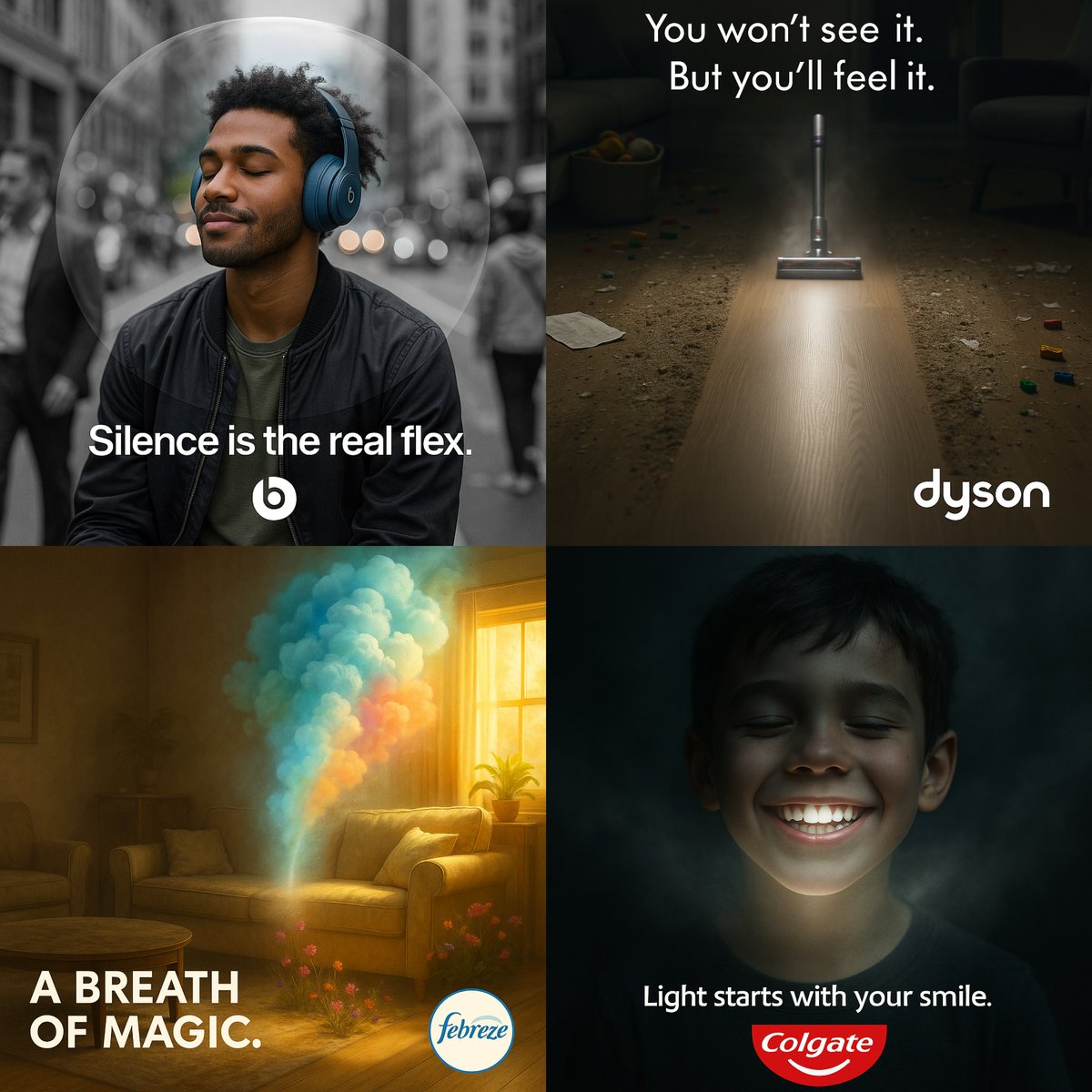
GPT-4o PROMPT: Invisible Impact Conceptual Ads
Show the brand’s power without showing the product.
Just enter the brand name, the rest reveals itself.
The prompt in the next comment ⬇️
Bubbly logos with GPT-4o.
PROMPT:
Create a photorealistic render of the “Pepsi” logo, where the entire logo is constructed from a dense cluster of glossy liquid bubbles that mimic soap foam or chemical froth. The bubbles should vary in size and form the full structure of the logo, appearing suspended in a semi-translucent fluid texture. Use the original brand colors as the hue of the bubbles to maintain brand recognition. The overall effect should be vibrant, organic, and slightly surreal, with high contrast. No background elements, outlines, or containers. High-resolution. Black background. Square 1:1 aspect ratio.
Excellent Flow Diagram to Help You Choose the Appropriate Controls for Your Data Entry Form! 🙌
FREE Full Resolution Download 🔖
Choosing controls:
Controls are defined as a non-free form input field, meaning they don’t require the user to enter data. Checkbox, Pill, Radio buttons, Selectable Cards and Toggle buttons.
Link attached 👇
#ux #uxdesign #interaction #interactiondesign #forms #userinput #prototyping #design #ui #uidesign #usability #productdesign #userresearch #ecommerce #psychology #business
Excellent 10 Principles for Good Design, to Boost Your UX / UI Designs, by Dieter Rams! 🙌
FREE Cheatsheet attached 🔖
1. Good design is innovative
Possibilities for innovation are not, by any means, exhausted. Tech development is always offering new opportunities for innovative design. But innovative design always develops in tandem with innovative technology, & can never be an end in itself.
2. Good design makes a product useful
A product is bought to be used. It has to satisfy certain criteria, not only functional, but also psychological and aesthetic. Good design emphasises the usefulness of a product whilst disregarding anything that could possibly detract from it
3. Good design is aesthetic
The aesthetic quality of a product is integral to its usefulness because products we use every day affect our person and our well-being. But only well-executed objects can be beautiful.
4. Good design makes a product understandable
It clarifies the product’s structure. Better still, it can make the product talk. At best, it is self- explanatory.
5. Good design is unobtrusive
Products fulfilling a purpose are like tools. They are neither decorative objects nor works of art. Their design should therefore be both neutral and restrained, to leave room for the user’s self- expression.
6. Good design is honest
It does not make a product more innovative, powerful or valuable than it really is. It does not attempt to manipulate the consumer with promises that cannot be kept.
7. Good design is long-lasting
It avoids being fashionable and therefore never appears antiquated. Unlike fashionable design, it lasts many years – even in today’s throwaway society.
8. Good design is thorough down to the last detail
Nothing must be arbitrary or left to chance. Care and accuracy in the design process show respect towards the user.
9. Good design is environmentally-friendly
Design makes an important contribution to the preservation of the environment. It conserves resources and minimises physical and visual pollution throughout the lifecycle of the product.
10. Good design is as little design as possible
Less, but better – because it concentrates on the essential aspects, and the products are not burdened with non-essentials.
Back to purity, back to simplicity.
#ux #ui #uxdesign #uidesign #productdesign #uxresearch #userresearch #usability #figma #html #css #js #visualdesign #mobile #webdevelopment #webdesign #appdesign #apple #android #design #userexperience #designsystem
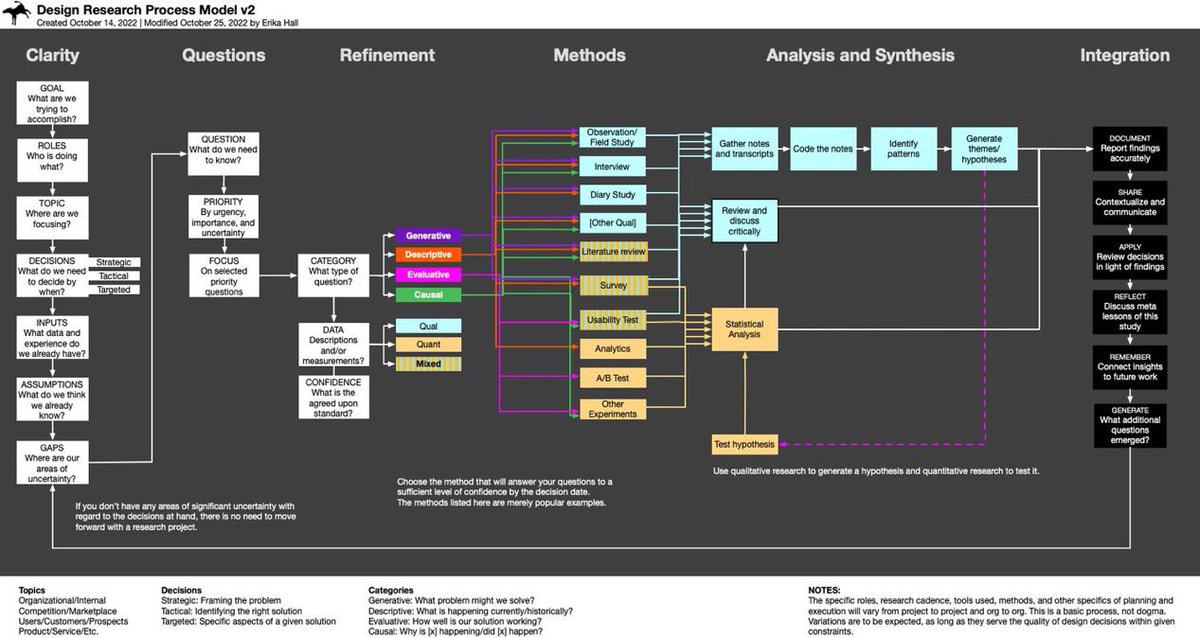
Interesting Design Research Framework to improve your Product Design UX 🙌
Design research?
"When I say design research I mean asking and answering questions in a systematic way in order to make more intentional and informed decisions about planning and creating new things and ways of doing things."
Roles
Who does what in the design research process may vary among organizations, depending on industry, size, structure, capabilities, etc.
It’s critical to define roles and communication protocols to increase collaboration and information flow and prevent silos and political territories from forming. Aim to cultivate generous expertise, instead of gatekeeping for clout.
How to use this diagram
The most important use of this diagram is as a touchstone and a checklist in conversation with anyone who participates in design decisions throughout your organization. Having a basic process to refer to enables more intentional decisions about practice and process, even when under pressure to deliver.
The Phases:
Clarity
This is the conversation you need to have before starting on any research project, no matter how small.
Both collaboration and effective design research require clear goals and roles. You need to understand what level of decision you’re talking about to know how much time and effort you should invest in answering your questions. The time-and-budget-based objections to research are fake. Just back your whole plan out from when you need to make a decision. You can always learn something useful if you’re clear on what you need to know and by when. If you need an entirely new product strategy by tomorrow, ask how you got in this spot. Probably by someone avoiding these conversations.
Questions
Once you have identified the information gaps that either block or add risk to your work, move ahead to forming research questions. Brainstorming questions is another really productive activity not enough teams do. It is far more useful and collaborative than brainstorming ideas in most cases.
Select your highest priority question/s to carry forward and turn into actual research projects.
Refinement
This is when you get really clear on your question, before choosing a method. How you phrase your research question (again, not an interview question) determines what is possible for you to learn. Do you need ideas, or descriptions about what happens in the real world? Are you at the point of evaluating a solution? (Don’t say “validate” or I’ll haunt you.) Are you trying to establish a cause and effect relationship? Do you already have a hypothesis to use as the basis for an experiment? (A hypothesis is based on data. If you have a wish, you do not have a hypothesis)
Methods
Now you get to choose a method. Research methods and activities are simply ways to answer your question. There’s no one right method. Pick the one that will give you the kind of data you need to inform your choices. And consider the colorful lines serving suggestions. Maybe you get some generative-style ideas from running a test on your competitor’s product or service, or on your own. The key is—say it with me—being intentional. Using the tool or the method is not learning. Learning is learning.
Analysis and Synthesis
The type of analysis you do depends on your question and method, so in some sense, this is the easy part. The learning to arguing ratio should be much higher here if you’ve followed all the proceeding steps. This is also the potentially time-consuming part. Sometimes you will need to do a few rounds of analysis.
Integration
So many organizations invest so much in doing research activities, and then POOF, it’s like the work never happened. Look ahead to integrating insights at the very beginning. How and when you go about documenting and communicating will depend upon how the organization as a whole works. One more process to design!
by @muledesign
#ui #ux #uidesign #uxdesign #userexperience #productdesign #prototyping #uxresearch #usertesting
Excellent Cheatsheet to Help You Understand Your Customers in Your Next Design Project 🙌
FREE Cheatsheet attached 🔖
Four levels of customer understanding
Level 1
What they say
Don't rely too much on CRM data, surveys, or polls. It may look like data, but it's often just opinions.
Level 2
What they think or feel
Good surveys and buyer interviews can help you understand this by looking at customer expectations and experiences.
Level 3
What they do
To influence what customers buy, you need to understand their actions. Use open ended questioning, task analysis, and behavioural analytics.
Level 4
Why they
To get deep understanding, find out why customers act the way they do. This can be done through detailed interviews, psychological analysis, and behavioural observation.
#ux #uxdesign #ui #uidesign #productdesign #uxprocess #userexperience #design #research #userresearch #uxresearch #usertesting #usabilitytesting #prototyping #startup #digital #business #startup