Truly, I will be keeping the interaction between text and illustration close at hand while looking at texts, cartoons, illustrations, film, etc. from here on out. Thinking this way has helped me wring out the embedded aesthetic values that are hiding behind the forefront. #CL727
Travisano’s attention to “the nature of childhood experience and with ways cultures construct and have constructed childhood” (22). Society can mold, tug, pull, and influence a child’s mind through print and visual media in preparation to enter into that very same society. #CL727
It has been an illuminating semester learning about the aesthetics of children's literature. There are so many aspects of this genre that I hadn't previously considered and I'm looking forward to using what I learned in future reading. #CL727
The variety in illustration is reflective of the ways in which a retelling/reimagining of a single text can create, perpetuate, or challenge different ideologies, stereotypes, or misconceptions. Some challenge the status quo while others work to preserve it. #CL727
The positive side of the debate would be when Martin writes that “[Bannerman] wrote about minority characters at a time when minorities in society and especially in literature were marginalized to the point of invisibility” (7). Yet, Bannerman did this in a damaging way. #CL727
"The story was written as entertainment by a mother for her daughters… The setting is fanciful and was never meant to be taken literally” (Lester). The debate about controversial books, perhaps especially those written in different social times, is one worth having. #CL727
Julius Lester noted being "amazed at the variety of the artwork in those books," speaking of the many versions and retellings of "The Story of Little Black Sambo." Although we looked at only a few, the differences among them showcase just how many interpretations can arise #CL727
“It is quite possible that an animal has spoken to me and that I didn’t catch the remark because I wasn’t paying attention" (White 145). Yet another parallel to The Little Prince in the warning against living with your senses closed off to the world around you. #CL727
“Children almost always hang onto things tighter than their parents think they will" (White 93). The relationship between growing up and memories that stick with you touch on life's developmental moments. #CL727
“Trust me, Wilbur. People are very gullible. They’ll believe anything they see in print" (White 115). White hits this print media idea, pointing towards what is written in print becomes inherently more important and more likely to be received as true. A modern parallel. #CL727
“Nobody, of the hundreds of people that had visited the Fair, knew that a grey spider had played the most important part of all" (White 226). Wilbur gained value through Charlotte's use of print media. Wilbur's ghostwriter will never gain the recognition deserved. #CL727
“If I can fool a bug... I can surely fool a man. People are not as smart as bugs” (White 89). White strikes a similar vein to The Little Prince here, in that while grownups are supposed to know everything, perhaps it is really bugs-or children-that strike closer to truth. #CL727
"Marie Lucille" (33) in Brooks' "Bronzeville," is an example of text and illustration working together to deepen the work. The text "The me that only / Yesterday / ... Is gone already" is paired with an illustration of a woman sitting pensively, expanding the aesthetics. #CL727
"Jim" (35), in Brooks' "Bronzeville," is an altogether wholesome and heartbreaking poem. The page shares a full-green background with the opposite page, showing that we all share a common space outside our houses, yet inside the window there exists vastly different worlds #CL727
Brooks' "Bronzeville" has representations of family dynamics. "Eunice in the Evening" (36) the family is shown to be holding tight-nit values. "Everybody's There," expressing the value of sitting down as a family to spend time together in one room, especially at mealtime. #CL727
The poem "Tommy" in Brooks' "Bronzeville" initially reminded me of the proverb, "A society grows great when old men plant trees whose shade they know they shall never sit in." Yet it further comments on the inability to halt growing up while also holding sexual undertones. #CL727
Herrera crafts the breakfast scene with sensory detail in “The Flying Jalepeno Cousins,” layering the poem w/metaphor that deepens the emotional impact. The “wavy city” can symbolize how family mornings can be their own world—sometimes destroyed by a deluge of jalapenos. #CL727
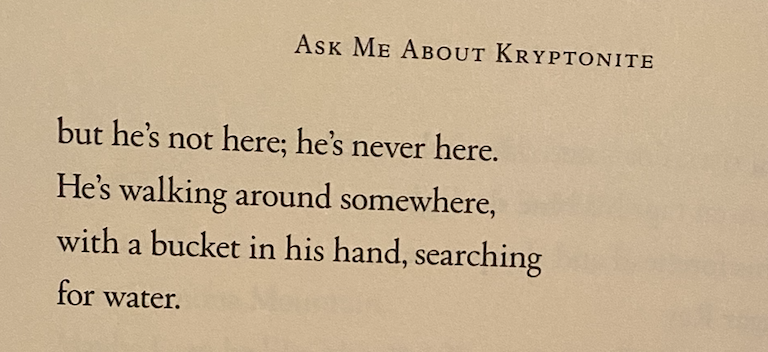
Interesting parallel to The Little Prince search 4 water: “It was as sweet as a feast. That water was merely more than a drink” (Saint-Exupery 71). Brings forth a sense of always searching and never attaining, carrying a bucket to fill with dreams that might never arrive. #CL727
Herrera’s use of sound and repetition can be felt in “Ask Me About Kryptonite,” especially in the language surrounding Sweet Pea with an abundance of S sounds. He writes “Sweet Pea snaps his gloves,” “Sweet Pea slips slow,” and “Sweet Pea rises, floats and dances.” Jabs🥊? #CL727
“You wanna be a chump / or a champ” is a false dichotomy presented to Juanito by su primo Chacho (7). Is the only way to make it to throw up your fists? The silliness of this is shown by Herrera’s use of both “new dog in town” and “toughest cat,” asking can one be both? #CL727