This is my most profitable hook EVER
The first 30 seconds of a script decide whether somebody watches for 40 minutes or leaves in 8 seconds.
I have tested dozens of hook structures across military history, romance, true crime, and empire content. One format consistently holds retention through the opening 2 minutes, which is the window YouTube uses to decide whether to distribute or bury you. Here is the template.
"On [SPECIFIC DATE], [PERSON with one defining detail] [DRAMATIC VERB] [SPECIFIC LOCATION]. [Their target] was [vulnerable]. [Person] expected [obvious outcome]. What [they] found instead [changed] [larger consequence]."
Here is the version from a 1.2M view military history video:
"On January 17th, 1781, a British officer named Banastre Tarleton rode toward a small cattle grazing field in upstate South Carolina with over 1,000 of the best trained soldiers in the British army. His target was a ragged force of American troops, half of them untrained militia, who had a reputation for running at the first sight of a bayonet charge. Tarleton expected an easy victory. What he rode into instead was one of the most perfectly executed tactical traps in the history of warfare."
Now why every piece of that works.
The specific date flips the viewer into documentary mode. Their subconscious registers this happened, this is real, this is worth my time. "A long time ago" reads as fiction and the trust drops instantly.
The defining detail turns a name into a character. Tarleton with 1,000 elite soldiers has POWER. One detail per character, never two, or the pacing dies.
The vulnerable target hands the viewer somebody to root for. The power imbalance assigns sides without a word of instruction, and a viewer who picked a side is emotionally committed to the outcome.
The expected outcome confirms the obvious prediction, then begs to be broken. The viewer now watches specifically to see HOW.
The payoff tease reveals the trap exists and hides what it looked like, how it was built, and why it worked.
Below 70% retention in the first 30 seconds and the algorithm deprioritizes the video regardless of how good the other 39 minutes are.
The hook is the gatekeeper for everything else you built.
Niche specific hook templates for every AI story format are inside elevate(.uno)
스크린샷 속 UI를 코드로 바꿔주는 오픈소스 도구
GitHub 스타를 무려 7.4만개나 받음
AI가 레퍼런스 스크린샷 화면을 분석해서
자동으로 레이아웃, 간격, 버튼 등을 코드로 재구성해 줌
바이브코딩할 때 레퍼런스와 결과물이
자꾸 다르게 나온다면 이 도구로 빠르게 초안을 잡고
내 프로젝트에 맞게 수정해가면 좋을 듯
화면 녹화 영상으로 사용 흐름을 보여주면
인터랙션/애니메이션도 구현할 수 있음
you'll never need to pay for clipping tools again!
- Capcut
- OpusClip
- Flowjin
someone built fully AI powered tool that just destroyed the $49/month clipping industry
you get to:
> cllip any YouTube or local videos
> no watermarks, no limits, self-hosted
> permissions to plug in Claude or any AI model of your choice
100% Free & open source.
Github Repo: https://t.co/lmex9Pkkd5
Detailed Youtube Guide: https://t.co/LwUpBk5Qsp
catch: you'll need a paid Gemini account (every student gets 1 year free plan, so it's basically free)
everyone can clip from now!
i finally cracked frontend design with AI... without using any skill
frontend needs taste to not look like slop, and i'm more of an engineer than an artist, so i'm genuinely bad at it
my way around it: collecting inspirations and modules from other people, building a lego of components
resources you can send to your agents:
- https://t.co/7CUfh1jSmr
- https://t.co/hKiKiyjLd8
- https://t.co/XMkWlWenQv
- https://t.co/k3p8MhfvCj
- https://t.co/PTkhqaLgU7
it's VERY easy for agents to edit components once they have the code
you send the link, your agent fetches the full list of components, then you ask it to find the best way to integrate them into your frontend foundation
the easiest way i found to make your UI/UX drastically better without being a genius designer
🚨 Este tipo acaba de FILTRAR el metodo MAS FACIL para hacer dinero en 2026
Claude Code + YouTube = $62,000/mes
Nada complicado (Solo 13 minutos)
Guarda esto en favoritos para que no lo pierdas
New minimal websites on https://t.co/4c7SwuFKfr:
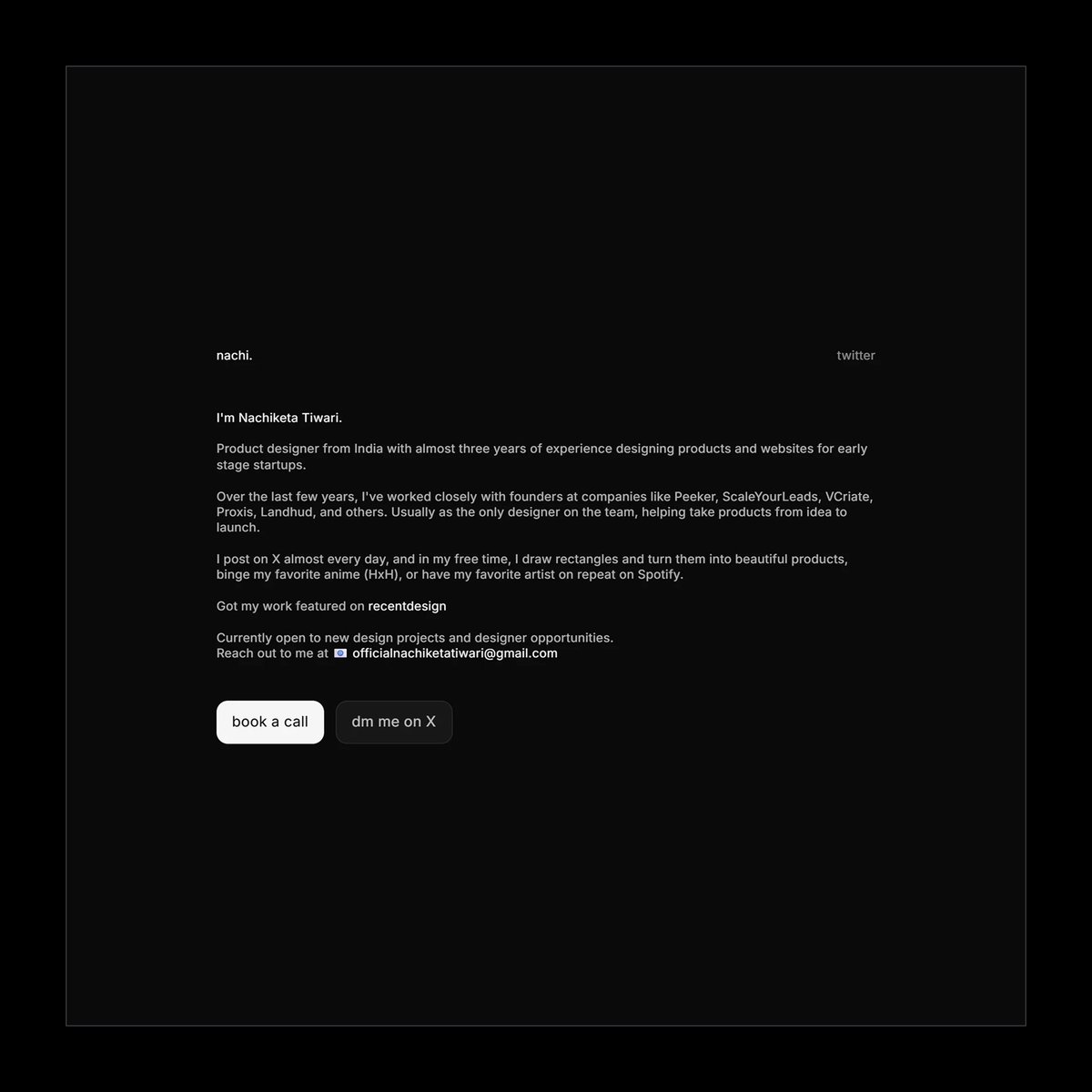
01 • https://t.co/EPJAmjaTeF by @nachidesigner
02 • https://t.co/784hwuOEYB by @urstruelysv
03 • https://t.co/A8NBJOqt9l by @vanjek
04 • https://t.co/You7GWX1tO by @nilseller
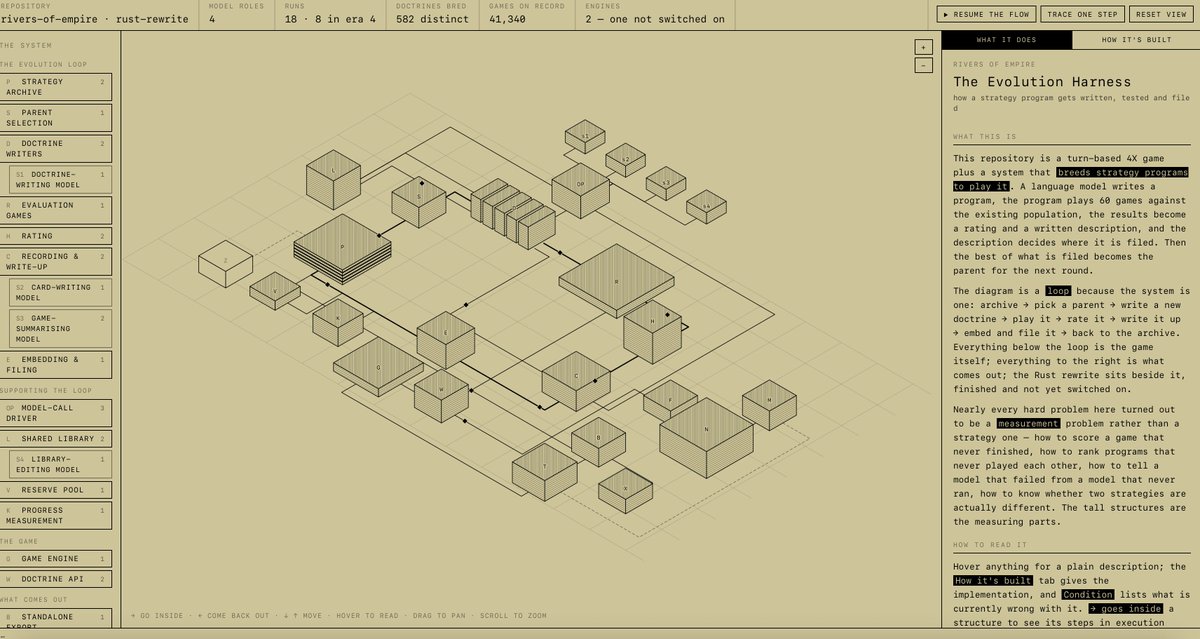
i've started having claude turn my codebases into visual diagrams so i can discuss the codebases with claude more easily - the moving dots are data snippets that i can inspect
La mejor compra que he hecho recientemente es este NUC, un miniPC que lo tengo como servidor en casa.
Puedo usar Claude Code desde el móvil con Termius + Tailscale como VPN, tiene 32gb de RAM y 1TB de almacenamiento. Va sobrado para todo lo que tengo instalado:
- Mis sideprojects para poder vibecodear desde cualquier lado en el móvil
- Loops con agentes (ej: mejoras de SEO automático cada 2 semanas para mis proyectos)
- Hermes agent
- Jellyfin como servidor multimedia (va increíblemente bien)
- Home Assistant para varias automatizaciones que quiero hacer en casa
Lo único que me falta es un teclado plegable bluetooth para completar el setup 🤣
En wallapop los hay a millones. Nuevos salen bastante más caros, los Beelink tienen bastante buena pinta.
Todo configurado en menos de 30-40 mins con claude, sin hacer prácticamente nada a mano.
This is not what HTML slides usually look like.
beautiful-html-templates is a library of 34 designed slide templates built for coding agents. Serif typography, warm paper, sage and blush accents. You paste one line, your agent picks a template and builds the deck. AGENTS.md tells it how.
And it's completely free.
⭐ 3.9K #HTML #Frontend
https://t.co/kro0sVzfFZ
Follow for daily dev finds 🔔
Headroom is a context compression layer. Built by Tejas Chopra, Senior Netflix Engineer.
It sits between your agent and the LLM. Compresses tool outputs, logs, JSON, RAG chunks before they hit your token bill. Multiple specialized compressors. Reversible. Runs locally.
Every viral post about this tool says "up to 95% fewer tokens."
The repo's own description says 20% for coding agents.
The 95% is real, for structured machine data. Logs. JSON payloads. Repeated templates. On that surface, the savings are massive.
For coding agents (Claude Code, Cursor, Codex), the repo itself says 20%.
Then there's Evan Boyle, engineer on GitHub's Copilot team, who integrated Headroom and ran real-world tests. His finding: neutral to negative. Compression stripped context the model needed. The model requested originals. Total token usage went up.
The project is real. $700K in collective savings across 200 billion tokens, per Chopra's Open Source Summit talk. The problem it solves is real.
But "up to 95%" is doing heavy lifting in every viral post. The number that applies to your coding agent is closer to 20%. Maybe less.
Announcing OpenWorker! An open-source agent that doesn't just chat with you, but delivers finished work -- like hand you a polished document, send a slack message, or update a calendar entry.
Ask it to prepare a customer brief, untangle your calendar, draft a report, or triage a Slack alert. It works across your files and everyday tools, produces the deliverable, and checks in before doing anything consequential.
OpenWorker runs on your Mac, with Windows support coming soon. It does not lock you into any one model. Bring your own API key and run it with GPT 5.6 Sol, Claude Fable, Gemini 3.6, an open weight model (like Kimi, GLM, DeepSeek, Inkling), or Ollama to keep your data local. Your data does not leave your machine except through an LLM provider and integrations that you choose.
@rohitcprasad and I are building OpenWorker because AI coworkers are an important way to get work done, and we want there to be an open, privacy-preserving, model-independent option. Check it out and let us know what you think!
Try it out: https://t.co/P0mGnI1o31 (requires your own API key)
Source code: https://t.co/NYCiTD6hSq
how to produce long form documentaries with claude
this is how creators are producing long-form youtube documentaries in the sleep niche for about a low cost. you'll spend most of your effort building the workflow once, then every script after that runs through the same pipeline for cents.
the format that works in this niche is different from normal youtube. your viewers are actively trying to fall asleep. that's the entire point. so people leave for two reasons: they got bored, or it worked and they're out. the ones who fall asleep come back later and keep listening. that repeat listening is a huge part of why the niche prints.
which means the script is 90% of the whole thing. average view duration on my channels sits close to 25 min. that number does not come from cinematic visuals or fancy editing. it comes from narrative structure. if the script gets repetitive, drifts off topic, or loses momentum halfway, people stop listening. better footage cannot rescue a weak story here.
the problem is the format does not scale on its own. one video needs a 15k-20k word script, hours of narration, hundreds of visual changes, music, and final assembly. writing that manually takes forever. editing every scene takes even longer.
here's the workflow i set up:
claude api (NOT the chat app. HIGHLY RECOMMENDED to not skip this. in the chat interface you end up typing "continue.. write chapter 4.. don't repeat yourself.. you forgot what happened in chapter 2" and by the halfway point it's contradicting earlier sections and drifting from the outline. you spend more time babysitting than writing. the api sends every request automatically and you pay per actual usage instead of another monthly subscription)
google sheets connected to the claude api. this is the whole engine. you don't need to be a dev. the sheet does two things: first it generates the full documentary structure/outline. then it writes ONE chapter at a time instead of trying to produce the entire 20k words in a single response (which is where models fall apart). before each chapter, it passes claude three things: the outline, the instructions for that specific section, and a running summary of everything already written. that running summary is the trick. it's why chapter 8 never contradicts chapter 2.
capcut ai video maker for the first edit. it generates voiceover, subtitles, and an initial visual sequence from auto-matched stock footage. the stock matching is not perfect, but it gets you a 90% first draft way faster than manually searching for hundreds of clips. note: capcut caps at 3000 words, so you split the script into sections, generate each one, export, and combine into the final video.
HERE'S HOW THE PRODUCTION ACTUALLY RUNS:
step 1 —> topic + title + thumbnail. do NOT skip this. ai cannot tell you which topic has demand or whether a title creates curiosity. this is where most of the value still is. figure this out before you touch any automation.
step 2 —> run the sheet. it builds the outline first, then writes chapter by chapter, feeding itself the running summary each time so it stays consistent. cost for a full script usually lands around $0.30-0.40 depending on the model, input length, and number of revisions.
step 3 —> paste script into capcut in sub-3000 word chunks. generate voiceover + subtitles + auto-matched visuals for each. export each section.
step 4 —> combine sections into the final 2-3 hour video. then you handle the parts ai can't: pacing check, misleading visuals, final editorial judgment.
the reason this matters is repeatability. every script moves through the exact same production structure, but you can still change the topic, tone, evidence, pacing, and narrative direction each time. so it stops being random one-off videos and starts being a system.
the math:
capcut is ~$20/mo and allows many exports. claude api is a little above thirty cents per script. at 30-40 documentaries a month that works out to roughly $1 in direct software cost per finished video. that figure does NOT include your time, research, thumbnails, subscriptions, failed ideas, or the cost of building the workflow itself. it is not the full cost of the business, it's the direct software cost.
one more thing worth knowing: mixing real historical/stock footage alongside ai assets is the best defense i've found against the "reused/inauthentic content" flags that destroy fully automated channels. that's from experience, not a rule youtube publishes.
this is not passive income and it's not a one-click youtube machine. it's a production system that makes experimentation cheaper. ai removes the repetitive work. it does not remove the need for taste.