Researchers at MSK have developed a new computational approach to better understand why #Tcells, the immune system’s primary cancer-fighting cells, respond differently to immunotherapies.
Led by computational oncologists @bengrbm and @SohrabShah, the team created a statistical model called TCRi that links a T cell’s unique receptor sequence to its biological behavior, helping reveal how these cells recognize and react to cancer.
By analyzing more than 167,000 T cells from patients treated with checkpoint inhibitor immunotherapies, the researchers aimed to uncover how a T cell’s genetic identity influences its activity and how those behaviors change during treatment, potentially improving the ability to predict which patients will benefit from immunotherapy.
“This approach produces a standardized measurement that lets us compare results across different studies and clinical trials,” Dr. Greenbaum says. “We have a way to learn from this data what a meaningful T cell response to an immunotherapy looks like — or doesn’t.”
Learn more about this research: https://t.co/UJL48fxQ3k
✨ Excited to share new work in @NatureGenet, with next-door neighbor @SohrabShah! Our labs – led by @nceglia; @GreedyApple; Zach Sethna; and @elhanati_yuval - applied information theory and probabilistic modeling to the question of how T cell dynamics changes in response to immunotherapy, particularly coupling between a T cell's T cell receptor (TCR) and its phenotypic state.
T cell responses are critical to cancer immunotherapies. Their behavior is often strongly influenced by their TCR, which directly engages with antigens presented on the cell surface. How clonal the sequenced TCR repertoire is in a dataset has been used to understand response – TCRs that recognize an antigen multiply – but its often a noisy measure, and we wanted to extend this logic to single-cell data in an eqiposed way. Information theory offers a solution.
The specific question of how information is propagated between the TCR and its phenotypic state also becomes a general way to probe genotype-phenotype mapping. The mutual information between receptor and state - that is how much knowing about one tells you information about the other - and how that changes can then be used to probe therapeutic response. Given data sparsity this becomes a problem in probabilistic inference – which was addressed here via a cool hierarchical Bayesian framework led by @GreedyApple & @nceglia.
A flux in phenotype and stronger mutual information post-treatment was associated with response to immunotherapy. In non-responders, therapy did not improve poor communication between TCR and phenotype. Hence information dynamics can be used to measure response.
We are already collectively using this approach across many, many projects. We use variants to analyze vaccine data with @TheVinodLab at the Olayan Center for Cancer Vaccines @MSKCancerCenter, in multiple projects with @break_cancer, throughout the Halvorsen Center @CompOncMSK, and elsewhere. It was a lot of fun and we hope you enjoy! Code link included! 👇 👇 👇
https://t.co/mB7QQLNipv
🚨We are looking for a highly motivated and curious PhD candidate with a strong interest in biology, computational methods, and theory to work on the problem of antibiotic resistance evolution 🤓🧫✨
Apply by Sep 18! 🚀
https://t.co/C2zwuCReDu
Finally get to say that a drug I helped discover is in human trials.
The team sprinted for 6 years on this. We went from a thought-to-be undruggable target to profound degradation very quickly, and then several more years optimizing for human dosing. That speaks to the power of DNA encoded libraries and modularity of TPD, and the hard road that is drug *development*.
https://t.co/KOGCqd2wlC
Thrilled to share our latest work is out today in @Nature
ZFP36L2 orchestrates stress-adaptive plasticity in regeneration and cancer.
https://t.co/YFOTEapoB8
We are thrilled to share our latest work out today @Dev_Cell! Appendiceal adenocarcinoma (AC) is a rare, aggressive cancer that frequently spreads to the peritoneum. Until now, lack of robust preclinical models has severely limited drug discovery. https://t.co/8rPe1G87CZ🧵👇 🔗
We are looking for a highly motivated and curious PhD candidate with a strong interest in biology, computational methods, and theory 🧫 📊 🤓
Join us to work on ecological and evolutionary processes in bacteria and beyond!
Apply by March 26th! 🏃♀️ 🏃♂️
https://t.co/VguvjbJH4m
1/ I'm a bioinformatian who uses Claude (and code) every day. Most people use it like a search engine. Anthropic quietly published a page that shows you what you're actually missing.
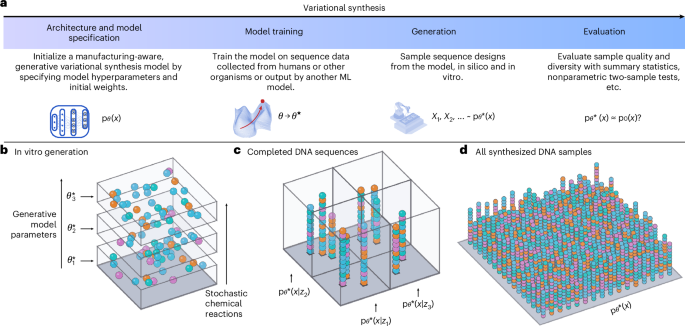
Our paper on variational synthesis is out now in Nature Biotechnology. Manufacturing-aware generative models — AI architectures that know how to physically build their own designs — enabling synthesis of DNA encoding ~10^16 AI-designed proteins at a cost that would be roughly a quadrillion dollars using conventional methods.
1/n Have you ever wondered whether an amplified oncogene in a patient’s tumor (HER2/EGFR/CCND1/…) is carried on extrachromosomal DNA (ecDNA) vs embedded within a chromosome? Bulk WGS + genome graph can hint, but in practice it’s often hard to resolve. Here is our new preprint.
Today marks a meaningful milestone -- I am starting as a lab investigator @CompOncMSK and thoracic oncologist @MSK_DeptOfMed, focused on improving treatment through a deep understanding of cancer evolution. I'll soon be looking for fellow travelers on this mission. Stay tuned!
Excited that this is out in @PNASNews !
https://t.co/G7CuvCXAY7
In a sentence, we show that different mutational processes can have different long-term impacts on eco-evolutionary systems. 1/n
Part 2 of our combined efforts with @SohrabShah and @VStrongMD to understand immune evasion in gastric cancer describes the work in this preprint, led by @GreedyApple and Emily Stroobant in a brilliant collaboration: https://t.co/JH2nTgc80T