A thread (1) Effective revision / intervention during Easter Holidays.
Invited students with targets of 7-9 to attend Easter revision. Didn't want to do more of the same so made the key focus 'complex thinking'. First task- exam board explanation of level 4 / complex thinking 👇
One of the greatest ever anti-war (Iraq) speeches by the late, great Tony Benn:
“What fools we are to live in a generation for which war is a computer game for our children and just an interesting little channel for news item.
Every Member of Parliament tonight who votes for the Government motion will be consciously and deliberately accepting responsibility for the deaths of innocent people if the war begins.”
I'm running a webinar on Wed 25 Feb, 4-4.45pm exploring what it takes to reclaim the purpose of KS3.
Register here (live and recorded):
https://t.co/1PsvWzPGDc
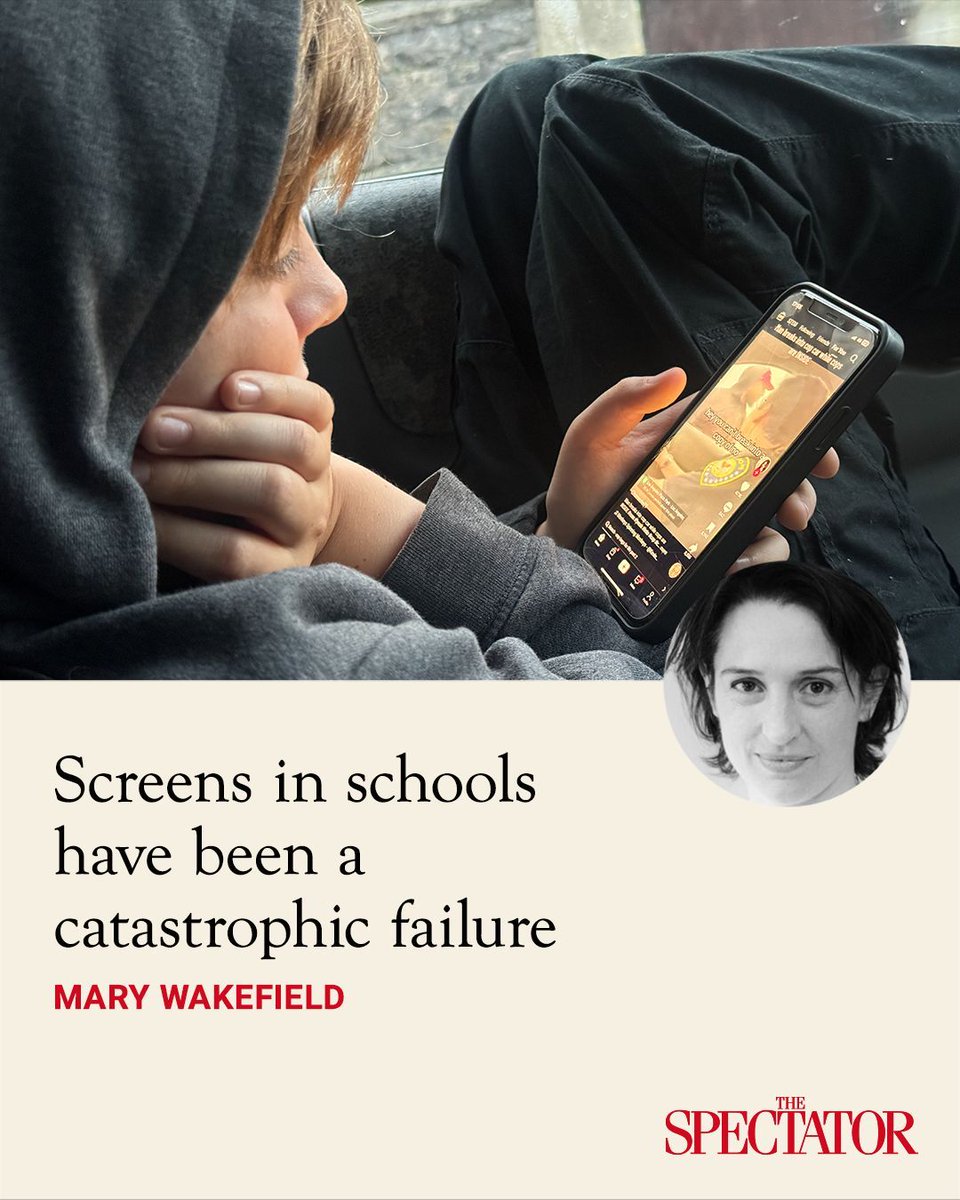
About a decade ago, the people I dreaded meeting most at parties were the ed tech evangelists – men and women who lit up with zealous excitement about bringing screens into schools.
If only every schoolchild had a laptop, they thought, then humanity could flourish, nurtured by the great river of the internet and by an exciting stream of educational apps.
✍️ Mary Wakefield
Article | https://t.co/gcNWj71zKe
📚 Teacher of English- Vacancy
We are recruiting a Teacher of English to join our strong and supportive department at Park View School, Durham.
If you are passionate about English and inspiring young people, we would love to hear from you.
Apply:
https://t.co/E1fRcBlzID
📚 Vacancy: Head of KS4 English
An exciting opportunity to lead KS4 English at Park View School.
We are looking for an ambitious middle leader to drive outcomes and support our excellent English team.
Apply:
https://t.co/6Qq6mF68Yw
#EnglishTeacher#MiddleLeadership
And this is why education is stuck in such a rut, and constantly regresses back whenever we make an inch of improvement: because the progressive tropes are so intuitively attractive, easy, and simple, and the reality of learning is much more complex and difficult.
You don't learn very well by watching an amusing or entertaining video; you retain the information in it like a river running through you. You're aware of it temporarily until it is replaced by the next packet of facts, but you don't retain it well or in a way you can retrieve easily later. You might remember novel, surprising, amusing, or shocking parts well enough, but miss the details that weren't obvious, or the links between them.
Knowledge and skills are acquired through scaffolded explanations/ demonstrations followed by the student processing it, using it, thinking about it. The teacher then checks their understanding and offers high quality feedback, reinforces, corrects, redirects or reconstructs. Then the next lesson connects meaningfully with the last one in a similar way, infused with retrieval and revision of prior concepts to ensure deep learning.
Videos can be part of that, but they are not that. We actually do know a lot now about how we learn, and how we teach, and collectively they tend to be called the Learning Sciences, or Evidence-Informed Education. It's urgently required across the world as an antidote to both the winner-takes-all grindhouse of poorly led-lecturing, or more commonly, the inane performative pantomime of progressive flim-flam.
Mr B's references here demonstrate the old Keynesian adage of how so-called practical men who believe themselves free from bias, are usually in the grip of some long dead economist or philosopher. He trots out the most pedestrian and reactionary dogma about learning while believing himself to be a common-sense revolutionary. It's not his fault. I don't know anything about being a social media megastar.
But tech, no matter how shiny, cannot replace the architecture of the human brain. There is a 1300g bag of neural porridge inside every one of us that isn't going anywhere fast, so we better get busy using it to understand how to replicate and build on how we already actually learn, rather than what we wish it was like- or what sells content.
Agree: every good school I see is turning the tap down or off on screen time. Not one successful school doing the opposite.
Yet just a few years back, how many schools, LAs, city councils were proudly proclaiming ‘we are a 1-2-1 device institution’?
You can’t even say ‘hindsight is wonderful, but at the time that’s what we thought was best.’ There *was* no evidence base for this immersion in shiny smart tech. Even at the time.
Even if it had been free, you couldn’t have justified it. The fact that it was hugely expensive, makes it a warning from history about how easy the education sector still succumbs to glossy novelty.
The current demonstration of schools turning low-tech again, is a good example of how evidence adoption *can* make a difference.
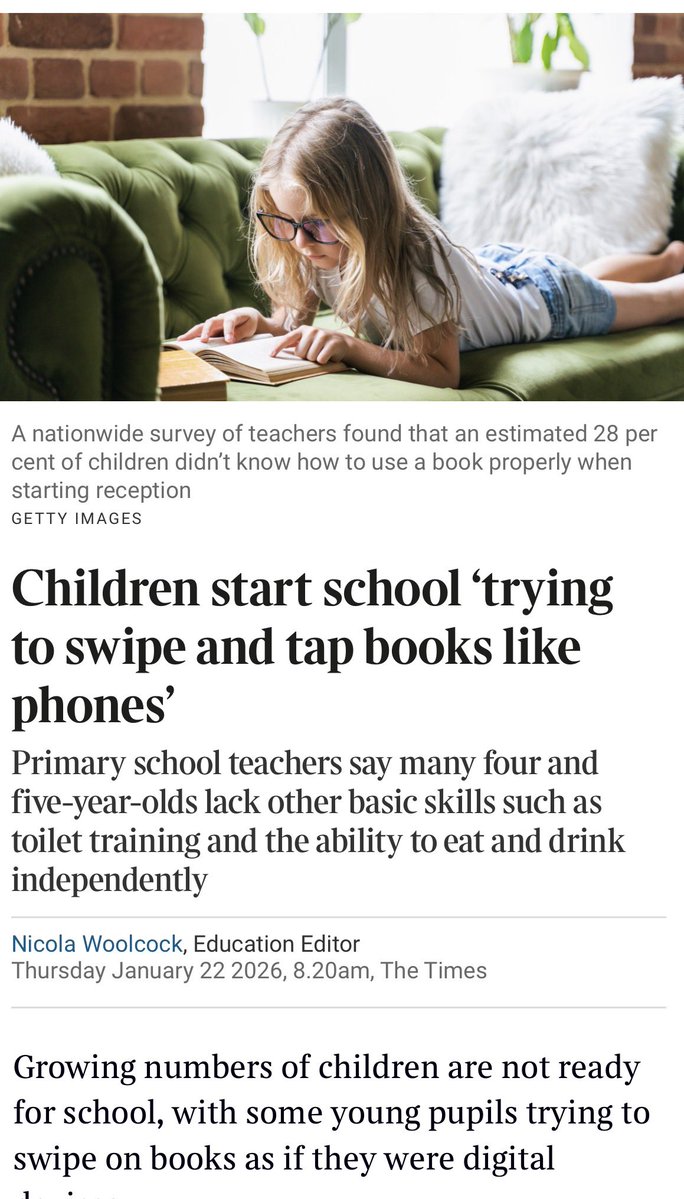
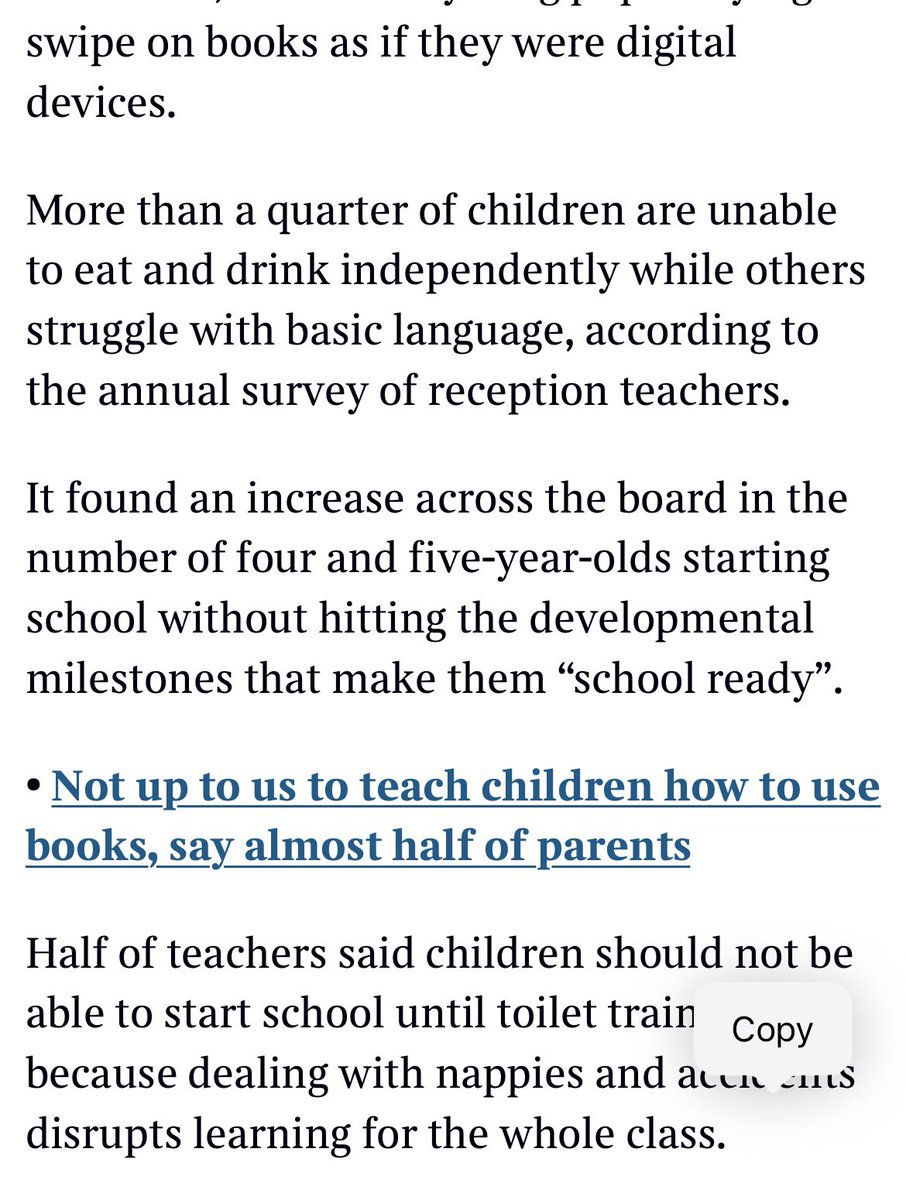
Utterly damning report in @thetimes today about the growing unpreparedness of children entering reception. These aren’t rounding errors: almost a quarter of children begin lacking basic capabilities and habits, like toilet training, language or social skills, and coping independently.
First of all, the smoking gun here is almost certainly a smoking phone. Apps, screens, and doomscrolling provides an easy, lazy simulation of childcare, but is really a pacifier for the growing mind, learning nothing, thinking about nothing.
Secondly, I’ve always resisted calls for national parenting advice/ support programs, on the grounds of state over reach. But with this level of structural incapacity, I’m not so sure anymore.
At a time when England’s schools are rightly drawing admiration from countries around the world, it’s vital we don’t lose that edge to the need to provide generational remedial support for the basics that parents should provide. We need a reset on the relationship of expectation.
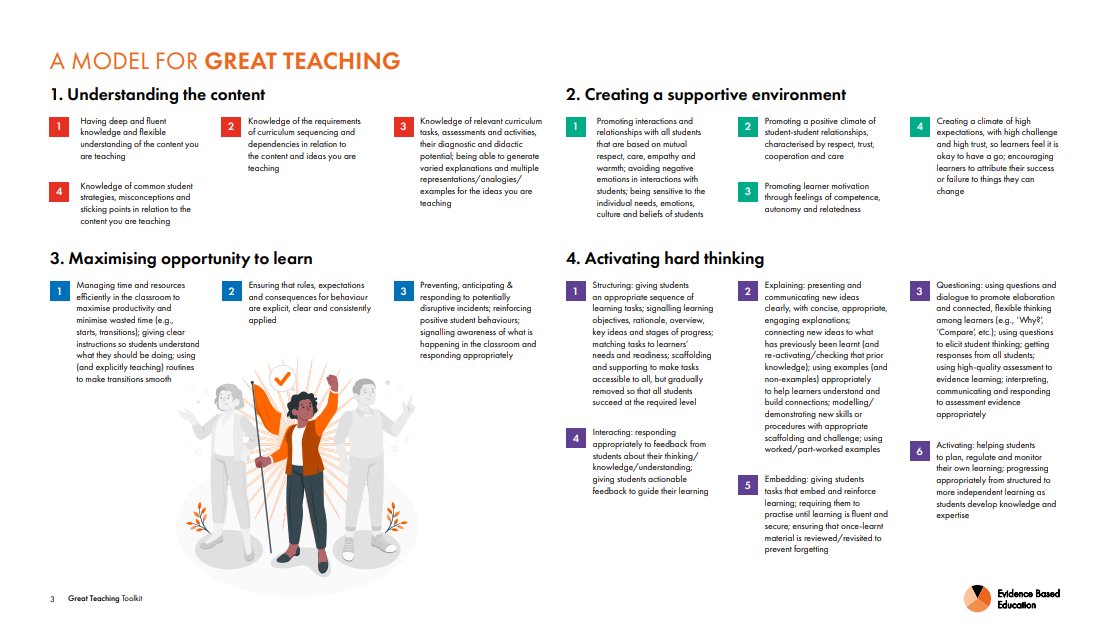
What does great teaching look like? The Model for Great Teaching is an excellent summary of the Great Teaching Toolkit Evidence Review (Coe et al, 2020).
1 Understanding the content.
2. Creating a supportive environment.
3. Maximising opportunity to learn.
4. Activating hard thinking.
@EvidenceInEdu
https://t.co/ozIH5SHGzK
Misbehaviour, if unchecked, is contagious. That small disagreement in a distant corner of the classroom won't put itself out. It's more likely it will escalate, and pass a point of easy de-escalation. If you don't intervene early, it catches fire. Onlookers watch, distracted, then become drawn into it. Suddenly the whole class is focussed on the fire.
If you still do nothing, the behaviour normalises; new boundaries are tested and broken. No one feels safe now, and if they were looking to you to restore order before, now they realise that you have abdicated responsibility, and it's everyone for themself.
-Intervene as early as possible.
-Challenge every behaviour that breaks the boundaries you have set.
-Never back down.
-Either you are in charge of the room, or the most chaotic children are. There are no other options. So decide.
@tombennett71 This was a school where behaviour from some was so violent that teachers went on strike. Imagine how unsafe students felt going there each day. This head is doing amazing work: more power to him.
BREAKING: SCHOOL HAS DETENTIONS. It always amazes me how alien real schools often can be to people who don’t work in the sector.
Detentions are a standard deterrent in schools. Saturday detentions are also pretty common, as a last deterrent before suspension. Making the news for this is very strange.
All power to the head for trying to turn this school around after a history of bad behaviour. People who push back on this are tacitly consenting to an unbearable status quo of disruption, abuse and chaos. But then, they’ll never have to face it- only other people and children.
https://t.co/d3IObTIoc4
Restorative approaches need the subject to be aware of the wrong they have done, take responsibility for it, and sincerely endeavour to do better. While this is *always* an attitude to encourage, it is also not one that you can expect in every case. Often, children *want* to have the negative impact that they produce, and if you frame it as something they should feel remorse for, they won't agree.
Which is why these approaches are useful as bolt-ons to the behaviour system (in order to foster and scaffold moral understanding) they are not a substantive *replacement* for a system predicated on norms, routines, boundaries and consequences.
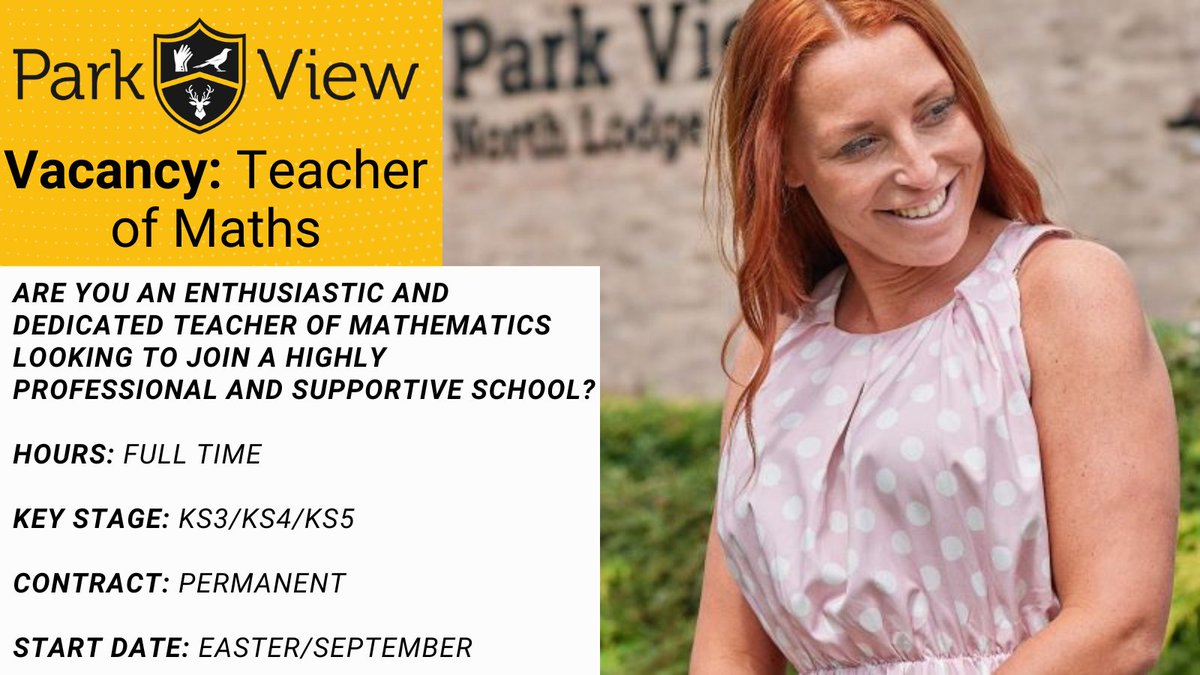
We are looking to recruit a talented and dedicated Teacher of Maths to join our school at Easter or in September. If interested, visit our website here: https://t.co/QslsRgW61c