On July 12th, 2021, the Nationals selected OF Jacob Young out of the University of Florida with the 203rd overall pick (7th round). Young is in his 4th season with the Nationals, his third year of being a consistent starter. Young has accumulated 6.7 fWAR across his career so far and is in the midst of a breakout offensive season. But can Jacob, with his career-average 82 wRC+, be a true piece for the Nationals? I believe so. Here’s why…
Let’s start with the facts.
Jacob Young is a true center fielder who has played in 115 games this season, accumulating 393 PA. Young ranks 3rd in MLB among CF with 12 OAA. This indicates that Young has absolutely outstanding range in the outfield. He is also tied for 4th among all outfielders with 10 FRV (95th percentile). Additionally, Jacob was a Gold Glove finalist in each of his first two full MLB seasons. While not every defensive metric views Young’s 2026 defense as favorably (he currently has only +1 DRS), Statcast metrics and his career history show that he is an elite defender. He has well established himself as a defender, but this year the offense is trending up as well. Young’s bat speed is up to 69.5 mph (a 1.2 mph increase from 2025), which is still well below average but a major improvement. This, in part, has led to a substantial increase in average exit velocity, up to 88.2 mph (33rd percentile) from 87.6 mph in 2025 (16th percentile). While ultimately, he still doesn’t hit the ball particularly hard, it is an improvement. Jacob combines this with an above-average Whiff% and Chase%, at 21.5% and 27.2%, respectively. This is actually down from previous seasons (especially the Whiff%), possibly from his bat speed increase (though there are other factors that could be in play and I would need more data to make a definitive conclusion on this), but is still above league average. Where Jacob has made the biggest improvement, though, is his GB% and his Pull Air%. Young posted a GB% above 56% in each of his first 3 seasons, including a 56.5% GB% in 2025. This is much higher than the league average of 44.1%. In 2025, this led to a 27.9% LA Sweet Spot% (3rd percentile) and, combined with his poor exit velos, a 1.9% Barrel% (4th percentile). In 2026, Young has dropped his GB% all the way down to 40.5%! This, combined with better exit velos, has led to a 36.4% LA Sweet Spot% (72nd percentile!) and a 6.2% Barrel% (33rd percentile). Young also combines this with a substantially better pull approach, jumping from a 5.9% Pull Air% in 2025 (well below league average) all the way to a 15.5% Pull Air% (slightly below the league average of 16.8%). These are significant improvements that allow Jacob to hit more line drives, leading to more hits in general, as well as more power with his ability to pull balls in the air. This improvement is clearly seen with Jacob jumping from a career-low 66 wRC+ in 2025 to a 95 wRC+ so far in 2026. So what does this mean for Jacob’s overall output?
I’ve long said that if Jacob could be a league-average hitter, he would be a top-10-caliber CF. This season, Young is tied for 11th in fWAR among CF. His defense gives him such a high floor at an important position, and with about league-average offense, he is a very valuable player. With 3 years of arbitration coming up, Jacob should be manning CF for the Nationals for at least the next 3 years. If Young can maintain something close to league-average offensive production alongside his elite defense, he has the profile of a 2–3 fWAR player annually, making him an extremely valuable role player. I expect the offense to stay close to league average based on the improvements made this season. One interesting thing to note is that since Young took a few games off in July to fully recover from a lingering left hand injury, he has a phenomenal .371 wOBA (94th percentile).
Ultimately, Young still doesn’t hit the ball particularly hard, which limits his overall offensive upside. But he makes up for this with much-improved launch angles and solid contact skills. With Jacob’s outstanding defense, he projects to be a valuable player in CF. He also provides some baserunning value, posting a +2 baserunning value (83rd percentile.) While I don’t think Jacob will ever be a superstar or “cornerstone” piece, he absolutely deserves to be the everyday starter in CF for the foreseeable future, as long as his offense remains close to league average and he doesn’t suffer a significant falloff on defense.
*Note that this data was pulled from 8/24/26 but screenshots are from 8/25/26, so their may be some small discrepancies
On July 11th, 2021, the Nationals selected Brady House with the 11th overall pick in the MLB Draft. House was a highly ranked HS shortstop who profiled long-term at 3B, where he ended up playing. House was ranked as a top 100 prospect most of the time he was in the minors but has had an up-and-down start to his young career. This performance raises a question: Is Brady House a long-term answer at third base for the Nationals? While he shows promise, I’m not fully bought in. Here’s why…
Let’s start with the facts.
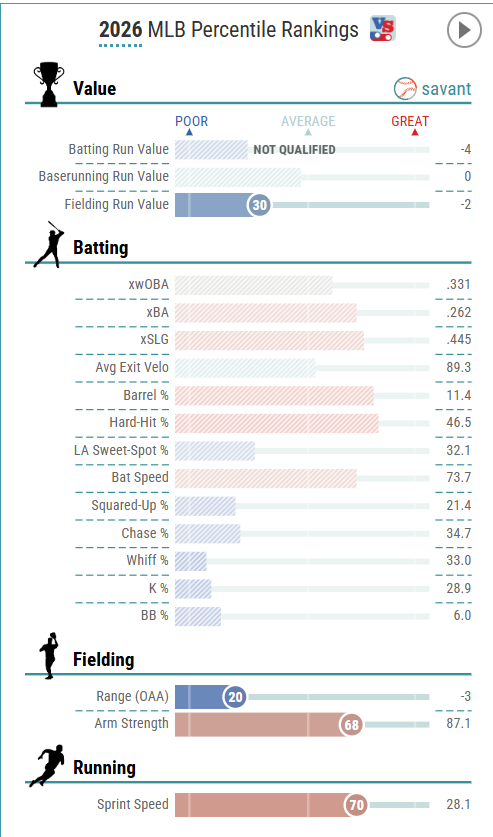
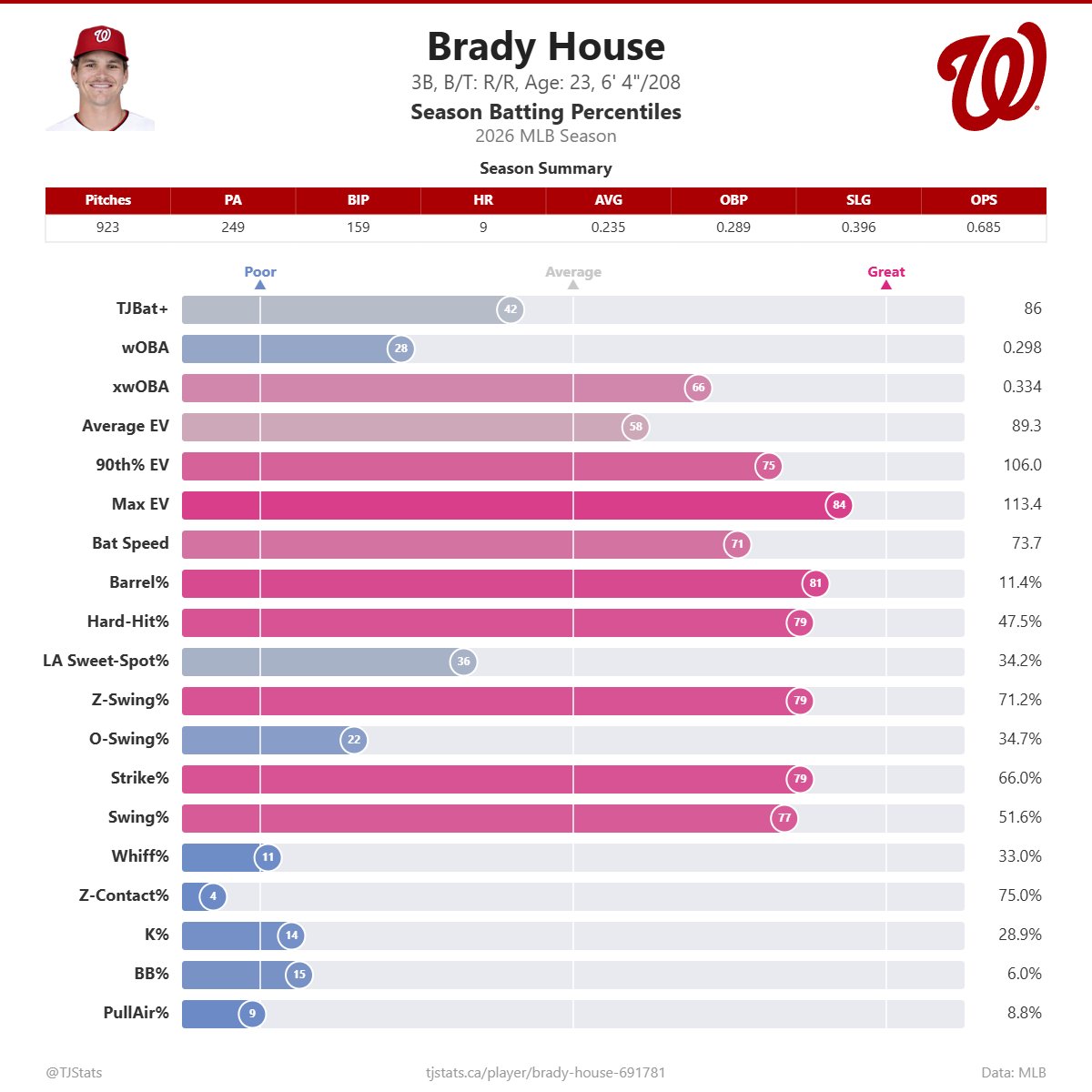
Across 65 games and 249 PA this season, House has an 88 wRC+ and 0.2 fWAR. He also has -3 OAA, playing almost exclusively 3B (he has one game at 1B). Brady struggles to take walks, shown by his low 6.0% BB% (15th percentile), and his 34.7% Chase% (22nd percentile) which demonstrates poor swing decisions. He combines this with a high 33.0% Whiff% (11th percentile), leading to a high 28.9% K% (14th percentile). Brady also has a higher-than-average GB%, though not by much, at 46.7% compared to the league average of 44.1%. When he does hit the ball in the air, he very rarely pulls the ball, with an 11.2% Pull AIR%, very low compared to the league average of 16.8% Pull AIR%. This lack of pulling the ball in the air limits Brady’s raw power from translating into games. So then, what does Brady do well?
He hits the ball hard. Brady posts well-above-average bat speed (73.7 mph) and Hard-Hit% (46.5%). Yet, his 89.3 mph average exit velocity is only around league average. This strong quality of contact leads to a .331 xwOBA, a decent bit higher than his actual .301 wOBA. This suggests that Brady has a little more offensive potential than his actual results have shown, and based on his quality-of-contact metrics, he may actually be closer to a league-average hitter than his 88 wRC+ suggests. So, what does this mean for Brady and the Nationals?
Brady’s horrific chase and whiff issues, combined with his currently subpar defense, make it difficult to truly get excited about his future. While there are some top hitters in the league with both whiff and chase rates above 30%, these hitters generally need to post exceptional quality-of-contact production and Pull AIR% to make it work (look at PCA with his 49% Hard-Hit% and his absolutely ridiculous 33.8% Pull-AIR%). Brady is simply not quite there, especially with his Pull AIR%.
But there is some good news for Brady…
He’s only 23! While fixing whiff and chase issues is a huge challenge, it’s not impossible, and Brady could certainly develop with more time in the majors. Additionally, I believe his defense will start to look better, based on the fact that he was a pretty good defender all throughout the minor leagues. If he can play above-average defense at third, he will buy himself some time to fix his offensive profile. He’s putting up close enough to league-average hitting to warrant time to develop. If Brady can make major strides in at least one of his Chase%, Whiff%, or Pull AIR%, his offensive profile instantly makes him an above-average big league hitter.
There’s plenty of reason to still be excited for House, and I am by no means suggesting that the Nationals should be looking to replace him soon. In fact, I believe he should be playing every day (seriously, why is Jorbit Vivas still starting at third frequently??) to help his development. But I still wouldn’t hold my hopes on House being the 3B well into the future. He needs to make significant strides heading into next season to warrant being high on him as a player. One thing that gives me hope is the Nationals’ ability to teach hitters how to pull the ball in the air. But I worry with Brady that trying to pull the ball too much may actually make his whiff issues worse, which it seemed to do earlier in the season. He may be at his best hitting the ball to the opposite field, and if so, he needs to figure out how to improve his approach.
Ultimately, Brady is a serviceable 3B for the time being, with room to grow into much more. But with potential other options looming (Seaver King getting some time at third👀) I wouldn't get your hopes too high with Brady.
@NatsAnalysis This is some great in-depth stuff you are providing! I love how you are using advanced metrics in these write-ups as most writers seem to still be focusing on the old-school numbers that don’t provide as much insight. Great stuff! Keep up the good work!
@SleeperHQ This is great, but commissioner customizable playoffs would be even better. Would love to be able to implement a top 6 PLUS highest total points of the remainder go to the playoffs. Slightly different than just top 7.
#dawgsbaseball drops a heartbreaker to Freedom tonight, 5-4. Proud of this team and their effort, heart and energy. They represented their school, families and community the right way all year long.