Generational run since being promoted. He showed good contact skills and swing decisions in AA this year as well, even if the production wasn’t great. But his Pull Air% has increased by 12.4% since being promoted to AAA, and now that we have data his EV numbers look pretty good as well. Wonder if coaches in AAA or the dev staff saw something they could change to get him to pull the ball more🤷♂️
The second half is essentially when JY returned from his lingering hand injury, which helps support the point I made in his write up yesterday. This 148 number is almost certainly unsustainable, this production is really primarily coming from optimal launch angles, he still isn’t hitting the ball hard (though he is also running really good K% and BB% during this stretch). BUT, even with that number going to come down the LA improvements should keep his offense around league average and that is an awesome sign for him. Been a really fun year to have JY on the team
On July 12th, 2021, the Nationals selected OF Jacob Young out of the University of Florida with the 203rd overall pick (7th round). Young is in his 4th season with the Nationals, his third year of being a consistent starter. Young has accumulated 6.7 fWAR across his career so far and is in the midst of a breakout offensive season. But can Jacob, with his career-average 82 wRC+, be a true piece for the Nationals? I believe so. Here’s why…
Let’s start with the facts.
Jacob Young is a true center fielder who has played in 115 games this season, accumulating 393 PA. Young ranks 3rd in MLB among CF with 12 OAA. This indicates that Young has absolutely outstanding range in the outfield. He is also tied for 4th among all outfielders with 10 FRV (95th percentile). Additionally, Jacob was a Gold Glove finalist in each of his first two full MLB seasons. While not every defensive metric views Young’s 2026 defense as favorably (he currently has only +1 DRS), Statcast metrics and his career history show that he is an elite defender. He has well established himself as a defender, but this year the offense is trending up as well. Young’s bat speed is up to 69.5 mph (a 1.2 mph increase from 2025), which is still well below average but a major improvement. This, in part, has led to a substantial increase in average exit velocity, up to 88.2 mph (33rd percentile) from 87.6 mph in 2025 (16th percentile). While ultimately, he still doesn’t hit the ball particularly hard, it is an improvement. Jacob combines this with an above-average Whiff% and Chase%, at 21.5% and 27.2%, respectively. This is actually down from previous seasons (especially the Whiff%), possibly from his bat speed increase (though there are other factors that could be in play and I would need more data to make a definitive conclusion on this), but is still above league average. Where Jacob has made the biggest improvement, though, is his GB% and his Pull Air%. Young posted a GB% above 56% in each of his first 3 seasons, including a 56.5% GB% in 2025. This is much higher than the league average of 44.1%. In 2025, this led to a 27.9% LA Sweet Spot% (3rd percentile) and, combined with his poor exit velos, a 1.9% Barrel% (4th percentile). In 2026, Young has dropped his GB% all the way down to 40.5%! This, combined with better exit velos, has led to a 36.4% LA Sweet Spot% (72nd percentile!) and a 6.2% Barrel% (33rd percentile). Young also combines this with a substantially better pull approach, jumping from a 5.9% Pull Air% in 2025 (well below league average) all the way to a 15.5% Pull Air% (slightly below the league average of 16.8%). These are significant improvements that allow Jacob to hit more line drives, leading to more hits in general, as well as more power with his ability to pull balls in the air. This improvement is clearly seen with Jacob jumping from a career-low 66 wRC+ in 2025 to a 95 wRC+ so far in 2026. So what does this mean for Jacob’s overall output?
I’ve long said that if Jacob could be a league-average hitter, he would be a top-10-caliber CF. This season, Young is tied for 11th in fWAR among CF. His defense gives him such a high floor at an important position, and with about league-average offense, he is a very valuable player. With 3 years of arbitration coming up, Jacob should be manning CF for the Nationals for at least the next 3 years. If Young can maintain something close to league-average offensive production alongside his elite defense, he has the profile of a 2–3 fWAR player annually, making him an extremely valuable role player. I expect the offense to stay close to league average based on the improvements made this season. One interesting thing to note is that since Young took a few games off in July to fully recover from a lingering left hand injury, he has a phenomenal .371 wOBA (94th percentile).
Ultimately, Young still doesn’t hit the ball particularly hard, which limits his overall offensive upside. But he makes up for this with much-improved launch angles and solid contact skills. With Jacob’s outstanding defense, he projects to be a valuable player in CF. He also provides some baserunning value, posting a +2 baserunning value (83rd percentile.) While I don’t think Jacob will ever be a superstar or “cornerstone” piece, he absolutely deserves to be the everyday starter in CF for the foreseeable future, as long as his offense remains close to league average and he doesn’t suffer a significant falloff on defense.
*Note that this data was pulled from 8/24/26 but screenshots are from 8/25/26, so their may be some small discrepancies
On July 12th, 2021, the Nationals selected OF Jacob Young out of the University of Florida with the 203rd overall pick (7th round). Young is in his 4th season with the Nationals, his third year of being a consistent starter. Young has accumulated 6.7 fWAR across his career so far and is in the midst of a breakout offensive season. But can Jacob, with his career-average 82 wRC+, be a true piece for the Nationals? I believe so. Here’s why…
Let’s start with the facts.
Jacob Young is a true center fielder who has played in 115 games this season, accumulating 393 PA. Young ranks 3rd in MLB among CF with 12 OAA. This indicates that Young has absolutely outstanding range in the outfield. He is also tied for 4th among all outfielders with 10 FRV (95th percentile). Additionally, Jacob was a Gold Glove finalist in each of his first two full MLB seasons. While not every defensive metric views Young’s 2026 defense as favorably (he currently has only +1 DRS), Statcast metrics and his career history show that he is an elite defender. He has well established himself as a defender, but this year the offense is trending up as well. Young’s bat speed is up to 69.5 mph (a 1.2 mph increase from 2025), which is still well below average but a major improvement. This, in part, has led to a substantial increase in average exit velocity, up to 88.2 mph (33rd percentile) from 87.6 mph in 2025 (16th percentile). While ultimately, he still doesn’t hit the ball particularly hard, it is an improvement. Jacob combines this with an above-average Whiff% and Chase%, at 21.5% and 27.2%, respectively. This is actually down from previous seasons (especially the Whiff%), possibly from his bat speed increase (though there are other factors that could be in play and I would need more data to make a definitive conclusion on this), but is still above league average. Where Jacob has made the biggest improvement, though, is his GB% and his Pull Air%. Young posted a GB% above 56% in each of his first 3 seasons, including a 56.5% GB% in 2025. This is much higher than the league average of 44.1%. In 2025, this led to a 27.9% LA Sweet Spot% (3rd percentile) and, combined with his poor exit velos, a 1.9% Barrel% (4th percentile). In 2026, Young has dropped his GB% all the way down to 40.5%! This, combined with better exit velos, has led to a 36.4% LA Sweet Spot% (72nd percentile!) and a 6.2% Barrel% (33rd percentile). Young also combines this with a substantially better pull approach, jumping from a 5.9% Pull Air% in 2025 (well below league average) all the way to a 15.5% Pull Air% (slightly below the league average of 16.8%). These are significant improvements that allow Jacob to hit more line drives, leading to more hits in general, as well as more power with his ability to pull balls in the air. This improvement is clearly seen with Jacob jumping from a career-low 66 wRC+ in 2025 to a 95 wRC+ so far in 2026. So what does this mean for Jacob’s overall output?
I’ve long said that if Jacob could be a league-average hitter, he would be a top-10-caliber CF. This season, Young is tied for 11th in fWAR among CF. His defense gives him such a high floor at an important position, and with about league-average offense, he is a very valuable player. With 3 years of arbitration coming up, Jacob should be manning CF for the Nationals for at least the next 3 years. If Young can maintain something close to league-average offensive production alongside his elite defense, he has the profile of a 2–3 fWAR player annually, making him an extremely valuable role player. I expect the offense to stay close to league average based on the improvements made this season. One interesting thing to note is that since Young took a few games off in July to fully recover from a lingering left hand injury, he has a phenomenal .371 wOBA (94th percentile).
Ultimately, Young still doesn’t hit the ball particularly hard, which limits his overall offensive upside. But he makes up for this with much-improved launch angles and solid contact skills. With Jacob’s outstanding defense, he projects to be a valuable player in CF. He also provides some baserunning value, posting a +2 baserunning value (83rd percentile.) While I don’t think Jacob will ever be a superstar or “cornerstone” piece, he absolutely deserves to be the everyday starter in CF for the foreseeable future, as long as his offense remains close to league average and he doesn’t suffer a significant falloff on defense.
*Note that this data was pulled from 8/24/26 but screenshots are from 8/25/26, so their may be some small discrepancies
Granted, this stats is a little misleading because in 2 of these starts he didn’t make it through the 3rd inning and in a few others he got pulled early as well.. but even with that considered this is still nuts. Legitimately in Cy Young conversations🤷♂️
Cade Cavalli has now allowed three earned runs or fewer in 26 of his 28 starts, the most in Major League Baseball.
1. Cade Cavalli - 26
T2. Jacob Misiorowski - 24
T2. Cam Schlittler - 24
On June 5th, 2018, the Nationals selected RHP Jake Irvin out of the University of Oklahoma in the 4th round, 131st overall. Irvin has accumulated 105 starts across 4 seasons for the Nationals, tallying a career 5.05 ERA and an equivalent 5.05 FIP. Irvin has shown flashes of being a 4/5 starter in a rotation, but the numbers suggest the Nationals should probably look for a replacement sooner rather than later. Here’s why...
Let’s start with the facts.
Irvin holds a seven-pitch mix, primarily consisting of a four-seamer, curveball, and sinker, while also mixing in a cutter, changeup, sweeper, and slider. His slider grades out as his best pitch from a “stuff” standpoint at 108 tjStuff+, followed by his sweeper at 103 tjStuff+ and four-seamer at 100 tjStuff+. The rest of his arsenal grades out slightly below average, with his changeup at 99 tjStuff+, cutter at 98 tjStuff+, and both his curveball and sinker at 97 tjStuff+. Irvin throws his four-seamer 28.4% of the time, followed by his curveball at 23.7%, sinker at 20.9%, cutter at 11.3%, changeup at 6.8%, sweeper at 5.6%, and slider at 3.4%. His stuff mostly grades out as average or below average, with the major exception of his slider, which he only throws 3.4% of the time. But how does it actually play out?
Irvin’s 5.05 ERA and equivalent 5.05 FIP show that both his results and underlying performance have been subpar. These totals rank him toward the bottom of the league among starting pitchers. Irvin struggles to get batters to chase outside of the zone, as his 24.9% Chase% puts him in the 3rd percentile. On top of that, he tends to allow free passes, with his 9.9% BB% ranking in the 31st percentile, and he generates a slightly below-average swing-and-miss rate, with his 24.0% Whiff% ranking in the 42nd percentile. He also tends to give up hard contact, with a 12.3% Barrel% (3rd percentile) and a 43.8% Hard-Hit% (11th percentile). To make matters worse, Irvin often allows this contact in the air, supported by his 37.4% GB% (compared to the 44.1% league average) and, again, his 12.3% Barrel%. So, what does Irvin do well?
He gets really good extension and has a few well-performing pitches. Irvin gets 7.2 feet of extension, ranking him in the 96th percentile. Unfortunately, despite this elite extension, his arsenal still grades out as mostly average or below average. While it is an impeccable physical trait for Irvin, his stuff still gets hit fairly hard. Despite the underwhelming stuff grades, what really stand out are his curveball and changeup, which give up .236 and .131 xwOBAs, respectively. These pitches partially redeem the rest of Jake’s arsenal, helping him remain a serviceable No. 5 starter. However, his changeup is only truly used against LHH, so even that has substantial limitations. So, what does this all mean for Jake?
Ultimately, Irvin is a serviceable No. 5 starter, but the Nats should certainly look to upgrade upon him. He doesn’t truly do anything particularly well, though he does have some average traits, including his Whiff% and K%, that make him usable. This season, Jake is only making $2.8M, and at that value, he is worth keeping around if nobody else is truly knocking on the door for playing time. Jake has 3 seasons of arbitration left, and if the money stays down, the Nats wouldn’t be wrong for keeping him around to eat innings. However, if they truly want to compete, they should look to replace him in the rotation sooner rather than later.
On June 5th, 2018, the Nationals selected RHP Jake Irvin out of the University of Oklahoma in the 4th round, 131st overall. Irvin has accumulated 105 starts across 4 seasons for the Nationals, tallying a career 5.05 ERA and an equivalent 5.05 FIP. Irvin has shown flashes of being a 4/5 starter in a rotation, but the numbers suggest the Nationals should probably look for a replacement sooner rather than later. Here’s why...
Let’s start with the facts.
Irvin holds a seven-pitch mix, primarily consisting of a four-seamer, curveball, and sinker, while also mixing in a cutter, changeup, sweeper, and slider. His slider grades out as his best pitch from a “stuff” standpoint at 108 tjStuff+, followed by his sweeper at 103 tjStuff+ and four-seamer at 100 tjStuff+. The rest of his arsenal grades out slightly below average, with his changeup at 99 tjStuff+, cutter at 98 tjStuff+, and both his curveball and sinker at 97 tjStuff+. Irvin throws his four-seamer 28.4% of the time, followed by his curveball at 23.7%, sinker at 20.9%, cutter at 11.3%, changeup at 6.8%, sweeper at 5.6%, and slider at 3.4%. His stuff mostly grades out as average or below average, with the major exception of his slider, which he only throws 3.4% of the time. But how does it actually play out?
Irvin’s 5.05 ERA and equivalent 5.05 FIP show that both his results and underlying performance have been subpar. These totals rank him toward the bottom of the league among starting pitchers. Irvin struggles to get batters to chase outside of the zone, as his 24.9% Chase% puts him in the 3rd percentile. On top of that, he tends to allow free passes, with his 9.9% BB% ranking in the 31st percentile, and he generates a slightly below-average swing-and-miss rate, with his 24.0% Whiff% ranking in the 42nd percentile. He also tends to give up hard contact, with a 12.3% Barrel% (3rd percentile) and a 43.8% Hard-Hit% (11th percentile). To make matters worse, Irvin often allows this contact in the air, supported by his 37.4% GB% (compared to the 44.1% league average) and, again, his 12.3% Barrel%. So, what does Irvin do well?
He gets really good extension and has a few well-performing pitches. Irvin gets 7.2 feet of extension, ranking him in the 96th percentile. Unfortunately, despite this elite extension, his arsenal still grades out as mostly average or below average. While it is an impeccable physical trait for Irvin, his stuff still gets hit fairly hard. Despite the underwhelming stuff grades, what really stand out are his curveball and changeup, which give up .236 and .131 xwOBAs, respectively. These pitches partially redeem the rest of Jake’s arsenal, helping him remain a serviceable No. 5 starter. However, his changeup is only truly used against LHH, so even that has substantial limitations. So, what does this all mean for Jake?
Ultimately, Irvin is a serviceable No. 5 starter, but the Nats should certainly look to upgrade upon him. He doesn’t truly do anything particularly well, though he does have some average traits, including his Whiff% and K%, that make him usable. This season, Jake is only making $2.8M, and at that value, he is worth keeping around if nobody else is truly knocking on the door for playing time. Jake has 3 seasons of arbitration left, and if the money stays down, the Nats wouldn’t be wrong for keeping him around to eat innings. However, if they truly want to compete, they should look to replace him in the rotation sooner rather than later.
@realmattriordan I’m really rooting for him. I just don’t really like guys who struggle with whiff and chase at the same time. It’s tough to fix. But two walks tonight is encouraging👀
On July 11th, 2021, the Nationals selected Brady House with the 11th overall pick in the MLB Draft. House was a highly ranked HS shortstop who profiled long-term at 3B, where he ended up playing. House was ranked as a top 100 prospect most of the time he was in the minors but has had an up-and-down start to his young career. This performance raises a question: Is Brady House a long-term answer at third base for the Nationals? While he shows promise, I’m not fully bought in. Here’s why…
Let’s start with the facts.
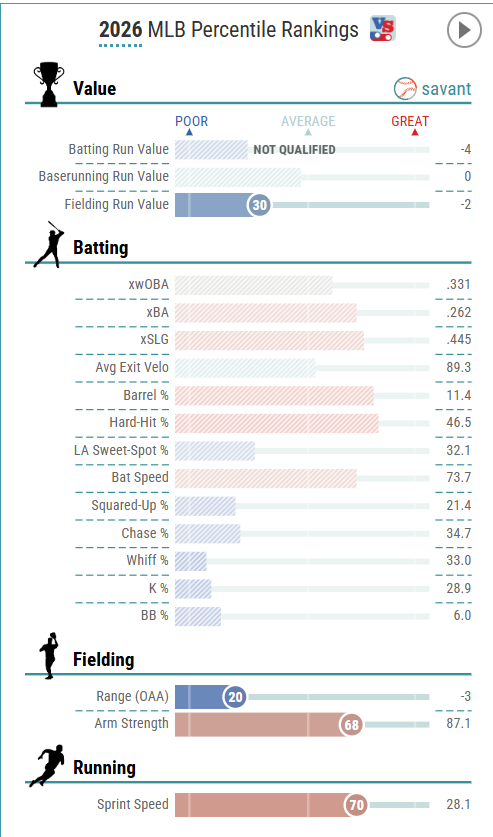
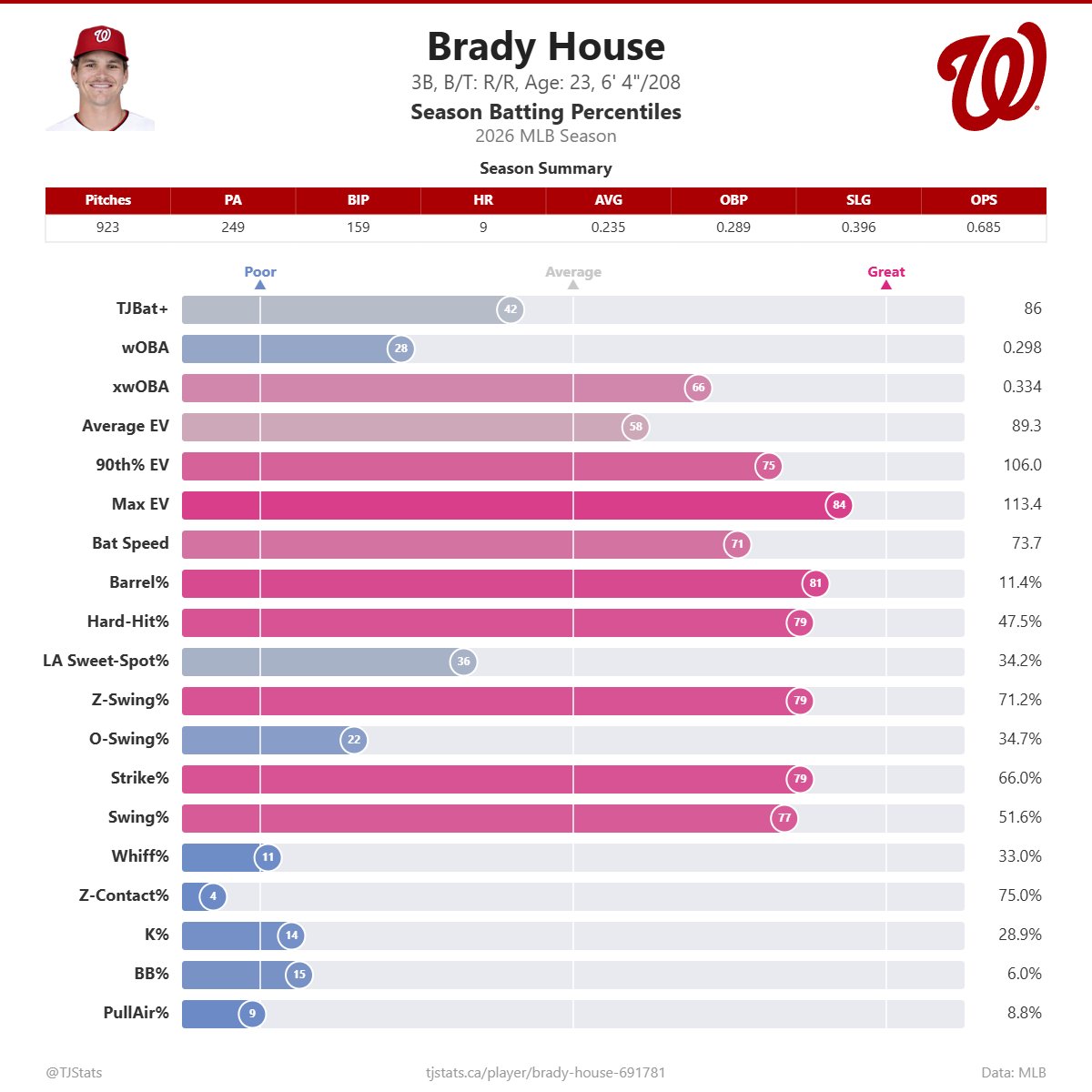
Across 65 games and 249 PA this season, House has an 88 wRC+ and 0.2 fWAR. He also has -3 OAA, playing almost exclusively 3B (he has one game at 1B). Brady struggles to take walks, shown by his low 6.0% BB% (15th percentile), and his 34.7% Chase% (22nd percentile) which demonstrates poor swing decisions. He combines this with a high 33.0% Whiff% (11th percentile), leading to a high 28.9% K% (14th percentile). Brady also has a higher-than-average GB%, though not by much, at 46.7% compared to the league average of 44.1%. When he does hit the ball in the air, he very rarely pulls the ball, with an 11.2% Pull AIR%, very low compared to the league average of 16.8% Pull AIR%. This lack of pulling the ball in the air limits Brady’s raw power from translating into games. So then, what does Brady do well?
He hits the ball hard. Brady posts well-above-average bat speed (73.7 mph) and Hard-Hit% (46.5%). Yet, his 89.3 mph average exit velocity is only around league average. This strong quality of contact leads to a .331 xwOBA, a decent bit higher than his actual .301 wOBA. This suggests that Brady has a little more offensive potential than his actual results have shown, and based on his quality-of-contact metrics, he may actually be closer to a league-average hitter than his 88 wRC+ suggests. So, what does this mean for Brady and the Nationals?
Brady’s horrific chase and whiff issues, combined with his currently subpar defense, make it difficult to truly get excited about his future. While there are some top hitters in the league with both whiff and chase rates above 30%, these hitters generally need to post exceptional quality-of-contact production and Pull AIR% to make it work (look at PCA with his 49% Hard-Hit% and his absolutely ridiculous 33.8% Pull-AIR%). Brady is simply not quite there, especially with his Pull AIR%.
But there is some good news for Brady…
He’s only 23! While fixing whiff and chase issues is a huge challenge, it’s not impossible, and Brady could certainly develop with more time in the majors. Additionally, I believe his defense will start to look better, based on the fact that he was a pretty good defender all throughout the minor leagues. If he can play above-average defense at third, he will buy himself some time to fix his offensive profile. He’s putting up close enough to league-average hitting to warrant time to develop. If Brady can make major strides in at least one of his Chase%, Whiff%, or Pull AIR%, his offensive profile instantly makes him an above-average big league hitter.
There’s plenty of reason to still be excited for House, and I am by no means suggesting that the Nationals should be looking to replace him soon. In fact, I believe he should be playing every day (seriously, why is Jorbit Vivas still starting at third frequently??) to help his development. But I still wouldn’t hold my hopes on House being the 3B well into the future. He needs to make significant strides heading into next season to warrant being high on him as a player. One thing that gives me hope is the Nationals’ ability to teach hitters how to pull the ball in the air. But I worry with Brady that trying to pull the ball too much may actually make his whiff issues worse, which it seemed to do earlier in the season. He may be at his best hitting the ball to the opposite field, and if so, he needs to figure out how to improve his approach.
Ultimately, Brady is a serviceable 3B for the time being, with room to grow into much more. But with potential other options looming (Seaver King getting some time at third👀) I wouldn't get your hopes too high with Brady.
On July 11th, 2021, the Nationals selected Brady House with the 11th overall pick in the MLB Draft. House was a highly ranked HS shortstop who profiled long-term at 3B, where he ended up playing. House was ranked as a top 100 prospect most of the time he was in the minors but has had an up-and-down start to his young career. This performance raises a question: Is Brady House a long-term answer at third base for the Nationals? While he shows promise, I’m not fully bought in. Here’s why…
Let’s start with the facts.
Across 65 games and 249 PA this season, House has an 88 wRC+ and 0.2 fWAR. He also has -3 OAA, playing almost exclusively 3B (he has one game at 1B). Brady struggles to take walks, shown by his low 6.0% BB% (15th percentile), and his 34.7% Chase% (22nd percentile) which demonstrates poor swing decisions. He combines this with a high 33.0% Whiff% (11th percentile), leading to a high 28.9% K% (14th percentile). Brady also has a higher-than-average GB%, though not by much, at 46.7% compared to the league average of 44.1%. When he does hit the ball in the air, he very rarely pulls the ball, with an 11.2% Pull AIR%, very low compared to the league average of 16.8% Pull AIR%. This lack of pulling the ball in the air limits Brady’s raw power from translating into games. So then, what does Brady do well?
He hits the ball hard. Brady posts well-above-average bat speed (73.7 mph) and Hard-Hit% (46.5%). Yet, his 89.3 mph average exit velocity is only around league average. This strong quality of contact leads to a .331 xwOBA, a decent bit higher than his actual .301 wOBA. This suggests that Brady has a little more offensive potential than his actual results have shown, and based on his quality-of-contact metrics, he may actually be closer to a league-average hitter than his 88 wRC+ suggests. So, what does this mean for Brady and the Nationals?
Brady’s horrific chase and whiff issues, combined with his currently subpar defense, make it difficult to truly get excited about his future. While there are some top hitters in the league with both whiff and chase rates above 30%, these hitters generally need to post exceptional quality-of-contact production and Pull AIR% to make it work (look at PCA with his 49% Hard-Hit% and his absolutely ridiculous 33.8% Pull-AIR%). Brady is simply not quite there, especially with his Pull AIR%.
But there is some good news for Brady…
He’s only 23! While fixing whiff and chase issues is a huge challenge, it’s not impossible, and Brady could certainly develop with more time in the majors. Additionally, I believe his defense will start to look better, based on the fact that he was a pretty good defender all throughout the minor leagues. If he can play above-average defense at third, he will buy himself some time to fix his offensive profile. He’s putting up close enough to league-average hitting to warrant time to develop. If Brady can make major strides in at least one of his Chase%, Whiff%, or Pull AIR%, his offensive profile instantly makes him an above-average big league hitter.
There’s plenty of reason to still be excited for House, and I am by no means suggesting that the Nationals should be looking to replace him soon. In fact, I believe he should be playing every day (seriously, why is Jorbit Vivas still starting at third frequently??) to help his development. But I still wouldn’t hold my hopes on House being the 3B well into the future. He needs to make significant strides heading into next season to warrant being high on him as a player. One thing that gives me hope is the Nationals’ ability to teach hitters how to pull the ball in the air. But I worry with Brady that trying to pull the ball too much may actually make his whiff issues worse, which it seemed to do earlier in the season. He may be at his best hitting the ball to the opposite field, and if so, he needs to figure out how to improve his approach.
Ultimately, Brady is a serviceable 3B for the time being, with room to grow into much more. But with potential other options looming (Seaver King getting some time at third👀) I wouldn't get your hopes too high with Brady.
@AJ_Lich A BABIP roughly .070 below the average at A+ (and the eye test tells you he’s hitting the ball pretty hard so the luck should turn around quick) while STILL putting up .413 OBP and stealing bases at a high level. At 18. Kid is a beast
@starsstrikesbb Absolutely. If you can’t see the upside you aren’t looking very hard.. a few tweaks and he’s a legit back end reliever. The stuff will play if he can get it in the zone enough
Also at some point I might chart some of his starts looking for fastballs 97+ mph.. he threw quite a few last night and got a few whiffs so I’m curious what his Whiff% would like with that threshold
Just watched Cade’s whole start from last night (couldn’t watch it live) and it feels like a good time to bump my “Cade could be a Cy Young candidate” post
On June 10th, 2020, the Nationals selected RHP Cade Cavalli out of Oklahoma with the 22nd overall pick in the draft. Cade immediately became one of the top Nationals prospects and showed substantial progress throughout the minors. But a slew of injuries halted Cavalli’s hype and kept him from pitching on a major league mound for about three years. Cavalli is finally fully back in 2026, looking to prove himself as a frontline starter, and I believe he has done so. Here’s why…
Let’s start with the facts.
Cavalli touts a formidable six-pitch mix consisting of a four-seam fastball, a knuckle curve, a sinker, a sweeper, a changeup, and a cutter. He throws these pitches with a frequency of 33.2%, 26.6%, 13.6%, 13.2% (primarily against RHH), 7.8% (primarily against LHH), and 5.5%, respectively. His “stuff” grades out with his sweeper as his best pitch at 111 tjStuff+, followed by his changeup at 110 tjStuff+, his knuckle curve at 106 tjStuff+, his sinker at 102 tjStuff+, his four-seamer at 100 tjStuff+, and finally his cutter at 96 tjStuff+. He holds an overall grade of 104 tjStuff+, putting him in the 76th percentile among MLB pitchers with 200 PA against. His stuff is well above average, but how does it actually play out?
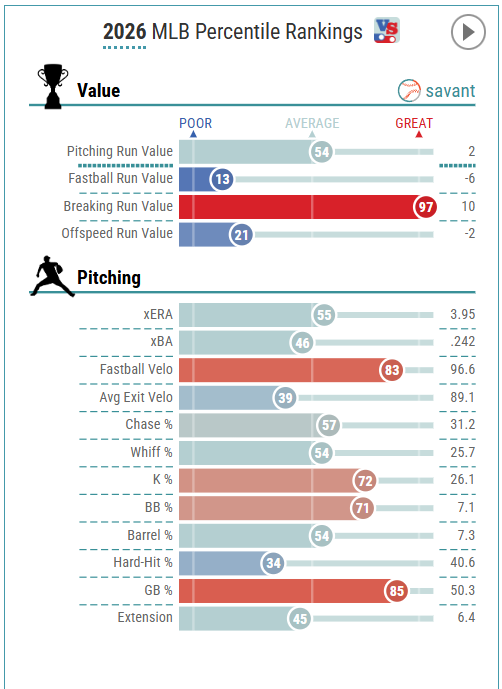
The answer is, quite well. Cavalli holds a well-above-average 26.1% K% as well as a fabulous 7.1% BB%. He is able to limit walks while also generating Ks. On top of this, when he does allow contact, it is on the ground more often than not, with a 50.3% GB% (84th percentile). This has led to Cade Cavalli posting a 3.36 ERA and 3.46 FIP up to this point in the season. Cavalli’s FIP ranks him 17th in the major leagues, firmly cementing him as a No. 1/2 starter on just about any team in the league.
Cavalli generates most of his value on breaking balls, with his knuckle curve and sweeper holding .241 and .153 wOBA against, respectively. His fastball pitches (four-seamer, sinker, and cutter) aren’t quite as strong, putting up a -6 Fastball Run Value (13th percentile). This disparity between pitch types aligns with his stuff grades, where his fastballs all grade out about average, while his sweeper and knuckle curve are well above average. Cavalli generates a fabulous 38.2% Whiff% on his knuckle curve and a 33.1% Whiff% on his sweeper, while his four-seamer, sinker, and cutter have Whiff% of just 21.7%, 12.9%, and 17.6%, respectively. Additionally, most of Cavalli’s hard contact is given up on fastballs. His knuckle curve holds a 28.7% Hard-Hit%, and his sweeper puts up a 33.3% Hard-Hit%. His fastballs give up 46%, 49.3%, and 48% Hard-Hit%, respectively. His changeup doesn’t fit into either category but is also a valuable weapon, posting a 24.1% Whiff% and a 34.5% Hard-Hit%, essentially sitting in between his fastballs and breaking pitches. So what does this mean for Cavalli?
While you could infer from this that Cavalli needs to throw his fastball less, I do not believe this is the case. Cavalli throws his four-seam fastball with an average velocity of 96.8 mph and can touch 100, which makes it a fastball that hitters have to respect. This pitch is important for the rest of his arsenal being so deadly.
An interesting wrinkle with his fastball is how it plays at different velocities. I studied four different starts of his, including his best start on 6/30 against Boston, his “worst” start on 4/13 against Pittsburgh, and two randomly selected starts on 5/21 and 6/7 against the Mets and Diamondbacks. I didn’t pick a fully random sample because the game against Boston was a specific case study that prompted my research. Earlier, we established that Cade’s four-seamer has a 21.7% Whiff% across the season. I analyzed every pitch of these four starts to isolate how many whiffs Cade was getting when throwing his fastball at 99+ mph versus throwing it below 99 mph. In the Boston game alone, he threw six fastballs over 99 mph (he must’ve been really amped up for some reason), generating four whiffs. One of these fastballs was not swung at (taken as a ball) and therefore does not count toward Whiff%, meaning Cavalli had an 80% Whiff% (4/5) on balls over 99 mph in that game. In the other three games that I studied, Cade’s fastballs combined for four total whiffs, and he threw zero fastballs over 99 mph. These four whiffs came across a total of 111 fastballs (all below 99 mph), 48 of which were swung at, equaling an 8.3% Whiff%. While this is by no means an adequate sample size (and I can’t stress enough that this is a small sample), it is an eye-opening example of just how good Cade’s fastball can be when he hits his top velocities. If I were in the Nationals front office, this is something I would examine even further to get more statistically significant results, and I would be thinking about seeing if there’s any way to get Cade to sit a tick higher with his fastball. If Cavalli could find a way to improve his fastball without sacrificing command or stamina (which is admittedly a large ask), I believe Cade has another level to his game that could potentially put him in a Cy Young race.
But saying he should add fastball velo is much easier than actually doing it. So let’s analyze Cade as he is…
With his 3.46 FIP, I believe Cade has established himself with a floor of a No. 3 starter in any rotation over the next few years, with a more than reasonable chance to be a No. 1 or 2. Cade projects to finish this season at about 3.4 WAR, assuming he continues on a similar pace. I believe this is a good baseline for his performance over the next two seasons, giving a rough projection that he will likely put up between 2.8–4.0 WAR in each of the next two years. This roughly values him between $28–40 million (using a $10M/WAR calculation), depending on which side of the projection he falls on. Cavalli’s actual contract is worth $4 million next season (on a team option) and then two years of arbitration. This means that next season, Cade will have a rough surplus value of $24 million (assuming the lowest projection), which is an incredible value for the Nationals! However, with pitchers, injury risk always needs to be thought about, especially for a guy with an extensive injury history like Cade. But regardless, the numbers are still exciting.
Overall, Cade is an extremely exciting breakout for the Nationals this season, and he should be a staple of the rotation for multiple seasons going forward, generating significant value for the Nationals.