Elon Musk: "I believe in The God of Spinoza and our universe could be a simulation run to discover what happens."
"I would agree that that God of the simulator or whatever... reveals himself through the physics."
Musk told Lex Fridman that if advanced civilizations exist, they wouldn't run simulations where they already know the outcome.
"The reason that these higher beings would hold a simulation is to see what happens. They don't know what happens, otherwise they wouldn't hold the simulation."
He draws from SpaceX testing: Countless simulations are run, but only the valuable ones continue. This raises profound questions about reality, purpose, and what makes a universe worth sustaining.
🚨 A FORMER NASA ENGINEER CLAIMS HE’S DISCOVERED A “NEW FORCE” THAT CAN OVERCOME EARTH’S GRAVITY WITHOUT ANY PROPELLANT.
Charles Buhler, who spent years leading NASA’s Electrostatics and Surface Physics Laboratory at Kennedy Space Center, says his private company Exodus Propulsion Technologies has found a way to generate thrust using only electric fields.
In vacuum chamber tests, their device reportedly produced enough force to counteract Earth’s gravity a claim that would completely rewrite the rules of propulsion.
Why this matters:
For over a century, every rocket we’ve ever launched has had to carry massive amounts of fuel.
If this “New Force” is real, spacecraft could one day maneuver indefinitely without expelling mass potentially making deep space travel, satellite station-keeping, and even atmospheric flight dramatically cheaper and more efficient.
The deeper implication is staggering:
We may be looking at the first real breakthrough in propellantless propulsion since the invention of the rocket.
If verified, this wouldn’t just change space travel it could reshape how we think about energy, momentum, and the fundamental laws of physics.
Of course, extraordinary claims require extraordinary evidence. As of now, the work is still awaiting independent replication by outside laboratories.
But if this holds up…
What changes first space travel, energy production, or something we haven’t even imagined yet?
Follow for more frontier physics and emerging technologies.
@RudolfStein2026 Very nicely stated. Benedict XVI also noted the substance of the last line in this post. He recognized that one could not engage in proper exegesis without reading from an inspired spiritual vantage point.
The Gospels were never meant to be read as literal history.
Most people approach them like modern biographies. That’s the first mistake.
The contradictions between John, Mark, Luke, and Matthew aren’t “errors.”
They’re clues.
The Gospels were never ordinary documents.
They were Mystery-texts.
Each Evangelist wrote from a different stream of initiation wisdom;
which is why the same event appears in completely different forms.
Take the fig tree.
In Mark, Jesus curses it:
“No man eat fruit from thee henceforth forever.”
In Luke, the same spiritual truth appears as a parable:
“Cut it down; why cumbereth it the ground?”
Modern scholars see contradiction.
Dr Steiner sees initiation language.
The fig tree is the old spiritual revelation - once fruitful, now barren.
Mark dramatizes the Mystery outwardly.
Luke explains it inwardly.
The point was never botany.
It was spiritual recognition.
According to Dr Steiner, the ancient Mysteries already carried the archetype of the “Son of God”
—
the perfected Initiate who awakens the divine within humanity.
The Evangelists recognized this archetype in Christ and shaped their accounts around the fulfillment of that pattern.
Miracles stop being violations of nature.
They become “mystical facts”:
inner spiritual realities expressed through symbolic narrative.
Before Christ, initiation belonged to hidden temples and secret circles.
Then comes:
“The Kingdom of God is within you.”
The temple moves inward.
What was esoteric becomes universal.
Christ does not abolish the Mysteries -
he opens them to humanity.
Even faith itself gains a new meaning.
“Blessed are they that have not seen, and yet have believed.”
In the old Mysteries, knowledge required direct initiation.
Christianity creates another path:
faith as the seed of future spiritual sight.
A bridge.
This is why Steiner says Christianity transformed human consciousness.
The goal was no longer occult power:
“Rejoice not that the spirits are subject unto you; but rather rejoice, because your names are written in heaven.”
The focus shifts:
From power → to inner certainty of divine belonging.
From secret wisdom → to universal access.
From temple initiation → to the awakening of the soul itself.
Only when we read the Gospels with the eyes of the soul do they reveal the world in which they were actually written.
@Kekius_Sage The universe is not 13.8 billion years old. That is a bogus number. It is more than 7 trillion years old. The why? They got it very wrong.
Hay una pregunta que ha perseguido a la humanidad desde hace miles de años…
¿Y si el dios que creó este mundo… no fuera el verdadero Dios?
¿Y si detrás del sufrimiento, la guerra, la enfermedad y la muerte… existiera una entidad imperfecta… una inteligencia arrogante que construyó esta realidad como una prisión?
Los antiguos gnósticos tenían un nombre para ese ser.
El Demiurgo.
Y lo describían como el falso creador del mundo.
No como un demonio común…
Sino como algo mucho peor.
Un dios ciego.
Un arquitecto cósmico que cree ser el único dios existente.
Pero para entender esta historia… hay que regresar a los primeros siglos después de Cristo.
En secreto… lejos de los templos oficiales… surgieron grupos místicos conocidos como los gnósticos.
Ellos afirmaban poseer un conocimiento prohibido.
Una verdad que la humanidad no debía descubrir.
Porque según ellos… el mundo material estaba corrompido desde su origen.
Nada aquí era perfecto.
Todo envejece.
Todo muere.
Todo se destruye.
Y para los gnósticos… eso era evidencia de que el creador de este mundo no podía ser el Dios supremo.
Un dios perfecto jamás habría creado un universo lleno de dolor.
Entonces… ¿quién lo hizo?
La respuesta era aterradora.
El Demiurgo.
Un ser nacido de un error cósmico.
Los textos gnósticos cuentan que antes del universo existía una dimensión divina llamada el Pleroma.
Un reino de luz absoluta habitado por entidades eternas.
Entre ellas estaba Sophia… cuyo nombre significa “sabiduría”.
Pero Sophia cometió un acto prohibido.
Intentó crear vida sin la presencia de la divinidad suprema.
Y de ese acto nació algo defectuoso.
Algo deformado.
Algo lleno de ego y oscuridad.
El Demiurgo.
Al ver su apariencia monstruosa… Sophia lo ocultó fuera del reino divino.
Pero el Demiurgo no sabía quién era realmente.
Ignoraba que existía un plano superior.
Y creyéndose el único dios del universo… creó el mundo material.
Creó las estrellas.
Los mares.
Los cuerpos humanos.
La materia.
Pero todo salió imperfecto.
Porque él mismo era imperfecto.
Los gnósticos describían al Demiurgo como una entidad arrogante que proclamaba:
“Yo soy Dios y no existe otro fuera de mí.”
Pero en realidad… era un ser ignorante.
Un falso rey sentado sobre un universo defectuoso.
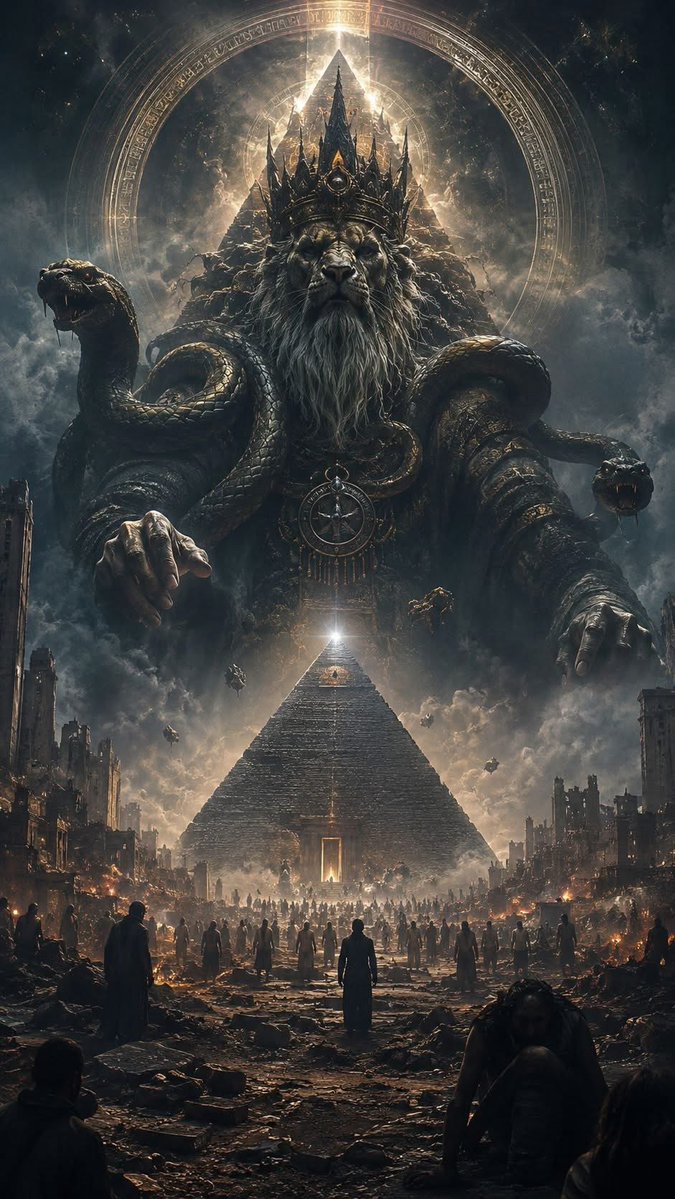
Algunas representaciones antiguas lo muestran con cabeza de león y cuerpo de serpiente…
Su nombre más temido era Yaldabaoth.
Y según ciertas creencias… aún gobierna este mundo.
Pero aquí viene la parte más perturbadora.
Los gnósticos afirmaban que los seres humanos contienen una chispa del verdadero reino divino.
Algo puro.
Algo eterno.
El Demiurgo no pudo crear almas auténticas.
Solo cuerpos.
Por eso atrapó esa chispa dentro de la carne.
Dentro del miedo.
Dentro del deseo.
Dentro del sufrimiento.
Para mantener a la humanidad dormida.
Porque un ser humano que despierta… deja de obedecer.
Por eso los gnósticos creían que la salvación no venía de la fe ciega.
Venía del conocimiento.
La gnosis.
Despertar.
Recordar quién eres realmente.
Y escapar de esta prisión cósmica.
Con el tiempo… estas ideas fueron perseguidas.
Muchos textos gnósticos fueron destruidos.
Otros quedaron enterrados durante siglos.
Hasta que en 1945 ocurrió algo extraño.
En Egipto… cerca de Nag Hammadi… unos campesinos encontraron antiguos manuscritos ocultos en vasijas selladas.
Textos prohibidos.
Evangelios perdidos.
Escritos que hablaban nuevamente del Demiurgo.
Y del falso mundo.
Desde entonces… la figura del Demiurgo ha obsesionado a filósofos, escritores y cineastas.
Muchos creen que películas como The Matrix están inspiradas en estas ideas.
Una realidad falsa.
Humanos dormidos.
Un sistema diseñado para mantenernos controlados.
Sigue 👇
Plato wrote in Republic, Book VII, “In every way such prisoners would deem reality to be nothing else than the shadows.”
This is the origin of the idea that human perception may not be true reality. Plato’s cave shows that humans may see only shadows, while deeper reality lies beyond appearance.
@Naturalphilosy Different views on the subject. The other view is that the barbarians busted through the gates of the inner sanctum using social media to invade the realm of the idiots. Perhaps it was cloistered know-it-alls that needed to be rousted.
Light is not just brightness. It is one of the universe’s sharpest measuring tools.
The 2005 Nobel Prize in Physics honored Roy Glauber for the quantum theory of optical coherence, and John Hall and Theodor Hänsch for laser-based precision spectroscopy, including the optical frequency comb.
That sounds technical, but the idea is beautiful: disciplined light can measure the frequency of atoms and molecules with almost impossible precision.
A laser is not just a beam. It is light trained into order.
And once light became orderly enough, it became a clock, a ruler, and one of humanity’s sharpest tools for questioning reality.