🧬 Passionate about transcription?
🚀 We’re recruiting a PhD student in Transcriptional Regulation @UCPH_health in Copenhagen
Work with RNA, CRISPR, sequencing & proteomics in the Gregersen Lab 👩🔬👨🔬 https://t.co/1IHWCoqOJa
Apply by Apr 10, 2026
https://t.co/SLfqWL8Zq7
🧬 Passionate about transcription?
🚀 We’re recruiting a PhD student in Transcriptional Regulation @UCPH_health in Copenhagen
Work with RNA, CRISPR, sequencing & proteomics in the Gregersen Lab 👩🔬👨🔬 https://t.co/1IHWCoqOJa
Apply by Apr 10, 2026
https://t.co/SLfqWL8Zq7
What is the function of the RNAPII-interacting SCAF proteins?
In our latest work, led by Smaragda Kompocholi, we show that SCAF1 shapes mRNA isoform expression during neuronal differentiation 🧬🧠
Loss of SCAF1 → shorter mRNA transcripts
https://t.co/0BsnwNelAU
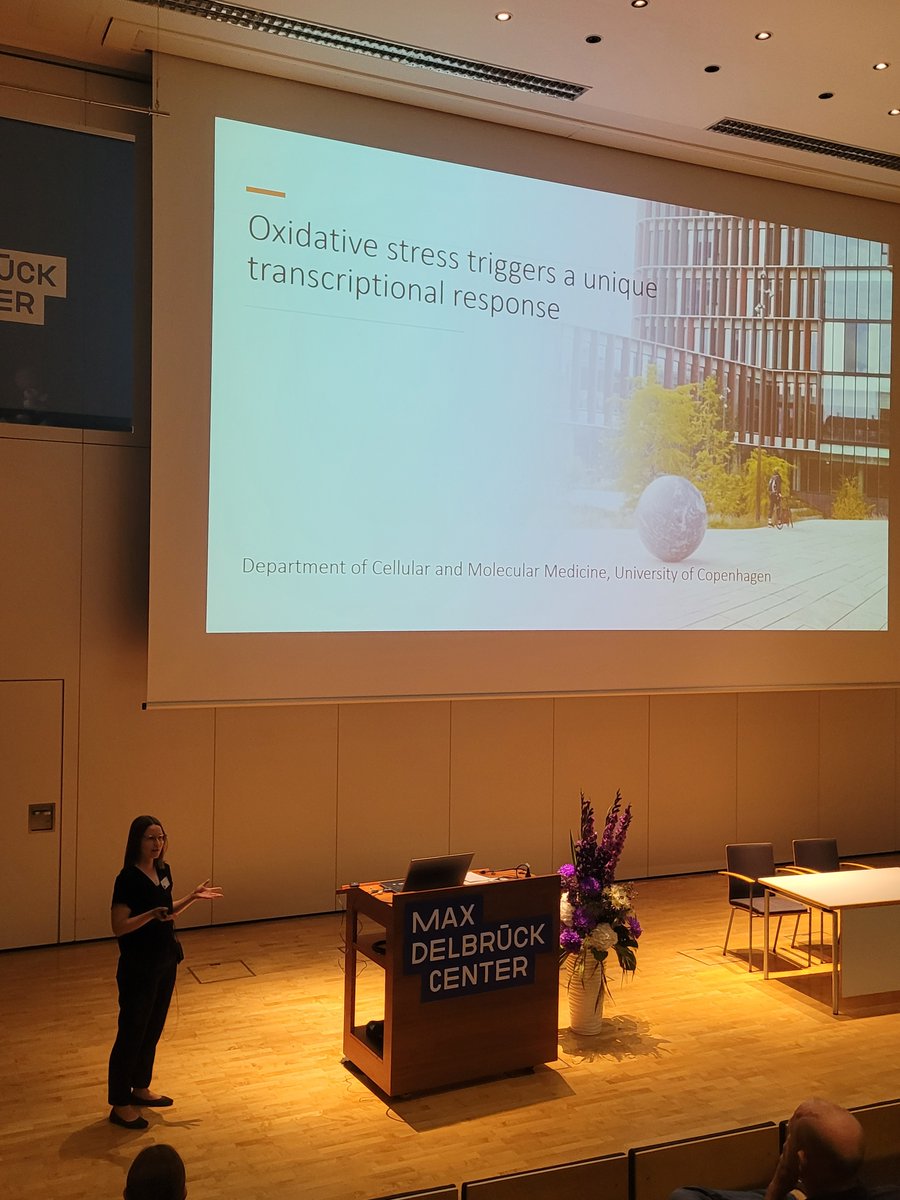
What happens to transcription upon oxidative DNA damage? 🧬💥
RNAPII halts instantly within genes ⛔️ and even more surprisingly: It restarts from where it stopped without leaving the DNA template 🚦
👀 How? Find out in our new preprint👇
https://t.co/YBTELBmiho
Key takeaways:
🔍Oxidative damage causes shutdown of transcription, without RNAPII degradation
🔍Stalled RNAPII resumes transcription from within the gene body
🔍PARylation controls early elongation restart
🔍BER and SSBR repair enable RNAPII recovery in the gene body
This beautiful work, led by Quentin Thomas, revealed a surprising spatial organization of the transcriptional response:
• Promoter regions: PARylation governs early RNAPII release
• Gene body: DNA damage and repair drive RNAPII stalling
Interested in measuring RNAPII elongation rates? We developed DRB/TTchem-seq2 to directly measure RNAPII elongation rates across 3,000+ genes 🧬https://t.co/wMFxLSARli
Fantastic work led by @liu_haiyue
More details below! 👇
#Genomics#Transcription#RNAPII#ElongationRates
The computational pipeline independently applies to existing DRB/TTchem-seq datasets - so you can improve the number of genes with single gene elongation rates from existing data, simply by using the new computational pipeline
Existing methods either rely on indirect estimates or are limited to a handful of long genes. So we built DRB/TTchem-seq2: Short timepoint sampling, new computational framework 📈 leading to a ~7 fold increased individual gene elongation rates measurements!
We are recruiting! Center for Gene Expression has 2 or more open positions for PhDs
@uni_copenhagen. Come join our team to work on RNAPII and transcriptional regulation (https://t.co/1IHWCoqOJa) Great city and amazing research environment. Deadline March 6 https://t.co/AzMgQXUwLI
Another chance to join our group! Center for Gene Expression has 2 or more postdoc positions @uni_copenhagen. Want to join our team to work on transcriptional regulation? More information at: https://t.co/bY0PpSkXhJ Deadline March 18. Apply here: https://t.co/8CA9EuJc4p
We are recruiting! Center for Gene Expression has 2 or more open positions for PhDs
@uni_copenhagen. Come join our team to work on RNAPII and transcriptional regulation (https://t.co/1IHWCoqOJa) Great city and amazing research environment. Deadline March 6 https://t.co/AzMgQXUwLI
Looking for a #postdoc or #PhD in eukaryotic #DNA replication and #CryoEM? We are recruiting! The positions are fully-funded by the @novonordiskfond and come with access to cutting-edge facilities and fantastic colleagues in #Copenhagen. See links below for more information.
We are recruiting a postdoc for a fully funded position in our group in beautiful Copenhagen! We encourage anyone interested in #DNAmethylation and/or #Bioinformatics to apply.
Deadline: 17 September
Apply here: https://t.co/nygCrG02s5
Please retweet!
📢 PhD scholarship in Copenhagen 🇩🇰
Do you want to...
🧬 study how ubiquitination regulates cellular metabolism in disease states?
👩🔬 join an international and ambitious team?
✅Then apply here before 11 Sep to join my team: https://t.co/71snneabST