Associate Professor, Section for Medical Biotechnology, Technical University of Denmark. Studies ubiquitin signalling in inflammation, metabolism, and disease.
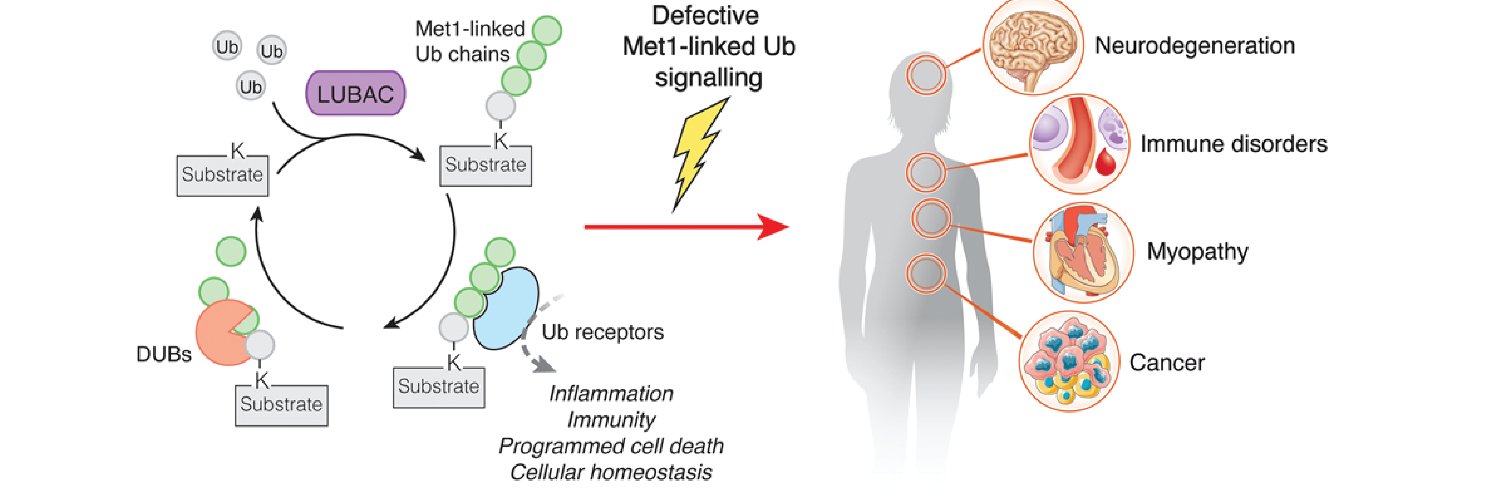
More evidence that LUBAC has functions beyond immune signalling. Our recent study shows that LUBAC and OTULIN regulate metabolic signalling: specifically they govern AMPK signalling to control metabolic adaption, autophagy, and cell death during energetic stress. This suggests that the metabolic symptoms observed in patients with LUBAC deficiency and ORAS, including glycogen storage disease, lipodystrophy, and liver disease, may be caused directly my metabolic dysregulation rather than being secondary to the systemic inflammation.
https://t.co/r3BLoOR2Nu
Look, saying “give students sufficiently challenging questions so that even with AI it’s a genuine challenge. that’s how they will work afterwards anyhow”, doesn’t work.
We teach 10-year old kids arithmetic operations, yet AI can do that too and better. Still, we think it’s worthwhile, and the solution is hardly to give them so challenging problems that they “need to use AI”. In my own course it’s mainly linear algebra and related methods. And that’s a useful skill to have even if “AI can do it”.
Do people really think that anything AI can do humans should not bother to learn?
@LabListon If that’s the reason, that’s what should be in the feedback. I’d prefer the chance to over-learn rather than being forced to learn nothing. Even just a percentile score would be useful. A notification that your proposal was not funded without any further explanation is useless.
I’m seeing a lot of uninformed takes, like this one, about cell simulation feasibility. I wanted to contribute some facts.
Alphafold works for predicting a subset of static structures (not how a protein structure changes shape under forces) on 1) well-ordered regions (not intrinsically disordered regions or long flexible loops) and 2) on proteins with plenty of evolutionary relatives (no orphan proteins).
Alphafold solved this subset of static structure prediction with a dataset that took 50 years (PDB; 1971 to ~2020) to collect. It did not solve protein dynamics or how proteins fold into their shapes. Those remain unsolved.
Cell simulation is vastly more complex and data hungry than any of this. Exact cell simulation means solving quantum equations for every atom and is totally intractable. But all approximations rely on - and are bottlenecked by - data, not compute.
So the extrapolation from “alphafold worked” to “therefore cell simulation is feasible” assumes far too much.
@pontus_rendahl I don’t disagree with you at all. It was more out curiosity whether you found a loophole ;) But yes, the reform has to start somewhere. And these changes would be welcome. There are some winds of change blowing for the PhD regulations. It just has very little political traction.
@pontus_rendahl But that would require changing the ministerial orders, wouldn’t it? At least for PhDs I think. I don’t think the universities have the remit to change the order or evaluation.
This paper is honestly just a litany of complaints, assembled by committee.
There are a lot of serious people working on progress studies and how to encourage risk taking in science, from @mattsclancy to @salonium to @RuxandraTeslo
The reality is that like most postdocs, I was given a large degree of leeway to craft my own project. My PI sugar daddy funded it all. Now that I have my own lab, I've got another 7 years of runway to work on literally anything I want. With a team of scientists under my supervision. All in all, that's 10-15 years to make a mark and do something worthy of the opportunity I've been given. If I don't succeed, well, skill issue.
To me, the most inspiring stories of risk taking in science are stories like Brian Kobilka and Shinya Yamanaka. Kobilka gave up HHMI funding to work on crystallizing GPCRs, ran out of money twice, even offered to cut his own salary. Everyone told him it couldn't be done, pharma had poured billions into the effort and failed. His first generation of postdocs working on the project also failed. But then the next group succeeded. For Shinya, the seminal iPSC paper is a two author paper. There's no collaboration, zero interdisciplinary team, and they were by no means a well resourced lab compared to the other mES powerhouses at the time.
The honest reality is that the extreme career pressures of the academic track drive postdocs in particular to be risk averse. Every MIT/Harvard postdoc is asking themselves: what's the surest route to a CNS publication so that I can get that dream job? If you take on a risky project, a bold hypothesis, you're well aware that you're betting your career on that paradigm shifting hypothesis being right. And so the careerist postdocs flock to labs that are willing to spend a $x00k on a scRNA-seq atlas, knowing that going hypothesis free is the surest route to publication.
It's a shame because the postdoc corps is the lifeblood of scientific research, the age at which young scientists are at the height of their creativity, skill, and determination. If there's one thing to fix, it is this.
As academics, we can do better than to coddle young scientists (ECRs I guess we're called), to lament the unsurmountable obstacles we face, the systemic pressures, the crappy administration, alas! It is not so. We must demand better from ourselves. Such that we are worthy of the public funding that supports us.
What do we make of the statement that 1260 ‘genetic variants’ account for between 4.8%-9.3% of our personality? https://t.co/KqIcchLiLO. If you believe, as most media has, that our personality is genetically determined, you are gullible.Short 🧵
This is total bullshit hype. I'm going to write up a more detailed piece on what this actually is vs. what it's being portrayed to be. But briefly ... 1/
I'm looking for a talented, motivated, and ambitious candidate for an open postdoc position in my group at @DTUtweet in the greater CPH area. This call has an emphasis on ML applied within chem/phys and proven skills are desirable. Please share and RT.
https://t.co/G8z8yvMxMQ
This is a wild overstatement of what was actually achieved. But “AI successfully remixed a small number of mostly already-observed, largely synonymous mutations and in a few rare cases managed to make it nonlethal” doesn’t sell hype as well
Kind of ironic how one of the main impacts of AI on higher Ed is to force assessment to move towards in person exams, pen and pencil written answers in booklets, device free settings. In other words we are rediscovering the past due to technological advancements.
I am begging everyone to stop outsourcing your brain to robots. Life is worth living only because we feel and control every part of it. Please don't give away your agency.
Ein paar Punkte zu Ceuta.
Ceuta ist nicht Europa 🇪🇺. Ceuta ist eine Enklave Spaniens 🇪🇸 in Nordafrika im histor. Marokko, ein Überbleibsel der spanischen Kolonialherrschaft.
Der Zeitpunkt ist relevant. Spaniens Premier Pedro Sanchez besuchte vor einigen Tagen nach vier Jahren erstmals wieder Algerien 🇩🇿, Marokkos Rivalen in der Region, was dem marokkanischen König 🇲🇦 nicht gefällt.
Spanien hat aktuell extrem schlechte Beziehungen zu 🇮🇱 und den USA 🇺🇸. Zwei der engsten politischen Partner des marokkanischen Königs. Dass Israel und die USA ein Interesse an Problemen für Spanien haben, liegt auf der Hand.
Die Emotion der Menschen in Ceuta ist echt. Selbst wenn einige geschickt worden wären, versuchen Tausende ihr Glück. Die Jugend sieht in Marokko kaum Zukunft und will um jeden Preis weg.
Rechte labern von „Invasion“. Wer in Ceuta einreist - selbst legal - ist offiziell noch nicht in die EU eingereist. Ceuta gehört nicht zum Schengen-Raum und um von dort aufs spanische Festland zu gelangen, braucht man Visum oder positiven Asylprozess. Spanien und Marokko verkündeten bereits, alle Personen zurückzuführen.
Das Geschehen hat somit keine konkreten Folgen. Außer dass weltweit gegen Sanchez, Spanien, Migranten und Muslime gehetzt wird. Man kann sich also selbst zusammenreimen, wessen Interessen aktuell bedient werden.