I’m thrilled to share that I’m starting my lab at @MpiBrain in Frankfurt, Germany! 🐠🧠🔬
https://t.co/BfAdJrPer9
#Neuroscience, #Zebrafish, #NeuroJobs
We will explore how brain circuits give rise to the computational algorithms animals use to solve real-world problems - using the larval zebrafish as a model.
More soon!
Don’t miss the Nanosympsium NANO024 – Connectomics at #SfN2025!
📍San Diego Convention Center, Room 33
⏰ 8 - 11:30 AM
12 speakers from academia & industry exploring #connectomics across species and questions.
With Gregor Schuhknecht @MPIBrain & Helene Schmidt @ESI_Frankfurt
3/3 Toolbox
To uncover how neuronal circuits give rise to the algorithms behind behavior, we will combine:
🐟 Quantitative behavioral assays
🔬 Functional imaging
⚡ Patch-clamp electrophysiology
🧠 Electron microscopy–based #Connectomics#Neuroscience#BrainCircuits
I’m thrilled to share that I’m starting my lab at @MpiBrain in Frankfurt, Germany! 🐠🧠🔬
https://t.co/BfAdJrPer9
#Neuroscience, #Zebrafish, #NeuroJobs
We will explore how brain circuits give rise to the computational algorithms animals use to solve real-world problems - using the larval zebrafish as a model.
More soon!
2/3 Model system
To study these questions, we will use the larval #zebrafish — a small vertebrate with a compact, transparent brain and rich innate behaviors.
Its experimental accessibility allows us to study neuronal circuits across many scales, from synapse to behavior. 🧠🐟
Nature Over Nurture: Functional Neuronal Circuits Emerge in the Absence of Developmental Activity [Engert Lab] @EngertLab@GregorFPS@bdanubius https://t.co/HgstowYlaP
Now out in @NatureComms, our paper on activity- and experience- independent maturation of sensorimotor behaviors in zebrafish. @GregorFPS@EngertLab
Since the preprint, we added new experiments confirming the effect and washout of anesthesia 👇
https://t.co/5OQRptjQiZ
@ranczlab @neurosutras@PLOSCompBiol@ETH@UZH_Science Other in vivo effects (pre-depression due to more active synapses, conductance state, muted EPSPs etc.) should have a bigger effect on synaptic computation. We accounted for these in a robustness analysis in SFig. 4. (unfort. wasn’t included in main pdf).
It pays off to persist and push projects over the finish line!🥳🏁
Finally out in @PLOSCompBiol: joint work by the three fantastic master’s students I supervised during my PhD at the Institute of Neuroinformatics @ETH & @UZH_Science:
https://t.co/MFlKQ6auYz
@ranczlab @neurosutras@PLOSCompBiol@ETH@UZH_Science Thanks, and very interesting question!
Well, from Fig 4d it looks slopes are pretty similar for 2 and 1.2 Ca, the effect is mostly muted EPSCs. So Ca prob. has some effect on short-term plasticity, but it actually looks surprisingly small to me.
Out now in PLOS Computational Biology! 🥳We combine patch-clamp recordings and modeling to explore how synaptic strength, short-term plasticity, and input synchrony work together to drive neuronal spikes. Enjoy the read! 🙂 https://t.co/fpESGKF1Jr
We are very excited to share our work using #zebrafish to study fast acting antidepressants work! Tl;dr –ketamine and related drugs drive minutes-long calcium elevations in astroglia sufficient to mediate their effects. https://t.co/1XIqOcIQqG Details below:
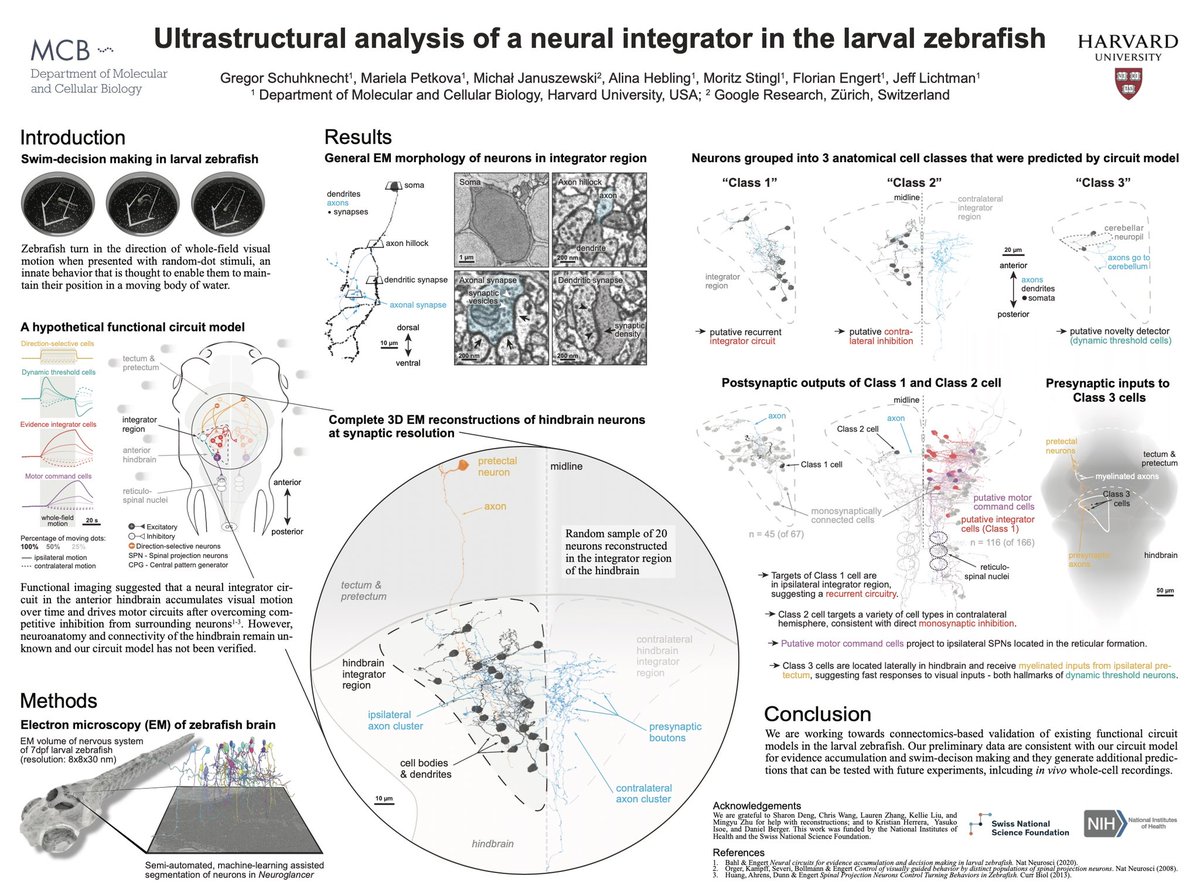
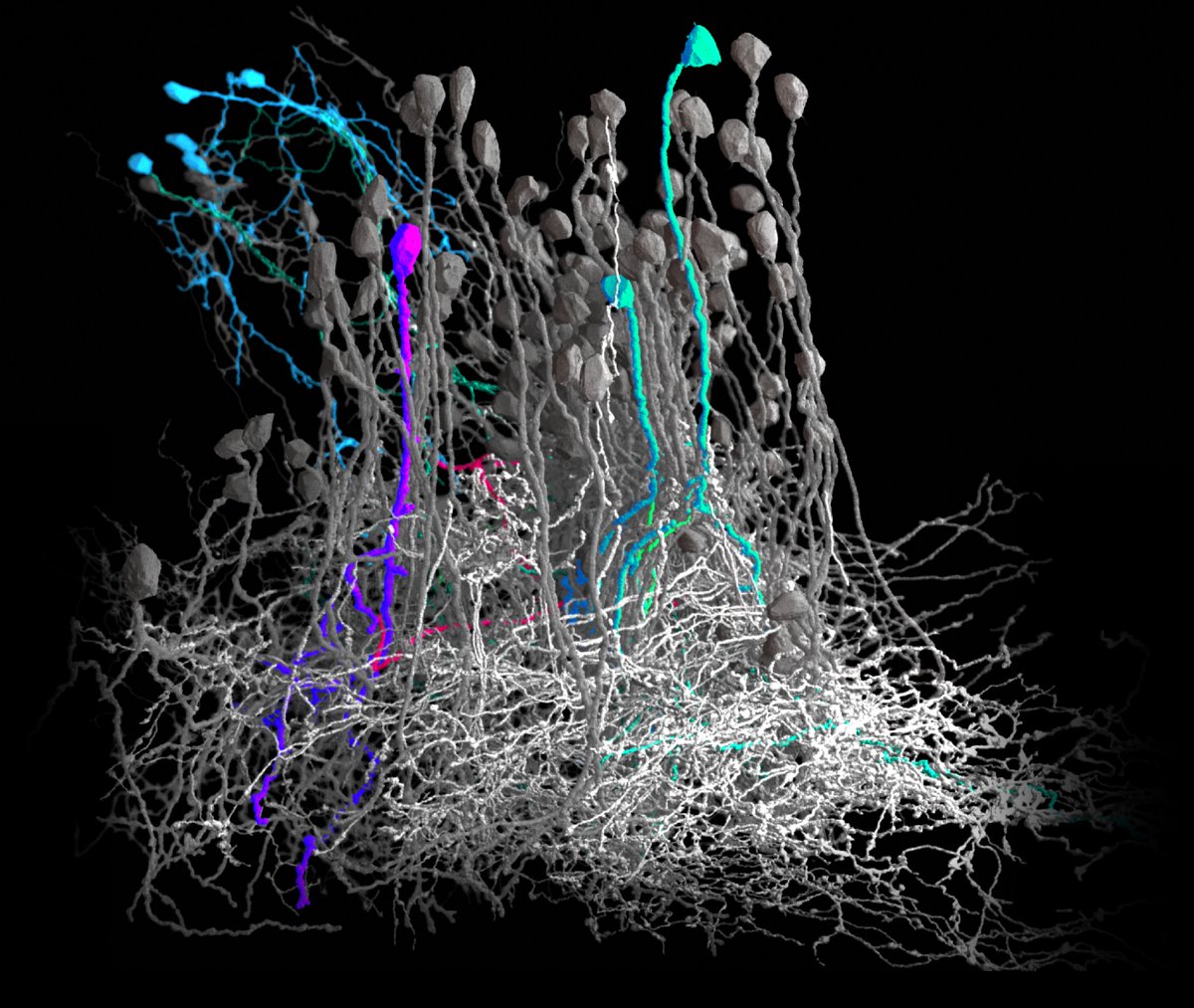
Come check out our poster today at #SfN22 on the Ultrastructure of a Neural Integrator Circuit in the Zebrafish Hindbrain. With @mer_petkova and @EngertLab.
Poster board X6, 11-12.
Cool new work from the Engert lab, showing that the optomotor response in zebrafish is normal even when fish are grown in the dark or neuronal activity blocked. Is this surprising or dogma breaking? Even in mammal VC, many aspects of visual behavior do not need activity.
With @bdanubius & @EngertLab: baby fish see, swim, and compute – right after we wake them up from blocking neuronal activity while their nervous system develops! Watch their brains light up for the first time ever, and already have tuned motion- and direction-selective circuits!




![MCB_Harvard's tweet photo. Nature Over Nurture: Functional Neuronal Circuits Emerge in the Absence of Developmental Activity [Engert Lab] @EngertLab @GregorFPS @bdanubius https://t.co/HgstowYlaP https://t.co/Y4DC3zIgWK](https://pbs.twimg.com/media/GFLeBSoWUAAC7Ce.jpg)