1. You made it more expensive to hire people
2. You made it more expensive to hire people again.
3. You made it illegal to hire people for less than $15 an hour.
4. You made it illegal to ask relevant questions before hiring someone.
5. You required the disclosure of information to competitors.
6. You expanded on an already existing law that will define disputes as “theft.”
In short…you just made it more difficult and costly to work in Virginia.
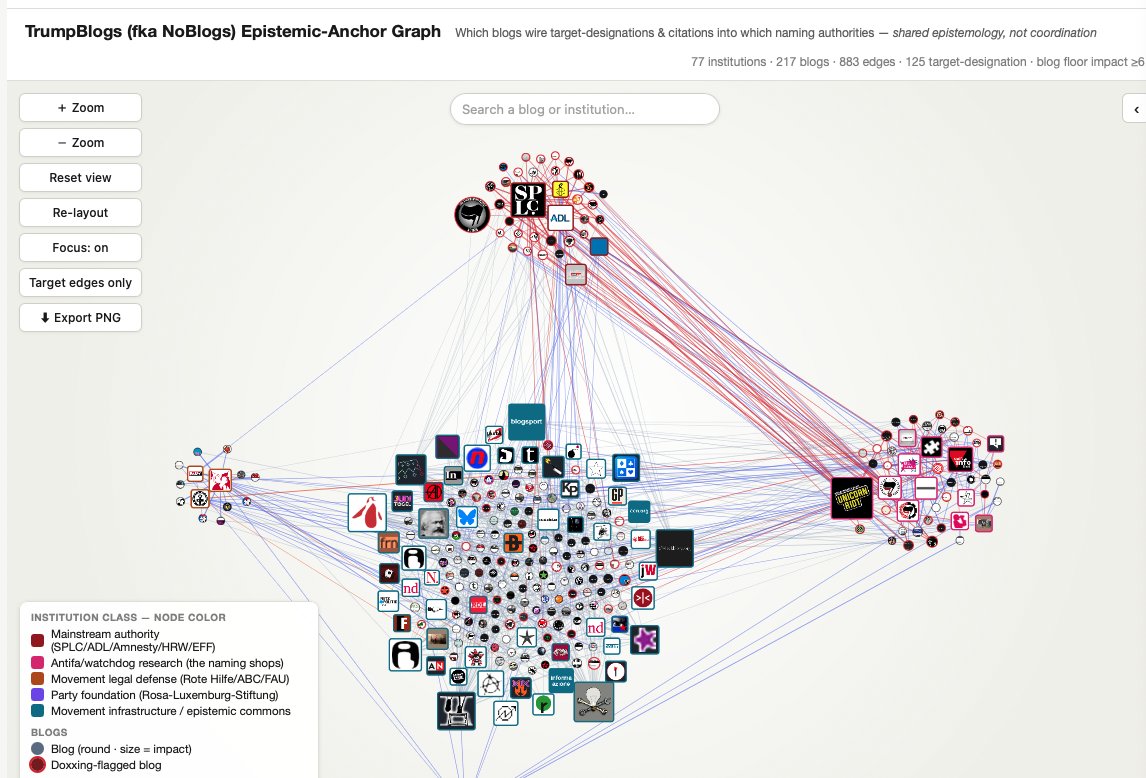
🚨 https://t.co/5ajzizjI8F STRIKES AGAIN: TRUMPBLOGS, FORMERLY KNOWN AS NOBLOGS 🚨
🏴 THE ANARCHIST INTERNATIONAL ON NOBLOGS, MAPPED — EVERY BLOG, EVERY CELL, EVERY CITY. 🌍
The militant far-left has spent years hiding in plain sight on https://t.co/HFD4sxphTk — the anonymous blog network that quietly powers antifa, anarchist, squat, and "solidarity" cells around the world. So on my own time, for free, I scraped the whole thing. Because I kick commie *** for fun and need no government funding or sanction for it.
Introducing an interactive map of 7000+ blogs across many countries and languages — antifascist, anarchist, ecological, prisoner-solidarity, migrant-border, revolutionary. Every one classified, geolocated, and searchable down to the verbatim quote.
* 🔥 Verified quotes. Every claim is a receipt — their words, not mine.
* 🌐 4000-plus blogs pinned to a live world map — zoom into your own city.
* ⚔️ Many blogs classified "operational."
* 🕸️ Click any blog, author, or cell and walk the network one tie at a time.
No grant funded this. No client asked for it. I do this for free, on my own time, because someone should.
🖥️ Data-heavy! Best viewed on desktop.
📖 A preview of what's coming: DataRepublican v2.0 — full site redesign — launches soon, ahead of my and @JoshuaLisec book UNELECTED (Passage Press, Oct 13).
And yes — if I can map the anarchist international in my spare time, I can map anything.
👇 Try it now (link in next post):
🧵THE UNIPARTY UNMASKED – They Believe They Are “Democracy”
The seven NGOs in the chart below, in my view, represent the Uniparty. Each of these organizations receives substantial financial support from USAID or the Department of State.
Around 2019, the phrase “democracy in danger” began to dominate public discourse, amplified by the media. This was odd—after all, the U.S. is a democracy (or more precisely, a constitutional republic). But as I traced the influence of these NGOs, a pattern emerged: they are controlled by establishment politicians, they play a major role in shaping political narratives worldwide, and their core mission is always framed as “protecting democracy.”
Originally, these NGOs were created to support U.S. democratic efforts abroad—many of them emerging during the Cold War to combat the spread of communism. But with the fall of the Soviet Union, their original purpose faded. Instead of dissolving, they redefined their mission. Now, they have positioned themselves as the guardians of democracy itself.
This shift explains why Trump’s re-election was framed as a "threat to democracy." To these NGOs, “democracy” means themselves. Their survival depends on maintaining that role, and any challenge to their authority is perceived as a direct attack on democracy itself.