Quand @nayibbukele exporte sa méthode en #Haiti : en trois semaines, il bouscule les gangs comme l’ONU n’a pas su le faire en plus de trente ans @atlantico
https://t.co/gdLK1OR3aD
Kay chèf gang jeff gwo lwa nan canaan 😳 sou do ti pèp la , @nayibbukele batay la pap kanpe pase vizite kay sa pou nou souple🙏 gang pa sipoze alèz , menm jan yo fe ti malere yo kite zòn yo ak tt sa yo t posede , pu yap domi nan lari se pou gang yo komanse santi menm doulè a tou
Désormais, les vrais gangs à vestes commencent à montrer leurs vrais visages. Ce résident des fiefs du gang des 400 Mawozo a donné une conférence ce mercredi pour défendre « l’innocence » de son patron, Wilson Joseph, alias Lanmò 100 Jou, qu’il présente comme un honnête citoyen défendant son pays, tout en critiquant le président @nayibbukele, qu’il qualifie de criminel notoire.
@RTConfiance
🚨🇸🇻🇭🇹Where is Wilson Joseph??? In this post I will cover some theories as to where the leader of the 400 Mawozo gang may be hiding. If any of you have additional information please contact me directly.
Joseph fled his mansion in Dimulseou before November 5th due to fears that Salvadoran forces would target the compound. The National Human Rights Defense Network reports that he escaped with the assistance of Chrisla “Krisla” Chéry, leader of the Ti Bwa gang. Krisla reportedly dispatched a vehicle to transport him from the Cul-de-Sac Plain to the gang's territory in Carrefour.
Carrefour is a major stronghold for gangs such as Ti Bwa and Gran Ravin. The city is strategically placed along National Route #2, a key highway connecting Port-au-Prince to Haiti's southern peninsula. The city serves as a the perfect choke point to isolate the capital city and as a launch pad for attacks.
They can also easily retreat from the capital to Carrefour if needed. South of Carrefour there are steep, rural hills leading to the Kenscoff and Jacmel communes. The mountainous terrain makes it difficult for Haitian police to repel ambushes.
Since April 2024 there has been effectively zero police presence within the 500,000 man city. Ti Bwa maintains checkpoints across key junctions and alleyways. Krisla's men have recently set up barricades and conducted vehicle searches in anticipation of raids into their strongholds. The security afforded to the gangs in Carrefour makes it an obvious choice for someone like Joseph who is worried about getting killed or captured.
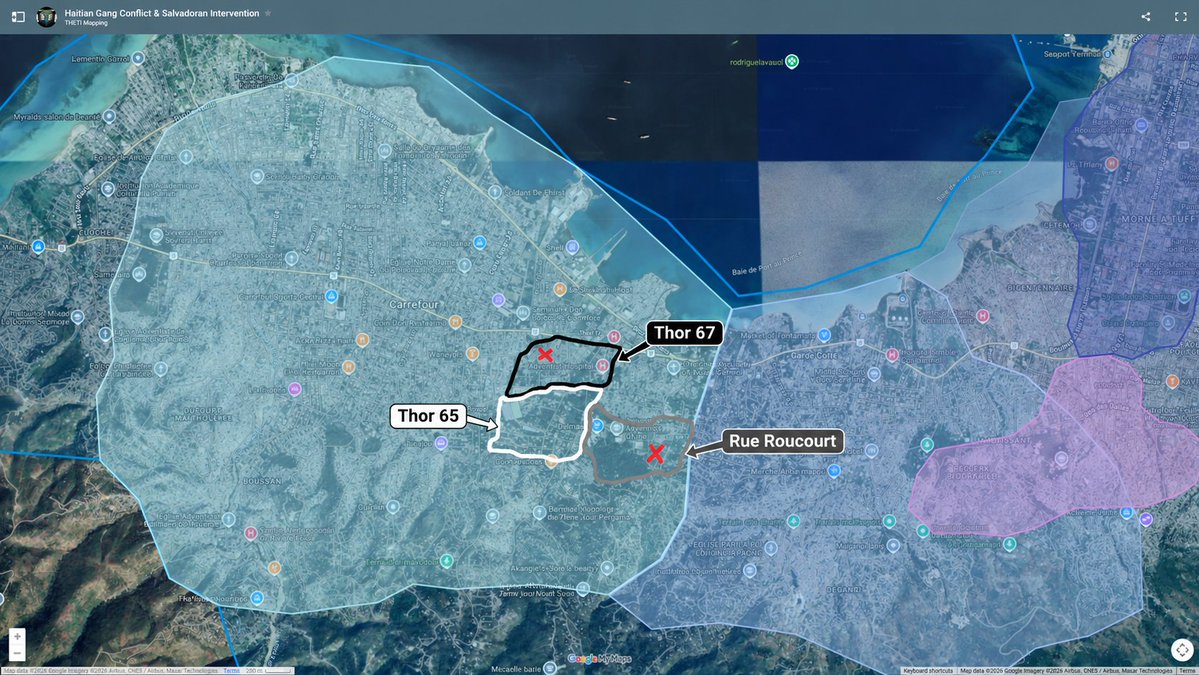
Chrisla has owns several houses and apartments in Carrefour that I'm working to locate. One specific location mentioned by locals is the Auberge du Québec hotel in the Thor 67 neighborhood. The hotel is allegedly used by Chrisla and other Ti Bwa members for high-level meetings, parties, and as a living quarters. I'd urge @nayibbukele and @FUERZARMADASV to investigate this lead by coordinating with the GSF and Haitian National Police. They should send their RQ-20 Puma and TAI Anka-S UAVs to the premises for reconnaissance purposes.
The NHRDN specifically noted that Wilson Joseph fled to the Thor 65 neighborhood, located just south of Thor 67. Eyewitnesses in Carrefour told AyiboPost that they spotted Joseph in the city on November 6th in the afternoon. Over the past few weeks many gang members, especially ones in senior leadership, have moved from the Cul-de-Sac Plain and Bon Repos (in northern Port-au-Prince) to hotels throughout the city, according to local residents.
Some of the hotels have shut down entirely in order to avoid being struck by drones. Another most wanted figure hiding in Carrefour is allegedly Dimitri Hérard, the former commander of the General Security Unit of the National Palace. He was arrested for his complicity in the assassination of Haitian President Jovenel Moïse. In March 2024 he broke out of prison with the assistance of the Viv Ansanm coalition. Since then he's provided training, firearms, vehicles, intelligence, and logistical support to gangs, especially Ti Bwa.
Eyewitnesses claim they say Joseph and several heavily armed men leaving a hotel in the Thor area. AyiboPost claims a meeting was held at this hotel with Chrisla. Another important location mentioned by locals is the Villa ORMISO hotel in the Rue Roucourt neighborhood. Locals claim this area also served as a meeting point for Joseph and other gang members.
It's likely that El Salvador, Haiti, and the GSF are already aware of all this information because of November 10th they launched a new operation into the Martissant neighborhood, located between Port-au-Prince and Carrefour. Several armored vehicles and dozens of ground forces were spotted entering the Martissant 2A area near the Saint Bernadette Church.
Kamikaze drones are being used to strike gang compounds and toll checkpoints. I'll write a more detailed post about these advances later, but the bottom line is that the PNH may be as close as 3km away from one of Joseph's recent hiding spots! Please take this information seriously but do your due diligence before pursuing this lead further @pnh_officiel!
By liberating the people of Haiti, President @nayibbukele is dismantling globalism’s largest criminal financial structure in the Americas.
LAW AND ORDER. 🇸🇻🇭🇹
Haïti est prise au piège d’un vaste réseau d’intérêts économiques et politiques aux multiples ramifications, à l’intérieur comme à l’extérieur du pays. Plus de 500 000 armes illégales seraient aujourd’hui entre les mains des gangs. Haïti ne les fabrique pas. Elles viennent d’ailleurs, alimentant un marché qui prospère sur l’affaiblissement de l’État et l’insécurité. Depuis des décennies, Haïti est devenue un vaste débouché pour les économies voisines. La République dominicaine y écoulerait chaque année plus de 800 millions de dollars de marchandises, selon un rapport du FMI. Un marché immense. Le problème est là. Haïti ne doit pas seulement être considérée comme un marché. Elle doit pouvoir produire, transformer, exporter et contrôler ses propres ressources. L’Artibonite illustre cette fragilité. Cette vallée agricole stratégique, l’une des principales zones productives du pays, est aujourd’hui largement soumise à la violence des gangs. Et les armes ? Les rapports des Nations unies ont régulièrement identifié la République dominicaine comme une voie majeure d’acheminement des armes et des munitions vers Haïti. Ce système profite à beaucoup de monde, sauf à Haïti, dont les élites locales consentent à accompagner la course vers l’abîme. Les médias mainstream en parlent encore trop peu. Il faut pourtant ouvrir le débat, documenter les circuits, interroger les responsabilités et surtout demander aux 5 ou 6 principaux candidats à la présidence quelle stratégie ils proposent pour sortir Haïti de cette dépendance économique, sécuritaire et politique. #PAPPPOST #Haiti
DID YOU KNOW??
The most notorious and powerful gang leader in Haiti, a former elite police officer named Jimmy Chérizier, allegedly got his famous nickname "Barbecue" not because of his violent reputation for burning down neighborhoods, but because his mother ran a popular fried chicken stall on the streets of Port-au-Prince when he was a child.
Before becoming a warlord, Chérizier was an officer in the Special Forces of the Haitian National Police (UDMO). His mother raised eight children by selling fried chicken on a street corner, leading locals to call him "Barbecue" from a young age.
Although Chérizier insists on this innocent origin story, his political enemies and human rights groups claim the name stuck because of his documented history of setting fire to entire neighborhoods and burning victims during extrajudicial massacres.
What makes Haiti's gang crisis historically unique is how these armed groups evolved from neighborhood gangs into a pseudo-state paramilitary force that effectively shut down the government.
In early 2024, Chérizier orchestrated an unprecedented truce between fierce rival gang alliances (the G9 Family and G-Pèp). Calling their united front Viv Ansanm ("Live Together"), the coalition raided the national penitentiary, freeing over 4,000 inmates, seized control of the international airport, trapped the Prime Minister outside the country, and took control of roughly 80% of the capital city. Walk with me 👇🏾 👇🏾
The Evolution of Political Paramilitarism in Haiti:
1. The Tonton Macoutes Precedent
1950s–1980s
Dictator François "Papa Doc" Duvalier created a brutal private paramilitary force (the Tonton Macoutes) to bypass the regular military, establishing a historical precedent of political leaders arming local street enforcers.
2. The 'Chimères' Era
2000s–2010s
Politicians across rival factions regularly armed youth gangs (Chimères) in urban shantytowns like Cité Soleil to control voting precincts and suppress political protests.
3. Formation of the G9 Alliance
June 2020
Ex-cop Jimmy Chérizier united nine major Port-au-Prince gangs into the G9 Family and Allies, using police armor and state connections to establish an economic monopoly over fuel terminals and ports.
4. Viv Ansanm & State Paralysis
2024–Present
Rival alliances set aside decades of bloodshed to form the unified Viv Ansanm front, storming national prisons, ousting the Prime Minister, and controlling 80%+ of Port-au-Prince.
More Surprising Facts About Haiti's Gangs:
A. Usurping National Ceremonies: In October 2021, Chérizier forced Prime Minister Ariel Henry to flee the official national memorial service for revolutionary founding father Jean-Jacques Dessalines. Minutes later, Chérizier arrived at the monument dressed in an immaculate white suit with a black tie, laying a wreath himself as if he were the head of state.
B. Controlling the Terminal Gate: Rather than relying purely on extortion or drug smuggling, Haiti's gangs amassed immense power by blockading the Varreux fuel terminal. Because Haiti relies entirely on imported fuel for electricity and transportation, controlling the terminal allowed the gangs to bring the country's hospitals, banks, and communications to a complete standstill at will.
C. The Role of Foreign Arms: Haiti does not manufacture weapons or ammunition. UN investigations revealed that the vast majority of high-powered assault rifles (including Barrett .50-caliber sniper rifles and AR-15 variants) used by Haitian gangs are illegally smuggled from Florida via commercial cargo shipping containers.
SUMMARILY!
Haiti's gangs evolved from state-sponsored political enforcers into a unified paramilitary coalition led by ex-cop Jimmy "Barbecue" Chérizier, whose childhood nickname belies his role in taking over 80% of the nation's capital.
Hopefully you've learnt something new today?
The Medic Who Writes™🌚
Cheers 🥂 🙂
The Haitian gang leader who hijacked a bus full of American missionaries in 2021, an 8-month-old baby on board, and swore on camera he'd put a bullet in every one of their heads unless he got $17 million is now writing letters to the UN asking for peace talks.
He finally ran into somebody who won't pay.
His name is Wilson Joseph, and his gang is called 400 Mawozo. On October 18, four Salvadoran air force technicians got ambushed out on the same plain east of Port-au-Prince that his letter came from. Nobody has claimed it, and the four haven't been seen since.
Bukele's answer went out three days later, written in Haitian Creole and aimed straight at the gang bosses. If those four came back hurt, he'd finish Haiti's gangs the same way he finished the ones back home. Then he laid out the other side of the deal. Bring them back alive and every Salvadoran soldier leaves Haiti that same day.
About a week later he had 2,000 troops on the ground, with El Salvador picking up 90% of the tab.
Kidnapping down there works like a business. A hostage is worth whatever the other side will give up to get him back, and the people who track Haitian gangs read this ambush as a play for exactly that, a way to force talks and keep troops out of gang neighborhoods. Bukele took that leverage off the table in public, on day three.
Which is how you get the letter. It's dated November 1 and addressed to the UN Secretary-General, and it calls 400 Mawozo a "rebel group" that "officially raised the white flag" back on August 20. That would be two full months before the ambush.
The letter also spends a good chunk of its two pages worrying about the safety of children. His UN sanctions listing cites recruiting kids.
A few days later somebody tagged Bukele in a post that supposedly showed Joseph's house, and Bukele replied asking for the exact address so they could destroy it. The gang's next letter called that house a symbol of peace.
Think about how big a swing this is for El Salvador. It's a country of about 6 million people with an army of roughly 20,500, so it sent close to one out of every ten soldiers it has to go get four guys. The UN-backed gang force the rest of the world has spent a year building has about 2,000 of the 5,500 troops it was promised, and El Salvador matched that in a week. The UN's history in Haiti makes the comparison sting even more. Its last big mission there ran 13 years and cost more than $7 billion, and its own peacekeepers brought in a cholera outbreak that killed close to 10,000 Haitians.
The UN says receiving the letter doesn't mean it recognizes or endorses anything. Joseph is still under UN and US sanctions, and now his gang has gone to Haiti's own disarmament commission too, asking for military operations to stop in some areas.
Those four technicians still haven't been found three weeks in, and none of this is a win until they come home. Kidnapping only pays when somebody on the other side is willing to deal, though. Joseph built a whole career on that, and right now he's the one waiting by the phone.
“This mission now goes far beyond rescuing our 4 soldiers and liberating Haiti… it’s hitting globalism where it hurts.”
@HerbertEsmahan says President Bukele has accomplished more in Haiti in 2 weeks than the U.N. has in 20 years. He argues Haiti has been DELIBERATELY kept in chaos, with $25 BILLION in foreign aid yielding little while NGOs, foreign governments, and transnational criminal networks exploited the country as a criminal financial safe haven.
Watch The Matt Gaetz Show on OAN Live today!