Business Agility consultant/coach, applying human-centered systems thinking to complex engineered systems & regulated industries. Congruent Compliance LLC.
True that.
I know I am small enough because I have enough cash at hand and zero danger of a call from Klink.
Annoyed the market is down, not stressed. Looking at what to sell a put in.
Preach.
Nothing is risk free. Options are not hard as others might make them seem and not as simple as others wild have you believe.
There is no magical risk free automatic money machine. The hope it exists will damage your ability to trade.
So today was Exhibit ZZZ of why SELLING OPTIONS FOR INCOME is a trap.
You would be hard-pressed to find someone that believes in the potential and the opportunities and all the benefits of active trading more than I do.
But when you start hearing phrases like "options for income" or "paycheck trades" or any of that other garbage, it does such an incredible disservice to the volatility and the variance that you are engaging with when you choose to trade actively.
Oftentimes, the ones that are espousing the "options for income" trades, they're doing so in a way that is so incredibly misleading to their audience and the people that follow them.
Because whenever we hear the word "income," there are some unwritten associations that we all make with that word:
Stable, regular, reliable.
I put in the work, I get paid.
I show up, I make money.
As long as I clock in every other Friday, I'm going to get some dollars.
And it is the unscrupulous characters in our world that are trying to tap into those connotations to lead you to believe something that just isn't true.
Because spoiler alert: selling options just isn't like that. It's never like that.
Because you'd have to have a pretty crazy profession if you showed up to work only to see the compensation you've already earned get clawed back by 4% or 7% or 10% or 15%, out of nowhere, like anyone who's been long the market has had to endure over the course of the last few weeks.
And so, if you take nothing else away from this move in the market and the corresponding impact it's had on your portfolio (if you've been long), I hope that you have a whole new appreciation for the risk that exists in every option along the chain
Including and ESPECIALLY those super low delta puts that look so safe and secure...until they all explode to the high heavens just like they have over the course of the last 48 hours.
@optionsuncapped
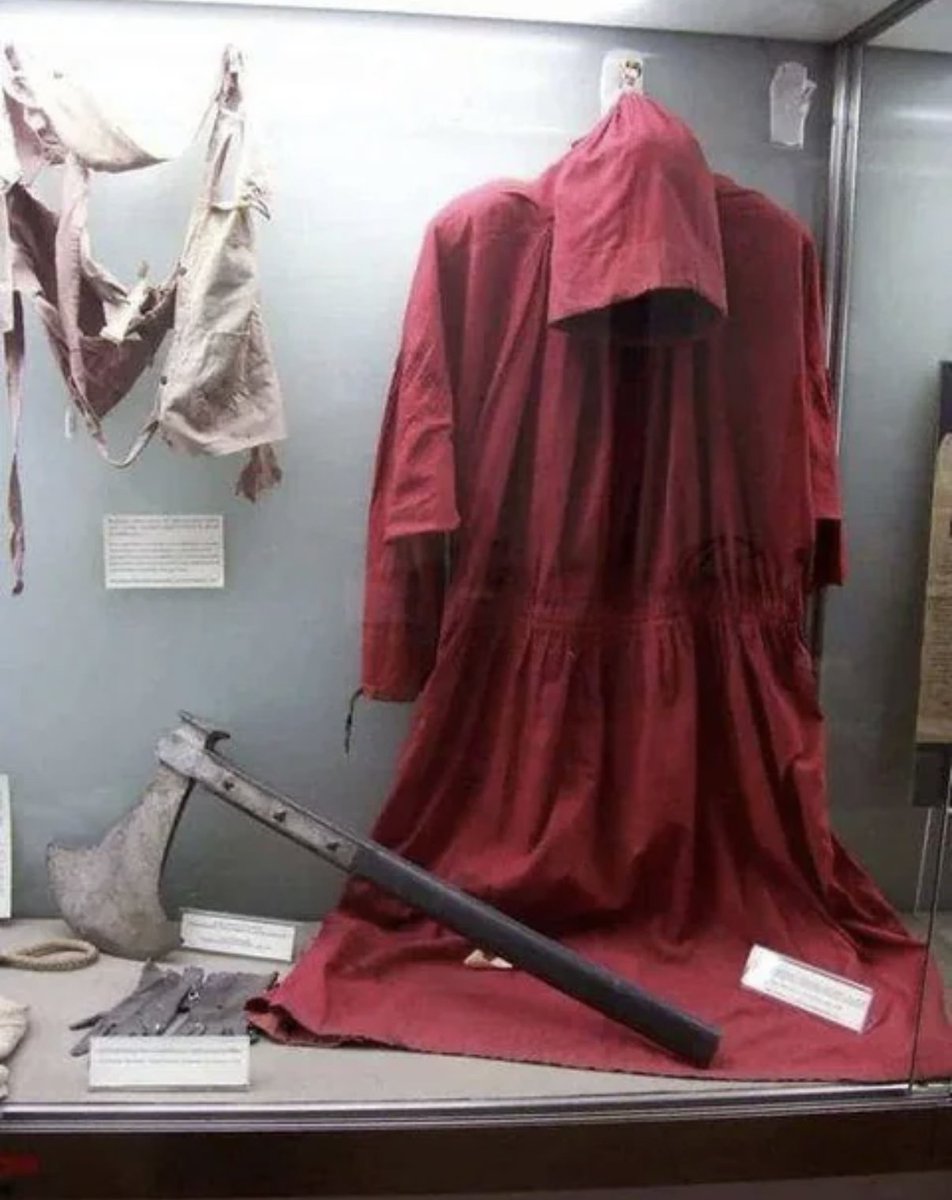
Did you know the Pope once had his own personal executioner?
And he killed 514 people.
His name was Giovanni Battista Bugatti.
Better known as “Mastro Titta,” (the Master of Justice) and he served as the official executioner of the Papal States from 1796 to 1864.
He began his career at just 17 years old and didn't retire until he was 85.
When he wasn't executing criminals, he reportedly worked as an umbrella painter in Rome.
He lived across the Tiber River because executioners were restricted from entering the city. Whenever Romans saw him crossing the Ponte Sant'Angelo bridge wearing his distinctive red cloak, they knew someone was about to die.
His methods included hanging, beheading, the guillotine, and even quartering. Executions were public spectacles that attracted enormous crowds.
Bugatti was also known for reportedly offering condemned prisoners a pinch of snuff tobacco before their executions.
When he finally retired in 1864, Pope Pius IX granted him a lifetime pension.
He died five years later at the age of 90.
His red cloak and execution instruments are preserved in Rome's Museum of Criminology, a chilling reminder of a time when the Pope ruled as a temporal sovereign and capital punishment was carried out under his authority.
Gary Wetzel was twenty years old when he lost his left arm in a rice paddy in Vietnam. But the most astonishing part of that day was not what he lost. It was what he did afterward.
On January 8, 1968, he was a door gunner with the 173rd Assault Helicopter Company. His helicopter was hit and crashed into a kill zone. Two rockets exploded inches from him. The blast threw him into the mud.
His left arm was hanging by threads of flesh. His right arm was shredded. His chest was torn open. Blood poured from his leg.
He was dying.
Yet he got back up.
An enemy automatic weapons position was pinning down American troops. Gary realized his machine gun could still fire. He climbed back into the gun well, tucked his mangled left arm into his waistband, and used his damaged right arm to man the gun.
He fired until he silenced the position.
Only then did he try to help his wounded commander. He collapsed, regained consciousness, and crawled through the mud until he reached them.
The next morning he was found barely alive. Doctors amputated his left arm. Infection followed. He underwent more surgery in Tokyo. Over 400 stitches were removed while they fought to keep him alive.
Months later, soldiers he had helped save came to the hospital. They showed him photos of their wives, children, and girlfriends.
“Because of you,” one said through tears, “this is what I’ve got to go back to.”
On November 19, 1968, President Lyndon B. Johnson presented him with the Medal of Honor.
Gary returned home to South Milwaukee, Wisconsin. He learned to live with a prosthetic arm and became a heavy equipment operator — a job that normally requires two hands. He figured out how to do it with one.
He married, raised a family, and lived quietly. But he never stopped serving. When he heard about a four-year-old girl born without a left hand, he organized a charity ride with his motorcycle friends to help send her to a special camp and take her family to Disney World.
At 77, he still thinks about Vietnam every day.
“I never have a day where I don’t think about the war,” he once said. “When I go to bed at night, I take the war off. And when I get up the next day, I put the war back on.”
He doesn’t see himself as a hero.
“I’m not Superman. I was just a guy doing his job.”
Gary Wetzel lost an arm that day. But because he refused to stop, other men went home to their families. Their children grew up knowing their fathers. Their lives continued.
And decades later, the same man who lost an arm in Vietnam was helping a little girl who had been born without one.
@optionsuncapped@jatan28 This was a “once a year” kind of gut check. Feels worse due the last two weeks grinding down .
But this was not 1987, the dot com bust, or the housing bubble bursting.
@optionsuncapped -4% on portfolio today. Still up 1/2 a house for the year. Stress level 3.5 out of ten. Sold a second /NQ short put. SPX zero dte bots were +$8k! Have enough access to cash.
Market down= might roll stocks into a Roth.
In 1835, a Young French Aristocrat Predicted the Exact Bureaucratic Trap Threatening the West Today
Before the philosopher Alexis de Tocqueville ever set foot in America, radical tyranny had already scarred his family. During the French Revolution’s Reign of Terror, left-wing Jacobin zealots guillotined his great-grandfather and threw his newlywed parents into a Paris dungeon. Waiting daily for the executioner's blade, his father’s hair turned snow-white at the age of twenty-one. Only the sudden fall of Robespierre spared his parents' lives by a matter of hours, allowing Alexis to be born a decade later.
Raised in the shadow of state terror, Tocqueville became obsessed with a single question: why did the French pursuit of utopian equality end in a bloodbath, while the American Revolution produced the freest, most prosperous republic on earth? In 1831, at just twenty-five years old, he convinced the French government to send him to the United States under the mundane bureaucratic cover of inspecting American prisons. Once he arrived, he spent nine months traveling seven thousand miles by stagecoach, steamboat, and horseback to study the soul of the American citizen.
His observations became Democracy in America, one of the most brilliant political analyses ever written. Tocqueville realized that American greatness rested on three pillars: fierce individual self-reliance, decentralized local communities, and a strong foundation of religious morality. Whenever Americans saw a problem, they formed a local group and fixed it themselves rather than begging a distant politician for help.
Yet as he studied the young republic, Tocqueville foresaw a chilling vulnerability. He realized that a proud, armed citizenry would always fight back against an obvious military dictator. Therefore, future tyrants would abandon whips and chains in favor of welfare, cradle-to-grave safety, and endless administrative rules. They would conquer free citizens by offering to manage their lives in the name of compassion.
Describing this future nanny state in 1840, Tocqueville wrote a passage that reads like a headline from today:
"Above this race of men stands an immense and tutelary power, which takes upon itself alone to secure their gratifications and to watch over their fate... It seeks to keep them in perpetual childhood. It covers the surface of society with a network of small complicated rules, minute and uniform, through which the most original minds and the most energetic characters cannot penetrate, to rise above the crowd... till each nation is reduced to nothing better than a flock of timid and industrious animals, of which the government is the shepherd."
Tocqueville called this system "soft despotism." Nearly two centuries ago, he understood that when citizens trade personal responsibility for government security, the state gladly reduces them to dependent children. Every bloated regulatory agency, speech code, and entitlement program today operates on the exact blueprint he exposed. Liberty rarely perishes overnight in a violent coup; it erodes quietly when a free people allow bureaucrats to become their shepherds.
I assert that AI systems and agents have a similar playbook on how they interact with humans.
I wonder what playbook they use interacting with other agents they encounter?
Thought or testing experiment? @michaelbolton
Ten million people have watched a comedian accidentally destroy the entire TED talk industry.
He filmed the talk once at TEDxNewYork in 2014 and openly admitted he had nothing to say.
Speaking coaches charge $5,000 to teach the exact tricks he used in 6 minutes to say nothing at all.
His name is Will Stephen. He is a comedian from Late Night with Seth Meyers who was invited to give a real TED talk and used it to prove the format is a costume anyone can wear.
Every TED speaker opens with a question, tells a personal story, cites a scientist, and shows a chart. Stephen did all four in six minutes with zero content.
His entire formula fits on a napkin.
Gesture with both hands. Ask the audience a question anyone can answer. Tell a mildly embarrassing story so they say aww. Point to a stranger on a slide and call them important. Flash a chart of random numbers. Wear glasses with no lenses. The audience will think you are brilliant.
That last trick alone has probably cost the public speaking coaching industry a hundred million dollars in sessions clients should have skipped.
"If you watched me on YouTube with the sound off, you would think I was a genius."
That is Will Stephen on the TED stage, three minutes into the talk he was paid to give. He wasn't lying.
Executives pay $15,000 for a keynote coach and still open with a joke the room never laughs at. Founders rehearse their pitch for weeks and still sound like Stephen at minute four, saying "wagga wah, gabba gabba" with authority.
The talk is free on YouTube. The method is written across every TED speaker's playbook for ten years.
Stephen still writes for Seth Meyers. Almost none of the ten million viewers have stopped nodding at empty slides since.
The formula is free. The willingness to actually say something before your next keynote, pitch, or townhall is the entire edge.
https://t.co/UFGznSoSS4
The trouble with a generous article like this one is that it makes a long series of questionable career decisions look like a plan. I’m tempted to take the credit, but too many of you have been here long enough to know better.
Big thanks to Jessica Manfre and @WeAreTheMighty for making me sound considerably more organized than I am, and for drawing attention to the work we’re doing at mikeroweWORKS—including opportunities for veterans to learn a skilled trade. Sorry it took so long to share, but I've been busy, making it up as I go along.
If you’re unfamiliar with We Are The Mighty, they’re a veteran-led media company dedicated to informing, entertaining, and supporting service members, veterans, and their families. They tell the stories of that community and help the rest of us better understand the people who serve. It’s worthwhile work, even if their editorial judgment occasionally leads them to highlight a former opera singer who became marginally famous for crawling through sewers with no discernible mechanical ability.
As always, the people worth lionizing are the ones who actually know how to build the stuff we all rely upon, and I’ve been fortunate to meet a lot of them, and smart enough, occasionally, to get out of their way. That's the only plan I've ever had, and I'm sticking to it....
Join the ticket lottery → https://t.co/IlROYCl9yb
THE PICK IS IN, ROCHESTER! 🍌⚾️
Watch our 2027 Banana Ball City Selection Show moment!
Loco Beach Coconuts vs. Texas Tailgaters
July 2–3, 2027 | ESL Ballpark
#BananaBall#ESLBallpark
A retired NASA engineer who had worked on the Space Shuttle program for 25 years was hired by SpaceX at age 62. He described the first week as the most disorienting experience of his professional life.
At NASA, a design change required 3 meetings, 2 committees, a review board, and 6 to 18 months of documentation. At SpaceX, his new supervisor said "if it works, build it. If it doesn't, change it by Friday."
He sat at his desk after the first day and called his wife. He told her he felt like a man who had been swimming with ankle weights for 25 years and someone just cut them off. He could move. He could decide. He could build something in the morning and test it in the afternoon. The constraint that he had accepted as the nature of aerospace engineering turned out to be the nature of bureaucracy.
Within 6 months he had contributed to more design iterations than he had completed in his last 5 years at NASA. Not because he was working harder. Because the time between having an idea and testing the idea collapsed from months to hours. The same brain. The same knowledge. A different operating system.
He described a specific moment where he proposed a modification to a Raptor engine component. At NASA, the proposal would have entered a queue. At SpaceX, the modification was machined by the end of the day and tested by the following morning. He watched his idea become a physical object in 18 hours. At NASA, 18 hours would not have been enough to schedule the first meeting to discuss whether to schedule a meeting.
He told an interviewer: "I didn't get smarter when I went to SpaceX. I got faster. The intelligence was always there. The system was in the way."
The difference between SpaceX and NASA is not talent. NASA has extraordinary talent. The difference is the time between a thought and a test. SpaceX compresses it. NASA elongates it. The same engineer produces 10x more at SpaceX than at NASA because the bottleneck was never the engineer. It was the meetings about the meetings about the work.