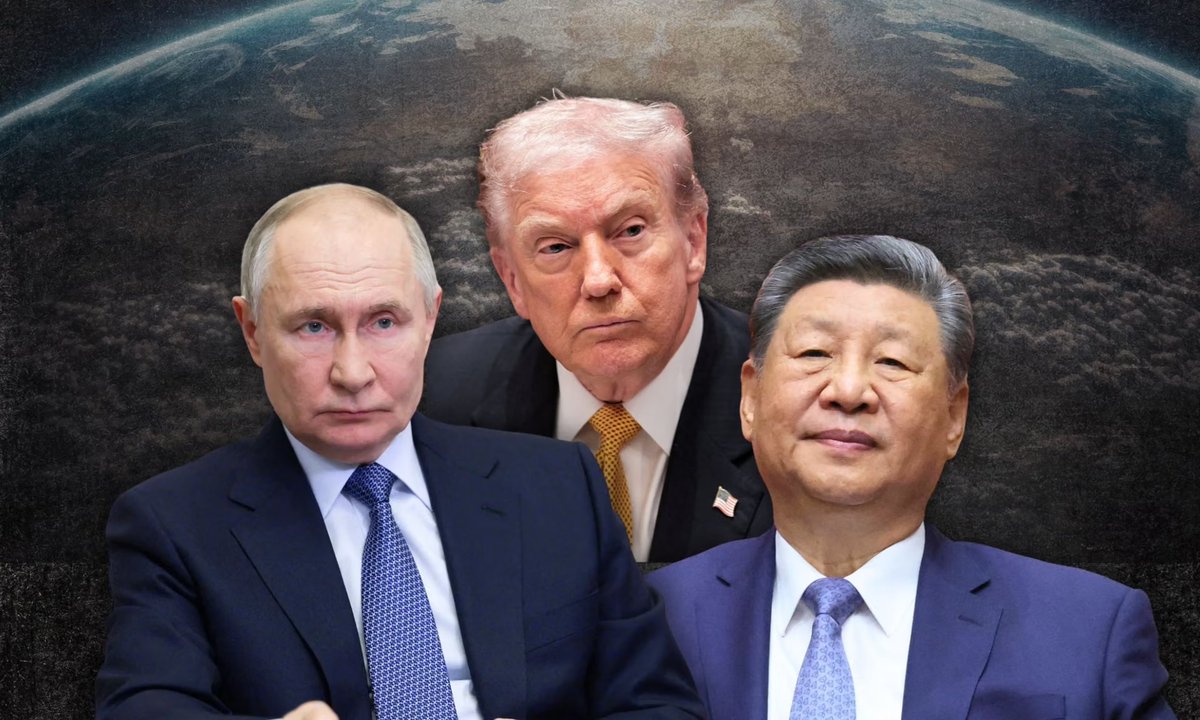
My latest in The National Interest.
Can the US, China, and Russia Keep AI from Triggering Nuclear War?
https://t.co/u2V9EEX5U4
The upcoming Donald Trump-Xi Jinping-Vladimir Putin summit will test whether great-power diplomacy can build a safer international order.
Beijing is bringing Trump and Putin together. The Chinese say it’s a major diplomatic milestone https://t.co/yeWjLH8NNs
As the mathematician and pro-democracy activist Jianli Yang writes, there is no small irony in the situation.
“Russia seeks to overturn an order from which it believes itself excluded. China seeks to reshape an order from which it has benefited enormously. The United States, which created and sustained that order, increasingly regards its maintenance as an excessive burden. The revolutionary, the reformer, and the reluctant guardian have become, in different ways, revisionists.”
My Latest in Providence.
America’s Foreign Policy After the Midterms: Neither Restoration Nor Drift , by @yangjianli001 https://t.co/zhKUD3lb39
The next two years may determine whether America continues breaking the old order without building a new one or begins the transition from disruption to reconstruction. The question is not whether America should put its interests first. Every great power does. The question is whether America understands that its enduring interests are best served by an international order that others also have reason to defend.
The next two years may determine whether America continues breaking the old order without building a new one or begins the transition from disruption to reconstruction. The question is not whether America should put its interests first. Every great power does. The question is whether America understands that its enduring interests are best served by an international order that others also have reason to defend.
Power-Trio Geopolitics @NRO
https://t.co/RYIYAIrVls
Democracy activist and scholar Jianli Yang wrote in advance of the summit that it could represent “one of the most consequential diplomatic encounters since the Cold War”:
Whatever the three leaders might negotiate concerning Ukraine, Taiwan, trade, nuclear weapons, or artificial intelligence, its larger significance would be unmistakable: The three powers most capable of shaping the international order would be gathering not primarily to defend it but to renegotiate their positions within, or against, it.
He cautioned that the danger is not simply or necessarily that the international order is ending: “The danger is that established arrangements are unraveling faster than replacements can be constructed.”
Jianli noted that diplomacy among these three powers remains crucial, particularly on nuclear weapons and AI. However, he argued that America’s role should be toward “building Liberal International Order 2.0: a more realistic, adaptable system that reconciles the constraints of power with the liberal purposes of peace, human dignity, freedom, and human welfare.” This involves renewing alliances, distributing defense burdens more fairly, and restoring international trust, among other steps.
美国之音:
https://t.co/TCZYvrp2dA
人权组织公民力量(Citizen Power Initiatives for China)创办人杨建利告诉美国之音(VOA),任何人被外界看成习近平的可能接班人都很危险,都可能被拿下。
杨建利说:“道理很简单:习近平不容在他力图继续执政完成千秋大业的时候,另一个权力中心形成,稀释甚至分裂他权力和影响力。”
杨建利表示,这样���来,中共必然陷进权力继承危机,而这是专制政权很难避免的危机,��别是在一个强人长期执政戛然而止的时刻。
My latest in National Review.
A Trump–Xi–Putin Summit Could Remake the World Order
https://t.co/io3xqmNo8N
I propose a three-dimensional test: a sustainable equilibrium among the distribution of power, mutually accepted rules, and a sufficiently legitimate foundation of values. The triangle partly satisfies the first dimension but falls short on rules and values.