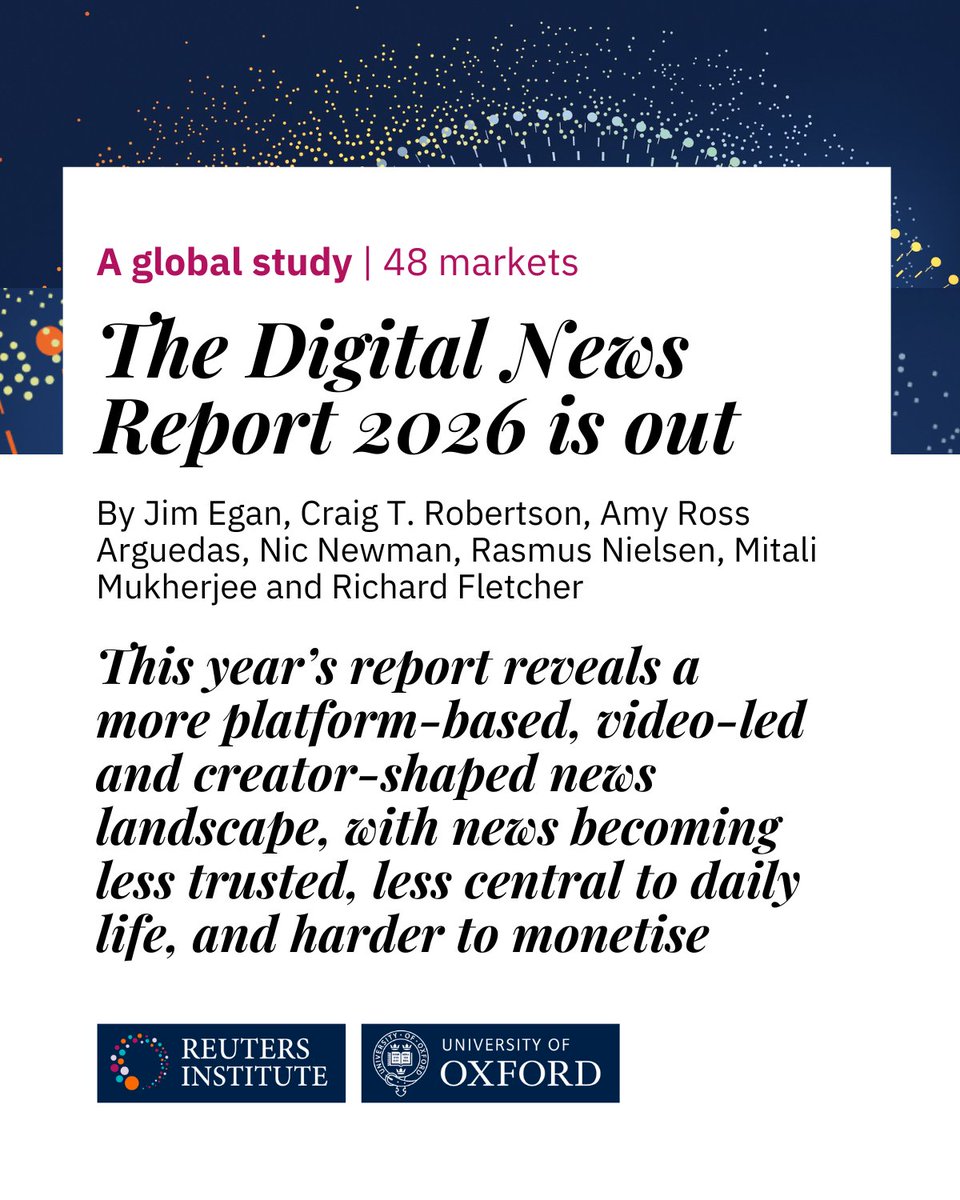
🚨 Our Digital News Report 2026 is out!
Authored by Jim Egan, Craig T. Robertson, Amy Ross Arguedas, Nic Newman, Rasmus Nielsen, Mitali Mukherjee and Richard Fletcher, it is based on 100K interviews in 48 markets
Full report
https://t.co/VWftVJSETy
7 findings in thread
Cracker Barrel's unpopular rebrand created a crisis—but its decision to respond thoughtfully to customer feedback and walk back the changes is helping to turn things around. See @heatherhaddon's analysis in the @WSJ: https://t.co/5dAMDOQJNf
McClatchy's AI tool repackages existing articles to run as new ones. McClatchy reporters don't want their bylines on those articles, and are unionizing in response. https://t.co/WsclUJphF0
Corporations are quietly backing away from sponsoring Pride events as political headwinds make decision-makers wary of the PR risks—impacting LGBTQ+ groups across the country in the process. via @NPR https://t.co/QGVBjx9UwR
Fresh leadership changes at BP add to recent turmoil: "The company has now had three chief executives and three chairmen since 2023." https://t.co/3tKxgux0Lk
"The Millennial D.T.C. company built a global brand based on sustainability and radical transparency. Now, after a years-long slump, it’s being acquired by one of China’s most notorious purveyors of ultra-fast fashion." @PuckNews https://t.co/YCJLOWOcks
NEW: The NYT’s standards editor Susan Wessling sent out a memo today saying staff members cannot bet on prediction markets on subjects they cover, are likely to cover or abuse non-public info about the Times to make money.
“This is a good moment to make clear that betting on the outcome of news events on the prediction markets is a violation of our principles and ethical guidance and is not permitted.”
With data from @nytimes API, I analyzed all national+local coverage since 2000—224K articles— to see which topics in each state get covered out of proportion to the rest of the country. A portrait of how the paper of record sees America, one state per tweet, alphabetical. 👇
Nielsen is the biggest data source in advertising. But some of its top clients, like NBC and the NFL, are now calling those numbers into question. https://t.co/wV959A2nJi via @WSJ
"Sponsors’ largess in turn is transforming hobby clubs from the cozy and unassuming groups of generations past into more polished and entrepreneurial organizations." https://t.co/gO95xGecYz
"What the Swiss company lost in chocolate, though, it gained back in a public-relations coup—as did multiple other companies quick to hop on the meme bandwagon." https://t.co/Ko9xgMC9jb
The Kennedy Center announced that @billmaher will receive the Mark Twain Prize for American Humor "despite the fact that, just last week, the White House flatly denied this to be true."
https://t.co/UDtwZ7TTky
"We’re barreling toward a rapid erosion of trust between authors and readers, and the publishing industry is unprepared to deal with the consequences." https://t.co/cAHVpZ8dGe
"USAID’s dismantling comes at a time when funding for science journalism is already in decline." Reporting in @Nature outlines the challenges facing science journalism globally: https://t.co/27ryuObZTi
“This is a classic example of short-term thinking that leads to communications crises." Group Gordon's Marykate Mattiello spoke to @Lexi_Lonas at @thehill about how colleges and universities are responding to the latest disclosures from the Epstein files. https://t.co/BLa3tXgmvX
Last year's Super Bowl was the most watched event in U.S. television history, providing companies who purchased ads with an opportunity to get in front of a massive audience. This year, ad prices are averaging $8 million for a thirty second spot. https://t.co/L8USFRJRoa
A new accounting rule has taken effect, requiring companies to disclose income taxes paid to authorities at the federal, state, and foreign levels.
https://t.co/2nQym7M0F5