Every great civilization has been built on great roads.
History proves this repeatedly. Every major leap in transportation has transformed societies. Ancient Rome connected its empire through an unparalleled road network. Britain expanded trade and administration through transport infrastructure. The United States built the Interstate Highway System, while China invested massively in expressways and high-speed rail. Wherever roads are build, economic growth follows. We have witnessed this in India too.
Roads are far more than strips of asphalt. They connect factories to ports, farms to markets, students to schools, patients to hospitals, and people to opportunities. Every well-designed road reduces the cost of doing business, saves time, improves safety, and increases productivity.
The opposite is equally true.
Poorly designed roads, inadequate drainage, and weak maintenance silently drain a nation's economy every single day.
Anyone who has travelled the Gurgaon–Noida route during the monsoon has seen thousands of commuters stranded for hours because of waterlogging. Similar stories play out in parts of Bengaluru and Hyderabad, where roads built for yesterday's traffic struggle under today's demand. Add poor civic sense and weak enforcement, and the problem compounds.
Think about the scale of the loss. If 10 lakh people lose just 30 minutes every day due to traffic congestion and poor roads, that's 5 lakh productive hours wasted every single day. This is equivalent to tens of thousands of workdays disappearing daily. Add fuel wastage, vehicle damage, pollution, delayed logistics, missed business opportunities, and emergency response delays, and the economic cost becomes enormous.
So road quality deserves same strategic attention as airports, AI, semiconductors, or defense manufacturing?
As India aspires to become a global manufacturing and technology powerhouse, we cannot afford to treat road engineering as an afterthought. World-class AI and semiconductor fabs deserve world-class roads to support them.
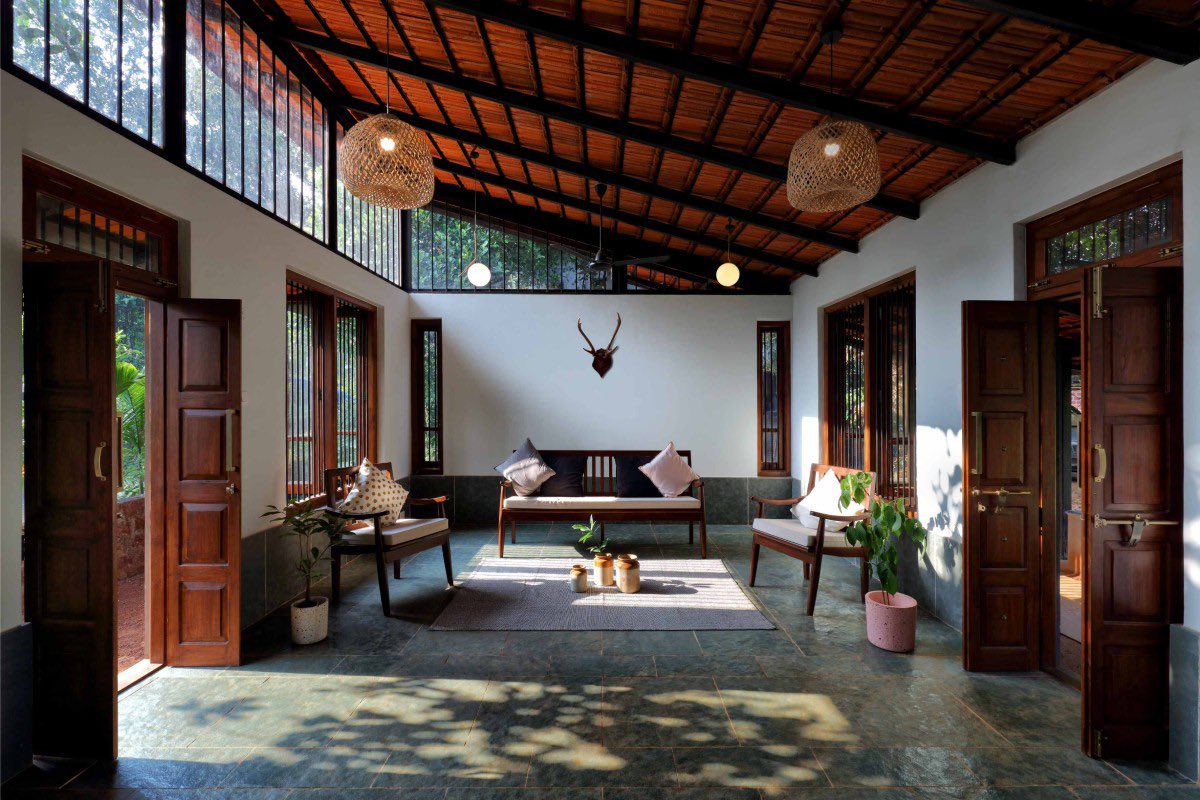
This house in Ratnagiri, Maharashtra was built on a budget, 1,100 square feet, using laterite stone quarried within 10 kilometres of the site, Mangalore clay roof tiles, teak wood joinery and clearstory windows along the eastern wall that pull morning light through the entire living area. Cross ventilation through high ceilings and large openings means no mechanical cooling. Not a single tree on the site was cut during construction.
This is not an expensive house. It is a disciplined one.
The crude indigenous designs we have in our communities do not need to be abandoned. They need effort. When slight effort is put into laterite, into fired brick, into rammed earth, when someone takes the time to lay it properly, orient the building correctly, and open it to the right wind, the result stops looking crude and starts looking like this. The people around us cannot see how good our materials are because we have never shown them what those materials look like when they are taken seriously.
Building kilns is not a fantasy. We have the clay. We have the land. We just have not decided it matters enough yet.
There is no pride in crudeness and there is no excuse for mediocrity when the solution is already in the ground.
Ratnagiri, Maharashtra, India | Articulated Design Initiative | Photography: Vaibhav Kapadi
Fifteen minutes before my flight landed in Delhi today, I finished watching Ford v Ferrari on the seatback screen. I was in China with Aditya and Arvind for SNEC Expo (the largest solar and battery expo of the world)
I am not an F1 racing fan, but the movie fascinated me. Not because of cars, but because of its story telling around innovation, engineering, and the relentless pursuit of excellence despite politics, bureaucracy, and repeated setbacks.
Coincidentally, on the same flight I met an old colleague who is now a Principal at ZS Associates. Sixteen years ago, when I worked at ZS Gurgaon, it was a team of barely 200 people. Today, ZS employs more than 6,000 people in India.
I asked Arpit about the biggest learning from his journey. He said, "Understanding and solving the complexities that come with scale."
Scale was also the core theme of our latest China visit. Over the last 12 days, we covered 18 factories across 10 cities in China.
This time we visited the world's largest cell manufacturer. We signed with some of the fastest-growing energy companies. We walked through some of Shanghai's most impressive corporate headquarters and also travelled to township-sized industrial campuses in Tier-3 and Tier-4 cities that looked like self-contained kingdoms. We met founders, CEOs, chairmen, R&D leaders, and technology teams. We signed agreements, built relationships, and gained insights into how these companies think and operate. It was inspiring. It was also overwhelming.
Rome was not built in a day. Neither is China.
In the era of social media and quick commerce, where everyone seeks instant gratification, we often forget that great products, companies, and ecosystems are built through countless iterations. They evolve version by version, year by year.
There is a line in Ford v Ferrari where Ken Miles says: "If you're going to push a car to the limit, it has to talk to you." That statement holds true for many engineering products. There is no magic soup. There is no magic wand.
The products we saw during our China visit in 2019 improved dramatically by 2023 and are almost unrecognizable in 2026. What appears to be overnight success today is actually the cumulative result of a decade of experimentation, failures, redesigns, and persistence that began years earlier.
Another highlight of this trip was understanding the influence of companies like Huawei and Emerson Electric on China's power electronics ecosystem.
Many mid-sized power electronics companies today employ dozens of highly specialized engineers who have spent their entire careers mastering the field. A remarkable number of successful founders and technical leaders began their journeys at Huawei or Emerson. These organizations did far more than build products. They built talent pipelines, engineering culture, and ecosystems.
The engineers trained there are now building companies that design and deploy gigawatt-scale energy systems, advanced power electronics, and technologies destined not only for Earth but eventually for the Moon and beyond.
Nations do not become technology leaders by producing a few successful companies. They become leaders by creating ecosystems that continuously produce great engineers, entrepreneurs, and builders.
We can always find a hundred reasons why something cannot be done. The path to glory begins when we start finding ways around those reasons.
Carroll Shelby says in one of the scenes:
"There's a point at 7,000 RPM where everything fades."
For individuals, companies, and nations alike, greatness often begins when the noise fades and the focus shifts entirely to the craft.
Reverse migration in Bihar. ❤️💪
One manufacturing startup in Patna has shown the way. @Java__sports , co founded by Trina and Nishant - they said we can build the world class sports products right here from Bihar.
I am supporting them with an angel cheque. Join me in investing, collaborating and supporting them to be the biggest “made in Bihar” sports brand.
Do visit them. Watch this 👇
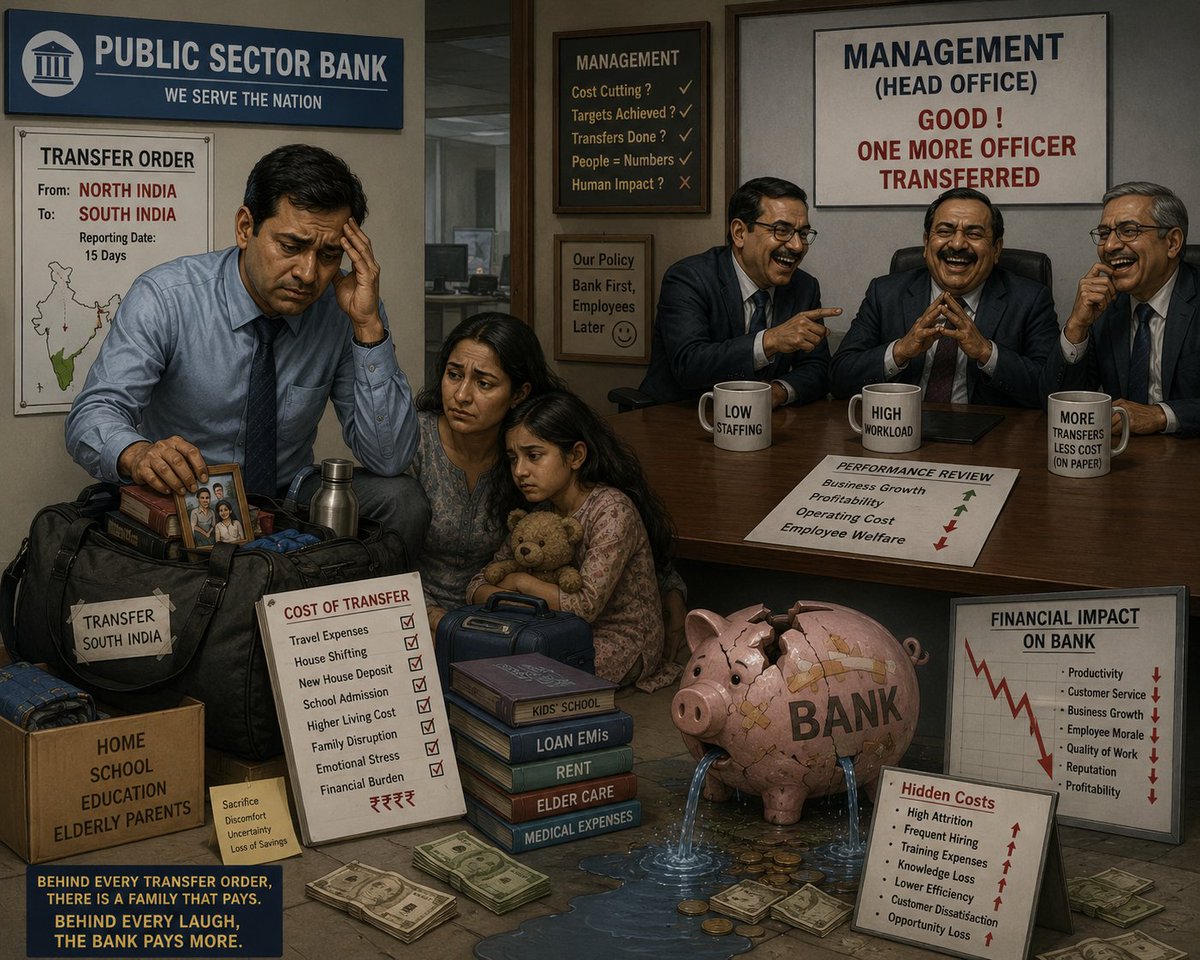
सरकारी बैंकों में स्केल-IV तक के अधिकारियों की लोन देने का पावर अधिकतम ₹10 लाख तक सीमित है वो भी डिजिटल पोर्टल आधारित और लगभग 100% नियम आधारित प्रक्रिया में। लोन माफी करने का तो अधिकार हीं नहीं ब्रांच लेवल पर, पूरा अधिकार कंट्रोलिंग ऑफिस की कमिटी के पास है।
फिर ऐसा कौन सा गंभीर “विजिलेंस एंगल” है जो 2026 के Ease of Doing Business युग में भी अधिकारियों को CVC guidelines के नाम पर पूरब से पश्चिम और उत्तर से दक्षिण भेजने को मजबूर करता है?
2006 वाले ट्रांसफर मॉडल को 2026 में ढोना सरकारी बैंकों के लिए बेहद महंगा सौदा बन ��ुका है। वित्तीय रूप से भी और मानव संसाधन के स्तर पर भी।
अब समय आ गया है कि नीति में व्यावहारिक और आधुनिक सुधार किए जाएँ।
@SunilLa58275710 @manish3065365 @ManishkBarnwal9 @ramshankarsingh @AshishTekale_ @AbhishekDukeBoi @aughad_mastana @idesibanda @PSBPunch @kanalmedia23