Finally - someone said it out loud. And in a national newspaper.
The city deserves top art institutions with a national and international pull. These institutions need to stimulate and disrupt.
Cont...🧵
By the brilliant @ruth_millington on the decline of Birmingham Museum (@BM_AG)
'Where there were once beautifully decorated ceramics by Victorian designer William De Morgan and objects by Morris & Co is now a large photograph of… a piece of bread. Mounted poorly on a tacky piece of board, the caption says “Crusty Cob” and asks: “What is your favourite filling?”
https://t.co/F6629ya3M1
1. Smart people are often, if not usually, very irrational. I grew up with a mid-140s-IQ-tested dad who believed in Biblical literalism. Intelligence is just a powerful engine, it says very little about your ability to steer.
2. Most prestige in our civilization is built around powerful engines. You get good test scores, pass hard classes, you are 'smart', and we stamp you with phDs and titles like Economist or whatever.
3. (Having well-rounded skills can help but does not save you. You can be a charming top-tier artist who still falls for a crypto scam).
4. Our civilization has very little explicit study into being *rational* - which is, imo, something like 'holding true beliefs'. You might be like 'well 'true' is relative', it's people just disagreeing about values all the way down - but I think this is wrong! There *is* such a thing as 'correct' - you can do things like cure cancer or lift people out of poverty, those are real things!
5. If we want to optimize for people steering in correct directions, we might do things like "have them make predictions about the way things will go, and then track how accurate they are." We might force them to "make beliefs pay rent", where you regularly put your beliefs into positions with high stakes so you can't just conveniently 'not notice' when you're wrong. There's a *ton* of stuff to do in this domain that is completely abandoned by people in academia (though you can find it in stuff like investment funds where they actually end up hurting if they're wrong).
5. When I say smart *and* rational, I mean people who are very good at steering in correct directions, with enough power to get there. I don't think most people in this culture even have a conception of these as meaningfully different!
Just deleted bluesky - first ever deletion. All the worst people who left here pretending to be dumb to sustain ideology they think makes them look clever.
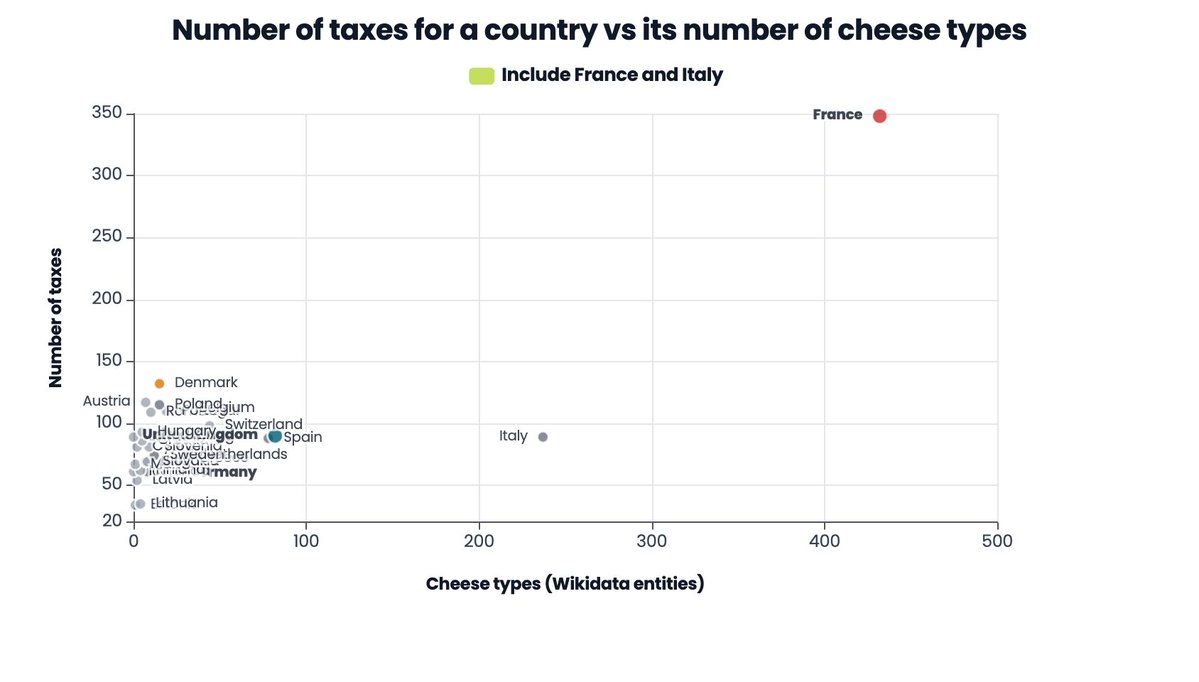
Very proud that Tax Policy Associates is the first to publish research identifying a highly statistically significant correlation between the number of cheeses a country has and the number of taxes (p=0.0000000375).
This changes everything.
Did e.g. the National Trust do anything like this, even at Peak Woke? Some measure of ‘faith’ perhaps necessary to commit such acts of iconoclasm with a clear conscience.
I love the Guardian: accidentally right at first glance, then profoundly misjudged, and for the wrong reason.
“The rooms were so monotonous and numerous that I got lost, couldn’t find my friends, asked a security guard for help, went up and down in a lift, sat on a bench and then left early. I do not recall a single piece of art.”
https://t.co/TuATUMuauz
@CapelLofft We've had a large financial services sector for centuries. It's high value-added, highly paid and vast potential productivity growth with AI. It manages savings and directs investments. We can't wish another economy into being, and there are real barriers we can remove.
Tax in the UK is the highest it’s been since 1945. That’s well understood – but another trend has been largely missed: the number of taxes in the UK is at its highest since the end of the Napoleonic Wars.
A new word: chromification.
Stainless steel is a useful material that can also be very cool, but it feels like we’re using it too much.
You’ve got the same chrome railings and bollards literally everywhere, regardless of the street or building they’re next to.
It’s actually quite strange to see exactly the same default stainless steel railings everywhere you go: in train stations, outside houses or shops, at museums, inside apartments.
That makes places feel generic, and because the colours are cold it gives everything an industrial vibe that isn’t particularly welcoming.
Plus shiny silver things are very reflective and therefore attention-grabbing, so these railings stand out in a way they really shouldn’t, disrupting everything around them.
You could make the argument that, in the past, identical cast iron railings were also used everywhere.
That’s sort of true, but the differences are a) those railings were painted, so the cold chrome feel wasn’t a problem, and b) they were always designed differently, with varying decorations, so they weren’t actually identical, unlike modern stainless steel railings.
The problem isn't stainless steel itself, which can be extremely beautiful when used properly; the problem is making it the default rather than using it with intention, which is the heart of all good design.
This isn’t about going back to cast iron railings. Stainless steel is more durable and cost-efficient (in the long run) so it’s only right that we should use it… in which case the question becomes how we use it.
And the good news is that these railings can be treated to create a bronze finish (or any other colour) which makes them warmer or more suited to the place they’re being installed.
It’s surely just a matter of time before that becomes more common… but the first step is pointing out the problem!
The blurbs for Kakistocracy are finally out.
See what the best people are saying about my new book.
“American elites are and have been greatly underrated. Whatever their flaws, we turn away from them at our peril. Populism, in turn, is a danger. Richard Hanania’s Kakistocracy makes this case better than anyone else and provides a fresh new perspective on what is happening in America and the rest of the world today.” —Tyler Cowen
“Richard Hanania is the world’s greatest living essayist. While I’m personally deeply prone to both-sidesism, he’s gradually convinced me that modern-day populists are objectively worse than the elite midwits they’re replacing. Kakistocracy—‘rule by the worst’—defends this thesis with grim aplomb.” — Bryan Caplan
“Richard Hanania has written a bracing examination of the populist age. Rejecting both romantic defenses of ‘the people’ and reflexive elite self-congratulation, Kakistocracy is a serious, data-grounded account of why movements that begin as corrections to genuine elite failures often end in something worse than what they replaced.” — Rob Henderson
“Only the man who helped create the online right could diagnose it this ruthlessly. Hanania shows how the fringe left accelerated the worst tendencies of the right, while the rest of us can only watch in horror. The result is a painfully accurate diagnosis of everything stale and deadening in American politics.” — Brianna Wu
The release is July 7. You can preorder here. There's no charge until the book is shipped, and preordering is the best way to support my work. https://t.co/UkXWcvEwpn
@HeraldOfRome@mcgillmd921 There are hyper-readers who can take in a page at a glance. I'm not one of them, but I probably have some natural advantage. A lot of the rest is compounding - when you've read around a topic you can focus on what's new. And some is focus.
@HeraldOfRome@mcgillmd921 I can't give you a reliable answer - depends a lot on my interest and familiarity. But that page labours a point I get quickly. There's probably fine detail I could linger over, but in general that's the sort of thing I'd read very quickly.