Coding agents can now operate graphics tools. How will they change the way we design graphics algorithms and conduct graphics research?
Join the discussion at the 1st Workshop on Agentic Graphics on Dec 1 afternoon at #SIGGRAPHAsia2026!
🔗 https://t.co/0HhJfgsWkP
Some of you thought that Inkling 2 Small was too big at 594B parameters. We heard you: Inkling 2 Mini is a looped transformer with just 26B parameters, small enough to run on your laptop, powerful enough for agentic work with a score of 20.1 on AA Index.
https://t.co/9HzaUMwghb
Video models can have high FPS while still feeling laggy if they respond to each action with high latency.
FastFrames proposes two simple techniques to bring the latency down to 36 ms.
Real-time video is not real until it responds in time!
For interactive video, FPS isn’t enough. Latency measures the actual responsiveness — from an input to an RGB output.
FastFrames-1.3B generates frames in 35ms on a B200 GPU and FastFrames-14B in 45ms on 8 B200s. We also accelerate LingBot-1.3B to 50ms for responsive camera control.
We open source all code and model weights.
https://t.co/7oCPJgtdJi
https://t.co/etWyvaGu5z
Apple just released FastFrames
Video Generation at Interactive Latency
FastFrames-L (14B): https://t.co/HXdhcV6V7B
FastFrames-S (1.3B): https://t.co/nWOrxxsJ39
Coding agents can now operate graphics tools. How will they change the way we design graphics algorithms and conduct graphics research?
Join the discussion at the 1st Workshop on Agentic Graphics on Dec 1 afternoon at #SIGGRAPHAsia2026!
🔗 https://t.co/0HhJfgsWkP
1/7 Excited to share SceneRig! 🦾
One image → an editable, simulation-ready 3D scene.
We combine AI agents with geometry and physics to reconstruct scenes for robot policy evaluation and replay of real-world manipulations.
Here’s how it works 🧵👇
Everyone's asking what humans are still worth in the age of AI. To me, it's the part of us that AI keeps flattening - our individuality.
Yet I feel I'm constantly being sold a choice: extend myself with AI, or preserving my unique thoughts, tastes and opinions. What if I didn't have to choose?
There is a future where we get the magic of feeling totally understood by the technology that serves us, while staying ourselves. In this future, the model of us -- our "second selves" -- must be owned by us.
That's the future we want to live in, and one we're building at Aesona.
The open, top-of-mind questions right now:
1. What's the right representation of a person and how should it evolve over time?
2. How do we measure individual-level alignment? How should you interact with the model to close gaps in what it doesn't yet know about you?
3. What should your second self refuse to say about you? How should the user create the right "disclosure policy" and how should it be enforced?
If this sounds like a future you want to build, my DMs are open!
🚀 Excited to kick off the Graphics × Science Workshop at #SIGGRAPH2026!
Computer graphics is becoming a foundational tool for scientific discovery. From computational imaging and molecular modeling to physical simulation, robotics, manufacturing, and AI, graphics is helping us model, understand, and design the physical world.
Looking forward to an exciting program featuring 3 keynote speakers and 58 highlighted papers.
🔗 https://t.co/29zAWyHXKk
#AI4Science #ComputerGraphics #ScientificComputing #Simulation #NVIDIA #NVIDIAOmniverse #NVIDIAAI
Excited to share 𝐄𝐫𝐫𝐨𝐫-𝐂𝐨𝐧𝐝𝐢𝐭𝐢𝐨𝐧𝐞𝐝 𝐍𝐞𝐮𝐫𝐚𝐥 𝐒𝐨𝐥𝐯𝐞𝐫𝐬 (𝐄𝐍𝐒), a PDE framework that recurrently corrects its own prediction by reading the PDE residual field rather than minimizing it!
Website: https://t.co/P9TJ3LETFH
There are three reasons why it's called "Functional Attention."
1⃣We make functions, instead of tokens, as first-class citizens for attention module.
2⃣It was inspired by the geometry processing concepts of functional maps.
3⃣It works!
What if attention wasn't about matching tokens, but operating in function space?
Glad to share our #ICML2026 paper:
📄 Functional Attention: From Pairwise Affinities to Functional Correspondences
w/ @Jiefang_Xiao@GaoMaolin @stevenygd Daniel Cremers
📄 https://t.co/rhn9NtwrBm
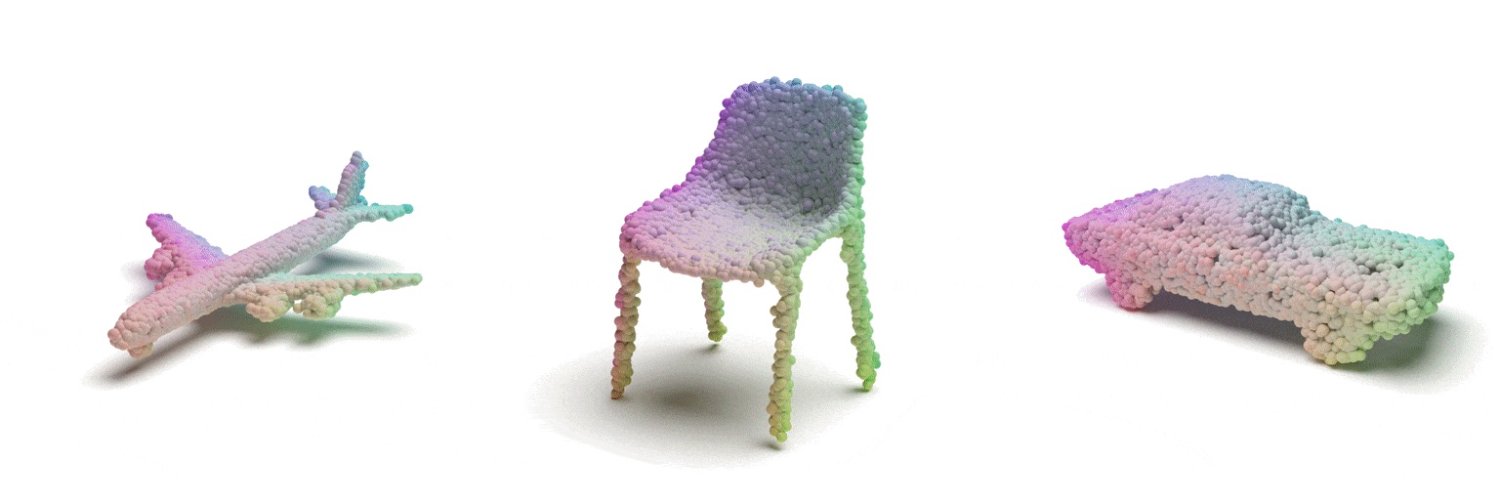
MeshFlow brings high-quality mesh with interactive speed. It's time to make mesh generation flow!
Arxiv: https://t.co/LvaAoq1GoH
Web: https://t.co/y6DsntORbz
Code: https://t.co/l1GHR9zjCb
Excited to share MeshFlow — a new approach that can generate meshes with a fraction of seconds, while achieving state-of-the-art generation quality.
Secret sources? Instead of autoregressive models, use equivariant flow-matching!
The #ECCV2026 reviewer discussion period has started! Reviewers should carefully read the authors’ rebuttal, consider the other reviews, and actively participate in the discussion BEFORE finalizing their reviews.