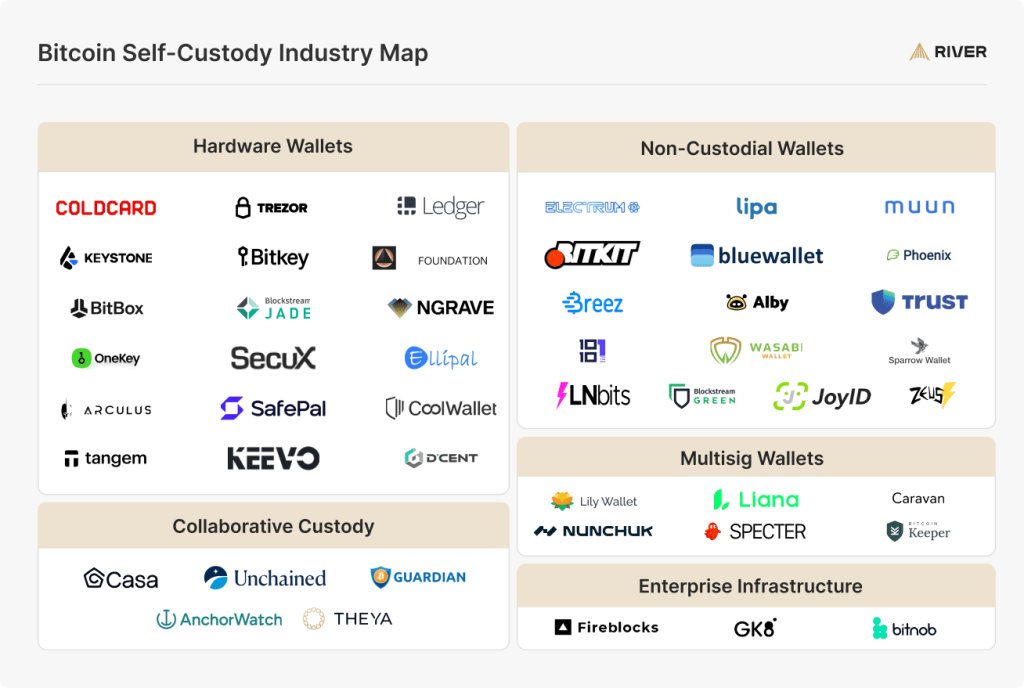
Hugo & the Nunchuk team continue to impress with their creativity & understanding of the tools needed to drive #Bitcoin adoption! Guardian is proud to be an Early Access partner, offering clients the most sophisticated & secure assisted m-sig self custody solution on the planet!
🟠 Are you passionate about orange-pilling others?
🟠 Are you a Bitcoin expert in self-custody and key management?
🟠 Do you dream of starting a Bitcoin-focused business?
We have exactly what you need. 👇
https://t.co/ilcsy1bfC0
Thank you for being the best partner for us and our clients, and for being the poster child for what a bitcoin exchange should be! Hats off to the entire @River team 👏👏
Why Bitcoin Will Surpass Gold
A conservative, first-principles proof
A First-Principles Supply Analysis
This conclusion relies on neither narrative, ideology, nor the extrapolation of recent price action. It is derived entirely from supply mathematics and thermodynamic constraints under deliberately conservative assumptions.
I approach this comparison with direct operational experience in both areas: I have developed a gold mine, and I have converted natural gas into electricity for Bitcoin mining. When these two systems are evaluated by their underlying cost and supply functions, the outcome is mathematically distinct.
Bitcoin’s monetary mechanics dominate gold’s over time.
1. The governing principle
In any competition between two stores of value, a system with exponentially decaying new supply will always mathematically overtake a system with linear supply growth, provided demand remains non-zero.
Gold: Supply expands at a roughly constant percentage rate forever.
Bitcoin: Issuance decays exponentially by protocol until it reaches zero.
This single asymmetry dictates the long-run outcome.
2. Gold: elastic supply, dilution under demand
Gold functions as a classical extractive commodity. Its supply is elastic:
1. Price rises.
2. Marginal deposits become economic to mine.
3. Capital flows into exploration and equipment.
4. Production increases, expanding above-ground supply.
5. Price pressure eases (dilution).
Annual mine output adds roughly 1–2% to the existing stock. Higher prices simply unlock lower-grade ore and deeper shafts. Gold is energy-intensive, but it is not supply-capped. In the gold market, demand ultimately converts into supply dilution.
3. Bitcoin: Inelastic Supply (Hardening under Demand)
Bitcoin inverts commodity economics. Its supply is perfectly inelastic:
1. Price rises.
2. More hash power is deployed.
3. Network difficulty adjusts upward.
4. New supply remains fixed.
The issuance schedule is immutable and capped at 21 million. Increased demand cannot increase the quantity of Bitcoin; it can only increase the amount of irreversible energy (security) embedded in the network. Bitcoin stores demand as thermodynamic work. Scarcity compounds.
4. The Halving: Enforced Exponential Scarcity
Bitcoin’s halving mechanism enforces the conservation of energy expressed monetarily. Every four years, the block subsidy is cut in half.
If the hash rate remains constant, the energy cost to produce one bitcoin doubles overnight. For miners to remain in equilibrium, the price must rise over time to match the rising thermodynamic floor. Gold has no equivalent mechanism.
5. Diverging Cost Functions
This leads to a permanent divergence in cost curves:
Gold: Marginal cost rises linearly. Supply softens.
Bitcoin: Marginal cost rises exponentially. Supply hardens.
6. THE CONSERVATIVE CROSSOVER MODEL
To determine when #Bitcoin flips Gold, we strip away bullish sentiment and look at the math using conservative baselines.
THE STARTING STATE
• Gold Market Cap: ~$30 Trillion (High-end est. w/ jewelry, bullion, reserves)
• Bitcoin Market Cap: ~$1.8 Trillion
• Initial Ratio: ~16.7x differential
THE ASSUMPTIONS
• Gold: Grows at 2% / year (Stable real price + supply expansion)
• Bitcoin: Market cap doubles every 4 years (~19% CAGR, significantly lower than historical avg)
THE EQUATION
Solve for time (t) where Bitcoin equals Gold:
1.8 × 2^(t/4) = 30 × (1.02)^t
THE SOLUTION t = ln(16.67) / [ (ln2 / 4) - ln(1.02) ]
t ≈ 2.810 / (0.1733 - 0.0198)
t ≈ 18.3 years
7. Interpretation & Implication
Under these muted assumptions assuming modest gold growth, slow bitcoin adoption, and zero monetization shocks Bitcoin overtakes Gold in approximately 18 years.
This parity implies a Bitcoin market cap of ~$30 trillion. With ~20 million coins outstanding, this corresponds to a price of roughly $1.5 million per Bitcoin.
The precise timeline depends on adoption speed; the direction, however, does not.
Final Conclusion
Gold is an extractive commodity where demand expands supply. Bitcoin is a thermodynamic protocol where demand hardens supply.
One dilutes under pressure; the other compounds.
Physics and mathematics determine the superior store of value. Narratives are irrelevant. Bitcoin does not compete with gold; it obsoletes gold’s monetary role through superior mechanics.
Exhibit A: The gold-to-Bitcoin market-cap ratio is collapsing. The decline is not cyclical or random; it follows a clean power-law decay R² ≈ 0.96.
December has been our highest volume month ever at @River 🚀
As more apps try to lure you into speculation and financialization, we are focused on building the world's most trusted financial institution to empower you to grow your wealth.
In 100 years there will be 10x as much gold.
That's assuming gold inflation stays the same, but it will likely increase due to advancements in technology.
There will a 1,000% increase in the supply of gold by 2140.
There will be a 5% increase in the supply of Bitcoin.
Scarcity by mere convention, or scarcity by code.
Bitcoin is the apex asset.
2016 and before: USA, Finland
2017: North Korea
2018: UK, Bhutan
2019: Russia, China
2020: Venezuela, Iran
2021: El Salvador
2022: Ukraine, Guatemala
2023: Ethiopia, UAE
2024: Argentina
2025: Saudi Arabia, Luxembourg, Brazil, Czech Republic, Taiwan
I think the beatdown in Bitcoin sentiment stems from the dominant majority of its investor base having an extremely narrow thesis that cannot fathom or accommodate the reality of its relative performance deficit versus metals in 2025. The Bitcoin investor base is very high conviction and enthusiastic, but IMHO tends to fit the description more of the hedgehog (“knows one big thing”) than the fox (“knows many things”).
The dominant story that will go down on the historical record in financial history for this year was the structural break of old pricing mechanisms and clearing venues in metals markets. This has been visibly brewing on the charts and headlines for over a decade that the close followers of the trend have been watching slowly develop, but this year was the jailbreak. It happened “gradually then suddendly”, as Bitcoiners well understand. Pretty much every metal has now joined gold in violent breakout, there is a tectonic shift taking place on the financial side of the global commodities trade. This trend is still under the radar for the majority in the broad investment profession and the overall public. If you want to get up to speed on this, @Sorenthek is a must follow.
Most of the Bitcoin investor base struggles to apply and extend their core thesis across these other dominant trends and international developments interacting with each other in this era of violent transformation were in. They struggle to explain or incorporate the key story of 2025 into their mental model. So when Bitcoin consolidates for over twelve months after going on a mini-bender euphoria upon November 2024’s election result, and combining with comparison against your neighbor who is max long metals after he posted an absolute banner year, that challenges your entire framework and hence the individual goes through the solemn process of self-questioning and doubt that is evident in the deeply underwater sentiment.
In reality the Bitcoin framework and thesis aren’t at all broken, but proceeding from here will require work and heavy lifting to build up and break through the plateau. Some will sell their coins in this consolidation to those who will do the work and be there for the next phase. That is how markets get society’s resources into the right hands. In time this will all play out and everything will be fine … except for the bondholders who think they’re going to maintain their purchasing power.
@pmarca Double-digit growth is coming within 12 to 18 months.
If applied intelligence is proxy for economic growth, which it should be, triple-digit is possible in ~5 years.
WARREN BUFFETT: “The natural course of government is to make the currency worth less over time.”
"They devalue it at rates that are breathtaking... In the end, if you've got people that control the currency, you can issue paper money."
"Fiscal policy is what scares me in the United States."
The real Strategic Bitcoin Reserve is the one you’ve been building up for years.
Don’t wait for anyone else to fix the world. Take ownership of your financial life, with Bitcoin.
The question is: does Coinbase get it? If so why isn't Coinbase the largest Treasury company after being the dominant US exchange for so long?
Inquiring minds are wondering.


![david_eng_mba's tweet photo. Why Bitcoin Will Surpass Gold
A conservative, first-principles proof
A First-Principles Supply Analysis
This conclusion relies on neither narrative, ideology, nor the extrapolation of recent price action. It is derived entirely from supply mathematics and thermodynamic constraints under deliberately conservative assumptions.
I approach this comparison with direct operational experience in both areas: I have developed a gold mine, and I have converted natural gas into electricity for Bitcoin mining. When these two systems are evaluated by their underlying cost and supply functions, the outcome is mathematically distinct.
Bitcoin’s monetary mechanics dominate gold’s over time.
1. The governing principle
In any competition between two stores of value, a system with exponentially decaying new supply will always mathematically overtake a system with linear supply growth, provided demand remains non-zero.
Gold: Supply expands at a roughly constant percentage rate forever.
Bitcoin: Issuance decays exponentially by protocol until it reaches zero.
This single asymmetry dictates the long-run outcome.
2. Gold: elastic supply, dilution under demand
Gold functions as a classical extractive commodity. Its supply is elastic:
1. Price rises.
2. Marginal deposits become economic to mine.
3. Capital flows into exploration and equipment.
4. Production increases, expanding above-ground supply.
5. Price pressure eases (dilution).
Annual mine output adds roughly 1–2% to the existing stock. Higher prices simply unlock lower-grade ore and deeper shafts. Gold is energy-intensive, but it is not supply-capped. In the gold market, demand ultimately converts into supply dilution.
3. Bitcoin: Inelastic Supply (Hardening under Demand)
Bitcoin inverts commodity economics. Its supply is perfectly inelastic:
1. Price rises.
2. More hash power is deployed.
3. Network difficulty adjusts upward.
4. New supply remains fixed.
The issuance schedule is immutable and capped at 21 million. Increased demand cannot increase the quantity of Bitcoin; it can only increase the amount of irreversible energy (security) embedded in the network. Bitcoin stores demand as thermodynamic work. Scarcity compounds.
4. The Halving: Enforced Exponential Scarcity
Bitcoin’s halving mechanism enforces the conservation of energy expressed monetarily. Every four years, the block subsidy is cut in half.
If the hash rate remains constant, the energy cost to produce one bitcoin doubles overnight. For miners to remain in equilibrium, the price must rise over time to match the rising thermodynamic floor. Gold has no equivalent mechanism.
5. Diverging Cost Functions
This leads to a permanent divergence in cost curves:
Gold: Marginal cost rises linearly. Supply softens.
Bitcoin: Marginal cost rises exponentially. Supply hardens.
6. THE CONSERVATIVE CROSSOVER MODEL
To determine when #Bitcoin flips Gold, we strip away bullish sentiment and look at the math using conservative baselines.
THE STARTING STATE
• Gold Market Cap: ~$30 Trillion (High-end est. w/ jewelry, bullion, reserves)
• Bitcoin Market Cap: ~$1.8 Trillion
• Initial Ratio: ~16.7x differential
THE ASSUMPTIONS
• Gold: Grows at 2% / year (Stable real price + supply expansion)
• Bitcoin: Market cap doubles every 4 years (~19% CAGR, significantly lower than historical avg)
THE EQUATION
Solve for time (t) where Bitcoin equals Gold:
1.8 × 2^(t/4) = 30 × (1.02)^t
THE SOLUTION t = ln(16.67) / [ (ln2 / 4) - ln(1.02) ]
t ≈ 2.810 / (0.1733 - 0.0198)
t ≈ 18.3 years
7. Interpretation & Implication
Under these muted assumptions assuming modest gold growth, slow bitcoin adoption, and zero monetization shocks Bitcoin overtakes Gold in approximately 18 years.
This parity implies a Bitcoin market cap of ~$30 trillion. With ~20 million coins outstanding, this corresponds to a price of roughly $1.5 million per Bitcoin.
The precise timeline depends on adoption speed; the direction, however, does not.
Final Conclusion
Gold is an extractive commodity where demand expands supply. Bitcoin is a thermodynamic protocol where demand hardens supply.
One dilutes under pressure; the other compounds.
Physics and mathematics determine the superior store of value. Narratives are irrelevant. Bitcoin does not compete with gold; it obsoletes gold’s monetary role through superior mechanics.
Exhibit A: The gold-to-Bitcoin market-cap ratio is collapsing. The decline is not cyclical or random; it follows a clean power-law decay R² ≈ 0.96.](https://pbs.twimg.com/media/G86R-BzagAQ6lbt.jpg)