A new @nberpubs paper from HCEO member @Gueyon_Kim et al. outlines eveidence that the local supply of college-educated workers -- largely associated with a college nearby -- drives the evolution of new types of jobs. https://t.co/AXCD1M5Asd
James Robinson and I have edited a two part series Whither Meritocracy? for the American Academy of Political and Social Science. I am delighted that Part One: Conceptual Issues of Meritocracy, is now available.
Here is the Table of Contents
1. David Miller, Meritocracy: A Qualified Defense
2. Daniel Markovits @DSMarkovits, How Meritocracy Became Self-Defeating
3. Steven Durlauf, Retrospective Versus Prospective Meritocracy
4. Glenn Loury @GlennLoury, The Limits of Meritocracy in a Racially Divided Society
5. Guido Alfani @guido_alfani, Meritocracy in Historical Perspective
6. David Lay Williams @LayWilliams, The Meritocracy Debate of the Eighteenth Century
https://t.co/dPxWi8WyLp
Meritocracy is a major dimension of research activity at the Stone Center for Research on Wealth Inequality and Mobility @UCStoneCenter. Daniel Markovits and I had a public conversation on his important book The Meritocracy Trap
https://t.co/P0PxAclz3l
Four of our podcasts have particular focus on meritocracy.
Episode #22: Lauren Rivera @Laurenaudrie on Meritocracy and Its Failings
Episode #54: Leslie McCall @LeslieMcCallgc on Intersectional Inequality, AI, and Meritocracy
Episode #58: Thomas Mulligan on Acting Meritocratically
Episode #59: Jahel Queralt @jahelqueralt on the Costs of Moralizing Success and Failure
Dear followers, please see this new paper on the labor market and macroeconomic effects of low birth rates. Although almost all analysts and policymakers are very worried about the prospect of stagnant and aging populations, the evidence from cross-country and within the United States points to the opposite: lower birth rates predict faster growth of GDP per worker and wages. The reason: labor scarcity encourages more technology adoption.
Very happy that this paper which explores the dynamics of Black versus White occupational mobility from 1870 to 2020 is now forthcoming. It has been a wonderful experience to work with extraordinary coauthors Gueyon Kim, @Gueyon_Kim, Dohyeon Lee, and Xi Song @xisong.
Methodologically, we start by constructing Markov chain transition matrices decade by decade. We employ recently developed measures of mobility as movement between parents and children and mobility as dissipation of the memory of ancestor status in the conditional probability of occupational attainment in descendants and so address the distinction between structural and exchange mobility.
Substantively, I highlight two of our findings
1. Changes in the Markov transition matrices for the 1940 and 1950 birth cohorts play an essential role in the overall Black/White occupational mobility convergence for the post-bellum United States. These cohorts are the ones that entered the labor market in the Civil Rights era.
2. For more recent cohorts, the subsequent lack of progress towards occupational convergence reflects the failure of the Markov transition matrices to continue to evolve.
A guide for economists writing a literature review who want to summarize evidence, incorporate covariates, and adjust for selectivity, from @p_ganong, Avik Garg, and @maxkasy https://t.co/hOZRcJ4gck
Honored to be able to present my views on how the Trump administration is pursuing policies that will harm the economy in the long run.
https://t.co/XGIY328c3f
Using microdata on patenting from the Era of Mass Migration to highlight a new channel how immigrants contributed to US growth: they settled in urban innovation hubs, from Costas Arkolakis, Sun Kyoung Lee, and Michael Peters https://t.co/n8FBZwtai0
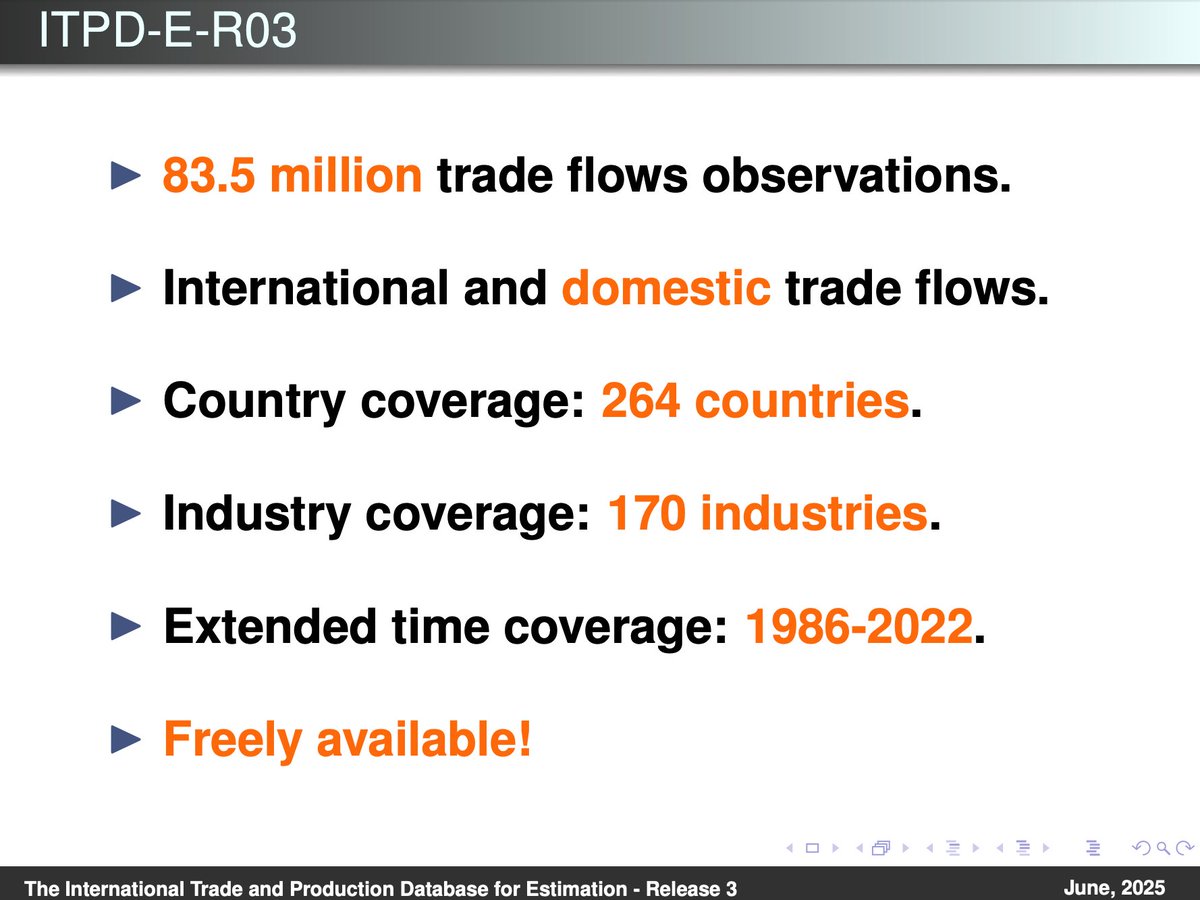
📢NEW DATA! Happy to share the new release of the International Trade and Production Database for Estimation - ITPD-E-R03. Thanks to my co-authors Mario Larch & @SergeShikher and to the USITC!
For details: https://t.co/Ip0l57yAaD
Enjoy the data and have a great summer!
📢 NEW DATA!
Javier Flórez, Mario Larch, Sebastien Bradley, and I are very happy share the update of the most disaggregated dataset of consistently constructed international and domestic trade flows -- GRANTPA.
So, let’s estimate GRAVITY with GRANTPA.
https://t.co/e6hEytJF71
🌎 PhD students: apply to 2025 Berkeley/Sloan Summer School in Environmental/Energy Economics! 🔗
Info + application link below 👇
🗓️Deadline: May 14 | Program: Aug 18–22 at Berkeley
w @auffhammer, @BorensteinS, TCarleton, MFowlie, KJack, ...
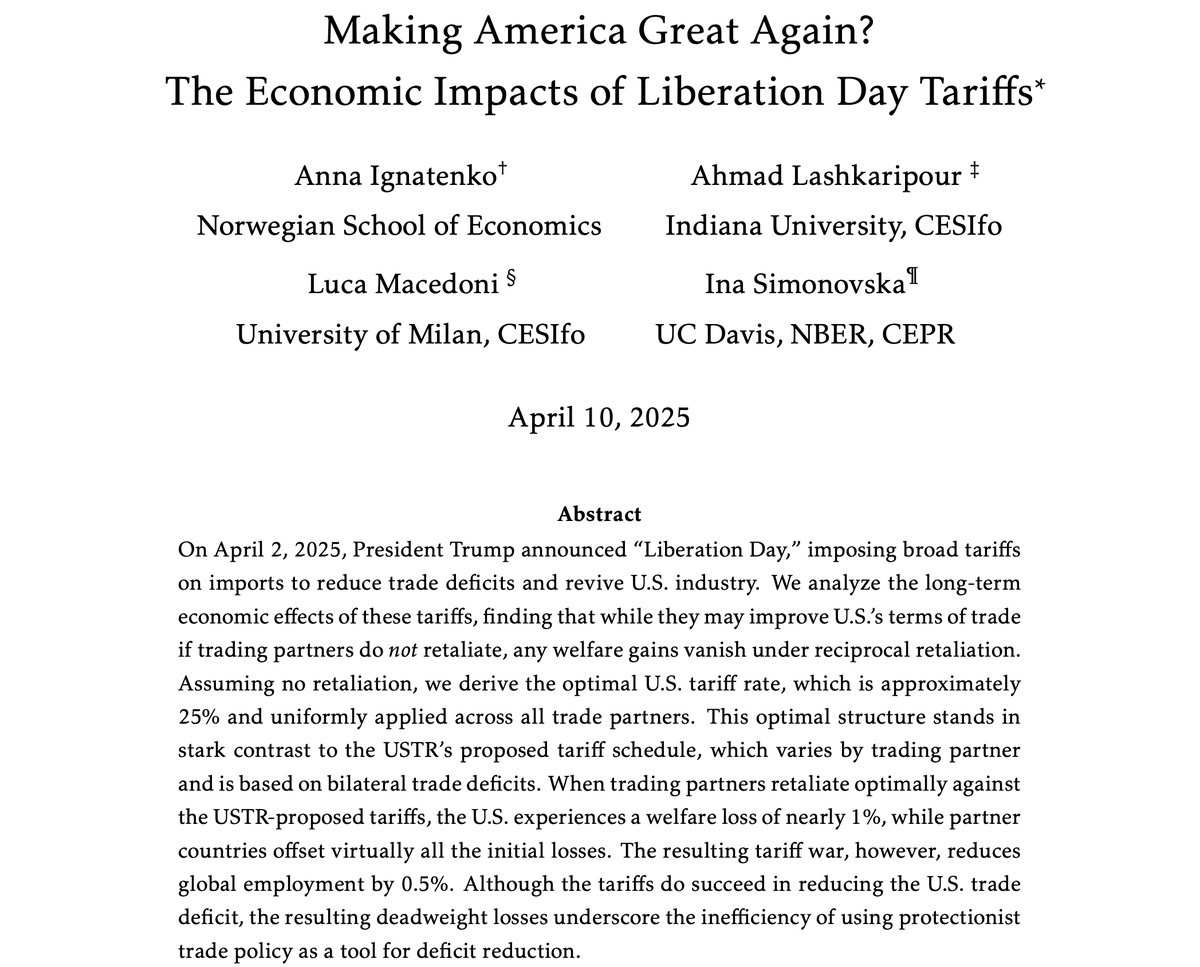
🚨We just released a paper examining the long-terms economic impacts of "Liberation Day" tariffs.
In summary: while these tariffs may help reduce the trade deficit, they will impose significant costs on the U.S. economy after retaliation by trade partners.
1/🚨New chapter in Handbook of Regional & Urban Econ: Spatial Environmental Economics 🌍
How do spatial forces affect the enviro? How does enviro shape spatial outcomes? Thread, chapter explore nascent subfield via stylized acts, models, research guide. w Clare Balboni.
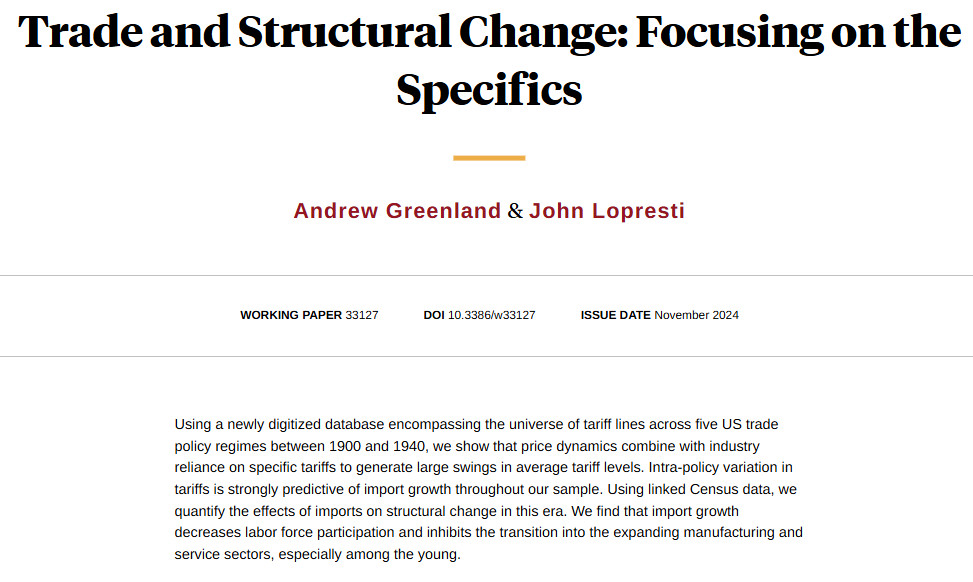
Using tariff lines across five US trade policy regimes between 1900 and 1940 shows that price dynamics combine with industry reliance on specific tariffs to generate large swings in average tariff levels, from @AndrewG_PhD and John Lopresti https://t.co/j0jnIdzqo1
@gillinat79 (@CBS_ECON) presented today on offshoring and skills segregation.
Dario and coauthors @Gueyon_Kim (@ucsc) and D. Lee analyse how offshoring impacts wages & workers relocation to low productivity firms. #Offshoring mitigates skill inequality and reduces domestic income
Reviewing the literature on firm wage differences and the fixed effects methods typically used to measure these differences, from Patrick M. Kline https://t.co/ZRGtBjghz9