@BluRadioCo Hace 15 días mi esposa sufrió el paseo de la muerte en el valle de aburra, paseamos por 5 hospitales, tenía un fuerte dolor abdominal y la despacharon con una infección urinaria que no tenía, sanitas nego el servicio en 3 hospitales
La #SuperTransporte llevó a cabo una jornada de capacitación dirigida al gremio de transporte de carga @Colfecar, con el propósito de aclarar dudas y resolver inquietudes sobre el sistema Vigía y las obligaciones asociadas a este aplicativo. #NosMovemosPorLaLegalidad
Harvard University is offering Data Science Course for FREE!
This course starts from basics of Machine Learning Algorithms and helps you build your own first ML project.
Course link 🧵👇
This is going to change Data Analytics!
A spreadsheet inside the Notebook which also generates Pandas code.
This makes Data Analysis easy for All!
A thread 🧵👇
How do we 𝗦𝗰𝗮𝗹𝗲 𝗠𝗟 𝗠𝗼𝗱𝗲𝗹𝘀 𝘁𝗵𝗮𝘁 𝗮𝗿𝗲 𝗮𝗹𝗿𝗲𝗮𝗱𝘆 𝗱𝗲𝗽𝗹𝗼𝘆𝗲𝗱?
The main types of Machine Learning Model Deployment that you will run into in real life situations: Batch, Embedded into a Stream Application and Real Time.
Let’s look into how we scale these applications, given an increase in Data Volume that needs to be processed.
There are two different ways you can scale an Application:
👉 𝗩𝗲𝗿𝘁𝗶𝗰𝗮𝗹 𝗦𝗰𝗮𝗹𝗶𝗻𝗴 - you add resources to the container or server that is running the Application without increasing the number of Applications.
👉 𝗛𝗼𝗿𝗶𝘇𝗼𝗻𝘁𝗮𝗹 𝗦𝗰𝗮𝗹𝗶𝗻𝗴 - you increase the number of Applications that are performing required work.
Let’s look into what it means for each type of Model Deployment:
𝗕𝗮𝘁𝗰𝗵.
➡️ You Load Data from a Data Warehouse/Lake.
➡️ Apply Inference.
➡️ Save results to another Database.
➡️ Product Applications can use the Inference Results from the Database.
You can scale your Application in two ways.
𝙑𝙚𝙧𝙩𝙞𝙘𝙖𝙡.
👉 You add more resources to the container performing Inference.
✅ You are likely to have your models trained with libraries like scikit-learn, vertical is easy as you will not need to rewrite any code.
𝙃𝙤𝙧𝙞𝙯𝙤𝙣𝙩𝙖𝙡.
👉 You perform Inference by leveraging a Distributed Compute Framework like Spark or Dask.
𝗦𝘁𝗿𝗲𝗮𝗺.
➡️ You Subscribe to a Kafka Topic.
➡️ Apply Inference in Real Time on new data coming in.
➡️ Save results to another Kafka Topic.
➡️ Product Applications subscribe to the Resulting Topic.
Stream Applications will almost always be scaled 𝗛𝗼𝗿𝗶𝘇𝗼𝗻𝘁𝗮𝗹𝗹𝘆.
Scaling is influenced by two factors:
👉 Number of Partitions in the Input Stream - Number of Consumers can’t be more than Number of Partitions. Any excess will Idle.
👉 Number of Consumers in the Consumer Group Reading from the Input Stream - you increase the number and Consumer Group takes care of rebalancing the Load.
𝗥𝗲𝗮𝗹 𝗧𝗶𝗺𝗲.
➡️ You deploy ML Model as a REST or gRPC server.
➡️ Backend Applications request Inference results directly from the endpoint exposed by the ML server.
In most cases the correct way to scale such APIs is usually 𝗛𝗼𝗿𝗶𝘇𝗼𝗻𝘁𝗮𝗹.
👉 We spin up new ML App containers.
👉 Wait for containers to become available - the endpoint should start returning Inference results Successfully.
👉 Register new containers with Load Balancer exposing them to a Backend Application.
Leave any thoughts in the comment section 👇
--------
Follow me to upskill in #MLOps, #MachineLearning, #DataEngineering, #DataScience and overall #Data space.
Also hit 🔔to stay notified about new content.
𝗗𝗼𝗻’𝘁 𝗳𝗼𝗿𝗴𝗲𝘁 𝘁𝗼 𝗹𝗶𝗸𝗲 💙, 𝘀𝗵𝗮𝗿𝗲 𝗮𝗻𝗱 𝗰𝗼𝗺𝗺𝗲𝗻𝘁!
Join a growing community of Data Professionals by subscribing to my 𝗡𝗲𝘄𝘀𝗹𝗲𝘁𝘁𝗲𝗿.
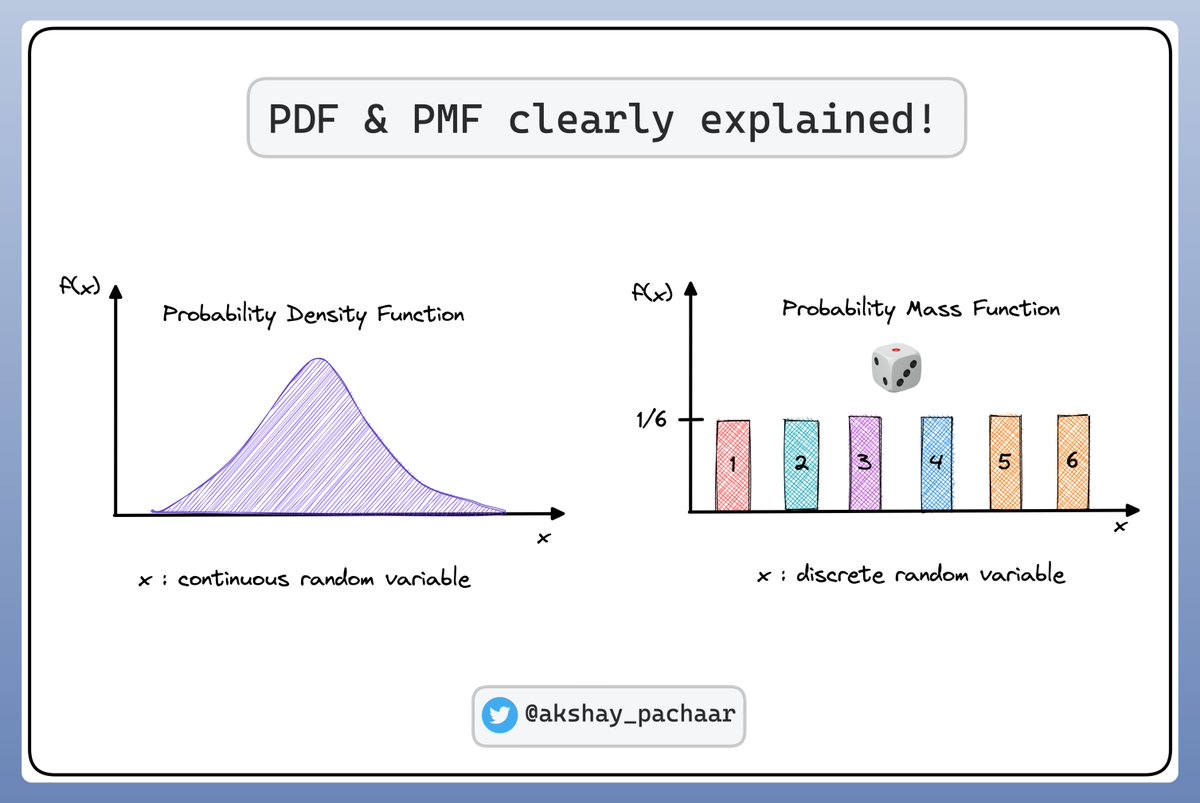
Two of the most fundamental concepts in probability & statistics are:
- Probability Density Function
- Probability Mass Function
Let's understand them today! 🚀
-- explained with python code --
A Thread 🧵👇
Here is a great Machine Learning course:
Applied Machine Learning
Cornell Tech, 2020.
100% Free. 80 videos.
Full playlist: https://t.co/XWgLghyGAQ
Make sure you follow @abacusai. There's a lot more coming!
NEW feature alert 🚨
Learn about the 3 new features in Dremio for Apache Iceberg in this quick video from Dremio Developer Advocate @Dipankartnt#ApacheIceberg
Aquí puedes leerlo en su versión online o descargarlo en pdf o epub:
🔗 https://t.co/yWkIWSW7NB
Se llama Pro Git, ha sido escrito por Scott Chacon y Ben Straub. Y tiene todo lo necesario para aprender Git desde cero a experto.
¡Ni más ni menos que 526 hojas! GRATIS 😄